

How Aesthetic Doctors Can Seize the 5G Era Dividend: Jin Xing of SoYoung Outlines Key Strategies
On November 2, 2019, at the 16th Annual Conference of the Chinese Medical Doctor Association Committee on Aesthetic and Plastic Surgery, held concurrently with the 2nd Chengdu “Medical Aesthetics Capital” Academic Conference, Jin Xing, Chairman and CEO of New Oxygen, delivered a keynote address titled “Essential Skills for Plastic Surgeons in the 5G Era.”
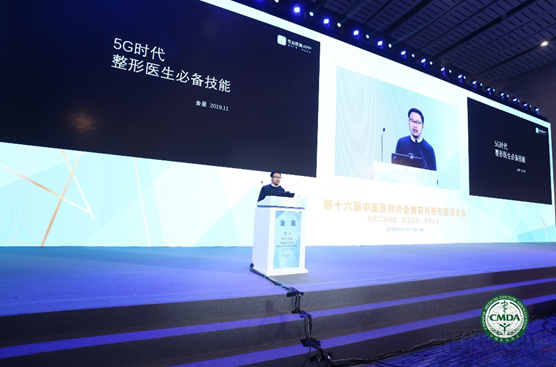
The image shows New Oxygen Gold Star delivering a speech at the Aesthetic and Plastic Surgery Conference of the Chinese Medical Doctor Association.
New Oxygen is China’s largest and most popular medical aesthetics platform. It went public in the United States in May 2019, becoming the world’s first internet-based medical aesthetics company listed on a stock exchange. Beyond medical aesthetics, New Oxygen has expanded into the broader internet healthcare sector, where its monthly active users have surpassed those of many general practice medical platforms, ranking it as China’s second-largest internet healthcare platform, just behind Ping An Good Doctor.
Jin Xing has over a decade of experience in the internet industry. In 2013, he ventured into the medical aesthetics sector and founded SoYoung. At this annual platform for industry exchange and dialogue, he analyzed the new opportunities brought by 5G from an internet perspective and shared with medical aesthetics practitioners the “three-piece set” for seizing this wave of dividends.
Below is a summary of Jin Xing’s speech:
Based on a series of indicators, I believe 5G will arrive faster than we anticipate. Next year will mark the first year of true 5G deployment in China, with smartphone penetration potentially reaching 20%.
This series of developments includes China Mobile’s official announcement in June that it would launch 5G smartphones priced around RMB 1,000 by the end of 2020; recent reports indicating that Apple will release four 5G-compatible iPhone models next year; and Lei Jun’s statement that Xiaomi plans to introduce more than ten 5G smartphones next year. Lei Jun also noted that all manufacturers are currently concerned that 4G phones may become unsellable by next year. In South Korea, with a population of only 52 million, 5G services were officially launched in April, reaching the first million users in just over 70 days and the second million in under 60 days, demonstrating remarkably rapid growth. Just two days ago, China’s Ministry of Industry and Information Technology announced the formal commercialization of 5G in China, with more than 130,000 base stations scheduled to be operational by the end of the year.
Major Chinese smartphone manufacturers currently ship an average of nearly 100 million units per quarter, amounting to approximately 400 million handset replacements annually in China. Given the current pace of new model launches and product iteration, at least 200 million of the 400 million smartphones sold next year are likely to be 5G-enabled. With China’s existing base of nearly one billion smartphone users serving as the denominator, we estimate that the 5G smartphone penetration rate could reach 20% next year.
A very interesting phenomenon is that around 2010, when 4G was introduced, people asked the same question: What exactly is the use of 4G?
Looking back at the past nine to ten years from today’s perspective, we can see that 4G has profoundly transformed our lives. First, 4G significantly accelerated the widespread adoption of smartphones. The rationale is straightforward: the availability of high-speed networks fueled demand for more advanced smartphones.
Second, 4G has significantly spurred the wave of mobile internet. First, people now predominantly access the internet via smartphones rather than PCs. Outdoor workers such as food delivery riders, couriers, sales representatives, and beauticians primarily rely on their mobile phones; likely, only office-based white-collar workers still regularly use PCs. Second, we have observed a substantial increase in daily screen time and a significant expansion in the diversity of usage scenarios. According to media reports, the average daily internet usage per person in China has reached six hours, meaning that one-quarter of each day is spent online. In terms of application scenarios, mobile internet has penetrated deeply into healthcare, education, transportation, dining, entertainment, payments, and nearly every other conceivable sector.
5G has three most striking features. First, it is fast: 4G speeds are approximately 50 times faster than 3G, while 5G is roughly 100 times faster than 4G. Second, it offers low latency: whereas 4G network latency ranges from 30 to 70 milliseconds, 5G latency is below 1 millisecond. Third, it provides ultra-large capacity, enabling true Internet of Everything connectivity. As the previous speaker discussed surgical robots, the widespread adoption of 5G will undoubtedly accelerate the practical implementation of telemedicine, autonomous driving, and the Internet of Things.
“If I were to sum up in one sentence the transformative impact of 5G, it would be: ‘The 5G era is the era of video.’”
We may not have consciously perceived the evolution of the internet over the past two decades, but a closer analysis reveals significant changes. I first went online in 1997, when the internet was almost entirely text-based with very few images. Over time, images became more prevalent, followed by the emergence of audio content. Later, video platforms appeared, and people grew accustomed to binge-watching TV series online. In recent years, short-video platforms such as Douyin and Kuaishou have rapidly gained popularity.
What is driving this series of changes? A close examination of the timeline reveals that it is the evolution of the internet. Around 2003, the widespread adoption of home broadband led to an abundance of video, audio, and image content. In 2010, the rollout of 4G networks enabled us to start watching videos on our mobile phones.
Among the top 10 most active apps, video-based products already account for half of the market. In terms of trends, short-form video is penetrating lower-tier markets at the fastest rate among all product categories.
Many of you may think, “I already know this; I’m watching more and more videos now.” No. You need to deeply grasp the changes at play, because you will find that this change is sweeping and transformative.
In essence, all internet products are in a competitive relationship, vying for users’ time. Of the six hours that users spend online each day today, more than half is likely occupied by video-based applications, and this share continues to expand.
Over the past few years, online trending platforms have undergone continuous evolution, from early blogs to Weibo, and later to WeChat, Kuaishou, and Douyin. In each era, some individuals seized the opportunities and became the hottest sensations of their time. If you missed the boom periods of Weibo and WeChat, now, on the eve of a new era, everyone is almost at the same starting line, giving you a new opportunity.
To help aesthetic medicine physicians capitalize on the opportunities of the video era, I have summarized a three-part strategy: live streaming, short-form videos, and video consultations.
Twenty years ago, before the advent of the internet, we had to go shopping in person, visiting stores and counters one by one, where sales assistants would provide introductions and allow us to try out the products.
Over the past decade or so, e-commerce has burgeoned. Shopping has become a matter of searching for keywords such as “A-line skirt” on e-commerce platforms. After a slew of results appear, we click through individual product listings, scrutinizing images, specifications, and customer reviews. Despite spending considerable time on this process, we may still remain uncertain about which option is truly the best.
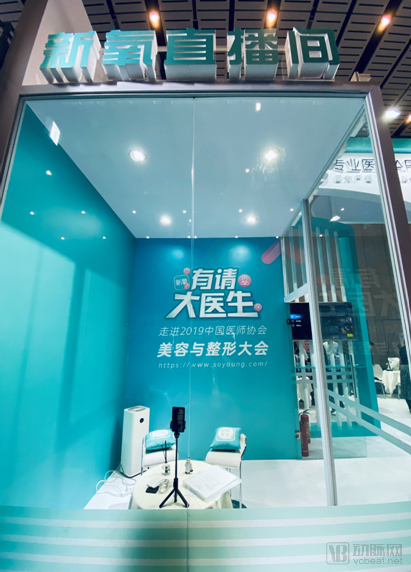
The first tool, “live streaming,” brings us back to the most fundamental shopping habits, with no barriers and high intuitiveness. This is particularly well-suited for the medical aesthetics industry, where consumer decision-making thresholds are very high. Live streaming can enhance communication efficiency, and there are many successful cases of doctors conducting live streams on New Oxygen. However, live streaming does place high demands on doctors’ eloquence and charisma. It exhibits a strong “winner-takes-all” effect, with traffic ultimately concentrating among a few top-tier doctors.
The second strategy, “short-form video,” offers the advantage of a low barrier to entry. In fact, many physicians have already produced short videos, which can be filmed and edited using just a smartphone. However, creating high-quality short videos is not easy. In terms of content, avoid covering generic information that is readily available through common searches. Instead, focus on highly specific knowledge points within medical aesthetics to precisely reach users actively searching for such details. Furthermore, it is essential to establish a distinct personal brand and maintain consistent, ongoing content production.
Platform selection is also crucial. Platforms like Douyin and Kuaishou are primarily entertainment-oriented, whereas users visit platforms like So-Young with the specific intent of undergoing medical aesthetic procedures.
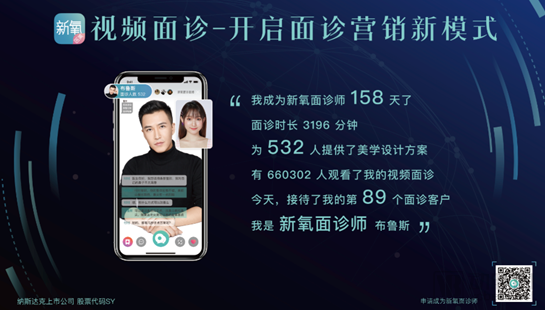
Many doctors say, “I don’t have strong eloquence and can’t stir up the audience’s emotions during live streams. How can I also leverage video?” This year, New Oxygen has launched a new 1-on-1 “Video Consultation” feature, which is the third component I will discuss. Through the mobile backend, doctors can view patients’ consultation requests anytime and anywhere. Once connected, a communication session lasting more than five minutes constitutes an effective video consultation, for which the patient pays the doctor 100 RMB. Its key advantage is enabling “face-to-face” communication between doctors and patients within minutes, allowing for rapid identification of consumer needs and the provision of targeted recommendations. In addition to meeting the Q&A needs of doctors and patients, we have found that, compared with traditional consultation methods, “Video Consultation” significantly shortens both the time to clinic visit and increases the visit conversion rate. Traditionally, it takes an average of 15 to 30 days for a patient to visit the clinic after initial consultation; with video consultations, this period is reduced to an average of 3 to 15 days. The clinic visit conversion rate has increased from 10–15% to 35%.
In summary, in the 5G era, I believe aesthetic medicine physicians should seize the dividends offered by a “trinity” of tools: live streaming, short-form videos, and video consultations. Good luck to all!