

Johnson & Johnson Delivers Strong Q4 2025 Results Amid 'Hundreds of Millions' Drug Pricing Impact, Raises 2026 Outlook

Johnson & Johnson
Medical Device R&D and Manufacturer
Johnson & Johnson (JNJ.US), a healthcare and pharmaceutical giant known as the "large blue chip" of the U.S. stock market, released its core Q4 2025 earnings data and 2026 outlook before the U.S. stock market opened on Wednesday. On an adjusted basis, the healthcare leader reported total quarterly earnings of approximately $6 billion in Q4 — representing a 22% year-over-year increase, or $2.46 per share, surpassing analysts' consensus estimate of $2.44 per share. Q4 revenue of $24.56 billion also exceeded Wall Street's expected $24.16 billion, reflecting a better-than-expected year-over-year growth of 9.1%.
Johnson & Johnson's Q4 overall sales and profits exceeded Wall Street expectations, driven by strong sales of the blood cancer therapy Darzalex, robust growth of the psoriasis drug Tremfya, and the strong resilience of its medical device business.
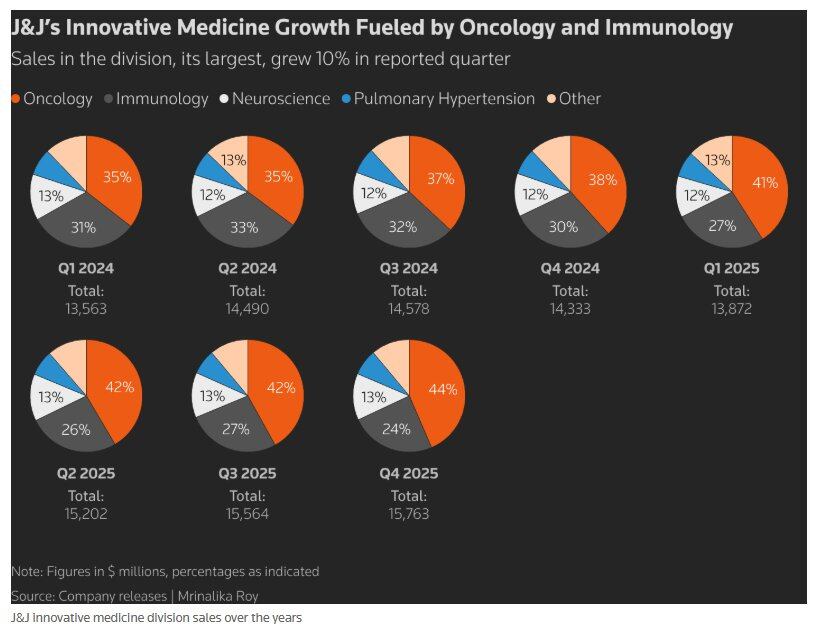
Sales in its largest division, Innovative Medicine, grew 10% this quarter to $15.76 billion, surpassing the expected $15.37 billion.
In Q4, Johnson & Johnson's medical device business achieved a better-than-expected 7.5% growth in quarterly sales, reaching $8.8 billion, surpassing the company management's previous expectation of approximately $8.69 billion. The higher-than-expected growth of this business was mainly driven by its cardiac device business, including key device operations incorporated into the product portfolio through the acquisition of Shockwave and the Abiomed business.
In the latest earnings disclosure report, Johnson & Johnson's management forecast indicates that its sales and profit expectations for 2026 will exceed Wall Street analysts' consensus estimates, even after accounting for the "hundreds of millions of dollars" impact from the drug price reduction and pricing agreement signed earlier this month with the Trump administration. In the fourth quarter of 2025, Johnson & Johnson achieved robust growth in sales and profits, surpassing Wall Street expectations, and concluded 2025 with resilient growth despite the heavy pressure of Trump's tariffs.
Johnson & Johnson is one of the 16 large pharmaceutical companies that reached an agreement with the Trump administration to lower drug prices in exchange for a full exemption from tariffs imposed by Trump on the U.S. market.
"We can't disclose specific details, but it involves a scale of hundreds of millions of dollars." Johnson & Johnson Chief Financial Officer Joseph Wolk said in a recent interview. "It also reflects the strong capabilities of our team: while absorbing the impact of this price reduction, we are still able to exceed (analysts') performance expectations for 2026 by a significant margin."
The company forecasts that its sales guidance range for 2026, calculated based on the operational reporting standard, will be approximately $99.5 billion to $100.5 billion, which is higher than the Wall Street analysts' general estimate of about $98.9 billion, according to analyst consensus data compiled by LSEG in London.
Johnson & Johnson management expects the adjusted earnings per share for the full year of 2026 to be in the range of $11.43 to $11.63, compared to the Wall Street analysts' previous consensus estimate of approximately $11.45 per share.
"2025 will be a year of rapid growth... This is thanks to our strongest pharmaceutical product portfolio in history and an even more robust R&D pipeline," said Joaquin Duato, CEO of Johnson & Johnson, in a statement, adding that the annual sales of the groundbreaking cancer therapy Carvykti exceeded $1 billion for the first time.
This strong earnings report comes at a time when the company is facing multiple challenges, including tariff uncertainties in its medical device division and mounting pressure on its blockbuster psoriasis drug Stelara due to increased competition from biosimilars. Earnings data shows that the drop in Stelara sales exceeded analyst expectations unexpectedly.
"Stelara has dropped so much — perhaps even more than analysts expected — and yet we are still able to continue achieving growth, which further demonstrates the strong overall growth effect brought by our pharmaceutical products," said Wolk, the company's chief financial officer.
"If you remove Stelara from the mix, our product portfolio can achieve cumulative growth of 14%, even 15%. These are the portfolios we will heavily rely on in the coming years and for the remainder of this decade."
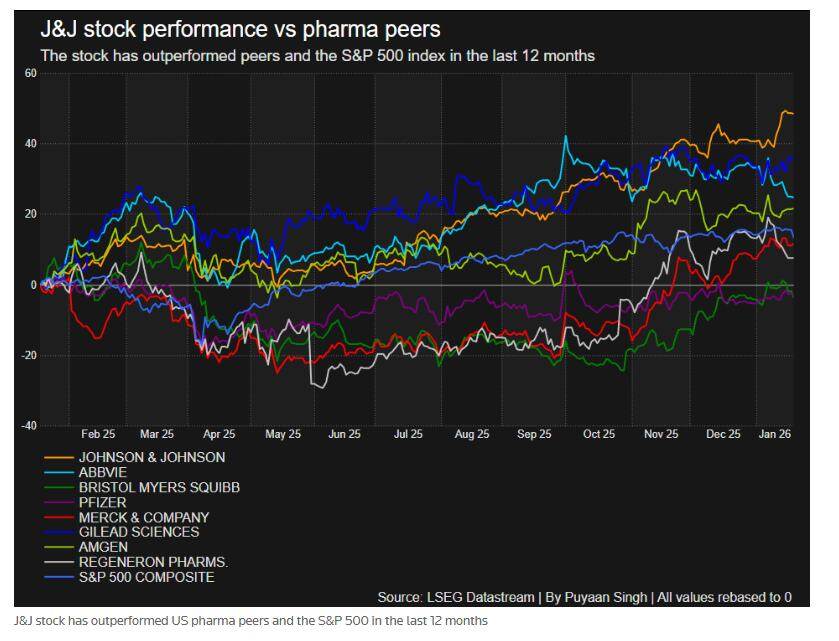
Despite beating forecasts and showing optimistic growth momentum, the company's shares once fell over 3% during pre-market trading in the U.S., but the decline narrowed significantly shortly thereafter. Its stock price has risen approximately 43% year-to-date in 2025, outperforming the S&P 500 Index as well as a number of competitors in the innovative drug business.
Johnson & Johnson's stock performance has also outperformed the S&P 500 index by a large margin since the beginning of this year, with an increase of over 5% and a market value as high as $525.7 billion. Johnson & Johnson has long held a relatively high weight in the S&P 500 index and has a certain degree of influence on the overall trend of the U.S. stock market.
The day before the latest results were announced, a court-appointed special monitor recommended allowing the expert testimonies — which link the company's talc products to ovarian cancer — to be formally admitted in court. Johnson & Johnson has been dealing with significant claims related to its talc products in both federal and state courts for many years and stated that its products are safe and do not cause any level of carcinogenic effects. The first federal "bellwether" trial is expected to commence as early as the second half of 2026.