

Synthetic Biology: The Third Biotech Revolution Attracting $16 Billion in Six Months
In 1953, Watson and Crick discovered the double-helix structure of DNA, ushering in the first biotechnology revolution and marking the entry of life sciences research into the era of molecular biology.
In 2003, the completion of the Human Genome Project marked the advent of the second biotechnology revolution, ushering in the era of omics and systems biology for life sciences research.
So, what is the third biotechnology revolution? After achieving the ability to “read” genes, advances in DNA synthesis and gene editing technologies have enabled a gradual transition from “reading” to “writing” genes. As biological concepts increasingly converge with engineering principles, the advent of the synthetic biology era may well lead the third biotechnology revolution.
The concept of synthetic biology was first publicly proposed by Polish scientist W. Szybalski in 1978. As a discipline that integrates bioscience with engineering, it has gradually become an investment hotspot over the past two years. According to Crunchbase data, total financing in the field of synthetic biology reached $3.8 billion in 2018, and this momentum continued to rise in 2019. In the first half of 2019, 65 synthetic biology companies raised a total of $1.9 billion, with Q2 2019 marking the highest quarterly fundraising on record. Crunchbase projects that if investment maintains this pace, the number of deals in 2019 will increase by 33%, while the total amount will remain on par with the previous year’s $3.8 billion.
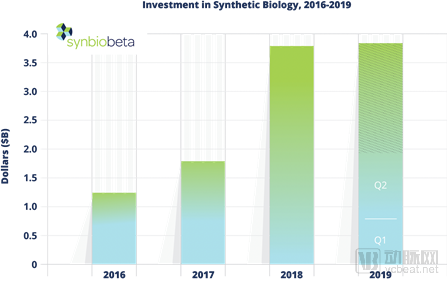
Figure: Total Investment in the Synthetic Biology Industry, 2016–2019
On the other hand, the global investment and financing environment has been less than favorable over the past two years. The difficulty institutions face in raising funds has also made it harder for startups to secure financing. Many companies and institutions have prepared to “tighten their belts” to weather the downturn. However, enthusiasm for investing in the healthcare sector has not waned but rather intensified, with more capital flowing into areas of technological innovation, among which synthetic biology is a major focus. Notably, Ginkgo Bioworks set a current record in biotechnology financing with a $290 million raise. Based on interviews with industry insiders and in-depth research, we analyze that the main reasons for the heating up of synthetic biology investments include the following points.
1. Highly efficient, clean, and cost-effective emerging technologies that meet market expectations
2. Dual Decline in Costs for Gene Sequencing and Editing, with DNA Synthesis Breaking Through Cost Barriers
3. Upstream Breakthroughs Drive Accelerated Industry Development
4. “IT” Technology Disrupts the Field, Achieving a Leap in Synthesis Efficiency
5. The commercial success of unicorns will encourage more people to participate
Why Is Synthetic Biology So Popular? To answer this question, we first need to understand what synthetic biology can do.
Synthetic biology typically generates novel metabolic pathways by modifying existing biological systems or by synthesizing genomes de novo to reconstruct living organisms, thereby producing new metabolites through these engineered pathways. Consequently, unlike chemical synthesis, biosynthesis does not require the establishment of large-scale chemical plants nor the employment of a massive workforce typical of such facilities.
Although significant costs are incurred in microbial engineering and the establishment of production lines, production costs will be controlled as scale increases, similar to chemical synthesis. Moreover, these engineered microorganisms are capable of self-replication. Therefore, synthetic biology not only reduces labor costs but also enables more efficient and cost-effective production of target products.
Liu Xiucai, founder of Cathay Biotech, was invited by the Chinese government in 1995 to lead a key scientific and technological project on “Vitamin C.” Within just one year, the adoption of biological methods for large-scale production halved the cost of Vitamin C, leading to a rapid concentration of global Vitamin C production capacity in China, a trend that has persisted to this day. Bluepha Microbiology, through itsEngineering halophilic strains for PHA synthesis can currently reduce production costs by more than 50%. These are examples of how synthetic biology lowers production costs.
Furthermore, some compounds that are difficult to produce via chemical synthesis can be synthesized relatively easily using biosynthetic pathways, as exemplified by the large-scale production of artemisinin.More importantly, compared to most heavily polluting chemical synthesis methods, biosynthesis is more environmentally friendly. Its advantages—cleanliness, high efficiency, and low cost—have rapidly won the favor of many. Especially in today’s era that advocates for a green environment, biosynthetic methods undoubtedly align with the developmental needs of the times.
In addition to manufacturing, another application of synthetic biology is the synthesis of substances that may otherwise require substantial material and financial resources to obtain, or that may not even exist in nature. It is noteworthy that since the beginning of the 21st century, the discovery of new antibiotics, compound molecules, and novel materials has largely reached a bottleneck. Taking antibiotics as an example, although there is a wide variety of antibiotics currently available on the market, they can be summarized into only about a dozen chemical structures, with each category encompassing dozens or even hundreds of subtypes. Over the past three decades, only two new classes of antimicrobial agents have been discovered.
There is an immense yet finite variety of compounds in nature. Since the beginning of the 21st century, the development of many molecular materials has stagnated, and after 2001, drug R&D efforts began shifting toward biologics. In both the materials and healthcare sectors, there is a strong expectation for greater innovation at the molecular level. There is a need for a “creation”-capable technology to enable new discoveries in materials, compounds, and even energy. The emergence of synthetic biology aligns precisely with these expectations.
Undoubtedly, synthetic biology has met numerous demands in production and manufacturing. However, since this concept was already proposed in the last century, why has it suddenly gained significant traction in the past two years? This is by no means accidental. As mentioned earlier, synthetic biology offers many advantages that align with market expectations. Yet these factors primarily address demand-side dynamics. Behind the rapid growth in financing, a more substantial driving force lies on the supply side—namely, breakthroughs in foundational technologies.
Synthetic biology involves the modification or even reconstruction of microbial metabolic systems, a process that entails DNA synthesis and assembly. Gene editing and high-throughput sequencing serve as critical enabling technologies. Although these two technologies have been established for many years, commercial applications related to gene sequencing and gene editing have only emerged in recent years due to previous constraints on cost and technical capabilities.
Let us review the history of biotechnology development over the past two years. In 2012, Illumina reduced the cost of whole-genome sequencing to below $1,000, commercial applications based on next-generation sequencing (NGS), such as non-invasive prenatal testing (NIPT) and tumor NGS assays, began to emerge, and a large number of NGS startups appeared worldwide. In 2013, Feng Zhang,Jennifer Doudna、Emmanuelle Charpentier inventedCRISPR Gene-Editing Technology, and the World Has Changed Because of It.The advent of CRISPR technology has propelled gene editing to a major leap forward. With its precision, affordability, and power, it has rapidly gained prominence in the life sciences industry, reshaping the landscape of the entire field and significantly reducing the cost of DNA synthesis. Zhang Haoqian, co-founder of Bluepha, told VCBeat that ten years ago, synthesizing a 1 kb DNA fragment in his laboratory cost approximately RMB 10,000; today, the cost for synthesizing an equivalent fragment is only RMB 300.
Due to the relatively low technical performance and high costs in the past, synthetic biology has remained a technology confined largely to laboratories. However, the decline in the cost of underlying technologies has also driven synthetic bio-As the cost of learned technologies decreased to a certain level, synthetic biology began to move toward commercialization.
During the synthesis process, extensive testing is required, ranging from the initial construction of DNA fragments to the final measurement of new drug outputs. The application of high-throughput operational platforms and automated workflows has significantly enhanced efficiency.
In experimental procedures, whether during the initial construction of DNA fragments or the subsequent measurement of output signals, samples and related reagents must be mixed and transferred. For instance, in the polymerase chain reaction (PCR) technique, commonly used for amplifying gene fragments, each reaction requires the addition of 5–6 types of reagents. Even with only 10 samples, this entails 50–60 pipetting steps. The substantial volume of pipetting work is not only time-consuming and labor-intensive but also prone to uncontrollable manual errors, leading to unstable experimental results. High-throughput liquid handling workstations can significantly improve pipetting efficiency through multi-channel pipette dispensing and automated robotic arm operations. Given the large number of combinations requiring testing, the application of high-throughput operational platforms is crucial for enhancing screening efficiency.
We temporarily classify companies engaged in DNA/RNA synthesis and industrial enzyme preparation as upstream enterprises. These were among the first to benefit from cost advantages. Similar to the impact of sequencer manufacturers on the sequencing industry, technological breakthroughs by these upstream companies have driven the development of midstream and downstream application enterprises.
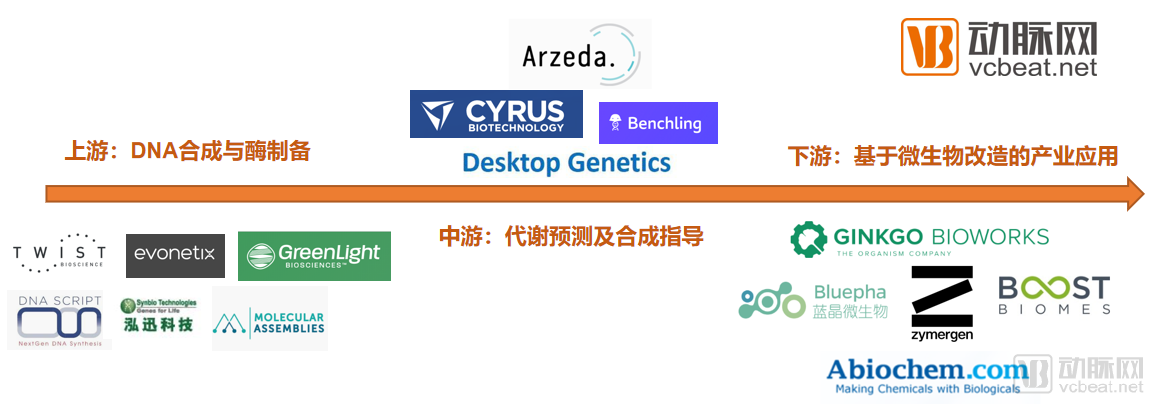
Upstream and Downstream Industry Chain of Synthetic Biology
Driven by advancements in tools, upstream DNA synthesis has achieved higher throughput and lower costs. For instance, Twist Bioscience, founded in 2013, leverages its core technology—a high-throughput silicon chip-based DNA synthesis platform—that offers a throughput 9,600 times greater than traditional methods. Each well on the chip corresponds to a single well of a 96-well plate and contains 100 honeycomb-shaped nanoreactors. Based on this platform, Twist Bioscience can perform high-fidelity, low-cost synthesis of DNA fragments and genes. In addition to higher yields, the company has reduced the reaction volume required for DNA synthesis by one million-fold by eliminating the need for subsequent amplification. Currently, its maximum synthesis length is 3.2 kb, with yields ranging from 100 to 1,000 ng.
The company went public on NASDAQ in November 2018, having raised a total of $253 million in funding prior to its IPO.
Also leveraging high-throughput synthesis technology is Synthomics, based in San Francisco, USA. The company was founded by a group of researchers from Stanford University. Synthomics possesses ultra-low-cost, high-throughput oligonucleotide synthesis technology. Its independently developed, highly automated platform, the Green Machine, can simultaneously synthesize oligonucleotides in 1,536 wells, offering higher throughput, lower costs, and shorter turnaround times compared to the standard 96-well format.
Moreover, based on innovations in the allocation of miniaturized, customized small-batch consumables, Synthomics claims that its Green Machine synthesizer conservatively reduces reagent consumption by 20-fold and lowers costs by 20-fold. On the other hand, Synthomics holds an IP portfolio that includes innovations centered on high-speed motion control, novel solid supports, miniaturized consumables, and microfluidic technologies. These downstream processing modules streamline workflows while eliminating errors associated with manual handling.
Synthomics raised $1.1 million in seed funding in 2014, while the amount of another round of financing obtained in 2016 has not yet been disclosed.
Of course, upstream technologies are not exclusively concentrated in North America; there are also companies in China dedicated to DNA synthesis. Hongxun Technology has its Chinese headquarters located in the Suzhou Nano Industrial Park. Its technology combines electrochemical methods to synthesize tens of thousands, or even hundreds of thousands, of primers on a single semiconductor chip in one go. The company secured Series A financing from BGI Genomics in 2014, while its Series B round saw participation from Kaifeng Venture Capital, Xieli Investment, and Yahui Medical.
All of the aforementioned companies were established in 2013. Moreover, San Diego-based Molecular Assemble and Boston-based GreenLight Biosciences were also founded in that same year, while the French company DNA Script was established in 2014. A review of the biotechnology timeline reveals that 2013 marked the emergence of CRISPR gene-editing technology.
Following the decline in upstream DNA synthesis costs, downstream application research enterprises are bound to be the next beneficiaries. However, we need to insert an intermediate factor here, because beyond cost reduction, the integration of another technology has enabled a qualitative leap in synthetic biology’s synthesis efficiency and success rate. This technology is computer science.
We regard the stage in synthetic biology that employs algorithms, models, machine learning, and other technical means to predict synthesis outcomes and simulate metabolic pathways as the midstream sector. In this phase, advancements in artificial intelligence and cloud computing provide researchers with powerful tools, enabling them to simulate their concepts on virtual platforms, thereby reducing operational complexity and failure rates. Robust computational design can significantly decrease the workload associated with screening experiments and support the optimization of cell factories. In this field, the convergence of biotechnology (BT) and information technology (IT) represents a major trend.
Based in Cambridge, Massachusetts, Asimov is dedicated to integrating computer science with synthetic biology. The company employs machine learning techniques to design genetic circuits, aiming to fundamentally enhance humanity’s capacity to engineer living systems. With billions of genetic fragments existing in nature, Asimov seeks to facilitate the design of novel biological systems by classifying, optimizing, and recombining these genetic elements. Biology is a highly complex discipline, and advances in genetic engineering have further expanded the design space to an immense scale. Both the architectural design of models and the complexity of modeling itself now surpass those of traditional biophysical systems. The incorporation of machine learning has undoubtedly provided a powerful tool for advancing synthetic biology.
It is understood that Asimov is developing machine learning algorithms to link large datasets with models of biological mechanisms, aiming to enhance human capabilities in designing and understanding biological complexity through artificial intelligence.
A similar example is Desktop Genetics, a recognized leader in gene-editing technology. However, Desktop Genetics is not a pure biotechnology company; its team comprises not only gene-editing experts and bioinformaticians but also a group of software engineers. Its founder, Riley Doyle, is a software engineer who transitioned from a background in biochemistry. Over four years, the company refined its core product, DESKGEN AI, a platform that makes CRISPR gene editing more predictable, convenient, and efficient, empowering scientists to expand their genomics research. Leveraging a suite of laboratory-validated algorithms derived from peer-reviewed studies and industry experience, the platform enables users to navigate every step of the CRISPR gene-editing process. Researchers can access the latest advancements, algorithms, and expertise in CRISPR gene editing on DESKGEN, helping them reduce the time and cost associated with gene editing.
Seattle-based company Arzeda applies AI’s predictive capabilities to the prediction of enzyme characteristics, protein energy, and metabolic pathways. Arzeda’s proprietary synthetic biology platform leverages recent advances in protein design and computational power to develop the complex genetic instructions required to construct highly customized proteins and enzymes. The integration of computational protein design with state-of-the-art high-throughput screening represents a fundamental shift from traditional protein engineering techniques. Powered by robust computational capabilities, Arzeda is able to create cell factories with industrial-scale production capacity.
Of course, beyond prediction, computational science is also being applied to the management of experimental workflows. This is precisely what Benchling, a San Francisco-based company, is doing: it has developed a platform that supports interface analysis, data sharing, and electronic lab notebooks, thereby enhancing efficiency by providing tools for experimental workflow and data management. In the midstream segment, interactions between biology and computational science are increasing; leveraging machine learning and other techniques to predict protein structures and optimize DNA sequences can significantly improve the efficiency of DNA or protein synthesis. Such integration has become a common choice among midstream companies. The incorporation of AI and computer technologies has made the development of synthetic biology more controllable and predictable, boosting both efficiency and success rates while reducing costs and enhancing technical feasibility.
The downstream sector involves the synthesis or engineering of microorganisms using DNA fragments, along with applied research on the resulting synthetic products. By modifying the genetic material of microorganisms, these entities enable the synthesis or production of specific substances. Such enterprises can be primarily categorized into two types: those providing solutions and those delivering synthetic products.
The precipitous drop in DNA synthesis costs, efficiency gains from automated high-throughput equipment, and the convergence of biotechnology with computer technology have ushered in unprecedented development opportunities for downstream applications in synthetic biology, giving rise to industry unicorns such as Zymergen and Ginkgo Bioworks. These companies can be broadly categorized into two types: those that provide solutions and those that deliver synthetic products.
Zymergen and Ginkgo Bioworks are headquartered in California and Boston, respectively. Zymergen’s technology integrates artificial intelligence and machine learning to engineer microbes into “synthetic factories.” These engineered microorganisms can efficiently metabolize substrates to produce target products, such as biofuels, plastics, and pharmaceutical molecules. In December 2018, Zymergen secured $400 million in Series C financing from eight investors, including SoftBank. Prior to this round, the company had raised additional capital from multiple investors, bringing its total funding to $574.1 million.
Ginkgo Bioworks primarily provides enterprises with customized microorganisms, achieving this through the engineering of yeast and bacteria. Its business spans sectors such as food and industry. In 2017, Ginkgo Bioworks acquired Gen9, a pioneer in DNA synthesis and assembly. Gen9’s proprietary DNA synthesis and assembly pathways have further strengthened Ginkgo Bioworks’ capabilities in microbial engineering. The synthesis of these long DNA sequences is critical to Ginkgo Bioworks’ design of multi-gene enzymatic pathways. From 2014 to the present, Ginkgo Bioworks has completed five rounds of financing. The most recent two rounds each raised nearly $300 million, with the Bill & Melinda Gates Foundation participating in Series D, and Y Combinator involved throughout all rounds.
Unlike the first two companies, which focus on delivering technical solutions, Bluepha adopts a more direct commercial strategy by providing vertical products. Professor Chen Guoqiang, founder of Bluepha, and his team isolated halophilic strains from the shores of Ayding Lake in Xinjiang. These strains can thrive in high-salinity environments that are intolerable to most other microorganisms. Leveraging engineered halophilic strains, Bluepha has developed two business lines: materials synthesis and the production of active pharmaceutical ingredients (APIs) for natural chemical drugs and traditional Chinese medicine.
In the material synthesis business line, halophilic strains can tolerate the continuous intracellular accumulation of PHA, with peak content reaching up to 80%, thereby reducing PHA production costs by more than 50%. In the pharmaceutical compound synthesis business line, in addition to synthesizing lead compounds, Bluepha is also exploring the synthesis of specific bioactive substances derived from plants.
Zhang Haoqian, co-founder of Bluepha, stated in an interview with VCBeat that the unit price of plant-based active ingredients is typically extremely high, and demand from the consumer sector is driving rapid growth in the global market for related products. The company aims to leverage synthetic biology to engineer microorganisms for the production of specific plant-based active ingredients, thereby significantly reducing their acquisition costs. Bluepha has currently completed two rounds of financing, with investors including FreeS Fund and Lihua Venture Capital. Although its fundraising amounts remain substantially lower than those of unicorns such as Zymergen and Ginkgo Bioworks, the commercial successes achieved by these latter companies have ushered in promising prospects for Bluepha.Despite the fact that investment and financing in China’s synthetic microbiology industry have only just begun, Zhang Haoqian remains confident about the future.。
In 2015, Luo Yu founded Yikelai Biotech with the aim of achieving industrial-scale production of chemicals using biocatalytic enzyme technology. Rather than selling enzymes externally, Yikelai focuses on their directed evolution to catalyze reactions and mass-produce final products. The company successfully screened a mutant of a specific lyase in under one year and, based on this breakthrough, developed a novel synthetic route for S-cyanohydrin. This innovation enabled Yikelai to replace Royal DSM as the supplier of S-cyanohydrin to FMC Corporation, the world’s fifth-largest crop protection company.
In the pharmaceutical sector, Yikelai Biotechnology successfully screened a specific transaminase mutant and developed a novel synthetic route for sitagliptin—the first globally to successfully circumvent Merck’s patent. Additionally, leveraging the successful screening of a specific dehydrogenase mutant, the company established an innovative process for the preparation of R-3-aminobutanol (an intermediate for dolutegravir). Dolutegravir is currently one of the most prominent antiretroviral drugs for HIV/AIDS and has been included in the procurement lists of charitable organizations such as the World Health Organization (WHO) and the Bill & Melinda Gates Foundation.
In addition, Cathay Biotech, a well-established company founded in 1997 in China, is currently the world’s largest supplier of long-chain dicarboxylic acid series products, with a market share exceeding 80%. The success of its long-chain dicarboxylic acid project represents a notable commercial case globally where bio-based products have replaced petrochemical counterparts. It is reported that Cathay Biotech has initiated its A-share listing process following the completion of its latest round of financing. Ginkgo Bioworks reached a valuation of $4.8 billion after completing its Series E financing round.Zymergen Raises $400 Million in Series C Funding, with Valuation Long Surpassing Unicorn Status.
Investors vote with their feet, always staying one step ahead in spotting opportunities. Perhaps it was precisely the recognition of these advantages in synthetic biology, and the capture of development opportunities arising from the convergence of technological breakthroughs and market demand, that drove this trend. Following the first surge in financing volume in 2018, more new investors entered the field in 2019.
In the capital markets, companies such as Twist and Beyond Meat have demonstrated robust performance following their IPOs, while unicorns like Zymergen and Ginkgo Bioworks are poised to enter the public markets in succession. Social and political factors, such as the Green New Deal, are also expected to create favorable policy conditions for the synthetic biology industry. With growing recognition from the market, policymakers, and investors, synthetic biology is likely to experience accelerated advancement in the coming years.
However, on the other hand, the development of synthetic biology also faces certain challenges. Biology exhibits incredible unpredictability, and it is currently impossible to ensure that organisms will produce outputs consistent with initial design specifications and predicted outcomes. In the supply chain segment, chemical synthesis remains the mainstream approach. Synthetic biology still has a considerable way to go before becoming a fully mature engineering discipline. How far off this future is, and when the marketization of synthetic biology will truly arrive, remain questions that the industry must continue to explore.
Special Thanks: Zhang Haoqian, Co-founder of Bluepha; Cao Wenqing, Researcher at Probe Capital. We extend our sincere gratitude to both for their strong support of this article.