

Beijing Tongren Hospital and Tencent Joint Team Wins Top Prize in Medical AI Competition with Intelligent Screening System for Blindness-Causing Eye Diseases
Recently, the finals of the 4th Technological Innovation Competition (Medical AI), hosted by the Beijing Hospital Administration Center and co-organized by the Beijing Academy of Artificial Intelligence, kicked off. After fierce competition, a joint team composed of Beijing Tongren Hospital, Tencent, and Beihang University won the first prize with their “AI-Assisted Screening System for Blinding Eye Diseases.” The innovation and clinical utility of this highly influential and promising “Medicine + AI” achievement received unanimous recognition from the competition judges.
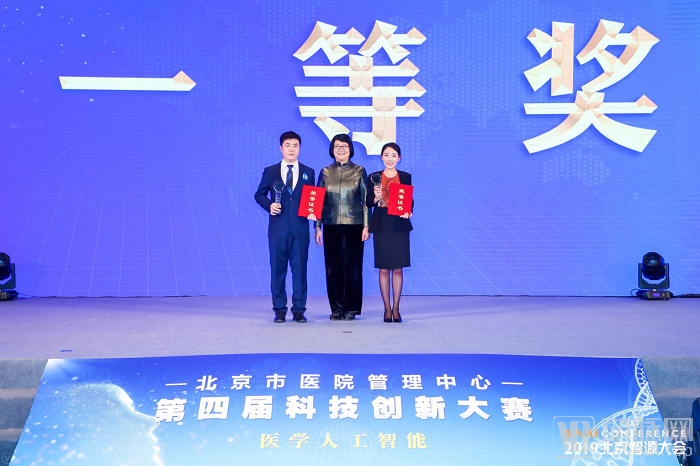
Beijing Tongren Hospital’s “AI-Assisted Screening System for Blinding Eye Diseases” Project Wins First Prize in the Competition
The award-winning project is a scientific achievement in AI-assisted diagnosis of blinding eye diseases, developed by Professor Wang Ningli’s team at Beijing Tongren Hospital in collaboration with Tencent and Beihang University. This multi-disease, multimodal intelligent screening and auxiliary diagnostic software system for ophthalmology, designed for tiered diagnosis and treatment, will leverage a cloud platform to connect medical entities—including health examination centers, primary care hospitals, and tertiary A-grade hospitals—into an iterative closed-loop system. By decentralizing high-quality medical resources to the grassroots level, it aims to assist ophthalmic institutions at all levels in establishing a truly intelligent ophthalmology framework, thereby advancing the development of ophthalmology in China.
At the event, this invisible “AI assistant” was integrated with fundus examination equipment to “demonstrate” its powerful capabilities to the audience: participants underwent retinal imaging using an all-in-one AI fundus screening device; with a single click, the images were uploaded to the cloud and processed by the AI evaluation system for intelligent analysis. Within 50 seconds, participants received their AI-based assessment results. The entire fundus examination took only a few minutes, a diagnostic speed and accuracy that truly impressed attendees.
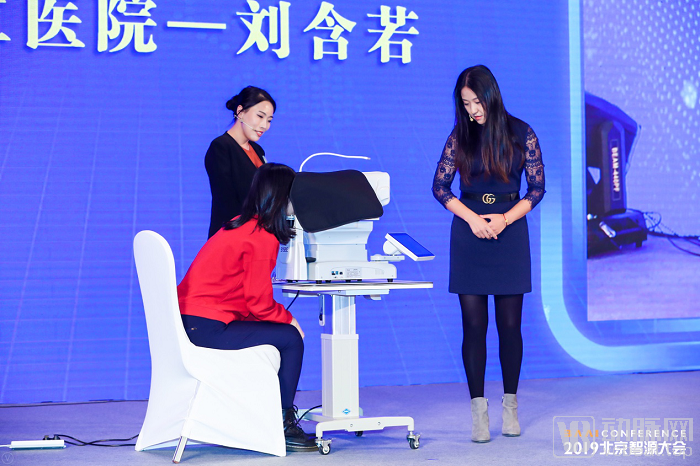
Live Demonstration of an AI-Assisted Screening System for Blinding Eye Diseases
AI Cracks the Challenge of Fundus Disease Screening, Building an Intelligent Ophthalmology System
“The eyes are the windows to the soul,” yet in China, the situation regarding blinding eye diseases such as glaucoma and diabetic retinopathy remains grim. Taking glaucoma as an example, epidemiological survey data indicate that the prevalence of primary glaucoma is approximately 3.8%, with the number of patients aged 40 and above projected to reach 21 million by 2020. However, most patients are already in the middle to late stages at the time of initial diagnosis, resulting in irreversible vision loss or even blindness, thereby imposing a heavy burden on their families and society.
Among these, fundus examination plays a pivotal role. It not only helps detect ocular diseases but also reveals subtle clues of systemic conditions such as hypertension and coronary heart disease. However, the shortage of ophthalmologists has prevented many patients from receiving timely diagnoses. The current prevalence of fundus examination is disproportionate to its clinical value.
In this context, Tencent began exploring the field of fundus diseases, aiming to provide new approaches for the widespread adoption of fundus screening through artificial intelligence. In October 2017, the “Tencent Miying” Diabetic Retinopathy Screening System was launched. Leveraging Tencent’s leading AI technology, the system classifies diabetic retinopathy into five grades according to international standards, achieving a detection accuracy of 97% and a staging accuracy of 85%.
To expand the application scenarios of AI in fundus screening, Tencent and Professor Wang Ningli’s expert team from Beijing Tongren Hospital jointly launched a collaborative research project on AI-assisted glaucoma diagnosis on November 16 last year. This June, leveraging deep learning of extensive disciplinary knowledge, clinical data, and expert clinical experience, the two parties’ research outcome—the glaucoma screening feature of “Tencent Miying”—has established a professional diagnostic model capable of highly accurate intelligent identification of glaucoma, with an accuracy rate exceeding 95%.
With the support of Tencent Youtu Lab, the glaucoma screening feature of “Tencent Miying” adopts leading unsupervised domain adaptation technology to enhance the generalization capability of deep learning models on multi-center images, effectively addressing the issue of model performance degradation in clinical testing. Meanwhile, Tencent Youtu Lab has also designed a spatial attention mechanism based on multi-model cascading, which enhances the weights of key regions focused on by clinical glaucoma experts, thereby improving the interpretability of model outputs and ultimately increasing the sensitivity and specificity of glaucoma detection.
With the assistance of “Tencent Miying,” the efficiency and accuracy of fundus disease screening have been improved, and the workflow for fundus disease screening has been optimized: patients undergo fundus photography at primary healthcare institutions or off-site screening centers; the “Tencent Miying” intelligent fundus screening system performs remote intelligent analysis and automatically generates assessment reports to enhance diagnostic efficiency, with final review and confirmation conducted by ophthalmologists.
This means that professional ophthalmologists, with the assistance of “Tencent Miying,” can provide broader screening support to primary care and community settings through remote diagnostic technical services. This approach helps address the shortage of ophthalmologists at the grassroots level and promotes the widespread adoption of low-cost fundus examinations in communities and primary care facilities. Furthermore, while detecting ocular diseases, the system can also identify various systemic conditions such as diabetes and hypertension, making primary care screening an efficient and convenient disease management model. Currently, the system has been jointly validated with more than 30 hospitals across China and is being piloted in primary healthcare systems in provinces and municipalities including Guangdong, Guangxi, and Shandong. It is believed that an increasing number of people will benefit from this initiative.