

CDE Solicits Public Comments on Technical Requirements for Quality and Efficacy Consistency Evaluation of Generic Special Injectable Chemical Drugs
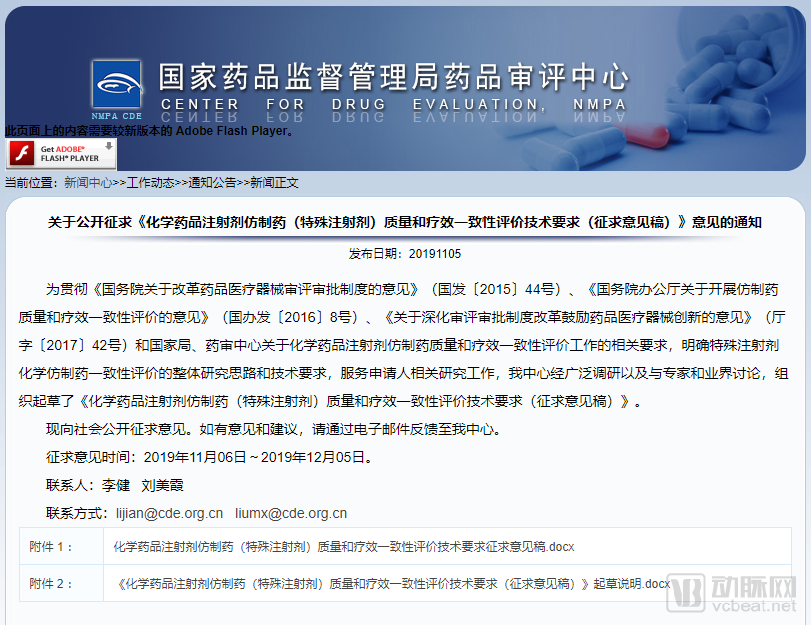
VCBeat (WeChat ID: vcbeat) has learned that on November 5, the Center for Drug Evaluation of the National Medical Products Administration released the “Technical Requirements for Quality and Efficacy Consistency Evaluation of Generic Chemical Injections (Special Injections) (Draft for Comments)” (hereinafter referred to as the “Draft”).
The Draft Opinion initiated its research phase in June 2018, with the first draft completed in December 2018. The initial version for expert discussion was finalized in February 2019, followed by two expert symposia held in July and September 2019, respectively, to conduct in-depth discussions and revisions with representatives from academia and industry.
This document outlines the overall framework and general principles for the development of generic special injectables, details the pharmaceutical research content and evaluation key points for chemical generic special injectables, and describes the evaluation methods for human bioequivalence studies. It clarifies that, prior to conducting human bioequivalence studies or clinical trials, appropriate animal species should be selected for non-clinical comparative pharmacokinetic studies of chemical generic special injectables.
Public Solicitation of Opinions and Suggestions
The full text of the Draft Opinion is as follows:
Special injections refer to injectable products whose quality and the in vivo behavior of their active ingredients are significantly influenced by formulation and manufacturing processes, compared with conventional injections. These factors may further affect the safety and efficacy of the preparations in the body. Examples include liposomes, intravenous emulsions, microspheres, and suspension injections.
Specialty injectable chemical generic drugs should, in principle, comply with the requirements set forth in the Technical Requirements for Quality and Efficacy Consistency Evaluation of Generic Chemical Injectable Drugs. This document serves as a supplement thereto, aiming to propose the overall framework and general principles for the development of generic specialty injectables, thereby providing technical guidance for their research and development.
I. Overall Considerations
For specialized injectables, given the complexity of their formulation characteristics, a stepwise comparative research strategy should be adopted based on the formulation and product attributes. This strategy should begin with pharmaceutical and non-clinical comparative studies between the test product and the reference listed drug, followed by human bioequivalence studies, and further clinical studies if necessary. If the results of pharmaceutical and/or non-clinical studies indicate inconsistencies between the test product and the reference listed drug, the applicant should further optimize the formulation and manufacturing process of the test product before reinitiating the studies.
II. Pharmaceutical Research
In accordance with the Technical Requirements for Quality and Efficacy Consistency Evaluation of Generic Chemical Injections, consistency evaluation for special injections shall, while conducting studies in compliance with the aforementioned technical requirements, also scientifically design trials based on the characteristics of special injections and by referencing the relevant technical requirements for special formulations issued by the FDA and EMA. Attention is recommended to the following issues:
(I) Formulation and Manufacturing Process
In principle, the formulation should be consistent with that of the reference listed drug (RLD). It is recommended to investigate the grades of excipients and the critical quality attributes (CQAs) of those excipients that may affect the in vivo behavior of the injection.
The manufacturing processes of specialized injectables may affect their in vivo behavior and warrant in-depth investigation; for specialized injectables produced using aseptic processing, particular attention must be paid to sterility assurance measures and validation at each manufacturing step.
The manufacturing process and batch size for registration batches and commercial batches should, in principle, remain consistent. The batch size of registration batch samples shall comply with the "General Requirements (Trial) for the Production Scale of Registration Batches of Generic Chemical Drugs" issued by the authorities.
(II) Quality Research
Key quality attributes under evaluation may include, but are not limited to, the following: physicochemical properties (such as appearance, viscosity, osmolality, pH/acidity-alkalinity, etc.), Zeta potential, particle morphology, particle size and distribution (e.g., D10, D50, D90, etc.), in vitro dissolution/release behavior, free and bound drug, and drug polymorphs and crystalline forms.
In principle, quality comparison data for at least three batches of reference product samples should be provided.
(3) Considerations for Human Bioequivalence Studies/Clinical Trials
Samples from commercial-scale batches shall be used for human bioequivalence studies and/or clinical trials.
For specific injectable products for which the FDA or EMA has published guidelines, it is recommended to conduct comparative studies with the reference listed drug in accordance with their technical requirements.
III. Non-Clinical Studies
Unlike conventional injectables, special injectables typically involve drug release processes and adsorption by bodily fluid components after entering the body. Therefore, differences in formulation and manufacturing process between the test product and the reference product may alter the in vivo pharmacokinetic behavior of the drug, thereby leading to changes in efficacy and toxicity. In vitro pharmaceutical comparative studies alone are often insufficient to fully reflect the differences in in vivo behavior between the test and reference products. In light of these considerations, prior to conducting human bioequivalence studies or clinical trials, appropriate animal species should be selected for non-clinical comparative pharmacokinetic studies to adequately demonstrate the consistency between the test and reference products in terms of in vivo pharmacokinetic behavior and/or distribution in pharmacodynamic/toxicity target organs.
Given that only drugs released from the formulation are typically active in vivo, it is recommended to separately measure the concentrations of drug-loaded and released drugs when determining blood drug concentrations.
IV. Clinical Research
Clinical studies may be conducted only after research has demonstrated pharmaceutical and non-clinical consistency between the test formulation and the reference formulation. A stepwise approach should generally be adopted for clinical studies, beginning with human bioequivalence studies, followed by further clinical investigations as necessary.
(I) Human Bioequivalence Studies
Establish discriminatory methods for human bioequivalence studies. General requirements and study design may refer to relevant guidelines such as the Technical Guidelines for Human Bioequivalence Studies of Chemical Generic Drugs Using Pharmacokinetic Parameters as Endpoint Evaluation Indicators and the Statistical Guidelines for Bioequivalence Studies. Specific study recommendations should focus on the following aspects:
Study Design: A randomized, single-dose, crossover study design is typically employed. Under special circumstances, an appropriate study design should be selected based on drug characteristics, the target indication population, and other relevant factors.
Subjects: Healthy subjects are typically used. When the inclusion of healthy subjects in the trial may pose safety risks, it is recommended to select patients with the proposed indications for the investigational drug.
Sample Size: The number of enrolled subjects should provide sufficient statistical power for the bioequivalence evaluation.
Analytes: If the active substance of a special injectable exists in multiple forms in vivo, bioequivalence studies should fully consider the impact of each form on safety and efficacy, and scientifically and rationally select the analyte based on the drug’s characteristics. The analytical method must be fully validated, possess sufficient specificity for the target analyte, and demonstrate adequate sensitivity to detect differences between the test and reference products.
Bioequivalence Evaluation Criteria: Data should be provided, including the AUC0–t, AUC0–∞, and Cmax geometric means for both the test and reference formulations, as well as the geometric mean ratios and their 90% confidence intervals. In special cases (e.g., microspheres), additional exposure metrics may be required to assess early exposure or exposure during specific time intervals.
Acceptance Criteria for Bioequivalence: In general, for the primary endpoint metrics, the 90% confidence interval of the geometric mean ratio of the aforementioned parameters should be no less than 80.00% and no more than 125.00%.
Pilot Study: Prior to the formal trial, a pilot study may be conducted in a small number of subjects to validate the analytical methods (including the ability to distinguish the analyte), assess variability, optimize sampling times, and obtain other relevant information. Data from the pilot study shall not be included in the final statistical analysis.
Others: In addition to meeting the current requirements for registration submission materials, a comprehensive scientific rationale for key issues should be provided based on product characteristics, including but not limited to study design, subject selection, sample size, analytes, and bioequivalence evaluation metrics.
Human bioequivalence studies using pharmacodynamic endpoints as the primary evaluation criteria shall be conducted in accordance with relevant guidelines. In special circumstances, prior communication with regulatory authorities is permitted.
(II) Randomized Controlled Clinical Trials
Whether randomized controlled clinical trials are required should be determined through discussion based on the drug’s characteristics, as well as the results of prior pharmaceutical, nonclinical, and human bioequivalence studies. For cases where human bioequivalence studies demonstrate that the test product is not bioequivalent to the reference product, the applicant should further optimize the formulation and manufacturing process of the test product and conduct comparative studies anew.
For the following situations (not limited to), it is recommended to conduct randomized controlled clinical trials to demonstrate the equivalence of the test formulation and the reference formulation:
(1) Lack of accurate and reliable bioanalytical methods for biological samples makes it impossible to evaluate the bioequivalence between the test formulation and the reference formulation through bioequivalence studies.
(2) The results of the human bioequivalence study indicated differences between the test formulation and the reference formulation, and it remains uncertain whether these differences would have a significant impact on the safety and efficacy of the drug.
(3) The correlation between drug concentrations in the systemic circulation and efficacy or safety is poor; therefore, human bioequivalence studies are insufficient to evaluate the consistency of efficacy and safety between the test formulation and the reference formulation.
For clinical trials, it is recommended to communicate with regulatory authorities in advance.