

Promoting Standardized Diagnosis and Treatment of Respiratory Diseases at the Primary Care Level under New Conditions: Ensuring Universal Access to Basic Respiratory Healthcare in China's Moderately Prosperous Society
According to the latest epidemiological data, there are approximately 100 million patients with chronic obstructive pulmonary disease (COPD) and around 60 million asthma patients in China. In stark contrast, public awareness of COPD stands at merely 2.6%, and only 40% of asthma patients have achieved adequate disease control. Behind this significant disparity lies a substantial medical burden. Enhancing the prevention, diagnosis, and treatment of respiratory diseases in China, as well as standardizing their management at the primary care level, represents a critical challenge that the medical community must currently address.
On November 3, at the “4th China Academic Forum on Prevention and Control of Respiratory Diseases in Primary Care,” Academician Wang Chen, a member of the Chinese Academy of Engineering, Vice President of the Chinese Academy of Engineering, President of Peking Union Medical College and Chinese Academy of Medical Sciences, and an expert in respiratory medicine and critical care medicine, delivered a keynote speech titled “Promoting Standardized Diagnosis and Treatment of Respiratory Diseases in Primary Care under New Conditions.” VCBeat (WeChat ID: vcbeat) has compiled and edited the highlights of his presentation.

Academician Wang Chen Delivers Speech at the 4th China Academic Forum on Prevention and Control of Respiratory Diseases in Primary Care
In his speech, Academician Wang Chen elaborated on the positive changes in the prevention and treatment of respiratory diseases both domestically and internationally over the past four years, from four perspectives: international outlook, domestic situation, discipline construction, and the current status of diseases. He provided insights into promoting standardized diagnosis and treatment of respiratory diseases at the primary care level under new conditions, and set forth goals and requirements for the future development of primary care respiratory disciplines.
International Perspective
In recent years, the international community has placed increasing emphasis on respiratory diseases, with China assuming a special and significant role. The 13th Global Alliance against Chronic Respiratory Diseases (GARD) Conference was held in China, during which the Beijing Declaration on International Action for Lung Health Promotion (hereinafter referred to as the “Beijing Declaration”) was released. The Beijing Declaration fills a gap in the World Health Organization’s (WHO) efforts in the prevention and control of respiratory diseases. The Director of the WHO Department of Noncommunicable Disease Management stated that the Beijing Declaration is of milestone significance, exerts substantial global influence, sounds a new clarion call for the prevention and control of respiratory diseases, and calls for global collaboration to jointly combat chronic respiratory diseases.
The Beijing Declaration issues a call to action on the prevention and control of respiratory diseases from five aspects: First, it calls on governments worldwide to take action against chronic respiratory diseases; Second, it promotes multi-sectoral collaboration to control risk factors for chronic respiratory diseases, with a particular emphasis on tobacco control; Third, it strengthens primary healthcare systems to enhance the capacity for preventing and treating chronic respiratory diseases, thereby achieving universal health coverage, as universal health is unattainable without robust primary care; Fourth, it supports scientific research; Fifth, it enhances cooperation to advance national strategies.
This declaration calls for collaborative efforts from all sectors of society to actively advance the prevention and control of respiratory diseases, proposing new requirements for managing chronic respiratory conditions from a fresh perspective. Respiratory diseases are recognized as one of the four major global chronic diseases, alongside cancer, cardiovascular and cerebrovascular diseases, and diabetes and other metabolic disorders. Within the field of respiratory diseases, priority is given to the prevention and control of chronic obstructive pulmonary disease (COPD), followed by asthma, interstitial lung diseases, sleep-disordered breathing, pulmonary hypertension, and other chronic respiratory conditions.
Domestic Perspective
In 2016, the state issued the Outline of the “Healthy China 2030” Plan, marking China’s first medium- to long-term plan in the health sector. The outline clarifies the grand blueprint and action plan for healthcare and public health in China. In 2019, the state further released the Healthy China Action (2019–2030), which serves as the concrete implementation roadmap and pathway for the Healthy China Strategy.
Among the 15 special initiatives in the Healthy China Action Plan, eight are closely related to the prevention and control of respiratory diseases and involve respiratory health (popularization of health knowledge, national fitness, tobacco control, promotion of healthy environments, occupational health protection, cancer prevention and control, prevention and control of chronic respiratory diseases, and prevention and control of infectious and endemic diseases). The Chinese Thoracic Society (CTS) and the Chinese Association of Chest Physicians (CACP) have jointly promoted the initiative for the prevention and control of chronic respiratory diseases, issuing a call to action to their peers in the respiratory field and to society at large.
In China, we have released the white paper on chronic respiratory diseases, titled “Epidemiology and Prevention and Control Strategies for Chronic Respiratory Diseases in China,” to provide systematic guidance for physicians in the prevention and control of chronic respiratory diseases (CRD). Based on existing epidemiological survey data and jointly revised by experts in the field of respiratory medicine, this white paper comprehensively elaborates on the current status of CRD in China, covering its epidemiology, major influencing factors, current prevention and control practices, as well as strategic and policy recommendations. We recommend that primary care physicians and healthcare professionals read and actively discuss this document.
Discipline Development
From the perspective of disciplinary background, the field of respiratory medicine has proposed a strategy of “three pillars” to promote its development:
First, adopt specialized training, focused study, and single-subject specialization in talent development, and implement standardized management;
Second, standardize the prevention, diagnosis, and treatment system and capacity building for respiratory diseases at the primary care and departmental levels through departmental development. Many community hospitals at the primary care level do not have dedicated respiratory departments; however, they must still establish a standardized system and capability for the prevention, diagnosis, and treatment of respiratory diseases, including standardized management of common respiratory conditions such as cough and the common cold;
Third, from the perspective of industry development, establish a medical consortium for the Department of Respiratory Medicine.
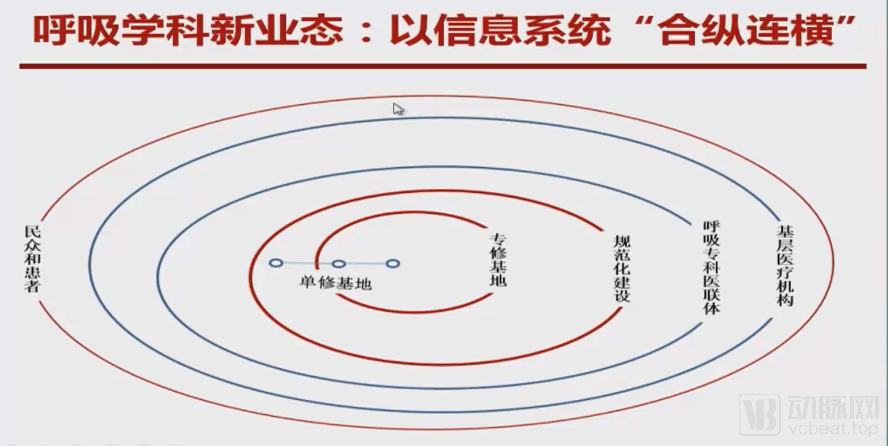
New Business Models in Respiratory Medicine (Image sourced from the presentation slides of Academician Wang Chen)
Within the new ecosystem of respiratory medicine, 79 hospitals currently serve as specialized training bases, while several hundred others function as advanced fellowship training centers. If we can successfully establish and refine this new model for respiratory care, and design and implement strategies accordingly, the future of China’s respiratory community holds great promise. Once our vision for building this new ecosystem is clearly defined, we must strictly adhere to this blueprint in its execution.
Prevention, diagnosis, and treatment of respiratory diseases at the primary care level constitute the most fundamental, grassroots-oriented, and widely impactful component of the overall blueprint, closely tied to the well-being of the general public. Effective prevention and control of respiratory diseases truly depend on the concerted efforts of a vast number of primary healthcare workers. Currently, we have established Primary Care Respiratory Disease Prevention and Treatment Alliances in 28 provinces, municipalities, and autonomous regions. We have launched a series of initiatives to strengthen respiratory healthcare at the primary level, including knowledge dissemination and training programs such as “Know and Share Respiratory Health” and “Strengthening Primary Care, Walking Together”; as well as projects aimed at standardizing the prevention, diagnosis, and treatment systems and enhancing capabilities for respiratory diseases in primary healthcare institutions. By collaborating with the general practice community, family physicians, and the community medicine sector, we are jointly advancing the work of preventing, diagnosing, and treating respiratory diseases at the primary care level.
Among the 26 action indicators outlined in the “Healthy China 2030” initiative, six are related to respiratory diseases. The target for public awareness of chronic obstructive pulmonary disease (COPD) by 2030 is set at 30%; however, the current population awareness rate stands at merely 2.6%. Given the low baseline for respiratory disease awareness, the target has been set conservatively. If we can genuinely enhance the capacity for prevention, diagnosis, and treatment of chronic respiratory diseases at the primary care level, I believe it is highly feasible to ultimately achieve a 70% awareness rate. This would also serve as a testament to the professional competence of both pulmonologists and general practitioners.
In the Standardized Prevention, Diagnosis, and Treatment System and Capacity Building Project for Respiratory Diseases in Primary Healthcare Institutions (hereinafter referred to as the “Primary Respiratory Standardization Project”), primary healthcare institutions are required to be equipped with diagnostic and therapeutic equipment and medications for respiratory diseases, cultivate physicians and nurses specializing in the diagnosis and treatment of respiratory diseases, and strengthen the prevention and long-term follow-up management of these conditions. In many regions, screening for chronic obstructive pulmonary disease (COPD) has been incorporated into local basic public health services, making the Primary Respiratory Standardization Project an effective approach to genuinely enhance the diagnostic and therapeutic capabilities of primary care physicians in managing respiratory diseases.
Furthermore, at the national policy level, the development of respiratory medicine has become a matter of national will and priority. On December 3, 2018, the National Administration of Medical Administration and Hospital Management issued the Guidelines for Medical Services in Respiratory Medicine, the first department-specific medical service guideline in China, aimed at advancing respiratory disease management through discipline construction in large hospitals. In September of the same year, to strengthen the prevention and control of respiratory diseases, the Department of Primary Healthcare under the National Health Commission supported standardized construction projects for primary care respiratory services, incorporating them as a key component of the “Quality Service Campaign for Primary Healthcare Institutions.” This year, China will also release a government document recommending standardized construction projects for primary care respiratory services, thereby promoting the prevention, diagnosis, and treatment of respiratory diseases at the grassroots level.
Currently, the Primary Care Respiratory Standardization Project is actively underway. A total of 416 primary healthcare institutions from 17 provinces, municipalities, and autonomous regions across China have participated in the evaluation. Among them, 192 were rated as “Excellent,” 178 as “Compliant,” and 46 as “Under Development.” During the evaluation period, 156 expert visits were conducted nationwide for assessment. The primary healthcare institutions that met the requirements through this review process were officially accredited at this year’s Annual Conference on Respiratory Medicine, the Annual Conference on General Practice, and the current Primary Care Respiratory Forum.
Current Status of the Disease
In 2016, chronic non-communicable diseases caused 9 million deaths in China. The latest data from The Lancet, a prestigious international medical journal, indicates that there are 99.9 million patients with chronic obstructive pulmonary disease (COPD) in China. The prevalence of COPD is 8.6% among individuals aged 20 years and older, and 13.7% among those aged 40 years and older. I recommend that all patients undergo routine spirometry during their regular health check-ups. Pathological changes in the small airways can indeed be intervened at an early stage, which is one of the key reasons why I advocate for early screening.
Individuals at high risk for respiratory diseases—such as smokers, those with a family history of chronic obstructive pulmonary disease (COPD), individuals experiencing respiratory symptoms like coughing, young children with recurrent respiratory infections, and workers with repeated occupational exposure to dust—should undergo screening.
In China, the prevalence of asthma among individuals aged 20 and above is 4.2%, corresponding to 45.7 million patients, while the number of asthma patients under the age of 20 is estimated to exceed 10 million. However, regarding the current status of asthma diagnosis and treatment in China, only 28.8% of asthma patients have ever been diagnosed by a physician, and only 23.4% have undergone pulmonary function testing; among these, merely 5.6% have received inhaled corticosteroid (ICS) therapy. In terms of the disease burden of asthma in China, 26.2% of asthma patients aged 20 and above exhibit airflow limitation, which is significantly higher than the 16.2% reported in Western countries. Furthermore, the proportion of Chinese asthma patients aged 20 and above who sought emergency care at least once in the past 12 months due to acute exacerbation of respiratory symptoms is twice that of the UK (15.5% in China vs. 8.8% in the UK). This indicates that the standardization of prevention, diagnosis, and treatment for respiratory diseases remains far from adequate, accessibility to medical services urgently needs improvement, and primary healthcare providers bear significant responsibility.
Next Step Work Objective: Universal Access to Primary Respiratory Care in the Year of a Moderately Prosperous Society
2021 marks the year of achieving a moderately prosperous society. It is my hope that within three years (2019–2021), the evaluation and accreditation rate for the Standardized Prevention, Diagnosis, and Treatment System and Capacity Building Project for Respiratory Diseases in primary healthcare institutions across all regions will reach 100%. Standardized construction efforts, ranging from secondary and tertiary hospitals to primary healthcare institutions, should meet corresponding standards, ensuring that everyone enjoys access to primary respiratory care in this year of moderate prosperity. This is not only a national mandate but also a public need and the responsibility of respiratory healthcare professionals. Driven by robust national policies, we should mobilize all primary-level respiratory alliances, with disciplinary leaders from the fields of respiratory medicine, community medicine, and general practice at the core, to work together toward this goal.
Future reviews of standardized construction for primary care respiratory medicine will be conducted on a nationally unified information platform. Project applications can be submitted via the official website of the Primary Care Respiratory Alliance. The review process adopts a model combining online evaluation, offline random inspections, and expert re-evaluation, ensuring strict quality control and comprehensive coverage across 28 provinces, municipalities, and autonomous regions. Collective applications are encouraged; for instance, Tianjin, Shanghai, Beijing’s Daxing District, and Shenzhen’s Luohu District have all implemented collective application procedures for their reviews. Currently, the primary care respiratory standardized construction project is supported by policy measures from the Department of Primary Health Care of the National Health Commission. In alignment with the “Healthy China—Action for Prevention and Control of Chronic Respiratory Diseases,” and in collaboration with general practitioners, the initiative aims to fully leverage the role of provincial primary care respiratory alliances. The plan is to complete reviews for 1,000 primary healthcare institutions by the end of 2019, 14,000 by 2020, and 25,000 by 2021.
Prevention and control of respiratory diseases at the primary care level are closely linked to the public interest. For physicians, it offers a broad platform to enhance their diagnostic and therapeutic capabilities. For the vast population of patients with respiratory conditions, effective prevention and management safeguard their health. For the industry, the development of respiratory medicine must be grounded in primary care, mobilizing general practice, and leveraging standardized respiratory disease data to drive disciplinary advancement. For society and the nation, given that respiratory diseases are common in primary care settings, this presents a valuable opportunity to promote the development of primary healthcare services. Here, we once again pay tribute to the outstanding “Most Beautiful Primary Care Respiratory Physicians.” Let us join forces to continue promoting standardized diagnosis and treatment of respiratory diseases at the primary care level under new circumstances, thereby advancing primary healthcare through standardized prevention, diagnosis, and management of respiratory diseases.