

Zhongsheng Kangyuan Submits IPO Prospectus: A Pioneer in Neoantigen-Based Personalized DC Cancer Vaccines
Years ago, clinical trials of tumor vaccines based on tumor-associated antigens (TAAs) flourished. Examples included peptide vaccines targeting the tumor antigen mucin 1 (MUC1), melanoma-associated antigen 3 (MAGEA3), and human epidermal growth factor receptor 2 (HER2) in breast cancer; numerous TAA-dendritic cell (TAA-DC) vaccines; and TAA-based DNA and RNA vaccines utilizing viruses, bacteria, and virus-like particles. Unfortunately, all these efforts ended in failure. The only approved product, Provenge, also met with a dismal outcome due to concerns over its efficacy in large patient populations and its high cost.
After 2013, personalized cancer vaccine technology based on tumor neoantigens emerged.
In July 2017, Nature simultaneously published two articles from different research teams, affirming the clinical application prospects of next-generation tumor vaccines for the treatment of melanoma. In April 2018, Science Translational Medicine reported that the 2-year overall survival rate reached 100% in patients with advanced ovarian cancer treated with personalized dendritic cell (DC) tumor vaccines. In the same year, the American Society of Clinical Oncology (ASCO) Annual Meeting disclosed that personalized DC tumor vaccines induced durable immune responses in patients with endometrial and mucinous carcinomas, significantly improving their progression-free survival.
However, the clinical outcomes of these two generations of tumor vaccines differ significantly, primarily due to differences in their targets (antigens). Tumor-associated antigens are recognized by the host immune system as self-components, resulting in weak T-cell recognition and response. In contrast, tumor neoantigens are a class of tumor-specific antigens arising from gene mutations within cancer cells. They exhibit high affinity for the T-cell receptor (TCR) on the surface of T cells, and targeting them for immunotherapy typically avoids immune-related toxic side effects.
In 2017, nearly one hundred clinical trials for next-generation cancer vaccines were registered on ClinicalTrials.gov, and the number of research articles and patent applications related to tumor neoantigens increased rapidly. Consequently, capital began to fervently pursue tumor neoantigen projects. According to incomplete statistics, more than 30 companies worldwide are specifically engaged in the research and development of tumor neoantigens, including emerging unicorns such as Moderna Therapeutics, Gritstone, and Neon Therapeutics.
However, starting in the second half of 2018, with leading companies, particularly Neon, which is engaged in the research and development of tumor neoantigen peptide vaccines, announcing large-sample clinical studiesunsatisfactoryData, the outside world began to question the value of this technology, and the capital market also entered a period of calm and observation.
Dr. Cheng Xudong, an Adjunct Professor at the Beijing Academy of Science and Technology, believes that tumor neoantigens are antigens unique to tumor cells, generated by random gene mutations within these cells, making them ideal antigens for therapeutic cancer vaccines.
The discovery and identification of tumor neoantigens involve complex, multidisciplinary approaches, integrating high-throughput gene sequencing, bioinformatics prediction, gene expression analysis, co-immunoprecipitation, MHC affinity assays, mass spectrometry-based proteomics, and analysis of tumor clonal subpopulation status. These processes impose exceptionally high requirements on sequencing technologies, data analytics capabilities, protein detection techniques, immunological validation, as well as the expertise of R&D and operational personnel, thereby establishing significant technical barriers.
“Nevertheless, research institutions and leading industry enterprises in Europe and the United States have conducted substantial foundational work in this field, thereby solidifying the basis for the clinical application of neoantigens.“Dr. Cheng Xudong pointed out. For example, in the field of tumor neoantigen-based peptide vaccines and mRNA vaccines, early clinical trial data for Neon’s NEO-PV-01 and Gristone’s GRANITE-001 have clearly demonstrated prolonged progression-free survival in patients with melanoma, non-small cell lung cancer (NSCLC), and bladder cancer.”
Dr. Cheng Xudong explained that subsequent data from NEO-PV-01, GRANITE-001, and other candidates did not demonstrate further significant breakthroughs in clinical efficacy. This was not due to any inherent issue with the neoantigens themselves; rather, while these approaches leveraged neoantigens to address the weak antigenicity of tumor cells, they failed to resolve the functional defects of immune cells in patients with cancer.
Patients with malignant tumors typically exhibit compromised immune function, making it difficult to initiate anti-tumor immune responses within the body. One of the primary reasons for this is the suppression of antigen-presenting cells (APCs), which fail to effectively present antigens to activate T cells. Therefore, to achieve the desired clinical efficacy, immunotherapy must address not only the issue of antigen availability but also the problem of immunosuppression in tumor patients. In other words, while large amounts of tumor-specific antigens are administered into the body, it is essential to ensure their efficient uptake and presentation by endogenous antigen-presenting cells, thereby activating a sufficient number of effector T cells.
Dr. Cheng Xudong stated that although many people became confused after early clinical trial data fell short of expectations, he remains convinced that the application and widespread clinical adoption of tumor neoantigen therapy represent the current and future development trend in cancer immunotherapy, despite this therapeutic modality having taken decades of human struggle against cancer to finally reach the clinic.
“Unlike most developers who focus on refining tumor neoantigen prediction technologies, we have found a breakthrough in the in vivo mechanism of action of tumor neoantigens. We believe that directly inducing patient-derived monocytes into dendritic cells (DCs), loading them with tumor neoantigens proven functional through in vitro assays, and culturing them into highly mature, healthy DCs before reinfusion can break immune tolerance in cancer patients and significantly enhance the clinical efficacy of tumor neoantigen vaccines.“Dr. Cheng Xudong told VCBeat.”
In May 2018, Dr. Cheng Xudong founded Zhongsheng Kangyuan Biotechnology (Beijing) Co., Ltd., focusing on the research and development of next-generation personalized tumor neoantigen dendritic cell (DC) vaccines. Shortly after its establishment, the company secured tens of millions of RMB in angel investment from prominent Chinese venture capital firms, including Cowin Capital, Huachuang Capital, and Shouke Kaiyang.
With the support of capital, the founding team rapidly overcame a series of technical challenges by combining independent R&D with academic collaborations. They established an internationally leading bioinformatics prediction system for multi-omics tumor neoantigens, a functional validation platform for tumor neoantigens, and a cancer big data processing platform, all with fully independent intellectual property rights. As the first company in China capable of high-precision, high-throughput, rapid, and cost-effective identification of tumor neoantigens, it stands on par with leading counterparts in Europe and the United States.
Meanwhile, through strategic collaboration with industry giants such as Miltenyi Biotec from Germany, we have achieved pharmaceutical-grade production of immune cell products, addressing the industry-wide challenge of transforming personalized dendritic cell (DC) formulations into marketable drugs and filling the domestic gap in industrialization within this field.
Currently, Zhongsheng Kangyuan has established R&D bases and production centers in Beijing and Philadelphia, USA. It has built the most advanced domestic R&D platform for dendritic cell (DC) cancer vaccines based on tumor neoantigens, and is comprehensively advancing exploratory clinical studies of personalized DC vaccines for intermediate-to-advanced stage hepatocellular carcinoma, pancreatic cancer, and glioblastoma in both China and the United States.
When VCBeat asked why dendritic cells (DCs) were chosen as the delivery vehicle for tumor neoantigens, Dr. Cheng Xudong stated that T cells, which play a crucial anti-tumor role in patients, cannot directly recognize tumor antigens. They can only be activated upon recognizing antigen peptide–MHC complexes expressed on the surface of antigen-presenting cells, subsequently differentiating into effector T cells to attack and eliminate tumor cells expressing those tumor antigens.
Dendritic cells (DCs) are professional antigen-presenting cells characterized by typical dendritic or pseudopod-like protrusions, high surface expression of MHC molecules, the ability to migrate to secondary lymphoid organs, and the capacity to stimulate the activation and proliferation of naive T cells. They are the most potent professional antigen-presenting cells known in the human body and the only antigen-presenting cells capable of activating naive T cells.
Dendritic cells (DCs) are the core and foundation of anti-tumor immune responses, as well as ideal antigen-presenting vectors for therapeutic cancer vaccines. The preparation of DC vaccines is straightforward: precursor cells of DCs are isolated from the patient, cultured in vitro, loaded with tumor antigens, and then infused back into the patient, thereby eliciting a specific anti-tumor T-cell response mediated by the DCs. Compared with other therapeutic cancer vaccines, DC vaccines offer at least the following clinical advantages:
First, it precisely and efficiently eliminates tumor cells, effectively repairing, restoring, and enhancing the patient’s own cellular immune function, breaking the state of immune tolerance in tumor patients, and achieving immune reconstitution;
Second, it can continuously mobilize various cytokines in the body to participate in the clearance of tumor cells, significantly reducing damage to normal cells while eliminating tumor cells, thereby demonstrating a high level of safety;
Third, the infused dendritic cells (DCs) can activate naive T cells to generate a primary immune response (a single DC can activate 100–3,000 T cells). The majority of these T cells directly exert tumor-killing effects, while a small subset differentiates into long-lived memory T cells that can immediately initiate a robust immune response upon re-exposure to the same type of tumor cells. Therefore, the immune protection system rebuilt by tumor neoantigen DC vaccines can remain effective for decades, achieving an organic integration of therapy and prevention.
Clinical trial results from hundreds of therapeutic cancer vaccines conducted both domestically and internationally have demonstrated that dendritic cell (DC) vaccines are stable, reliable, and highly safe. Sipuleucel-T, the first therapeutic cancer vaccine in human history approved by the U.S. Food and Drug Administration (FDA) in 2010 for prostate cancer, is an autologous DC vaccine.
Currently, among the second-generation cancer vaccines undergoing clinical trials globally, the tumor neoantigen vaccines with the most rapid progress and best efficacy are also dendritic cell (DC) vaccines.
In 2019, the final results of the phase II clinical trial SOV02 (NCT02107950) were presented at the 50th Annual Meeting of the Society of Gynecologic Oncology (SGO): The use of the dendritic cell-based immunotherapy DCVAC/OvCA in combination with the standard carboplatin and gemcitabine regimen for patients with platinum-sensitive recurrent epithelial ovarian cancer extended overall survival (OS) by more than one year in those with advanced recurrent disease. DCVAC/OvCa reduced the risk of death by 62% in second-line treatment for ovarian cancer, significantly increasing overall survival (OS) by 13.4 months and median progression-free survival (mPFS) by 1.8 months.
The tumor neoantigen-sensitized dendritic cell (DC) vaccine developed by US-based NWBio is currently widely used in the treatment of glioblastoma, advanced ovarian cancer, and advanced prostate cancer. In 2018, the company announced results from a Phase III clinical trial showing that its dendritic cell vaccine improved survival rates in patients with newly diagnosed glioblastoma, with some patients surviving nearly three times longer than those receiving standard therapy. The relevant data were published in the Journal of Translational Medicine.
“The combination of DC cells and tumor neoantigens has broken the current impasse in the clinical application of tumor neoantigen technology,” introduced Dr. Cheng Xudong. “Before the advent of tumor neoantigens, many hospital-based biotherapy centers in China were already extensively conducting clinical treatments with autologous DC vaccines. However, due to the lack of high-quality antigens such as tumor neoantigens, inconsistent DC cell manufacturing processes, and insufficient strict quality control, clinical outcomes were generally poor.”
Currently, the identification of tumor neoantigens has entered the commercialization stage. Meanwhile, driven by the development of the CAR-T industry, the manufacturing processes for GMP-grade miniaturized and automated production equipment for immune cell preparation are becoming increasingly mature, laying the foundation for the upgrading and iteration of DC vaccines.
This August, Sinocellgen signed a strategic cooperation agreement with Miltenyi Biotec, a globally renowned manufacturer of equipment and reagents in the field of cell therapy. According to the agreement, both parties will leverage their respective resource and technological advantages to collaborate comprehensively in areas such as the construction of platforms for tumor neoantigen discovery, full-process automation of DC vaccine production, and the establishment of CMC systems. This collaboration has injected strong momentum into Sinocellgen’s new drug application for its personalized neoantigen DC vaccine formulation.
Clinical trials of new drugs are the gold standard for evaluating the technical prowess of medical innovation companies. At present, domestic companies developing tumor neoantigen therapies are all in the exploratory clinical research phase. It is reported that Zhongsheng Kangyuan is collaborating with Peking University Cancer Hospital to conduct clinical studies on a new generation of tumor vaccines, which involve autologous dendritic cells (DCs) loaded with multiple tumor neoantigens for patients with intermediate-to-advanced hepatocellular carcinoma, cholangiocarcinoma, and pancreatic cancer. The study has enrolled 12 patients, and observations have shown that those who completed the treatment experienced shrinkage or disappearance of systemic metastatic lesions, achieving either partial response (PR) or stable disease (SD).
Another clinical study is a Phase I trial conducted by Sinocelltech in collaboration with the Department of Neurosurgery at Sun Yat-sen University Cancer Center, evaluating autologous dendritic cell (DC) vaccines targeting tumor neoantigens for the treatment of recurrent and progressive glioblastoma. Preliminary exploratory laboratory-level studies have been completed in multiple patients, and the formal enrollment of the first patient is imminent. Dr. Cheng Xudong told VCBeat that this will mark the first time a domestic company has used tumor neoantigen peptides identified through artificial prediction and in vitro validation to sensitize autologous DC cells from tumor patients, representing a clinical therapeutic attempt against malignant brain tumors.
Dr. Cheng Xudong holds a Ph.D. in Molecular Biology from the Chinese Academy of Sciences. In his early years in the United States, he studied under Dr. Sidney Altman, the 1989 Nobel Laureate in Chemistry, conducting research on the development of novel technologies for RNA therapeutics. Since returning to China in 2016, he has been engaged in clinical translational medicine research based on tumor genomics. He is a scientist-entrepreneur with multidisciplinary expertise in bioinformatics, molecular biology, and clinical oncology.
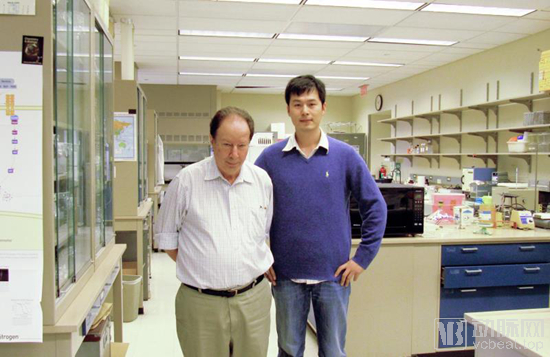
Dr. Cheng Xudong and his mentor, Dr. Sidney Altman
Currently, Zhongsheng Kangyuan boasts a first-class talent team covering R&D of neoantigen identification technologies, development of cell production processes, and clinical research on DC vaccines. It has established a 500-square-meter GMP-like production center for immune cell preparations in the Zhongguancun Park in Changping, Beijing, and has obtained certification for its CMC quality control system for immune cell production, which is recognized by national authorities.
“With advances in the genomics and immunology of malignant solid tumors, therapeutic vaccines based on neoantigen sensitization have made significant progress in treating these cancers. However, this field is currently dominated by Europe and the United States, while China remains relatively undeveloped. Zhongsheng Kangyuan is the first company in China to engage in the R&D of internationally advanced neoantigen-based dendritic cell (DC) vaccines, boasting a comprehensive platform and distinct technological advantages. Zhongsheng Kangyuan is well-positioned to rapidly close the gap with its European counterparts and fill this industrial void in China.”
"Dr. Cheng Xudong told VCBeat that Zhongsheng Kangyuan is rapidly advancing exploratory clinical studies for multiple indications and accelerating the IND registration and filing in China for next-generation personalized dendritic cell (DC) vaccine formulations. The company aims to provide more comprehensive and systematic data on clinical safety, tolerability, and efficacy, striving for the early market launch of a clinically effective, safe, and affordable new generation of tumor neoantigen DC vaccines. This will help address the current lack of effective clinical treatment options for progressive or metastatic solid tumors, enabling more patients with malignant solid tumors to benefit from this innovative, cutting-edge therapy," said Dr. Cheng Xudong confidently.