RemeGen
Biological New Drug Developer
Akeso
Innovative Antibody Drug Developer

AstraZeneca
Pharmaceutical Technology Research and Development Provider
MediLink
Antibody-Drug Conjugates Developer
Daiichi - Sankyo
Pharmaceutical Development, Production, Sales, and Consulting Service Provider
Hansoh Pharma
Pharmaceutical Research, Production, and Sales

As a weathervane in the global pharmaceuticals industry,January 12-15, 2026, the 44thThe J.P. Morgan Healthcare Conference (hereinafter referred to as "JPM Conference") was held in San Francisco.
On the global biotechnology competitive stage, "differentiated innovation" and "strategic focus" have become common challenges for pharmaceutical companies worldwide. A group of innovative companies represented by Pudong pharmaceutical enterprises have achieved a leap from "appearance" to "showcasing strength" on the global stage through cutting-edge innovations and significant international cooperation.


"Self-developed + Cooperation", Building a New Growth Engine
At this year's conference, multinational pharmaceutical companies in Pudong disclosed updates on their pipelines and long-term strategies. They either diversify their pipelines to mitigate risks, focus on R&D efficiency and differentiated competition, or leverage external collaborations to position themselves in cutting-edge fields such as bispecific antibodies, ADCs, autoimmune diseases, GLP-1, and neuroscience, aiming to build a moat for future growth.
Bispecific Antibody Field
JPM Day 1,AbbVieAndRemeGenObjectRemeGen has reached a licensing agreement for the PD-1/VEGF bispecific antibody drug RC148, with a potential total transaction value of 5.6 billion yuan. Both the upfront payment and the potential maximum transaction amount mark a new high for RemeGen's external BD activities.
Also on January 12,AkesoOverseas partner Summit Therapeutics revealed that it has submitted the marketing application for PD-1/VEGF bispecific antibody Ivonescimab to the FDA. According to the FDA review timeline, a regulatory decision is expected in the fourth quarter of 2026.
ADC Field
AstraZenecaAt this year's JPM conference, "next-generation immuno-oncology bispecific antibodies + high-value ADCs" were clearly identified as the dual pillars of innovation and growth. The company plans to comprehensively expand into the oncology and autoimmune fields through a strategy of "independent research and development + ecosystem collaboration," supporting its goal of achieving $80 billion in total revenue by 2030.
RocheMediLink continues to "double down" on the ADC field. On January 9, just before the JPM conference, MediLink announced a new exclusive licensing agreement with Roche for the YL201 project. The two parties will jointly advance the development and commercialization of this innovative antibody-drug conjugate (ADC) candidate targeting B7H3 across multiple solid tumor indications.
Daiichi - SankyoThis involves holding seven core assets, covering popular targets such as HER2, TROP2, and B7-H3, as well as high-demand indications like breast cancer, gastric cancer, and lung cancer.
GLP-1 Field
RegeneronList the small molecule GLP-1R agonist Olatorepatide (HS-20094) as a key strategic move into the trillion-dollar obesity and diabetes market.June 2025,Hansoh PharmaHansoh Pharma entered into a licensing agreement with Regeneron for Olatorepatide, receiving an upfront payment of $80 million. The total value of this deal could reach up to $1.93 billion, with Hansoh Pharma retaining the rights to Olatorepatide in the Chinese market.
RocheSimilarly, they are accelerating the layout in the metabolic disease track. Before the JPM conference, Roche paid $100 million in licensing fees to obtainShuoDibo Bio(Structure Therapeutics)'s GLP-1-related patents, to avoid patent overlap risks for the oral GLP-1 candidate drug CT-996. Meanwhile, Roche andMediLinkAkeso and Daiichi-Sankyo have reached another collaboration, with Akeso obtaining the global rights (excluding mainland China, Hong Kong, and Macao) to the ADC drug YL201 for an upfront payment and milestone payments totaling $570 million. Additionally, Roche's $5.3 billion collaboration with Zealand Pharma continues to progress, focusing on the development of fixed-dose combination therapies in the obesity field.
Roche announced that it will release Phase III supportive data for five new molecular entities (NMEs) by 2026, specifically targeting unmet needs in the weight loss field, including poor response, low tolerance, plateau stagnation, weight rebound after discontinuation, muscle loss, and obesity-related complications.
Novo NordiskWhile consolidating the advantages in obesity treatment, actively expand new indications related to metabolic diseases.
CNS Field
The field of central nervous system (CNS) diseases is regarded as the "third largest disease market" globally. On January 12,NovartisAnnouncement with Zhangjiang CNS Innovative Pharmaceutical EnterprisesSaiShen Pharmaceuticals(SciNeuro) has reached a strategic cooperation worth up to 1.5 billion US dollars, aiming to utilize its proprietary blood-brain barrier shuttle technology to develop Alzheimer's disease drugs.

LayoutAI, Building New Competitive Barriers
Nowadays, AI has penetrated into practical application levels. Multinational pharmaceutical companies are also actively embracing AI, betting on cutting-edge technologies and optimizing innovation models to build new competitive barriers.
(Image Source: Shanghai Securities News)
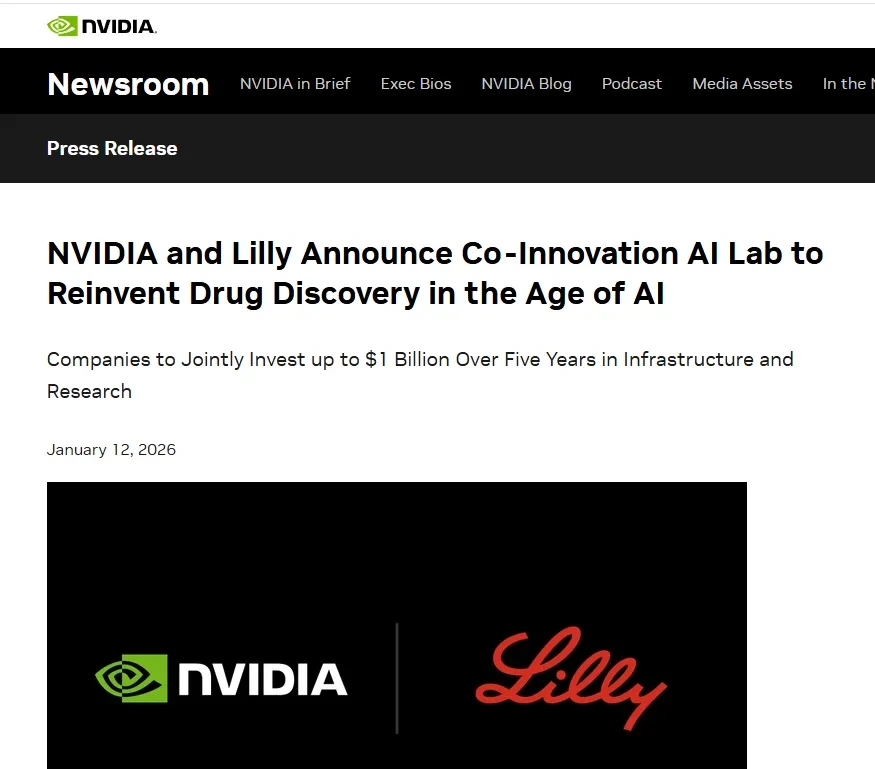
January 12,LillyAnnounced the establishment of an AI Joint Innovation Lab with NVIDIA, planning to jointly invest up to 1 billion US dollars within five years. In terms of R&D, Eli Lilly is rapidly advancing new platforms such as Antibody-Drug Conjugates (ADC), radioligand therapy, siRNA, and gene therapy, aiming to cover the entire value chain from drug discovery to patient support.
In 2023, Eli Lilly authorized the introductionInsilico MedicinePharma.AI Platform, Initiating Its Long-Term Collaboration with Insilico Medicine. By the end of 2025, Eli Lilly announced a further deepening of the partnership, reaching a research and development strategic cooperation agreement totaling over 100 million US dollars with Insilico Medicine, aiming to efficiently integrate the advantages of AI technology with drug R&D experience to accelerate the discovery and development of innovative therapies. Notably, as Insilico Medicine advances towards the largest Biotech IPO on the Hong Kong Stock Exchange in 2025, Eli Lilly has made its first foray as a cornerstone investor in an AI pharmaceutical company, joining top-tier investment institutions such as Tencent, UBS, and Schroders in a total subscription of 115 million US dollars, reflecting multi-dimensional confidence from the capital market.
EngSilicon Intelligence also successively announced the completion of multiple cooperation deals within January 2026:
●On January 5, Insilico Medicine partnered with French pharmaceutical company Servier in a multi-year R&D collaboration worth up to $880 million. Leveraging Insilico Medicine's self-developed artificial intelligence platform Pharma.AI, the collaboration will focus on challenging targets in the oncology field to identify and develop new drugs.
●On January 20, Insilico Medicine and Hengtai Bio jointly announced that they had reached a co-development cooperation agreement for the ISM8969 project. According to the terms of the agreement, Insilico Medicine will grant Hengtai Bio 50% of the rights to research, develop, register, manufacture, and commercialize ISM8969 globally. In addition, Insilico Medicine is entitled to receive upfront and milestone payments totaling over 500 million Hong Kong dollars, including an upfront payment of 78 million Hong Kong dollars expected to be paid within 30 days from the effective date of the agreement.
PfizerAt the JPM conference, it was also announced that its 2026 strategic priorities clearly focus on four aspects: maximizing the value of completed key transactions, delivering core R&D milestones on schedule, continuously investing for growth beyond 2028, andScale AI Applications Across All Business OperationsPfizer revealed that AI has become a key tool for the company to reduce costs, increase efficiency, and permeate the entire chain. By 2026, the company will focus on advancing three major deals: Seagen, Biohaven (NURTEC), and Metsera, to accelerate the development of related products.
AstraZenecaAnnounces the Acquisition of AI Partner Modella AI, Aiming to Apply Multimodal AI Foundation Models and AI Agents Across Its Entire Oncology Portfolio.

Pudong Power: The Global Debut of China's Innovation
At this year's JPM conference, a group of Chinese innovative pharmaceutical companies based in Shanghai's Pudong district made a collective appearance and announced their clinical progress globally. First-in-Class, First-in-China, and First-in-Human advancements are accelerating.
● Zai Lab
Zai LabRevealed that the company's DLL3-targeted ADC drugzoci, has already shown great potential in the treatment of small cell lung cancer (SCLC). It took less than two years from Phase I IND to global pivotal clinical trials. Zoci is currently the fastest progressing DLL3 antibody-drug conjugate (ADC) in Phase III clinical stage. It is planned to initiate three pivotal registrational studies by the end of 2026, including second-line and above small cell lung cancer, first-line small cell lung cancer, and neuroendocrine carcinoma. It is expected to become Zai Lab's first globally launched product in the oncology field.
● GenSci Pharma
Kinsay PharmaceuticalsShared 7 innovative R&D pipelines covering key disease areas such as oncology, respiratory and immunology, endocrinology, and women's health. All are potential First-in-Class (FIC) or Best-in-Class (BIC) innovative molecules. For example, GenSci128, an innovative small molecule drug targeting the TP53 Y220C mutation, has entered the clinical trial stage. TP53 mutations have clear clinical needs in various solid tumors, and currently, there are no approved therapies worldwide targeting this mutation. GenSci128 restores its tumor-suppressing function by specifically binding to the mutant protein, with preclinical studies showing good efficacy and safety.
● Ascentage Pharma
Ascentage PharmaComprehensively showcased the company's milestone progress in product commercialization, global clinical development, innovative pipeline expansion, and capital markets for 2025 at the JPM conference, while also providing an outlook for 2026.
Ascentage Pharma Builds a Broad Global Therapeutic Map Covering the Field of Hematological Tumors Around Two Core Listed Products: Naxitamab® (Third-Generation BCR-ABL Inhibitor Olverembatinib) and Lisoclob® (Bcl-2 Inhibitor Lisocabtagene Maraleucel).
Among them,Lisatochlor, as the first Bcl-2 inhibitor launched in China and the second globally, is also accelerating global clinical development. Four global registrational Phase III clinical trials are currently underway, including the GLORA study for the treatment of relapsed/refractory CLL/SLL patients, which has received approval from the U.S. FDA; the GLORA-2 study for the treatment of previously untreated CLL/SLL patients; the GLORA-3 study for newly diagnosed elderly or frail acute myeloid leukemia (AML) patients; and the GLORA-4 study for newly diagnosed intermediate- to high-risk myelodysplastic syndromes (MDS) patients, which is expected to gain synchronized approvals from the U.S. FDA, European EMA, and China’s CDE by 2025. Notably, in the MDS field, Risentof® is currently the world's only Bcl-2 inhibitor advancing in a registrational Phase III clinical trial for intermediate- to high-risk MDS, with the potential to address an unmet clinical need.
● Henlius
HenliusHenlius Unveils "Globalization 2.0" Strategy and Mid-to-Long Term Innovation Blueprint: Henlius has received approval for 10 products in multiple countries and regions worldwide. By 2030, the company plans to launch over 20 products globally, with more than 15 expected to be marketed in the U.S. and Europe. Moving forward, the company will continue to advance innovative molecules such as ADCs, multi-specific antibodies, and TCEs into clinical trials and commercialization, covering disease areas including oncology, autoimmune disorders, metabolism, and central nervous system conditions.
Moreover, during the JPM period, Henlius announced that Youmai Biologics had signed an exclusive global licensing agreement. According to the agreement, Henlius obtained the exclusive global rights to a monoclonal antibody targeting Interleukin-1 Receptor Accessory Protein (IL-1RAP) with "Best-in-Class" (BIC) potential. This collaboration marks that while Henlius continues to focus on cancer immunotherapy, it is also actively expanding its target layout in the field of immune-inflammatory diseases.
● Kelun-Biotech
Kelon Bio-TechIntroduction, the company already has Sac-TMT (Jia Tai Lai)®`) and Trastuzumab Deruxtecan (Enhertu`®) Two ADC drugs have been launched, covering two major indications: breast cancer and lung cancer; another nine uniquely designed ADC and novel DC drugs are in clinical stages, including cutting-edge directions such as bispecific ADCs and radiopharmaceutical conjugates (RDC). Targeting high-incidence cancers in China such as breast cancer, lung cancer, and gastrointestinal tumors, the company has initiated nine pivotal studies, while multiple Phase II clinical studies for gynecological cancers are also proceeding steadily. Additionally, the company has established several non-DC drug R&D pipelines and further expanded its indications to non-oncology fields.
As multinational giants deepen their technological moats and build foundations through collaboration, accelerate with AI, and navigate cycles with diversified pipelines, Zhangjiang Pharm Valley continues to optimize its industrial ecosystem. This supports innovative pharmaceutical companies in participating in global life science and technology competition through solid R&D and open cooperation.