

Neusoft Chairman and CEO Liu Jiren: Reconstructing Neusoft, Enormous Potential Ahead in Healthcare
Xikang Cloud Hospital
Cloud Hospital Platform Provider
Neusoft
Provider of Connectivity and Software Products and Services

Neusoft
Comprehensive Solution Provider for Clinical Diagnosis and Treatment

Ping An
Integrated Financial Group
Neusoft, China’s first listed software company, has ranked first among China’s medical solution service providers for nine consecutive years, making it the undisputed leader in the field of healthcare informatization in China.
At the recently convened 21st Neusoft Solutions Forum, themed “Empowering the New Economy, Creating New Value,” Dr. Liu Jiren, Chairman and CEO of Neusoft Group, delivered a keynote address titled “The Era of Software Empowerment.” He proposed redefining Neusoft’s new role in this era and articulated the characteristics and value of software in the new age. He also expressed the view that the healthcare sector holds vast potential for future growth. VCBeat (WeChat ID: Vcbeat) conducted an exclusive interview with Dr. Liu Jiren and has summarized his key insights as follows.
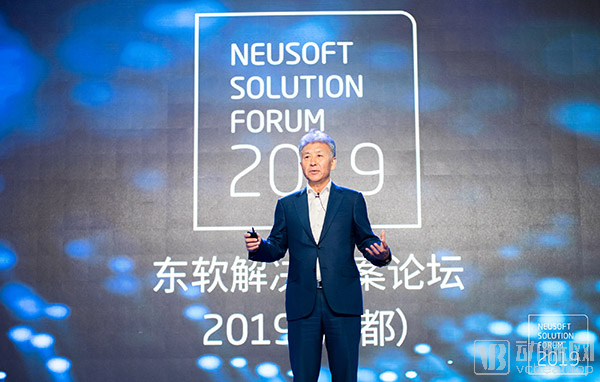
Dr. Liu Jiren, Chairman and CEO of Neusoft Group
Reinventing Neusoft: Creating Value with Software
Neusoft has traversed the software landscape for 28 years, possessing an intimate understanding of its evolutionary trajectory. From its origins as mere technology to products, then to solutions and services, and ultimately to integration, Neusoft has consistently proactively evolved and redefined its role. This instance is no exception; Neusoft intends to leverage this new role to articulate the characteristics and value of software in the new era.
“The Magic of Software” is Neusoft’s new brand slogan. Reinventing Neusoft serves as a specific tactical approach under its strategy of creating value through software. In the healthcare sector, Neusoft and its subsidiaries leverage information technology to promote the harmonious development of the healthcare ecosystem.
In the past, software companies would develop a successful product, achieve strong sales, and then continuously replicate this model. Today, we are in an era of software empowerment, where software can create market value, give rise to new entities, and even generate equity value. Taking Neusoft Xikang as an example, it does not offer traditional software products; it has even obtained more than twenty hospital licenses, functioning more like a new type of medical institution. Its clients include the general public, healthcare professionals, medical institutions, and insurance companies.
With the introduction of artificial intelligence, big data, 5G, online video, and technical platforms, software empowerment is now fully poised for takeoff. “Neusoft today is not merely a pure software technology company, but rather an enterprise that leverages software to empower and create diverse business models,” said Dr. Liu Jiren, expressing his vision for Neusoft in the era of future software empowerment.
Systematic Layout in Healthcare: A Vast Future Horizon
In the healthcare sector, Neusoft has successfully built a comprehensive healthcare ecosystem using software, covering sub-sectors such as the National Health Commission, hospitals, medical insurance, commercial insurance, civil affairs, poverty alleviation, employment, and elderly care. By leveraging technologies such as artificial intelligence, big data, and the Internet of Things (IoT), it integrates and innovates business models. The group’s healthcare landscape is fully composed of various segments, including Neusoft Corporation, Neusoft Wanghai, Neusoft Xikang, Neusoft Medical Systems, Neusoft Hanfeng, Living Space, Rongsheng Insurance, as well as the Neusoft Intelligent Medical Research Institute and the College of Health and Medical Sciences.
Healthcare has never been an isolated sector, with payment mechanisms standing as its most critical issue. Currently, 70–80% of hospital payments in China are covered by medical insurance, making it the primary source of revenue for hospitals. Neusoft holds over 50% of the market share in China’s medical insurance informatization sector, supporting social security services for 700 million people, and is rightly recognized as the leading player in domestic medical insurance informatization.
Furthermore, as a leader in comprehensive smart healthcare solutions for the cloud-intelligence era, Neusoft is committed to helping hospitals build the most powerful “smart brain” and facilitating their digital transformation. Today, leveraging its leading full-stack AI technologies, Neusoft comprehensively empowers hospitals across smart management, smart medical care, and smart services, integrating information technology into all business domains, processes, and operational links of hospital work, thereby continuously enhancing hospitals’ capabilities in service delivery, operational efficiency, quality of care, and discipline development. Meanwhile, targeting primary healthcare institutions, Neusoft has focused on developing its Cloud HIS products and building internet hospitals centered around patient visits and physician services, thus helping hospitals achieve more effective management and operations.
Neusoft has also made strategic moves in the Medical Internet of Things (MIoT). The newly established Neusoft Hanfeng focuses on building MIoT infrastructure, integrating medical application requirements with technologies such as 5G, IoT, and AI. This enables comprehensive connectivity and data acquisition and services for hospital medical equipment, medical staff, patients, and supplies. Based on its IoT platform, the company provides smart service applications for patients, smart healthcare applications for medical personnel, smart management applications for hospital administration, and smart medical consortium applications for regional healthcare networks.
Meanwhile, Neusoft has also made significant strides in its business operations outside mainland China. For instance, Macau’s largest hospital has adopted Neusoft’s next-generation core hospital system solution, which may represent another breakthrough for China’s healthcare software industry.
Driven by the implementation of DRG, Neusoft Wanghai has recently gained significant momentum. Neusoft Wanghai primarily focuses on hospital financial and cost management, covering hospital resources including personnel, finances, and materials.
Through Neusoft Wanghai’s solutions, hospitals can clearly understand their operational costs, even down to the true cost of treating a specific condition. This represents the greatest value and distinguishing feature of Neusoft Wanghai’s business: only by knowing the specific costs of medical care can insurance companies develop and price insurance products, and can health insurance schemes achieve effective cost control.
With the implementation of Diagnosis-Related Group (DRG) bundled payment systems, hospitals will need to adopt refined management practices to achieve profitability and ensure sustainable, stable development. Neusoft Wanghai’s solutions are designed specifically for this purpose. Meanwhile, internal drivers within hospitals will inevitably lead them to prioritize improving patients’ preventive care and rehabilitation outcomes, rather than relying on pharmaceuticals as the primary source of revenue as is currently the case.
Of course, prevention necessarily requires an incentive mechanism. Otherwise, neither individuals nor physicians would have the motivation to engage in it. This creates a significant opportunity for insurance innovation. “Managed care” is an innovative healthcare management model adopted abroad. Insurance companies sell health insurance policies to customers and pay healthcare providers on a per-capita basis. As long as healthcare institutions can effectively manage the health status of these individuals and prevent serious illnesses that would trigger insurance claims, they stand to benefit. In this way, patients achieve better health outcomes, while hospitals and insurance companies both improve their operational efficiency, resulting in a win-win-win situation.
Beyond in-hospital treatment, disease diagnosis and management also necessitate out-of-hospital prevention, primary care, post-discharge nursing, and community-based medical services. Xikang, another independent subsidiary under Neusoft, is an innovative enterprise invested by Neusoft in the fields of health management and internet healthcare. It is dedicated to building a robust cloud hospital platform for primary medical services, supporting medical institutions at all levels in delivering “Internet + Healthcare” services, and creating a new medical service system that is efficient, precise, measurable, and traceable. Currently, the Xikang Cloud Hospital Platform has been launched and is operational in more than 20 cities, connecting over 30,000 medical institutions, 47,000 healthcare professionals, and 50 medical specialties, while serving more than 34 million residents.
Neusoft Medical is a key component of Neusoft’s healthcare portfolio. With over two decades of deep roots in the field of medical imaging equipment, the company has reached a high level of maturity, offering CT, MRI, DSA, digital X-ray systems, PET/CT, radiotherapy equipment, ultrasound, laboratory automation systems, and a wide range of integrated clinical diagnostic and therapeutic solutions.
Currently, Neusoft Medical has launched China’s most advanced 256-slice wide-bore spectral CT and the world’s first trackless ceiling-mounted dual-center seven-axis intelligent angiography system. It has also introduced a new generation of strategic product lines—MDaaS (Medical Devices and Data as a Service). Over the past three years, its CT and MRI export volumes have ranked first in China, with its global market share rising rapidly. Firmly established as an industry leader, Neusoft Medical is a major force among domestically produced high-end large-scale medical equipment.
Particularly in countries and regions along the “Belt and Road” route, Neusoft Medical has expanded rapidly. Over 80% of these countries and regions have adopted Neusoft Medical’s equipment. A prime example is Kenya, where all hospitals utilize Neusoft Medical’s devices and its Imaging Cloud products.
To some extent, as a “national team” member, Neusoft Medical carries the dream of China’s medical device industry to become a global powerhouse.
In 2014, Hony Capital and Goldman Sachs jointly invested RMB 3.7 billion in Neusoft Medical Systems and Neusoft Xikang, setting a record at the time for the largest single financing round in China’s medical equipment and internet healthcare sectors. Since then, Neusoft’s series of innovative businesses—including Neusoft Medical Systems, Neusoft Xikang, Neusoft Wanghai, and Neusoft Reach—have secured over RMB 8.1 billion in total external investment. Investors include industry giants such as Ping An, Taikang, PICC, Goldman Sachs, and Hony Capital. In the coming years, these subsidiaries are expected to enter the capital market one after another.
At that time, Neusoft’s competitive advantage will become even more pronounced, having completed its strategic layout across multiple sectors.
Therefore, Neusoft has made substantial investments and strategic arrangements in connectivity within healthcare informatics. This connectivity encompasses building links among people, organizations, and systems; fostering connections across scenarios, business operations, and ecosystems; and integrating management, clinical care, and services. In fact, given Neusoft’s already comprehensive presence in the healthcare sector, these investments represent new directions within its internal systems, effectively covering all major domains of healthcare.
Dr. Liu Jiren believes that China will become one of the best places for health innovation worldwide in the future. This is due to its large population, mid-level economic development, vast territory, and significant disparities in healthcare across different regions. Medical technologies such as telemedicine, artificial intelligence, and big data are currently in utmost demand.
“We are highly optimistic about the healthcare sector. At present, if we consider which field offers safer, more reliable, and more sustainable long-term investment opportunities, I believe it is healthcare.” He expressed strong confidence in the future growth potential of the medical industry.
Neusoft and Baidu Join Forces to Build a New Type of Smart City
On the day of the Neusoft Solutions Forum, Neusoft and Baidu jointly released the “Cloud Intelligence Future City” comprehensive solution for new-type smart cities. This marks the first official launch of a holistic smart city solution by the two parties since they signed a strategic cooperation agreement in May this year.
The “Cloud Intelligence Future City” holistic smart city solution advocates the philosophy of “people-centric, cloud-intelligence enabled.” Both parties will establish an intelligent foundation based on the triad of “artificial intelligence, big data, and cloud computing,” leverage technologies such as the Internet of Things (IoT), edge computing, and 5G, and capitalize on the architectural advantages of “ABC+X” to build a leading digital twin city. By sharing city-level data resources and implementing one horizontal Urban Operations Management Center alongside ten vertical applications in key sectors, the solution provides robust support for government decision-making, public services, and industrial development. Leveraging the digital twin city, it achieves intelligent urban planning, construction, governance, and services, thereby enabling ubiquitous citizen-centric services, a transparent and efficient online government, precise and refined urban governance, a secure and reliable operational system, and an integrated, innovative digital economy.
Dr. Liu Jiren stated that Neusoft and Baidu will jointly promote the implementation of artificial intelligence (AI) in key sectors such as smart cities and healthcare, as well as innovate business models. Leveraging their leading AI technologies and profound industry expertise, the two parties will achieve complementary advantages, set a benchmark for the deep integration of AI with modern advantageous industries, and accelerate the deployment of AI and the intelligent upgrading of industries. The partnership with Baidu also marks a significant leap for Neusoft, transforming it from a provider of smart city solutions into a smart city operator.
To date, Neusoft has participated in the development of smart applications for more than 20 national ministries and commissions and over 200 central cities, accumulating vast amounts of business data and extensive industry expertise.
It comes as no surprise that Neusoft and Baidu have joined forces to build a shared ecosystem. Prior to this, Tencent and Alibaba, two of the “BAT” tech giants, had already formed strategic alliances with traditional software powerhouses: Tencent partnered with DHC Software, while Alibaba collaborated with ZTE Soft to co-develop their ecosystems. Through such alliances, internet giants and software leaders can leverage each other’s strengths while mitigating weaknesses. Undoubtedly, this will become a prevailing trend in the future.
Emerging technologies such as blockchain and 5G will help China establish its innovation capabilities on the global stage.
When discussing emerging technologies, Dr. Liu Jiren believes that blockchain has vast application scenarios, particularly playing a pivotal role in supporting trust mechanisms. In this context, the healthcare sector is a key direction for the practical implementation of Neusoft’s blockchain applications. Much of the data in the healthcare field, including personal health records and medical cases, demands extremely high security and must be tamper-proof. Especially when such data needs to be utilized and transmitted, it is essential to ensure more credible record-keeping.
Neusoft has maintained its research on blockchain and established a Blockchain Research Institute to explore the integration of blockchain technology into solutions and applications. Currently, several practical applications within Neusoft’s digital health sector have begun adopting blockchain technology.
Another noteworthy new technology is 5G. With its rapid response and computing capabilities, 5G enables applications such as virtual reality and remote medical diagnosis, opening up vast possibilities for innovation. Remote color Doppler ultrasound diagnosis is one practical application of 5G technology.
Neusoft has implemented remote color Doppler ultrasound diagnosis in Ningbo. Unlike CT scans, the quality of color Doppler ultrasound diagnosis depends on the operator’s technique. Through 5G-enabled remote operation, experts can conduct remote consultations and operate the equipment even in primary healthcare institutions where staff may lack experience. Meanwhile, remote surgery combining 5G with surgical robots is currently a key focus of industry research and development. Therefore, 5G is expected to have extensive applications in the medical field in the future.
Regarding new technologies, Dr. Liu Jiren further believes that the development of 5G, the internet, the digital economy, and even blockchain will be a crucial factor in establishing China’s innovation capabilities in the next round of global competition.
Take Neusoft’s development of China’s first domestically produced CT scanner as an example. CT scanning acquires the necessary imaging information of the body and rapidly generates images, a process that requires array processors with high computational power. At that time, such chips were under export ban to China.
Neusoft approached the challenge from a software perspective, enhancing efficiency and speed to enable CT systems to leverage commercially available PCs for computation, replacing expensive array processors. This innovation marked a new transformation in international CT technology, making Neusoft the world’s first company to use PCs for CT imaging. Since then, foreign CT manufacturers have also phased out costly array processors in favor of more cost-effective PC-based solutions.
Therefore, Dr. Liu Jiren believes that new technologies present an excellent opportunity for China’s development. Underpinning this opportunity is large-scale computing, encompassing computational power, algorithms, and massive amounts of data. Unlike in foreign countries, China has legal protections regarding data sensitivity, while placing relatively less emphasis on individual privacy. Consequently, the ecosystem for the application of new technologies in China ranks among the top globally.
In Conclusion
From its humble beginnings at its founding in 1991, Neusoft has grown into an industry giant, moving ever closer to Dr. Liu Jiren’s original vision of “building a company like Microsoft.” Maintaining vigilance in times of stability and proactively embracing change, while adhering to the core principle that everything revolves around software technology, have been key factors in Neusoft’s success.
As a traditional software enterprise, Neusoft is now proactively embracing the current era by proposing a transformation from a pure technology company to one that creates value through software. It aims to adopt more agile and innovative approaches, remain more customer-centric, and leverage software to help individuals, enterprises, and numerous industries navigate the upgrades brought by the Internet of Everything (IoE) era.
In two more years, Neusoft will also reach its thirtieth anniversary. For the software industry, where the average lifespan is only 7–8 years, Neusoft has already become an industry benchmark. What fruitful results will the restructured Neusoft yield by then? Let us wait and see.