

Portable Ultrasound Pain Relief Device Emerges as a New Growth Driver in the Booming $100B+ Home Medical Device Market
According toAccording to Wind data, the global market size for home medical devices was $26.2 billion (approximately RMB 174 billion) in 2016, with a compound annual growth rate (CAGR) of 6.33% from 2012 to 2016. The home medical device market in China has experienced rapid growth, achieving a CAGR of 22.21% during the same period.
The output value of home-use medical devices in Europe and the United States has exceeded US$26 billion, with an annual growth rate of over 16%, making it one of the fastest-growing industries in the next decade. In China, however, home-use medical devices account for less than 11% of the total output value of the medical device industry, indicating substantial market potential.
Driven by an accelerating aging population, a rising number of patients with chronic diseases, growing household consumption levels, shifts in consumption patterns, and the continuous improvement of the tiered healthcare system, the home medical device market has experienced sustained growth amid numerous favorable factors.
Home medical devices are experiencing a period of vigorous growth. However, due to the low technological barriers in this sector, China’s home medical device industry is highly fragmented, with severe product homogenization and limited market potential for individual products.
In the home-use medical device market, traditional categories such as blood glucose meters, blood pressure monitors, and massagers have become highly saturated red oceans, whereas emerging categories of home-use medical devices warrant greater attention.
Judging by international development trends, devices such as coagulation monitoring systems, home dialysis equipment, and sleep apnea monitors have already achieved significant market scale abroad, whereas these sectors remain either untapped or in their nascent stages in China.
In China, VCBeat (WeChat ID: vcbeat) has learned that at Chongqing University of Posts and Telecommunications, the R&D team led by Professor Pang Yu from the School of Optoelectronic Engineering has also been focusing on the development of home-use medical devices for many years.
As early as 2013, Professor Pang Yu was optimistic about the home medical device market and developed a basal body temperature tester with an accuracy of 0.03 degrees Celsius.
In 2016, Professor Pang Yu’s team began developing a wearable ultrasonic analgesic device. Leveraging the mechanical, thermal, and physicochemical effects of ultrasound, this device alleviates local swelling and pain caused by cumulative strain, as well as pathological pain, by miniaturizing large-scale ultrasonic therapy equipment into a compact, home-use product. This August, the portable ultrasonic analgesic device was showcased at the Smart China Expo, attracting numerous attendees for on-site trials.
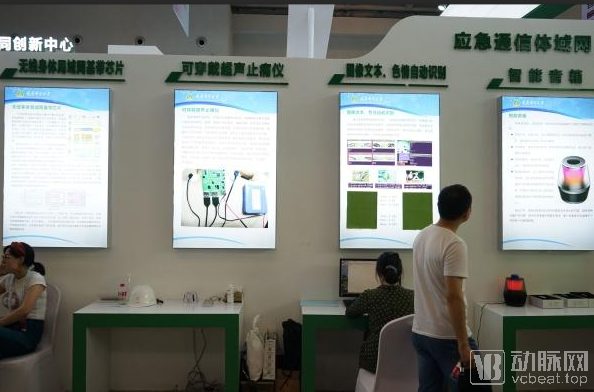
Wearable Ultrasound Pain Relief Device Showcased at Smart China Expo
Professor Pang Yu established the Chongqing Key Laboratory of Optoelectronic Information Sensing and Transmission Technology and the Chongqing Innovation Team for Smart Healthcare Systems and Harmony Technology.
Prior to focusing on the research and development of home-use medical devices, Professor Pang Yu participated in the R&D of multiple large-scale medical devices. He collaborated with Chongqing Shanwaishan Company to develop a series of blood purification products, achieving breakthroughs in the development of key components such as blood leak sensors, ceramic pumps, and conductivity sensor assemblies, thereby breaking the monopoly held by imported equipment.
Professor Pang Yu has also collaborated with Chongqing Xishan Technology to conduct specialized research, achieving significant breakthroughs in high-speed micro-motor drive control, high-speed grinding handpiece design, precision instrument development, and overall system intelligence. The successfully developed DK series of surgical power tools has become a leading brand for bone tissue surgical power systems in China.
When asked why he developed a portable ultrasound analgesic device, Professor Pang Yu smiled and said that it was actually related to the damp and cold weather in Chongqing.
Professor Pang Yu stated, “In the Chongqing-Guizhou region, the winter climate is extremely damp and cold, causing many people to experience joint pain during this season. However, in terms of medical devices for pain relief, there is a lack of specialized home-use equipment with significant efficacy. In physics, five modalities—sound, light, electricity, magnetism, and heat—can be applied to the human body. Currently, most analgesic products on the market rely on electricity, magnetism, and heat, while devices utilizing ultrasound therapy are relatively scarce.”
Ultrasound exhibits mechanical, thermal, and physicochemical effects. The thermal effect refers to the absorption characteristics of biological tissues, whereby a portion of the ultrasound energy is converted into heat. After being absorbed by the target tissue, the resulting rapid temperature rise can produce a pronounced thermal effect. The mechanical effect involves the vibrational energy of ultrasound inducing certain material movements within human cells; this effect causes intracellular friction, manifested as mutual friction and collision among tissue cells.
Meanwhile, ultrasound also exhibits functions such as the diffusion effect, thixotropic effect, cavitation effect, energy focusing, and anti-inflammatory cellular repair.
Based on current trials, the portable ultrasound analgesic device can alleviate local swelling and pain caused by cumulative strain. It relieves muscle spasms, reduces adhesions of tendons and ligaments resulting from aseptic inflammation, promotes the repair of ruptured muscle fibers, facilitates the regeneration of damaged articular cartilage and bone, alleviates joint mobility impairments, and inhibits the progression of osteoarthritis.
Clinically, ultrasound-based pain relief has already been widely adopted. However, the products currently used in hospitals feature relatively high power output and require administration under the guidance of qualified medical professionals.
By successfully achieving the miniaturization and portability of ultrasonic therapeutic devices, enabling low-power supplies to generate ultrasound, Professor Pang Yu’s team made key breakthroughs in ultrasonic frequency generation, circuit design, and control software development.
Currently, Professor Pang Yu’s team has completed the development of the prototype and will gradually commence clinical trials in the next phase.
Professor Pang Yu revealed that there is also a portable ultrasound analgesic device on the U.S. market, but it is primarily intended for treating athletes and is not suitable as a multi-scenario home-use product. To broaden the target population and expand the range of treatable conditions, Professor Pang Yu’s team designed an ultrasound analgesic device with lower frequency, more adjustable power levels, and longer battery life.
The wearable ultrasound analgesia device developed by Professor Pang Yu’s team, as a low-cost rehabilitation and physical therapy equipment, can be widely used in various settings such as homes, hospitals, beauty salons, and massage parlors.
Within the R&D team for the ultrasonic analgesic device, Professor Pang Yu earned his Ph.D. from McGill University in Canada. Dr. Liu Ting graduated from the University of Nancy in France and has been engaged in development work related to circuit design and biometric technology in Canada. Liu Wei, another member of the team, has long been dedicated to the development of ultrasonic medical equipment, participating in the R&D of various medical devices such as the High-Intensity Focused Ultrasound (HIFU) surgical scalpel and the Ashi Ultrasonic Therapist.
Why is Professor Pang Yu optimistic about the future of ultrasonic analgesic devices? He stated, “The ultrasonic analgesic device is a product that directly addresses users’ pain points. The need for pain relief can be quickly recognized by patients, so it does not require extensive market education.”
Professor Pang Yu believes that, relative to product performance, the level of market education sometimes determines a product’s lifespan.
Take, for example, the basal thermometer developed by Professor Pang Yu in 2013. Basal body temperature refers to the body’s temperature in a “basal state,” defined as a condition in which an individual is awake yet completely at rest, unaffected by factors such as muscle activity, mental stress, food intake, or ambient temperature.
The 2012 WHO handbook on the calendar method of contraception mentions that basal body temperature—the body temperature of women of reproductive age at rest—rises slightly after ovulation and remains elevated until the onset of the next menstrual period.
Basal body temperature is crucial for women's health monitoring, especially for those with infertility; however, its fluctuations typically range from 0.2 to 0.5°C.
As early as 2013, Professor Pang Yu developed a basal body temperature thermometer with a measurement accuracy of up to 0.01 degrees Celsius. The device, comparable in size to a car key fob, was paired with a mobile app featuring data analysis and recording capabilities. However, sales performance was poor after its market launch, as awareness of basal body temperature remained limited among consumers in 2013.
As a team with robust R&D capabilities, Professor Pang Yu also seeks to collaborate with enterprises that possess comprehensive sales channels to industrialize the ultrasound pain relief device, thereby benefiting more patients.
Those interested in the company, please contact the financing assistant Xiao Yun: DongMai_Investent