

WeDoctor's Liao Jieyuan: Digital Health Poised to Become a Trillion-Dollar Industrial Internet Opportunity
Imbalanced allocation of medical resources, persistently inflated drug prices, and long-term pressure on medical insurance funds… China’s healthcare reform has reached a critical juncture where change is imperative. From the establishment of the National Healthcare Security Administration to centralized drug procurement and payment method reforms, and further to the Healthy China Initiative, this new round of healthcare reform, which began a decade ago, saw unprecedented strategic stakes placed in 2019. Meanwhile, a landscape of industry innovation driven by digitalization is set to emerge in 2020.
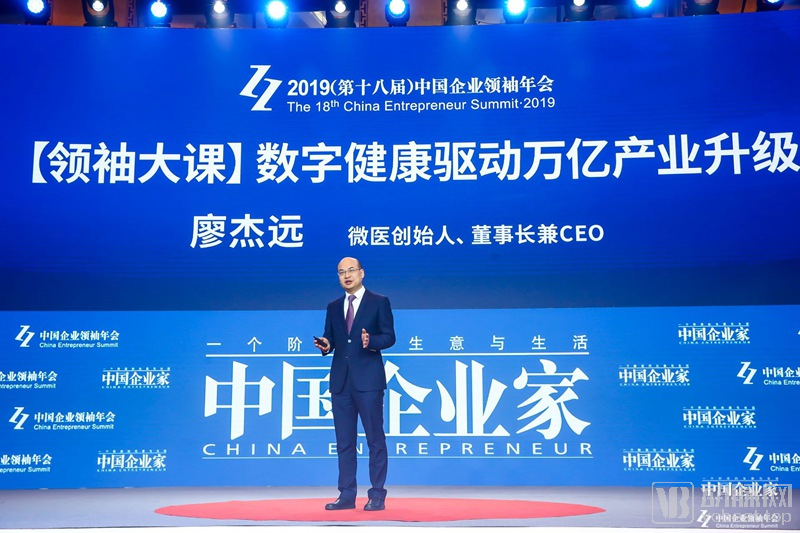
Industry players deeply immersed in the sector presented a comprehensive vision of this reform at an industry conference. Held from December 8 to 9 in Beijing, the 2019 China Entrepreneur Leaders Annual Conference was hosted by Chinese Entrepreneurs magazine. Over a hundred industry leaders, including Dong Mingzhu, Chairwoman of Gree Electric Appliances; Zong Qinghou, Chairman of Wahaha Group; and Wang Shi, Founder of Vanke, shared insights and engaged in discussions centered on “New Era, New Technologies, New Models.” Liao Jieyuan, Chairman and CEO of WeDoctor Group, was invited to deliver a lecture to the attending entrepreneurs, sharing innovative practices outlined in his presentation, “Digitalization-Driven New Healthcare Reform in China.”
Amid vigorous efforts to advance the “Healthy China” initiative, the era’s demand for a “health-centric” approach harbors immense opportunities. Chen Dongsheng, founder of Taikang Insurance Group, posits that the big health industry will become one of China’s fastest-growing sectors and evolve into a pillar industry on a scale surpassing even real estate and automotive. He Zhenhong, President of Chinese Entrepreneur magazine, argues that the intelligent era calls for hyper-connectivity, with large corporations serving as industrial platforms and smaller companies driving hard-core innovation in vertical niches.
Not long ago, the World Health Organization consolidated concepts such as health informatics, telemedicine, and digital healthcare into “digital health,” providing an unprecedented definition of the term. The WHO posits that digital health will upgrade the entire process of diagnosis, treatment, and health insurance, and released the Global Strategy on Digital Health 2020–2024.
In Liao Jieyuan’s view, the broadest track in the future industrial internet sector is digital health. He stated that digitalization typically reshapes an industry by reconstructing its existing ecosystem and service chain. During the consumer internet era, Alibaba remains the only digital platform in China to have achieved annual gross merchandise volume (GMV) exceeding RMB 1 trillion. The annual transaction scale of China’s pharmaceutical distribution market alone has surpassed RMB 2.2 trillion and continues to grow rapidly. This suggests that, in the era of the industrial internet, China’s second digital trading platform to surpass the RMB 1 trillion mark may well emerge in the healthcare and medical sector.
In his presentation, Liao Jieyuan introduced to the guests the three phases of the new round of healthcare reform objectives. The first phase involves reducing artificially high drug prices in pharmaceutical distribution through joint procurement of drugs and medical consumables. The second phase focuses on implementing tiered diagnosis and treatment to address the imbalance in the allocation of medical resources. The third phase aims to genuinely shift the focus from disease-centered care to health-centered care.
“Digital platforms have played a significant role in driving the coordinated reform of medical care, health insurance, and pharmaceuticals.” Liao Jieyuan introduced that, taking drug price reduction as an example, Sanming took the lead in China in implementing centralized procurement of drugs and medical consumables through the Haixi Pharmaceutical Trading Center, a digital platform. Over seven years, this initiative saved RMB 7.36 billion in expenditures on drugs and medical consumables, with the transaction volume on the Haixi platform exceeding RMB 100 billion in November 2019 alone. Recently, the central government issued a document requiring all provinces to promote the “Sanming experience.” In April this year, the Haixi Pharmaceutical Trading Center, under Weiyi (Micro Medical Group), was commissioned by the National Healthcare Security Administration to build a national subsystem for the tendering, procurement, and management of drugs and medical consumables. Building upon the Sanming model, this initiative aims to establish regional drug procurement platforms to achieve joint procurement, price negotiation, trading, settlement, and supervision, thereby further reducing procurement prices. Once operational, this platform is expected to save at least RMB 600 billion in fiscal expenditures annually.
WeDoctor established China’s first internet hospital, pioneering the integration of online and offline medical services through internet technology. This initiative created a new business model for internet hospitals and facilitated the implementation of tiered diagnosis and treatment systems via digital support. Furthermore, by leveraging intelligence technologies, WeDoctor, in collaboration with the Harvard T.H. Chan School of Public Health and Zhejiang University’s Ruiyi Medical Center, launched the “21st Century Barefoot Doctor” program. This initiative outputs standardized diagnostic and treatment pathways for common diseases and provides various AI-assisted diagnostic systems for both general practice and specialized care. These efforts focus on supply-side reforms to enhance primary healthcare capabilities.
In the transition from a “healthcare-centric” to a “health-centric” model, WeDoctor assists cities in building healthy cities by integrating data across medical care, pharmaceuticals, health insurance, preventive services, and elderly care through its underlying cloud platform, with a health portal at the top. These seven business systems are implemented city by city, truly establishing a healthcare maintenance system oriented toward health outcomes. “We call this the Health Community Consortium (Jian Gong Ti), which has become version 3.0 of China’s national healthcare reform. The goals of the Health Community Consortium are straightforward: improve the population’s health status, enhance healthcare efficiency, and curb the growth rates of fiscal spending and health insurance expenditures.”
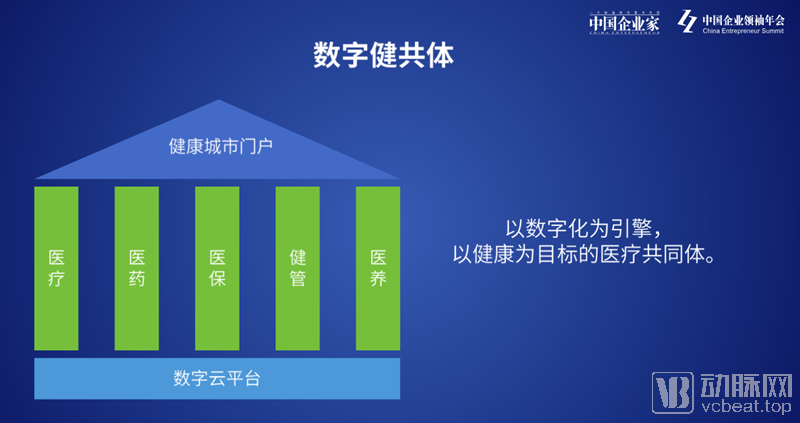
Currently, WeDoctor has assisted more than ten prefecture-level cities, including Tianjin, Pingdingshan, Sanming, Nanping, Longyan, Tai’an, and Dezhou, in building digital health communities, covering a population of over 25 million.
At the conference, WeDoctor unveiled its “Healthy City Partner” initiative for the first time. Moving forward, WeDoctor will open up its digital capabilities and closed-loop operational expertise in end-to-end service systems, collaborating with health partners to create industry demonstrations of digital transformation and advance the Healthy China strategy.