

FTC2019: How Can Only 200,000 Surgeries Meet National Demand? An Authoritative Forum on the Future of Cardiac Surgery in China
2019On November 9–10, 2019, the inaugural FTC China Forum on Frontier Technologies in Cardiac Surgery was held in Beijing. The event was hosted by the Cardiac Surgery Professional Committee of the China Medical Education Association and the Cardiovascular Surgery Technology and Engineering Branch of the China Medical Biotechnology Association, co-organized by Da Yisheng Bingqipu, and undertaken by VCBeat.
This forum brings together top cardiac surgery experts from Beijing Anzhen Hospital, The University of Texas MD Anderson Cancer Center, West China Hospital, Wuhan Asia Heart Hospital, and Xijing Hospital. It also invites distinguished guests from the investment community, industry, and research institutions to jointly discuss the development history, current status, and future trends of cardiac surgery in China. VCBeat has compiled the interviews and speeches of the conference participants. Due to the extensive content of this article, we have summarized the key points below in chapter order, allowing readers to select sections of interest.
1. The Sun Procedure's innovation has solved the challenge of treating aortic dissection;
2. Release of expert consensus to extend the benefits of standardized cardiac surgical procedures to more patients;
3. The standardized development of cardiac surgery departments at the primary care level is helping grassroots hospitals establish diagnostic and treatment capabilities in cardiac surgery, thereby retaining patients within their local regions;
4. Technology-driven disruptive transformations in cardiac surgery treatment modalities; minimally invasive interventions, heart failure therapies, and the personalized development of cardiac surgery subspecialties will become the mainstream in the future
The following is the main content:
Cardiac surgery is a game for the brave. From surgeon C. Walton Lillehei, who performed open-heart surgeries using cross-circulation in humans, to the daring urologist who inserted a urinary catheter into his own vein and threaded it directly into his heart, these pioneers have continuously challenged human understanding while driving progress in cardiac surgery. Fortunately, China also has such a group of fearless physicians who, with their experience and wisdom, are changing the rhythm of life for those in need.
In 1996, Professor Sun Lizhong of Beijing Anzhen Hospital introduced the foreign aortic elephant trunk procedure. Building on this foundation, he pioneered the aortic arch replacement combined with stented elephant trunk implantation in 2003, known as the Sun’s Procedure. This technique employs a specially designed stent-graft and delivery system, leveraging the self-expanding properties of the stent to seal the intimal tear and reconstruct the aorta for the treatment of patients with acute Stanford type A aortic dissection.
Aortic Dissection (AD) is a catastrophic cardiovascular condition in which blood from the aortic lumen enters the aortic wall through an intimal tear, forming a dissecting hematoma within the medial layer of the aortic wall and extending along the longitudinal axis of the aorta. As the main trunk vessel of the body, the aorta withstands pressure generated by cardiac contractions and carries a substantial blood volume; consequently, once an intimal tear occurs, the risk of aortic rupture is significantly elevated, resulting in extremely high patient mortality.
Clinically, aortic dissection is classified into type A (all dissections involving the ascending aorta, regardless of the origin site) and type B (all dissections not involving the ascending aorta) based on the location of the proximal intimal tear. The Sun’s procedure is specifically applied in the treatment of type A aortic dissection. In 2011, *Circulation* (IF=23.054), a top-tier international medical journal, published online the latest research findings on the Sun’s procedure for treating type A aortic dissection, demonstrating the superiority of combining surgical and interventional approaches while avoiding the weaknesses associated with either method alone.
At the FTC Conference, cardiac surgery experts including Sun Lizhong, Incoming Chairman of the Thoracic and Cardiovascular Surgery Branch of the Chinese Medical Association and Director of the Heart and Great Vessels Center at Beijing Anzhen Hospital; Zhu Junming, Professor at the Heart and Great Vessels Center, Beijing Anzhen Hospital; Zheng Jun, Deputy Chairman and Secretary-General of the Cardiac Surgery Professional Committee of the China Medicine Education Association and Professor at the Heart and Great Vessels Center, Beijing Anzhen Hospital; and Xu Shangdong, Secretary-General of the Cardiovascular Surgical Technology and Engineering Branch of the China Medical Biotechnology Association, jointly released China’s first “Expert Consensus on Surgical Techniques for Aortic Surgery.”
Secretary-General Xu Shangdong stated that the development of the "Expert Consensus on Surgical Techniques for Aortic Surgery" aims to systematically summarize preoperative procedural experiences in a concise and vivid manner, and to rapidly promote the widespread adoption of aortic surgery. This initiative seeks to enable more surgeons to perform this common cardiac surgical procedure, thereby benefiting a greater number of patients.
“Cardiac surgery practice in China is characterized by significant disparities across regions and hospitals. While some hospitals perform more than 10,000 procedures annually, over half of the hospitals conduct fewer than 100 cases per year,” emphasized Secretary-General Xu Shangdong.
In terms of the total number of surgeries performed nationwide in 2018, valvular heart disease (approximately 69,000 cases), coronary artery disease (approximately 45,000 cases), congenital heart disease (approximately 78,000 cases), and aortic diseases (approximately 23,000 cases) were the primary conditions treated in cardiac surgery. Among these, aortic disease surgeries exhibited the most significant growth trend among all cardiac surgical procedures. However, the majority of aortic surgeries in China were concentrated in major hospitals in cities such as Beijing (17%), Wuhan (10%), and Shanghai (8%).
In fact, since its inception, cardiac surgery has remained the crown jewel of human surgical medicine. More than a century ago, Theodor Billroth, the father of modern gastrointestinal surgery in Austria, asserted that “anyone who attempts to perform heart surgery will inevitably suffer ruin and disgrace.” Today, more than one hundred years later, although technologies such as cardiopulmonary bypass, minimally invasive interventions, and artificial kinetic devices have removed the heart from the realm of surgical no-go zones, cardiac surgery remains a frontier many hospitals are reluctant to venture into. Since 2012, the number of medical institutions in China performing cardiac surgery has shown a year-on-year decline.
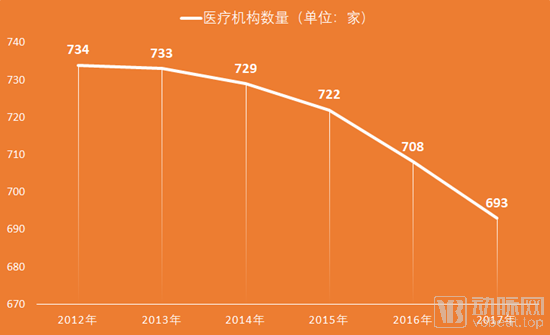
Number of Medical Institutions Performing Cardiac Surgery Nationwide in China, 2012–2017
Among nearly 700 hospitals with cardiac surgery departments, only slightly more than 20 perform over 1,000 procedures annually, and fewer than 100 hospitals reach an annual volume of 300 cases. In an interview with VCBeat, Director Sun Lizhong stated that due to the high technical difficulty, substantial equipment investment, and scarcity of discipline leaders in cardiac surgery, many hospitals have chosen to forgo this specialty. However, the proficiency level in cardiac surgery not only reflects a hospital’s comprehensive strength but also continuously enhances the collaborative capabilities of the hospital and its physicians. “Cardiac surgery spans multiple specialties, including critical care, anesthesiology, and extracorporeal circulation. Strengthening cardiac surgery will provide robust support for the development of cardiology and anesthesiology.”
Under the tiered diagnosis and treatment system, many cardiac surgeons in core cities voluntarily travel to second- and third-tier cities during their off-hours to perform surgeries. Director Sun Lizhong believes that this trend brings tangible benefits to patients. On one hand, medical expenses incurred by receiving local treatment can be conveniently reimbursed through medical insurance, thereby reducing the financial burden on patients. On the other hand, reduced long-distance travel leads to higher patient adherence to treatment plans.
Therefore, the Chinese Society of Thoracic and Cardiovascular Surgery (CSTCVS) of the Chinese Medical Association, in collaboration with the Cardiac Surgery Professional Committee of the China Medical Education Association—where Director Sun Lizhong serves—has spearheaded the “Systematic Project for Standardized Development of Cardiac Surgery in China.” This initiative continuously supports training for primary care physicians and strengthens grassroots thoracic and cardiovascular surgery infrastructure, while enhancing practical capabilities in cardiac surgery at the primary level and facilitating an exchange platform for clinicians and medical device R&D professionals.
“The greatest challenge lies in talent.” In recent years, Professor Zheng Jun has been assisting grassroots hospitals in establishing cardiac surgery departments. When a hospital launches a new cardiac surgery department, the first priority is to appoint a disciplinary leader. Due to variations across regions and institutions, such leaders must be cultivated internally. It takes more than a decade of accumulated experience—progressing from imitation to deep understanding—for physicians to mature into competent cardiac surgeons capable of meeting clinical demands. “The successful models of cardiac surgery cannot be directly replicated, which constitutes a major bottleneck hindering the development of cardiac surgery at the grassroots level,” pointed out Professor Zheng Jun. “Modern cardiac surgery development should embody several key principles: efficiency, standardization, compliance, and resource integration.”
At the FTC 2019 Forum, Professor Zheng Jun delivered a presentation titled “Methodology for Rapidly Establishing a Cardiac Surgery Department,” sharing his team’s development experience over the past several years.
First, conduct development positioning analysis and discipline capability assessment. Benchmark against external competitors and internal conditions, carry out on-site operational surveys at the hospital, and formulate and design an overall strategic map guided by disciplinary development. Second, build brand and influence, primarily through the accreditation of expert workstations, association endorsements, and regional center certifications. Third, employ systems engineering methodologies to develop planning. The team will assist grassroots hospitals in analyzing the rationality of their current talent pipeline structure for disciplinary development, evaluating the completeness of hardware configurations, and refining subspecialty development plans.
The final and most critical component is the continuous implementation of talent training programs, the advancement of referral systems with partner and subordinate hospitals, and the provision of expert outreach and support for key out-of-hospital cases. By leveraging professional publicity through leading national healthcare media outlets, the hospital aims to enhance its reputation and that of its medical disciplines.
Professor Zheng Jun emphasized that the development of cardiac surgery departments requires years of support and cannot rapidly reach a high level. “This is akin to starting a business; one must be mentally prepared for three to five years of sustained, arduous effort, and have material resources secured to provide support for five to eight years.”
In terms of specific talent development, Director Zheng Jun believes that, on the one hand, emphasis should be placed on cultivating clinical reasoning in surgeons by establishing connections between relevant knowledge points in cardiac surgery and modes of thinking; on the other hand, surgical mindset should be emphasized, enabling surgeons to anticipate the outcomes associated with different surgical approaches. “Not all cardiac surgeries can be performed using a single, standardized method.”
To date, Professor Zheng Jun’s team has assisted numerous hospitals, spanning county-level and municipal institutions, as well as public and private facilities, with varying levels of existing infrastructure—including those starting from scratch. “Our methodology enables hospitals to establish a cardiac surgery department from the ground up within eight months and accelerates the professional development of young physicians,” stated Director Zheng Jun.
FTC2019At the forum, Professor Cao Yong of the Department of Cardiovascular Surgery at Gaozhou People's Hospital, Mr. Lv Jinhan, President of Ningxia Hui Autonomous Region People's Hospital, and Ms. Xue Peili, Party Secretary of Sichuan Science City Hospital, shared their experiences in the development and growth of their cardiovascular surgery departments.
Professor Sun Lizhong pointed out that it is the product itself, rather than technology, that serves as the primary driver of disruptive transformation in cardiac surgery. As disease profiles and patient age demographics evolve, cardiac surgery teams must not only strengthen grassroots healthcare capabilities but also pursue continuous professional development, constantly innovating their methodologies in response to clinical needs.
During the FTC2019 Forum, the award ceremony for the “Top 10 Cardiovascular Technology Innovation Cases in China (2019)” was grandly held. Representatives from the ten winning cases—Jiecheng Medical, Jinkui Medical/Wuhan Asia Heart Hospital, Jian Shi Biotechnology, the Seventh Medical Center of the PLA General Hospital/Beijing Chaoyang Hospital of Integrated Traditional Chinese and Western Medicine for Emergency and Critical Care, Weimai Medical, Bioptimal Life Sciences, Maibo Medical/The Tenth People’s Hospital Affiliated to Tongji University, Beijing Anzhen Hospital Affiliated to Capital Medical University, Linyi People’s Hospital of Shandong Province, and People’s Hospital of Ningxia Hui Autonomous Region—attended the event to receive their awards.
The ten award-winning cases were selected by 23 industry experts over a two-month period from 44 innovative cases submitted across 15 provinces and municipalities, including Beijing, Shanghai, and Jiangsu. These cases signify that China’s cardiovascular field has entered a new phase of innovation, with established channels for seamless translation and integration between academia and industry.
In his lecture titled “Industry Development Trends in Cardiovascular Surgery,” Director Sun Lizhong pointed out that minimally invasive surgery, surgical treatment of heart failure, and the “intensive” growth of various subspecialties will become focal points for the development of cardiac surgery in the coming period.
Minimally Invasive Therapy Emerges as a New Trend in Clinical Cardiac Surgery Practice
Minimally invasive therapies involve interventional valves, small-incision procedures, and thoracoscopy, all of which are on a fast track of development.
Currently, transcatheter heart valves have become the most highly scrutinized segment in the innovation of high-value consumables among domestically produced medical devices. In the 1990s, transcatheter aortic valve implantation (TAVI) emerged as an alternative therapy for patients with surgical contraindications and those at intermediate to high risk. Since then, innovative domestic biotechnology enterprises have invested heavily in the research and development of biological transcatheter heart valves. Products independently developed by companies such as Hangzhou Qiming, Suzhou Jiecheng, Shanghai MicroPort, and Suzhou Jiapei have improved patient prognoses after entering clinical use. Furthermore, Professor Lu Fanglin from Xu Zhiyun’s innovative team in the Department of Cardiovascular Surgery at Changhai Hospital Affiliated to Naval Medical University, in collaboration with Ningbo Jian Shi Biotech, developed the world’s first transcatheter artificial tricuspid valve. In clinical practice, this device has successfully treated three patients suffering from severe tricuspid regurgitation complicated by right heart failure.
In recent years, minimally invasive thoracoscopic techniques have gradually gained widespread clinical adoption. At the FTC 2019 Forum, Professor Xu Xuezeng, a cardiac surgeon at Xijing Hospital, presented the hospital’s achievements in totally thoracoscopic surgery for cardiac diseases. According to Professor Xu, Xijing Hospital pioneered totally thoracoscopic cardiac surgical techniques globally. These techniques are now applicable to the treatment of 24 types of cardiac conditions, with Xijing Hospital holding pioneering expertise in 22 of these categories.
Heart Failure Treatment Will See Significant Advancements
China currently has approximately 10 million patients with heart failure, with around 300 heart transplantations performed annually. Ventricular assist devices have become one of the standardized treatments for heart failure recommended by international guidelines.
In China, heart failure treatment remains a relatively weak aspect of domestic cardiac surgery practice due to its late start. However, research on heart failure treatment in China has developed rapidly over the past decade. The development of ventricular assist devices (VADs) has undergone three stages: first-generation large-volume pulsatile pumps, second-generation axial-flow pumps, and third-generation magnetically levitated pumps. To date, seven cases of fully magnetically levitated artificial heart implantation have been completed in China through clinical trials and humanitarian exemptions.
Director Sun Lizhong pointed out that several domestic medical enterprises with independently developed therapies for heart failure have already entered clinical trials, and multiple Chinese-made ventricular assist devices will be available within the next 3–5 years.
"Intensive Development" of Other Subspecialties
Aortic diseases have been the primary focus of Professor Sun Lizhong’s expertise for over three decades. He believes that, against the backdrop of an aging population, suboptimal control of hypertension, and advances in diagnostic technologies, aortic surgery will increasingly move toward personalization and standardization. Rapid development is expected in areas such as aortic root remodeling, surgical and hybrid treatments for true aneurysms in elderly patients, management of residual thoracoabdominal dissections, and technical complications (including anastomotic leaks and complications associated with endovascular stent grafts).
Ischemic heart disease mainly includes ventricular arrhythmias, ventricular aneurysms, mitral regurgitation, and other complications. Over the past four years, coronary artery bypass grafting (CABG) has remained stable at approximately 45,000 cases per year, with greater emphasis expected to be placed on the management of complications in the future. Congenital heart disease was the first condition treated surgically in cardiac surgery, with annual case volumes fluctuating around 78,000 over the past four years. Due to factors such as an increase in advanced maternal age, improved prenatal screening, and a reduced incidence of birth defects, the volume of surgeries for congenital heart disease is expected to show a gradual decline while remaining relatively stable.
Since the first cardiac surgery performed by a Chinese physician in Chengdu, Sichuan Province in 1940, only 80 years have passed. Today, China has gradually established a comprehensive training system for cardiac surgeons, and more than 50% of the high-value medical consumables used in cardiac surgeries are now domestically produced. Director Sun Lizhong hopes that in the near future, China’s cardiac surgery technology and teams will extend to countries along the “Belt and Road” initiative, bringing stable heartbeats to more people suffering from heart disease. The development of cardiac surgery is always an ongoing journey.