

BeiGene's PD-1 Inhibitor Tislelizumab Nears Approval in China, Awaits Final Regulatory Green Light

BeOne
Developer of Molecular Targeted and Immune Anti-Tumor Drugs
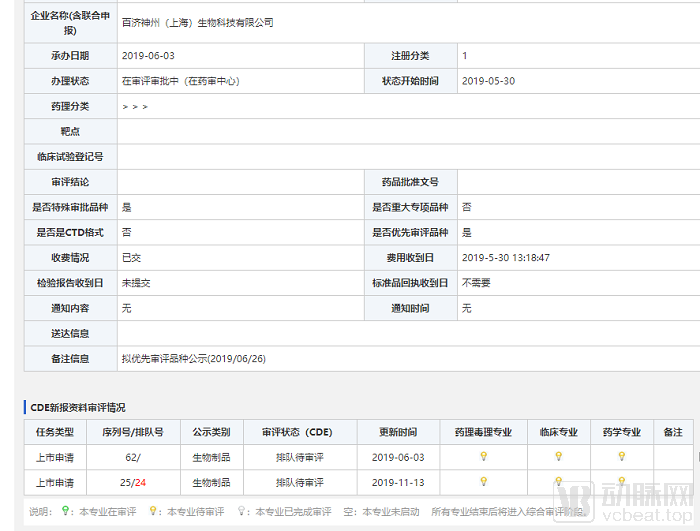
Image from YAOZHI Database
On November 12, 2019, VCBeat learned that the review process for BeOne Medicines’ PD-1 product, tislelizumab, at the Center for Drug Evaluation (CDE) had been completed, and the application had entered the CDE’s review queue. This means that BeOne Medicines’ PD-1 inhibitor, tislelizumab, is on the verge of receiving marketing approval.
It is understood that tislelizumab will be the fourth domestically developed PD-1 inhibitor to be marketed in China, and one of BeOne Medicines’ core products. As similar products—Junshi Biosciences’ toripalimab, Innovent Biologics’ sintilimab, and Hengrui Medicine’s camrelizumab—have already been launched, BeOne Medicines currently lags slightly behind in terms of timeline. However, based on its extensive portfolio of indications, BeOne Medicines remains confident about the market.
In terms of indication portfolio, BeOne Medicines is the first pharmaceutical company to submit a PD-1 monoclonal antibody for urothelial carcinoma, a therapeutic area that has seen no breakthrough treatments for many years. Furthermore, the company has completed enrollment in three Phase III clinical trials for lung cancer and one Phase III trial for squamous non-small cell lung cancer, maintaining a leading position in China. Regarding hepatocellular carcinoma, a cancer type with high prevalence in China, the Phase III study for first-line treatment has been initiated, while patient enrollment for the single-arm clinical trials evaluating second- and third-line therapies has been completed.
Wang Lai, Senior Vice President of BeOne Medicines, stated that the company would focus its PD-1 strategy on China. Given the characteristics of the Chinese market, a broad market layout is essential. For its PD-1 monoclonal antibody, BeOne Medicines is currently conducting 11 Phase III clinical trials and four registrational Phase II clinical trials, with more PD-1-based combination therapies under exploration.
In terms of marketing preparations, BeOne Medicines began building its team as early as 2018, and its core executive leadership is now largely in place. Among them, Dr. Wu Xiaobin, General Manager of China and President of the company, formerly served as the head of Pfizer China. Wu Qingyi, Chief Commercial Officer for Greater China, previously oversaw the successful launch of Aubagio (fingolimod) for multiple sclerosis at Sanofi, setting a record for exceptional new product launches within the company. Liu Yan, Vice President and Head of Marketing for Greater China, previously helped Takeda revitalize the Enantone franchise and drove Xalkori to become the top-selling product in Pfizer’s oncology portfolio.
Additionally, Phase I of BeOne Medicines’ large-molecule production facility in Guangzhou was announced as completed on October 30, 2019. With a total investment of RMB 2.3 billion and covering an area of 100,000 square meters, the facility is dedicated to process development and commercial-scale manufacturing of large-molecule biologics. The Phase I project achieved an 8,000-liter production capacity within just two years, and the PD-1 antibody tislelizumab will be manufactured at this site.
Currently, BeOne Medicines’ PD-1 antibody tislelizumab is fully prepared for production and commercialization, with product approval in the final queue. Everything is ready; all that remains is the final regulatory nod.