



On January 20th, after the market closed, Eyebright Medical (688050.SH), an ophthalmic medical device company, announced that it plans to acquire no less than 51% equity of Delta Medical, a leading enterprise in sports medicine, for an overall valuation not exceeding 1 billion yuan. The acquisition will be made through a combination of acquisition loans and the company’s own funds, thereby gaining control. The maximum purchase price for the corresponding equity is 510 million yuan.
This company, which focuses on "eyes" and specializes in ophthalmic sectors such as intraocular lenses and orthokeratology lenses, is attempting to extend its reach into the sports medicine field centered on "joints and muscles." Behind this cross-border acquisition lies the reality of the company's struggling core business, squeezed profit margins, and lackluster stock price. The three-year performance bet corresponding to the target's 1 billion yuan valuation, along with the competitive landscape of the industry, will introduce how many variables into this cross-border integration?
Growth Anxiety Amid Main Business Slowdown
Eyebright Medical, which once rose rapidly by capitalizing on the红利 of domestically produced intraocular lens alternatives, is now at a crossroads of growth.
Eyebright Medical is the only domestic company in the intraocular lens field to rank among the top five in China, and its orthokeratology lens business ranks second only to OcuScience in China. However, changes in the current market environment are posing severe challenges to its traditional advantageous businesses.
The intraocular lens business, as the company's core operation, has contributed nearly half of the revenue over the years. However, since being included in the fourth batch of China's national high-value medical consumables centralized procurement in November 2023, while it has brought a significant increase in sales volume for the company, it has also mercilessly driven down the unit price and gross profit margin of the products.
In 2024, the product's sales volume increased by 44.93% year-on-year, while the revenue growth during the same period was only 17.66%. The average selling price per unit continued to decline from RMB 437.56 in 2022 to RMB 338.06 in 2024. The overall gross margin gradually decreased from 84.75% in 2022 to 65.25% in the first half of 2025, with the profit margin continuously squeezed.
Reflected in the revenue structure, the proportion of revenue from surgical treatment services has contracted from 67.8% in the first half of 2022 to 46.23% in the same period of 2025.
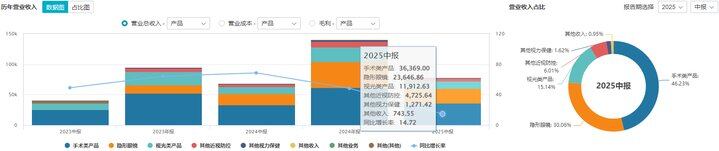
The OK mirror business, which the market has high hopes for as the second growth curve, also faces fierce competition.
Driven by the rapid catch-up of domestic companies such as Haohai Biotech and Ophthalmic, the industry competition has intensified, causing fluctuations in product ex-factory prices. In the first three quarters of 2025, Eyebright Medical's myopia prevention and control business achieved only single-digit growth. Another strategically positioned vision care business, mainly focusing on contact lenses, achieved a year-on-year growth of 28.89% in the first half of 2025. However, affected by the consumer market environment, its revenue declined in the third quarter. This business is still in the investment phase and has not yet become a profitable support.
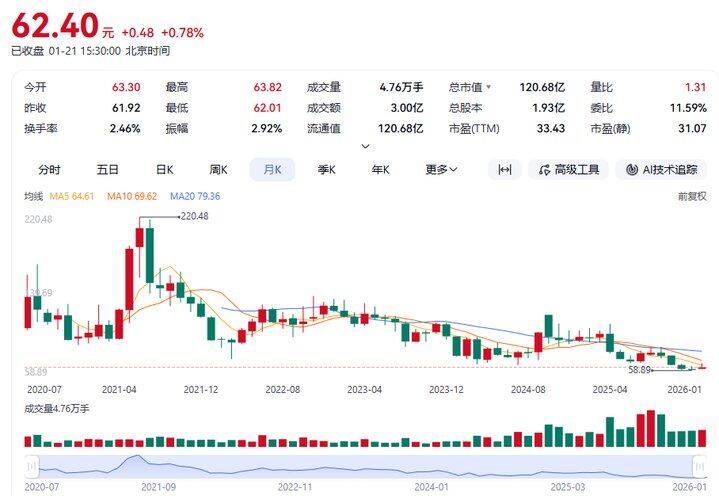
Performance pressure directly transmitted to the capital market. The stock price of Eyebright Medical has continued to decline since hitting an annual high of 117.65 yuan per share on October 8, 2024, and hit a low of 58.89 yuan per share during trading on December 10, 2025, marking a cumulative drop of 49.94% from its previous high, setting a new five-year low since its listing.
As of the latest closing date, the company's stock price was reported at 62.4 yuan per share, with a cumulative decline exceeding 36% over the past year, and its market value has significantly shrunk.
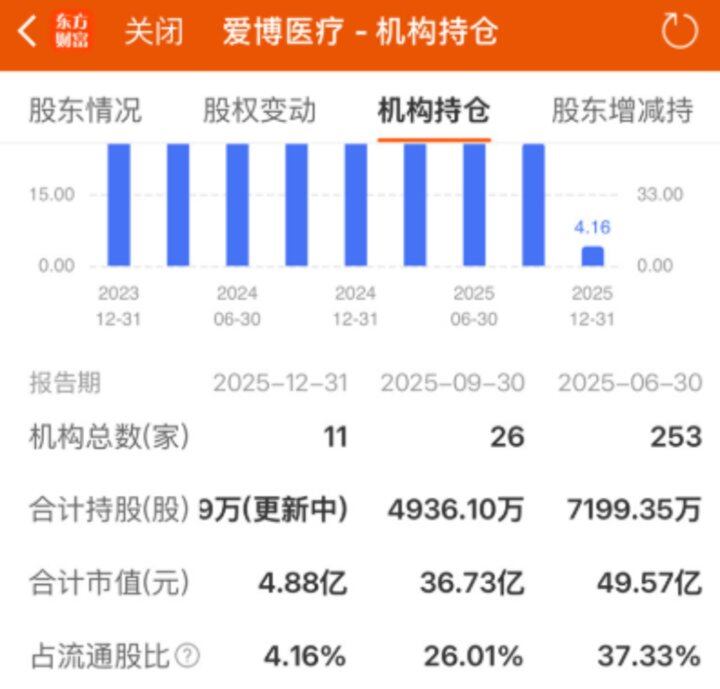
The叠加 of medical insurance DRG (Diagnosis-Related Groups) cost control has led to an unexpected significant decline in terminal surgeries, prompting institutional investors to start withdrawing. As of December 31, 2025, the number of institutional holders has sharply decreased from 253 in mid-year to only 11; the total shareholding ratio as a percentage of tradable shares has dropped substantially from 37.33% to 4.16%, with the corresponding market value of holdings shrinking from 4.957 billion yuan to 488 million yuan.
Endogenous growth has hit a bottleneck, and while expanding overseas represents another path, it cannot avoid numerous challenges such as cultural differences, regulatory barriers, channel development, and brand recognition—all of which take time to address. Against this backdrop, pursuing external mergers and acquisitions to find a high-potential new track that can create synergy with one's own business has become a practical, even urgent, choice.
As a result, sports medicine has come into the view of Eyebright Medical. This field combines the essential attributes of medical needs with the upgrading potential of health consumption, and offers vast space for domestic substitution. According to industry data, the market size of China's sports medicine is expected to reach 8-10 billion yuan by 2025, with the actual market size in 2023 being approximately 6-6.8 billion yuan. In recent years, the compound annual growth rate has been about 15%-20%. By 2030, the market size of China’s sports medicine is expected to exceed 13 billion yuan.
10 Billion Valuation and Three-Year Bet
"Changing fields is like crossing mountains—how big is the leap from ophthalmology to sports medicine?"
Eyebright Medical's chosen target, Delta Medical, was founded in 2016. Its core label is "a leading Chinese brand in sports medicine" and it is also a national high-tech enterprise and a "specialized, refined, distinctive, and innovative" little giant enterprise. Its strategic layout covers the entire sports health chain from preoperative prevention to surgical treatment and postoperative rehabilitation. It owns 276 patents in areas such as sports medicine implants, surgical tools, arthroscopic equipment, and sports rehabilitation devices.
Currently, Delta Medical has successfully been selected for Group A of the fourth batch of China's national high-value medical consumables procurement. As one of the main competitors in the Chinese market, it can leverage the centralized procurement policy to rapidly expand its market share, echoing Eyebright Medical's experience in the intraocular lens sector. In terms of distribution channels, Delta Medical not only covers the entire Chinese market but also exports its products to regions such as Southeast Asia, Latin America, the Middle East, and Europe, creating synergy with Eyebright Medical's overseas strategy.
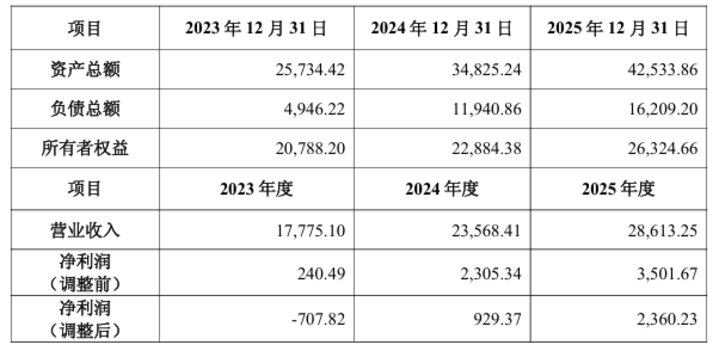
Financial data shows that Delta Medical has achieved a leap from loss to profit. The adjusted net profits for 2023 to 2025 are -7.0782 million yuan, 9.2937 million yuan, and 23.6023 million yuan, respectively, with profitability continuously improving.
According to the transaction agreement, founder Li Jianbo committed that Delta Medical will achieve a total audited net profit of no less than 165 million yuan from 2026 to 2028, including no less than 45 million yuan in 2026, no less than 55 million yuan in 2027, and no less than 65 million yuan in 2028. If the targets are not met, the founder must transfer the corresponding equity compensation at zero cost or the lowest price allowed by applicable laws.
From a valuation perspective, if calculated based on the highest overall valuation of 1 billion yuan, the price-to-earnings (P/E) ratio corresponding to the committed net profit in 2028 is approximately 15.38 times, which falls within a reasonable range in the current secondary market's medical device sector. However, relative to its projected net profit of 23.6023 million yuan in 2025, the P/E ratio would be as high as 42.37 times, surpassing Eyebright Medical's current TTM P/E ratio of 33.43 times. Eyebright Medical is betting on the digestion of its valuation and synergy value driven by high growth in future profitability.
But the difficulty of fulfilling the performance commitment is considerable. Currently, China's sports medicine market is still dominated by international giants. According to a relevant report by CIC Consulting, foreign brands such as Smith & Nephew, Johnson & Johnson, and Arthrex collectively account for about 80% of the market share. Among Chinese-produced brands, companies like Wego Orthopedics, Double Medical, Chunli Medical, Tianxing Medical, and Ruijian Medical are分散占据剩余份额, with the top three domestic enterprises holding approximately 8% of the market share. Delta Medical faces significant challenges in achieving a doubling of net profit growth over three years amidst fierce competition.
The Road to Cross-Boundary Collaboration Is Long and Difficult
For a cross-border M&A, the real test lies in whether the subsequent integration can unleash the "1+1>2" synergistic value. The crossover from ophthalmology to sports medicine, although both belong to the medical device field, shows significant differences in technology application, customer base, and clinical ecosystems, further testing the management's integration capabilities.
In terms of synergy potential, the契合点 between the two are concentrated in technology and channels.
As a materials-based medical company, Eyebright Medical has accumulated extensive experience in the research and development, production, and manufacturing of biomedical materials and high-end medical devices. Similarly, Delta Medical's sports medicine implants, surgical tools, and other products also require extremely high biocompatibility and mechanical performance from their materials. Theoretically, both parties can achieve technical sharing and product upgrade empowerment.
In terms of sales channels, Eyebright Medical's layout in domestic ophthalmic hospitals can mutually benefit from Delta Medical’s sales network that covers all of China and overseas. For instance, the ophthalmology channel can attempt to promote sports rehabilitation products, while Delta Medical's overseas channels can also facilitate the export of ophthalmic products.
But the realization of synergy is not easy. The pathogenesis and surgical techniques in ophthalmology and sports medicine are completely different, with the customer base shifting from ophthalmologists to orthopedic and sports medicine doctors. There are fundamental differences in decision-making chains and academic promotion systems, making channel reuse relatively difficult. The integration of the two companies in terms of corporate culture and management pace is also an invisible factor affecting the success of the merger.
Financial risks should not be overlooked. In recent years, Delta Medical has seen a continuous rise in its debt scale, with total liabilities reaching 49.4622 million yuan, 119 million yuan, and 162 million yuan from 2023 to 2025, respectively, showing that the growth rate of liabilities has outpaced revenue growth. Meanwhile, Eyebright Medical’s use of acquisition loans for its purchases could further increase its financial leverage. If the acquired company's performance falls short of expectations, it will exacerbate the company's financial pressures. For Eyebright Medical, this cross-sector acquisition may temporarily alleviate market concerns about its growth ceiling, but behind this new narrative, there may also be multiple uncertainties that could divert focus from the development of its core business.Text丨Company Observation, Author: Cao Qian, Editor: Cao Shengyuan)