

FTC 2019: How Hard Is Innovation? An Exploration of Cardiovascular Technology Innovation and Clinical Application
On November 9–10, 2019, the FTC 2019 Inaugural China Cardiac Surgery Frontier Technology Forum was held in Beijing. The event was hosted by the Cardiac Surgery Professional Committee of the China Medical Education Association and the Cardiovascular Surgery Technology and Engineering Branch of the China Medicine Biotechnology Association, co-organized by Da Yisheng Bingqi Pu, and undertaken by VCBeat.
This forum brings together top cardiac surgery experts from Beijing Anzhen Hospital, The University of Texas MD Anderson Cancer Center, West China Hospital, Wuhan Asia Heart Hospital, and Xijing Hospital, and invites distinguished guests from the investment community, industry, and research institutions to jointly discuss the development history, current status, and future trends of cardiac surgery in China.
Moderated by Zuo Lin, Partner at Shuncheng Capital, the panel featured an intense discussion on “Technological Innovation and Clinical Application in Cardiovascular Care.” Participants included Zheng Jun, Deputy Chairman and Secretary-General of the Cardiac Surgery Professional Committee of the Chinese Medical Education Association; Li Youjin, Deputy Director of the Cardiovascular Center at Ningxia People’s Hospital; Cao Peng, General Manager of Jianshi Biologics; Zhang Jin, General Manager of Jinkui Medical; Ruan Chengmin, Chairman and General Manager of Maibo Medical; and Zhu Qing, Vice President of R&D at MicroPort Endovascular.
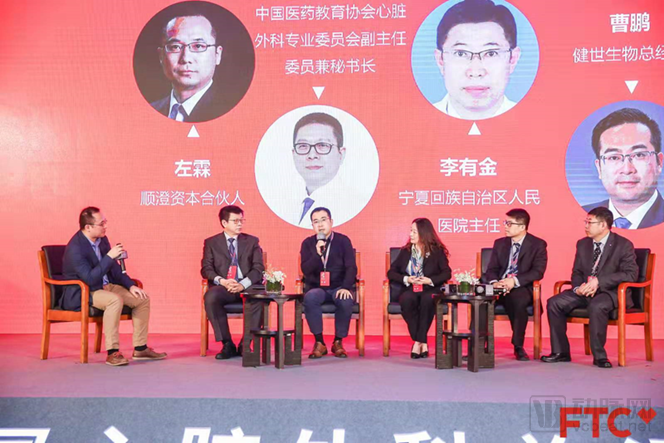
(The guest is speaking. Photo by VCBeat)
VCBeat has compiled the highlights of these insightful remarks for readers in the healthcare industry.
Zhang Jin, General Manager of Jinkui Medical:I graduated with a degree in medicine and worked in a hospital before joining a multinational corporation, where I was responsible for the marketing of medical devices. Initially, we introduced overseas products such as coronary stents into China through various channels. We observed that physicians could repair minimal-access injuries using imported products in just 15–20 minutes. This represented a significant advancement for cardiothoracic surgery at the time. During the promotion process, I also reflected on whether there was room for improvement and innovation in these products.
The answer is affirmative. These innovations all stem from advancements in technology and the development of materials science. Innovation in materials science requires a considerable amount of time; Jinkui Medical began its research in this field in 2002 and did not enter human clinical trials until 2010. Innovation demands not only prolonged refinement but also a team’s commitment to its original mission, with continuous product improvement. There are no shortcuts to innovation, nor can a product be fully researched and developed within just one or two years.
Cao Peng, General Manager of Jianshi Biotech:Good ideas often come from doctors because they work on the front lines and have the deepest understanding of medical pain points and clinical needs. Doctors’ innovations require collaboration with engineers and multidisciplinary medical teams to successfully develop innovative products, which is precisely the approach adopted by Jianshi Biotech. When a clinical need arises, product development demands joint efforts from experts in engineering, medicine, materials science, and other fields. Additional teams assist with clinical registration, market approval applications, and other steps, enabling the product to reach the market for clinical use.
Zheng Jun, Vice Chairman and Secretary-General of the Cardiac Surgery Professional Committee of the Chinese Medical Education Association:The primary challenge lies in material issues. Certain surgical procedures rely heavily on experience and technical expertise, demanding exceptionally high standards. Many physicians are eager to master these techniques, but the learning curve is steep; one significant barrier is the variability in the quality of consumable materials. Currently, there are substantial clinical needs, such as minimizing patient blood loss during the perioperative period.
Nowadays, it is not difficult for physicians to embark on cross-disciplinary entrepreneurial ventures; the key lies in having an excellent platform to facilitate communication and translation of ideas. Although physicians operate in diverse environments, possess varying case reserves, and differ in their perspectives and lines of thought, they indeed harbor many innovative ideas. While China has witnessed rapid development and an optimized innovation ecosystem over the past decade, a certain gap remains compared with the mature mechanisms and environments abroad. The primary challenge for physicians is the difficulty in finding suitable partners or accessing credible platforms and institutions.
When physicians collaborate with enterprises, misjudgments by the latter may result in investments failing to yield expected returns. A platform that screens and evaluates physicians’ innovative ideas can significantly reduce risks for both parties, facilitate the implementation of high-quality innovations, and promote product innovation.
Cao Peng, General Manager of Jianshi Biotech: We have profound insights in this regard. During the development of our valve products, we frequently engaged in in-depth discussions with clinicians, as surgeons encounter a wide variety of cardiac anatomies during procedures and possess the most comprehensive understanding of heart structure, as well as the morphology and etiology of valvular diseases. Only through regular collaboration and joint development with physicians can engineers design superior products.
Chinese physicians have many excellent ideas, but engineers must actively translate these concepts into reality. This is the only path forward for innovation in China’s medical device industry. I believe that an increasing number of innovative devices will inevitably stem from the integration of medicine and engineering, and I hope to see more physicians and engineers collaborate to jointly create a promising future for China’s medical device sector.
Zhu Qing, Vice President of R&D at MicroPort CardioFlow: MicroPort Endovascular has several notable cases in this regard. First, in collaboration with Professor Sun Lizhong, MicroPort Endovascular co-developed the Cronus® intraoperative stent graft. The use of the “Sun’s Procedure” for treating Type A aortic dissection has become the gold standard in this field, with cumulative usage of this stent graft exceeding 30,000 cases. Second, in partnership with Professor Jing Zaiping from Shanghai Changhai Hospital, MicroPort Endovascular co-developed the Castor® branched stent graft, driving continuous technological innovation.
Engineers must translate physicians’ innovative ideas into practically usable devices, making the initial concept critically important. MicroPort Endovascular places great emphasis on communication between engineers and physicians. Currently, MicroPort Group has standardized this interaction by establishing the Liangzhi Innovation Center. Through this center, the company maintains channels for engagement with physicians, regularly screens concepts proposed by physicians or sales personnel, and enables specialists to conduct targeted discussions with physicians regarding product direction.
MicroPort Endovascular’s product R&D directions are only finalized after discussions with physicians from various clinical departments. We believe that as an independent market entity, the company must identify market opportunities before making investments. Innovative products should originate from clinical practice and ultimately be applied back in clinical settings.
Cao Peng, General Manager of Jianshi Biotech: At present, many people are talking about innovation, but innovation is a difficult endeavor. Domestic capital lacks confidence in domestically developed innovative products. For example, when Chinese companies achieve breakthroughs in areas where large foreign corporations have not yet succeeded, many venture capitalists remain skeptical, questioning how Chinese firms can take the lead in fields where overseas players have yet to deliver results.
Objectively speaking, domestic enterprises generally lag behind certain advanced foreign counterparts. However, as they strive to catch up, it is particularly crucial for them to gain recognition from investors. After product development is completed, capital support is also essential to facilitate large-scale clinical application and promotion. At this juncture, we must be more confident: what foreign enterprises can achieve, domestic enterprises can equally accomplish. Investors need to have greater confidence in domestic enterprises.
Zhang Jin, General Manager of Jinkui Medical: We have also encountered such situations, where products developed using different materials and manufacturing methods were met with skepticism from investors because a well-known foreign medical device manufacturer had previously attempted similar research but failed. Investors would question: If established international companies could not succeed, how did Jinkui Medical manage to achieve it?
This is understandable, as domestically produced products have long lagged behind imported ones. China’s medical device industry only began to take off in the 1990s. However, I believe that with continued progress over the next five, ten, or even twenty years, more innovative Chinese products will emerge and gain widespread recognition.
Despite shortcomings in both materials and economics, China’s healthcare industry has not been hindered from achieving Chinese innovation through the creativity, diligence, and practical experience of its enterprises. The innovative model combining engineers and physicians also ensures the quality of such innovations.
Zhu Qing, Vice President of R&D at MicroPort CardioFlow: Regarding the challenges facing medical device innovation in China, I see three key issues. First, China lacks systematic epidemiological big data statistics and professional teams to screen for valuable data. Companies are not afraid of spending money, but they fear going down the wrong path. Once a wrong turn is taken, all prior investments go to waste.
Second, the review speed for medical devices needs to be improved. Currently, the device review process takes several years. If the review pace—particularly for innovative products—were accelerated, innovative enterprises would have strong incentives to develop superior innovative products.
Third, there is still significant room for improvement in domestically produced materials. While the delivery system component of stent systems can be fully localized, a certain gap remains between Chinese-made interventional materials and imported counterparts. This disparity prevents the use of domestic materials in the production of Chinese-made stents. If domestic materials were used, service life could be reduced, and long-term product stability, mechanical properties, and other performance metrics would also be compromised. Therefore, the development of related domestic industries serves as an important foundation for promoting the advancement of pharmaceutical and medical device enterprises.