

Yitu Health Unveils First-Year Achievements of 'AI Cancer Prevention Map' and Launches care.ai Multi-Omics Intelligent Research Platform at CCR2019
YITU
Provider of Full-Stack Intelligent Healthcare Product Solutions
From November 13 to 17, the annual national radiology conference in China—the Chinese Congress of Radiology (CCR2019)—was grandly held at the China National Convention Center. Nearly 10,000 radiology professionals, researchers, and industry vendors from around the world gathered in Beijing to exchange insights on the latest advances in radiology.
As the most remarkable technological advancement in radiology in recent years, the widespread application of medical AI in this field is profoundly reshaping its trajectory. An increasing number of medical AI products are being implemented in clinical practice, spanning areas such as early screening, diagnosis, follow-up, and scientific research, thereby serving as valuable assistants and a “second brain” for clinicians.
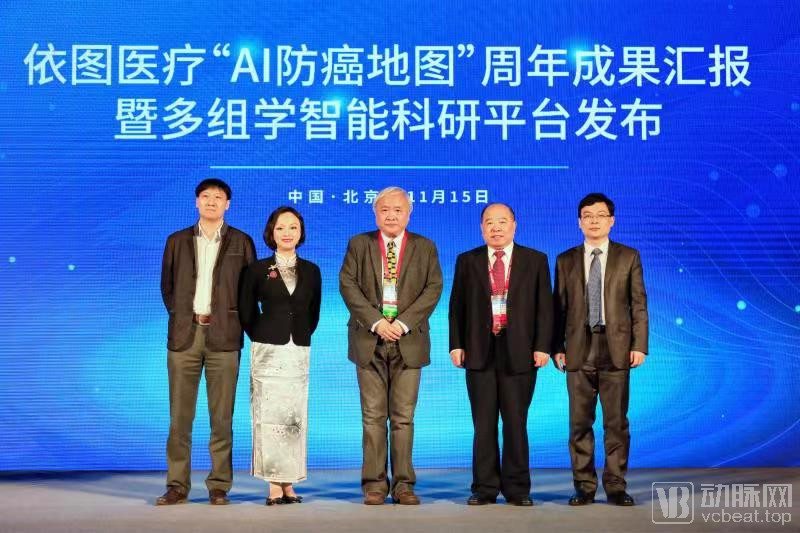
Professor Jin Zhengyu, Chairman of the Chinese Society of Radiology under the Chinese Medical Association and Director of the Department of Radiology at Peking Union Medical College Hospital;
Second from right: Professor Zhou Chunwu, Vice President of the Cancer Hospital, Chinese Academy of Medical Sciences;
Left: Professor Zhang Zhenfeng, Deputy Director of the Department of Radiology at The Second Affiliated Hospital of Guangzhou Medical University and Director of the Minimally Invasive Interventional Center at the Panyu Campus;
Second from left: Dr. Fang Cong, Vice President of YITU Medical;
Far right: Shi Lei, Vice President of Yitu Medical
On November 15, Yitu Healthcare, a leading domestic medical AI company, held in Beijing the anniversary results report for its “AI Cancer Prevention Map” project and the launch ceremony for its Multi-Omics Intelligent Research Platform. The event disclosed the annual achievements of the “AI Cancer Prevention Map” and the latest breakthroughs in the development of the research platform. Distinguished experts and guests attended, including Professor Jin Zhengyu, Chairman of the Chinese Society of Radiology and Director of the Department of Radiology at Peking Union Medical College Hospital; Professor Zhou Chunwu, Vice President of the Cancer Hospital of the Chinese Academy of Medical Sciences; Professor Zhang Zhenfeng, Deputy Director of the Department of Radiology and Director of the Minimally Invasive Intervention Center at the Panyu Campus of the Second Affiliated Hospital of Guangzhou Medical University; Dr. Fang Cong, Vice President of Yitu Healthcare; and Mr. Shi Lei, Vice President of Yitu Healthcare.
The “AI Cancer Prevention Map” is an ambitious initiative for intelligent early cancer screening. Leveraging Yitu Healthcare’s advanced medical AI products and its network of healthcare institution partners across China, the plan aims to build an intelligent early-screening platform covering multiple cancer types, thereby advancing oncology care from a focus on “disease-specific treatment” to a paradigm of “early screening, early diagnosis, and early treatment.”
Within just one year, the “AI Cancer Prevention Map” has been activated in multiple provinces and municipalities, including Guangdong, Fujian, Henan, Zhejiang, Chongqing, Hubei, and Liaoning. It has cumulatively served hundreds of thousands of individuals, conducted over 5,000 intelligent early screenings for lung cancer, and identified more than 50 suspected high-risk patients, demonstrating significant effectiveness.
While empowering early lung cancer screening at the primary care level, Yitu Medical has never ceased its advancements in scientific research.
At this press conference, the care.ai Multi-omics Intelligent Research Platform, integrating Yitu Medical’s latest scientific research concepts, was officially unveiled, drawing significant attention from numerous experts.
Unlike most existing research platforms on the market that rely solely on low-dimensional feature extraction, integration, and analysis of medical images, the care.ai Multi-Omics Intelligent Research Platform creatively introduces the concept of “multi-omics.” It places deep learning technology at the forefront of high-dimensional information extraction, assisting medical experts in exploring higher-dimensional medical information realms and turning the research dream of “small samples as big data” into reality. Furthermore, by incorporating multi-modal information—including imaging, text, genomics, and pathology—into the research workflow, the platform closely aligns with scientific research needs, providing comprehensive and robust AI support for scientific discovery.
“The tension between the ideal of big data and the reality of small samples is a common contradiction in medical research. As the information density of medical data continues to rise, the dimensions for assessing its value can no longer be limited to sample size alone; the data information density per sample has become a new dimension of value in clinical research. State-of-the-art AI technologies possess increasingly high intelligence density—the ability to deeply refine and analyze data value—fully extracting the vast amount of information contained within limited datasets, thereby transforming what were once ‘small-sample’ datasets into ‘big data.’” Shi Lei, Vice President of YITU Medical, stated when discussing the multi-omics intelligent research platform: “YITU’s care.ai Multi-Omics Intelligent Research Platform achieves technological innovations such as ‘letting algorithms design features, letting algorithms optimize training, and letting algorithms design algorithms,’ which will help medical experts conduct multi-omics intelligent research more efficiently and conveniently, accelerating the generation of research outcomes.”
As the opening highlight of this press conference, the anniversary report on the achievements of the “AI Cancer Prevention Map” drew significant attention from numerous experts. In the year since its launch, which provinces has the “AI Cancer Prevention Map” illuminated?
In Ningde, Fujian Province, 67-year-old Grandma Li underwent her first “Doctor + AI”-powered low-dose computed tomography (LDCT) intelligent early screening for lung cancer. Before the malignant nodule could spread, it was eradicated in its early stages through minimally invasive endoscopic surgery...
In Xinye County, Henan Province, nine patients with high-risk positive nodules were identified among more than 1,000 high-risk individuals. With support from tertiary hospitals, the province’s first county-level early screening center for pulmonary nodules and a multidisciplinary diagnosis and treatment center were established, making the vision of “major diseases treated within the county” no longer just a dream.
In Panyu, Guangdong, following the AI-powered early screening of 1,323 high-risk individuals in 2018, another 1,271 high-risk patients underwent AI-based early lung cancer screening in 2019. More encouragingly, 177 high-risk individuals identified in 2018 proactively accepted follow-up examinations, indicating that public resistance to early cancer screening is gradually diminishing...
Professor Jin Zhengyu spoke highly of the continued in-depth development of the “AI Cancer Prevention Map.” He stated that radiologists are a vital force in early cancer screening, and the application of AI technology in this field is becoming increasingly sophisticated and experience-rich. He expressed confidence that as the “AI Cancer Prevention Map” is implemented in more provinces and cities across China, the nation’s capabilities in early cancer screening, prevention, and control will be further enhanced.
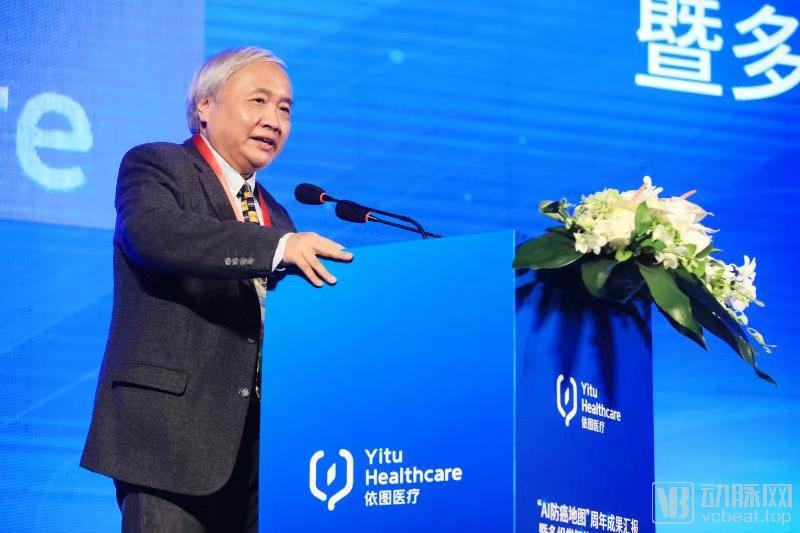
Address by Professor Jin Zhengyu, Chairman of the Chinese Society of Radiology and Director of the Department of Radiology at Peking Union Medical College Hospital
Professor Zhou Chunwu also emphasized: The state has long attached great importance to the early screening, diagnosis, and treatment of tumors. Imaging examination is a crucial component of early disease screening. For a long time, radiologists have been under significant pressure, with overtime image interpretation becoming the norm. The introduction of medical AI technology helps improve the efficiency, accuracy, and consistency of lung cancer screening, enabling more citizens to benefit from high-quality tumor screening services.
“The care.ai® Intelligent 4D Chest CT Imaging System has achieved full-process intelligence from lesion detection to management, providing a multi-dimensional pulmonary nodule management assistant for lung cancer diagnosis. This significantly enhances the efficiency and accuracy of early lung cancer screening, as well as the consistency of diagnostic results,” stated Professor Zhang Zhenfeng, a leader in multiple intelligent early-screening initiatives. “With the continuous advancement of the AI Cancer Prevention Map, awareness of early screening has become deeply rooted in public consciousness. Public acceptance of early lung cancer screening is increasingly high, with many individuals even proactively engaging in follow-up visits. Cancer screening is finally transitioning from physicians urging patients to ‘get checked’ to patients actively stating, ‘I want to get checked.’”
At this launch event, another star product also attracted the attention of many attending experts—the care.ai Multi-Omics Intelligent Research Platform.
In fact, “research platforms” are not a new concept. For many years, various forms of research platforms have been commonplace, achieving certain scientific outcomes through single-dimensional data, particularly in the annotation and standardized training of imaging data. However, they have struggled to make substantial breakthroughs in extracting deeper, multi-omics high-dimensional information and constructing intelligent algorithmic architectures. Their research outputs remain confined to single dimensions within isolated domains, resulting in severe low-level redundancy, protracted model development cycles, and persistently high costs for transfer learning. Consequently, these platforms fail to meet the increasingly complex demands of clinical research, akin to “sitting on a gold mine of data while selling pebbles.”
“Data purification and analysis permeate every stage of scientific research. Medical research often requires the integration of multi-dimensional data to achieve breakthroughs. The capability to integrate multi-dimensional data, extract high-dimensional information, and leverage intelligent data analytics directly determines research efficiency and the quality of outcomes.” Discussing the original intention behind building this platform, Shi Lei stated, “AI-enabled imaging has become the most valuable source of evidence in multidisciplinary research. The integration of interdisciplinary, multi-modal data has emerged as a key trend in ‘AI-based’ scientific research. Constructing an ‘Imaging+’ multi-omics research platform can empower radiologists to go beyond conventional imaging and conduct more comprehensive clinical studies.”
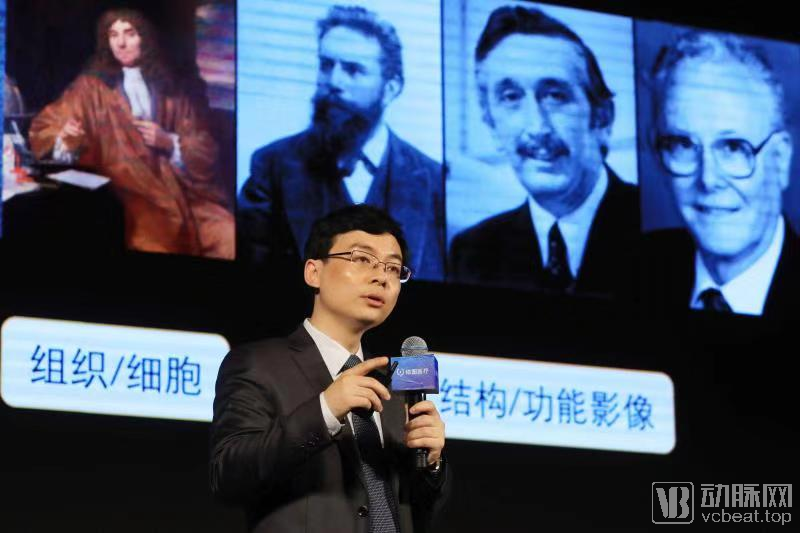
YITU Healthcare Vice President Shi Lei Launches Multi-Omics Intelligent Research Platform
Building a multi-omics intelligent research platform presents substantial challenges, imposing extremely stringent requirements on developers’ understanding of medical issues, comprehensive AI capabilities, and partner ecosystems.
“YITU Medical possesses world-class medical artificial intelligence technology and application experience. Its profound expertise in computer vision, natural language processing, knowledge graph technology, and other fields serves as the platform’s most robust technical foundation,” emphasized Shi Lei. “We are committed to technological innovation and look forward to deepening collaboration with more medical institutions and experts to advance medical scientific research.”