

CCR2019: Rational Reflection After the Hype — Challenges and Strategies for Medical AI

SHUKUN
Provider of Intelligent Products and Innovative Solutions

DeepWise
Developer of Artificial Intelligence Medical Imaging Diagnosis System

YITU
Provider of Full-Stack Intelligent Healthcare Product Solutions

HY Medical
Provider of Medical Imaging and Oncology Radiotherapy Platforms

Infervision
Artificial Intelligence Product Developer
In early November, Beijing was awash in golden hues, with ginkgo leaves scattered sparsely after strong winds. Inside the China National Convention Center, however, the atmosphere was bustling as the 26th National Congress of Radiology (CCR2019) of the Chinese Medical Association was underway.
Radiologists from across China have gathered here, while GE Healthcare, Neusoft Medical, United Imaging Intelligence, and Synovision, along with a host of AI enterprises, have also established their presence in this hub, sharing technological advancements and innovative business models with the entire industry.
Among these, artificial intelligence continues to firmly occupy the center stage of the discussion.
As one of the national major strategies, the issuance of documents such as the State Council’s “New Generation Artificial Intelligence Development Plan” and “Guiding Opinions on Promoting and Regulating the Application and Development of Health and Medical Big Data” has continuously driven the advancement of medical artificial intelligence technologies. However, relevant laws and regulations remain a blank slate regarding how enterprises can access and utilize hospital data.
Legal issues are just one of the challenges. According to Professor Kong Dexing, Director of the Institute of Applied Mathematics at Zhejiang University, the key bottleneck constraining artificial intelligence lies in “core algorithms”—the current state of AI algorithms fails to meet the demands of today’s healthcare environment for this technology.
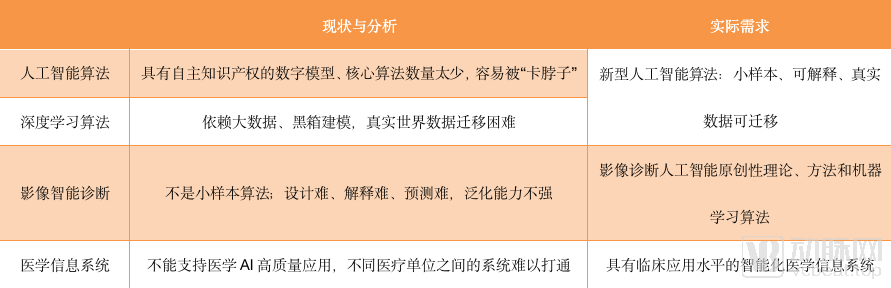
In fact, deep learning, a technology with a history of nearly 40 years, only achieved its current prosperity with the emergence of convolutional networks in 2012. However, several years of development may have already exhausted the technological dividends. Professor Kong Dexing believes that what medical artificial intelligence lacks is a new generation of AI capable of analyzing small samples, providing interpretable results, and digitizing real-world data. Without these capabilities, such AI may demonstrate excellent performance in the laboratory, but its accuracy will be significantly compromised once deployed in hospitals.
Furthermore, it is crucial to establish a corresponding intelligent information system. Hospitals must strive to build an IT infrastructure that supports AI-based medical products, with the urgent priority of breaking down data silos between different medical institutions and eliminating imaging format discrepancies among various devices.
These issues present both opportunities and challenges. In his speech, Professor Kong Dexing primarily categorized these issues into four points and proposed solutions from the perspective of “mathematical principles.”
Question 1: The Precision Bottleneck
The bottleneck in precision stems from the limitations of imaging equipment and physicians’ cognitive constraints. As Ren Zhengfei stated, “Current images are not captured by cameras but computed through mathematics.” The future of radiology lies in thorough digitalization.
From a clinical perspective, it takes one year for tissue lesions to appear after genetic abnormalities occur, and 5–20 years for these tissue lesions to progress to tumor formation. Although this timeline is lengthy, if physicians rely solely on medical equipment for visual observation of tumors, many lesions will inevitably be overlooked. This is not an issue of physicians’ competence, but rather a limitation of human visual perception.
Therefore, on the one hand, physicians require more precise equipment to generate more detailed imaging information; on the other hand, researchers need to employ mathematical and statistical methods to extract the intrinsic information embedded within medical images. Both aspects warrant in-depth research in the field of artificial intelligence.
Question 2: Deficiencies in Analytical Methods
At this stage, it is difficult to achieve high precision in medical image processing through computer vision, with the most common challenges being "different manifestations of the same disease," "similar manifestations of different diseases," and "ambiguous boundaries."
In response to these challenges, many AI companies have prescribed “multimodal” solutions, such as integrating electronic medical records and other data to “construct” a context-aware scenario for artificial intelligence. However, in practice, the accuracy of AI-based image recognition remains hampered by issues such as the lack of source-controllable, integrated image analysis pipelines and the application of rigid-body image processing techniques to deformable objects.
Question 3: Data Silos
Data silos are a long-standing issue. AI is a technology built on big data, large models, and substantial computing power; however, due to privacy, intellectual property, and other concerns, data across different medical institutions remains difficult to integrate, thereby failing to support high-quality applications of medical AI.
Can we address this issue through a novel approach? Federated learning may offer a solution. By leveraging this distributed computing paradigm, researchers can integrate data from multiple hospitals for artificial intelligence training, without compromising data attributes or security.
Question 4: Deep Learning Deficiencies
The three major challenges unique to the development of artificial intelligence in the medical field—reliance on big data, black-box modeling, and difficulties in transferring models to real-world data—are also the key factors constraining the advancement of this technology in healthcare. Currently, there are no effective solutions to these issues; perhaps only the development of next-generation deep learning algorithms can resolve them.
Overall, Professor Kong Dexing believes that while artificial intelligence is currently receiving widespread attention, the top-down development model based on “experience plus case studies” remains the mainstream approach for AI product R&D. As there have been no major breakthroughs in theory, technology, or methodologies, it will still take some time before clinical applications can be fully realized.
Back in the exhibition area, many participating medical device vendors remarked on the relatively subdued atmosphere of this year’s event. Indeed, while the number of exhibiting companies has decreased significantly compared to last year, radiologists engaging with exhibitors continued to stream steadily between booths.
Similar to international radiology societies such as the RSNA and ECR, AI startups and major medical imaging equipment manufacturers occupied the majority of the exhibition space. Leading equipment vendors, including GPS, Neusoft Medical, and United Imaging Healthcare, showcased their core competencies.
Taking GE as an example, the medical device giant not only showcased Edison and its related applications, which recently received FDA approval, but also unveiled the new-generation digital 64-slice CT scanner, “Revolution Maxima.” Huang Yi, General Manager of the CT Product Division at GE Healthcare China, told VCBeat: “This 64-slice CT is equipped with three core technologies: the ‘Digital Sky-Eye Visual Cognitive System,’ the ‘Digital Free-Heart Platform,’ and the ‘Digital High-Definition Diagnostic Platform.’ It can handle a daily patient volume of 150–200 scans and is widely applicable in various settings, including tertiary (Grade III) and secondary (Grade II) hospitals.”
In the AI enterprise segment, the novelty of this exhibition lies in the in-depth development of the concepts of “quality control” and “mobile terminals.”
Taking the new-generation Wingspan AI+5G Box (3.0) released by Wingspan Medical Group as an example, this edge computing intelligent gateway, equipped with a 5G communication module, enables the transmission of data from a large number of medical imaging devices across various on-site areas to the cloud. It provides real-time quality control, remote monitoring, remote maintenance, and fault warning functions, laying a solid foundation for the construction of large-scale remote medical imaging diagnosis platforms.
Coincidentally, HY Medical has also released its latest one-stop AI imaging solution, which integrates multiple diagnostic tools. With this device, hospitals can simultaneously access HY Medical’s AI-based clinical applications, research applications, and imaging informatics services.

HY Medical One-Stop AI Imaging Solution
Another highlight of the conference was the emphasis that startups placed on “quality control.”
PereDoc CEO Lian Jing stated, “Driven by DRG policies, we are not only leveraging artificial intelligence to address issues related to the acquisition, transmission, display, storage, sharing, management, and analysis of medical images, thereby enhancing the quality of imaging information within patients’ electronic medical records, but also applying our accumulated expertise in health informatics to perform quality control on medical record face sheets using NLP technology.”
The state of the exhibition booths reflects, to some extent, the current status of the artificial intelligence sector. Throughout 2019, the pace of development in the AI field indeed slowed down. To gain a better understanding of the current development status of AI enterprises, VCBeat visited several AI companies and has summarized their strategic adjustments as follows.
SHUKUN: Differentiated Competition and Product Quality Build Industry Barriers
For SHUKUN, 2019 was hardly a winter chill. After securing RMB 200 million in Series B financing in February, this artificial intelligence company achieved the world’s first multi-center study results comparing AI with the gold standard in May; by August, its head and neck CTA AI product had been deployed in ten Grade A tertiary hospitals, including Xuanwu Hospital; in September, its coronary CTA product was procured by Xi’an Gaoxin Hospital; and in October, it partnered with Pinggu District to launch the “Pinggu Model,” aimed at cardiovascular disease screening and prevention in primary care settings. At the CCR conference, SHUKUN signed a collaboration agreement with Synovision, targeting the primary care market.
SHUKUN’s breakthroughs do not end here.Recently, SHUKUN’s software for analyzing vascular stenosis in coronary CT angiography images successfully entered the Class III Medical Device Innovation Pathway, marking it as the first AI-assisted diagnostic product in China to enter this pathway.
Amid the Winter Chill, Why Does SHUKUN Maintain Strong Momentum? The Choice of a Differentiated Path Is One Key Factor: The Complexity of Cardiovascular AI Deterred Many Startups, Making SHUKUN the Only AI Product in the Cardiovascular Field to Enter Clinical Practice.
However, the choice of track alone is not enough to be the decisive factor for SHUKUN to take the lead. Only by impressing doctors with its products can an AI company survive.
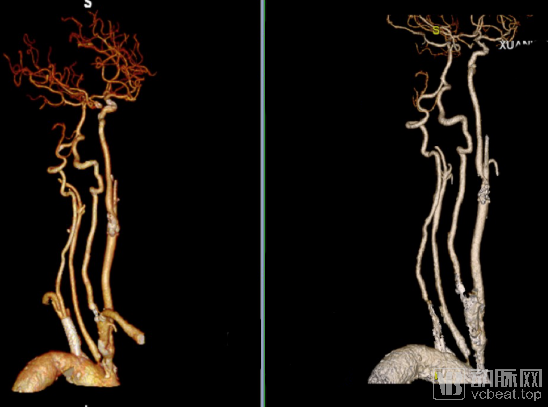
Left: AI-based reconstruction; Right: Traditional workstation
Taking coronary CTA products as an example, patients typically wait 7 days for a scheduled coronary CTA appointment, extending to 14 days during peak periods, with an additional 3-day wait for report retrieval after the scan. However, with SHUKUN’s coronary CTA solution, patients can undergo the CTA in the morning and receive their results by the afternoon.
Underpinning this is a win-win-win outcome for patients, hospitals, and physicians. Driven by the Diagnosis-Related Group (DRG) payment policy, shortened hospital stays translate into substantial savings in medical costs. This reduces both the time burden and out-of-pocket expenses for patients, while lowering the per-patient treatment costs for physicians and hospitals. With the capacity to serve more patients, their revenue streams are naturally secured.
Overall, SHUKUN has established a strong competitive moat in cardiovascular applications at Grade A tertiary hospitals. As its algorithms advance, SHUKUN is increasingly able to extract valuable information from lower-quality images, making primary care hospitals, health checkup centers, and private healthcare institutions the next core focus of its strategy.
DeepWise: Vertical Integration Yields Systemic Solutions
For a long time, DeepWise has been rolling out its AI products in a high-frequency, modular manner. However, with the introduction of products such as head and neck CTA, new dynamics seem to be emerging in this strategic landscape.
By integrating and optimizing its previous stroke-related products, DeepWise is able to provide clinicians with a comprehensive AI solution for the nervous system, which better addresses their clinical needs.
Furthermore, primary healthcare is also a crucial component of DeepWise’s strategic landscape. By establishing cloud “pipelines” for medical consortia, DeepWise has extended the value of AI enterprises beyond individual departments, creating an integrated imaging pathway that combines connectivity and processing. This facilitates the decentralization of medical resources to the grassroots level, comprehensively supporting tiered diagnosis and treatment.
Infervision: Go Deeper, and Even Deeper
If DeepWise aims to optimize its AI products from a vertical perspective to unlock emerging value, Infervision’s strategy lies in refining its existing product lines to achieve industry-leading excellence.
The publication of Infervision’s one-stop multi-system, multi-organ, and multi-task solution for chest CT on CCR underscores Infervision’s commitment to developing high-quality AI-assisted diagnostic products for chest imaging.
Yitu Medical: Expanding into New Markets in China’s Primary Healthcare and Overseas Medical Sectors
YITU Medical’s strategic deployment can be summarized in three key terms: deepening product development, expanding into primary care, and venturing overseas.
In deepening its product offerings, YITU’s three major AI products—NLP, computer-aided diagnosis, and research platforms—are advancing in tandem, addressing both the clinical workflow and research needs of physicians.
The grassroots-oriented “AI Cancer Prevention Map” has already been launched in multiple provinces and municipalities, including Guangdong, Fujian, Henan, Zhejiang, Chongqing, Hubei, and Liaoning. It has served hundreds of thousands of individuals, conducted over 5,000 AI-assisted early screenings for lung cancer, identified more than 50 suspected high-risk patients, and provided valuable insights to support primary healthcare services.
According to Fang Cong, Vice President of YITU, YITU Medical’s future strategic layout will continue to follow its current development path of “advancing clinical applications and scientific research in tandem.”
Wingspan Medical Group: Deploying in Primary Healthcare and Connecting Imaging Departments
In terms of strategy, this hospital, which started out as a software service provider, has always had clear goals and an ambitious layout. Unlike the aforementioned companies, Wingspan aims to build a cloud AI industry chain centered on primary care, enabling its platform to integrate more primary healthcare systems and expand the application of AI in medical imaging.
From the perspective of Gao Yunlong, CMO of Wingspan, primary healthcare represents the optimal scenario for AI applications. During this period, he believes that Wingspan should focus more intently on its core mission: establishing a presence in primary healthcare and integrating imaging departments.
Based on the analysis of the five representative companies mentioned above, primary care is undoubtedly the next battleground for AI enterprises. This market is sufficiently large, with ample demand awaiting AI-driven solutions to bridge information gaps and enhance the quality and efficiency of medical services. Furthermore, each company’s strategy has become more focused and, consequently, more rational in response to market dynamics. In this light, the field of medical AI has not lost its distinctiveness; there remains significant room for AI companies to explore and develop.
In the past, logging companies often harvested timber in the upper reaches of rivers and transported logs downstream via waterways for processing. However, due to variations in river width, logs frequently became lodged in the middle of the channel during drift, causing subsequent accumulations of wood. At such times, workers only needed to locate and move the single “key log”; once displaced, the piled-up logs would resume their flow, restoring normal operation throughout the entire chain.
In the field of artificial intelligence, startups have achieved certain results and are advancing into related areas based on these achievements. However, due to certain factors, the commercialization process has been stalled. The “critical log” blocking their progress is precisely regulatory approval.
Even so, the stringent approval process is indeed necessary. As a medical product, the prudent approach adopted by various regulatory bodies will, in the long run, prove beneficial to the development of the AI industry.
Therefore, the current state of the market may not reflect the true value of the AI medical imaging sector. Over the past period, this market was overvalued, and in the aftermath of the subsequent cooldown, we must also guard against undervaluation. This is because, although no one can guarantee that artificial intelligence products will achieve successful commercialization after obtaining regulatory approval, such approval inevitably creates a more favorable development environment for AI startups, within which their potential may be fully unleashed.
However, before that, AI companies still need to weather a difficult period.