

Zanubrutinib: The First Chinese-Origin Anticancer Drug Approved by the FDA – A Milestone in Global Oncology Innovation
BeOne
Developer of Molecular Targeted and Immune Anti-Tumor Drugs
On November 15, 2019, BeOne Medicines announced that its self-developed BTK inhibitor zanubrutinib (brand name: BRUKINSA™; generic name: zanubrutinib) had received accelerated approval from the U.S. Food and Drug Administration (FDA) for the treatment of patients with mantle cell lymphoma (MCL) who had previously received at least one prior therapy.
This marks zanubrutinib as the first anticancer new drug independently developed by a Chinese company to gain FDA approval for marketing, achieving a “zero breakthrough” for Chinese original innovative drugs in going global. Furthermore, this is BeOne Medicines’ first approved self-developed product, representing another significant milestone in the company’s development history.
At 10:00 a.m. on November 18, BeOne Medicines held a media briefing titled “FDA Approval of the BTK Inhibitor Zanubrutinib.” Four senior executives from BeOne Medicines and three clinical experts shared insights into the decision-making processes and R&D experiences across all stages of zanubrutinib’s development, from compound synthesis to market approval submission.
 Three Experts and Four Executives Participating in This Sharing Session
VCBeat has summarized the key points as follows:
1. BeOne Medicines opted to develop a highly selective BTK inhibitor, rather than blindly pursuing a multi-target approach;
2. One of the two pivotal clinical trials was conducted entirely within China, and the ICH mutual acceptance of data has begun to take effect;
3. Chinese clinical trials gain global recognition; domestic clinical trial institutions undergo FDA inspection for the first time, achieving zero deficiencies;
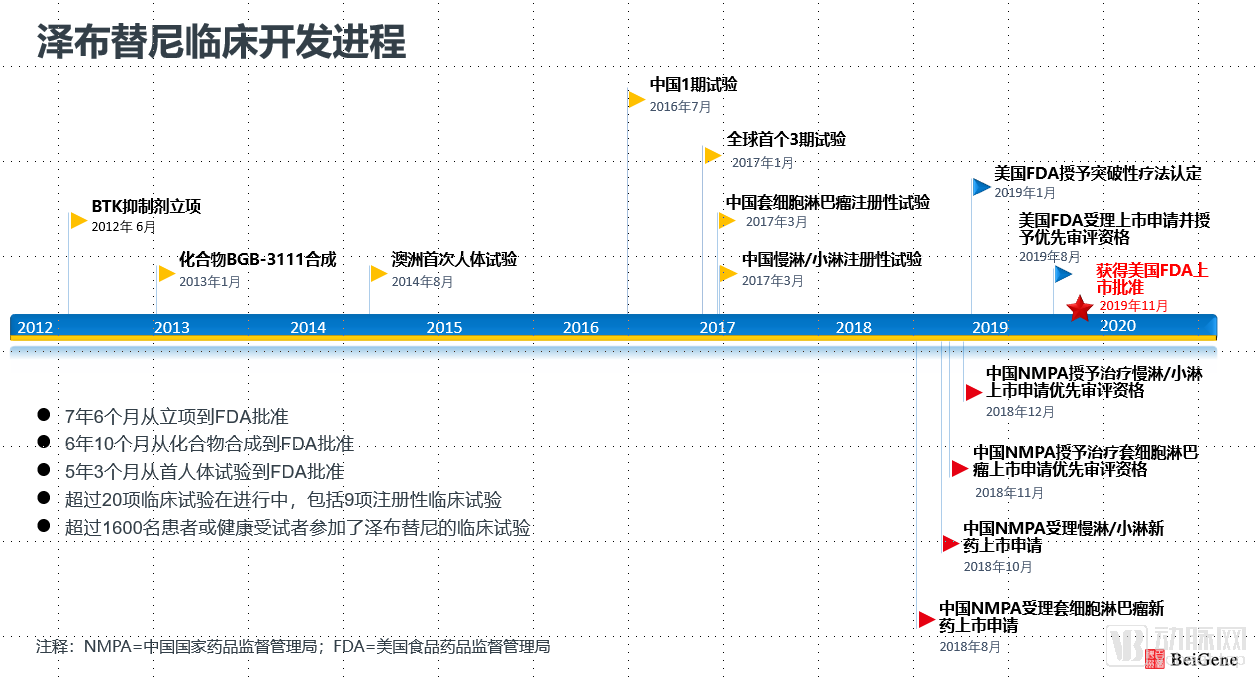
4. Approval was granted in 7 years and 6 months, reflecting a tight application timeline; for the Breakthrough Therapy Designation of zanubrutinib, all key materials required by the FDA were prepared in advance and submitted promptly;
5. Cancer cannot be cured, but it can be managed as a chronic disease. Zanubrutinib has successfully transformed mantle cell lymphoma into a chronic condition.
 The Development History of Zanubrutinib
“At the time, our goal was to develop a best-in-class drug, but achieving this is extremely challenging as it requires a thorough understanding of existing predecessor drugs. The key reason we chose to develop a BTK inhibitor was our belief that ibrutinib had its own weaknesses, and we had the capability to develop a superior drug,” said Dr. Wang Lai, recounting the project from its initial inception.
Ibrutinib is, in fact, a multi-target inhibitor, with BTK being merely one of its primary targets. Consequently, BeOne Medicines faced a dilemma at the outset: whether to trust in scientific research and develop a selective BTK inhibitor, or to follow ibrutinib’s approach by creating a multi-target inhibitor.
The decisive voice came from Academician Wang Xiaodong, founder of BeOne Medicines. The BeOne Medicines team decided to trust the efficacy of BTK inhibition observed in cellular and mouse models and proceed with the development of a selective BTK inhibitor. This pivotal decision paved the way for the subsequent creation of zanubrutinib.
In June 2012, the BTK inhibitor project was officially initiated. By January 2013, BGB-3111, later known as zanubrutinib, was synthesized by the chemical synthesis team and underwent preclinical testing.
Demonstrating robust efficacy at the cellular level and in mouse models, BeOne Medicines initiated corresponding clinical studies to develop BGB-3111 as one of its core products. In April 2013, BeOne Medicines filed relevant patents in China, which have since been extended to major countries and regions worldwide.
“After the chemistry team was established in 2011, most members did not receive salary increases in the early stages, and a few even accepted pay cuts to join our company. I believe that, as I mentioned earlier, this team is willing to work alongside our founding team to make a modest contribution toward realizing the dream of high-quality drug development.” Dr. Wang Zhiwei’s chemical synthesis team overcame numerous obstacles during the research and development of zanubrutinib.
Zanubrutinib was initially intended to be developed for its manufacturing process by a CDMO company, but the quoted price was exorbitant—far beyond what BeOne Medicines could afford. Although the chemical synthesis team lacked experts in process development, they took on the challenge and successfully optimized the molecular synthesis process. The production workflow for zanubrutinib still relies on this synthesis route developed by the team, which is a source of great pride for Wang Zhiwei.
In August 2014, as China had not yet implemented reforms to its new drug approval process, zanubrutinib first underwent its initial first-in-human clinical trial in Australia. In July 2016, the first patient in China received zanubrutinib; in January 2017, the first global Phase III clinical trial was launched; and in March 2017, a Phase II clinical trial for mantle cell lymphoma was initiated in China, alongside concurrent clinical trials for chronic lymphocytic leukemia/small lymphocytic lymphoma.
 Ongoing Clinical Trials of Zanubrutinib
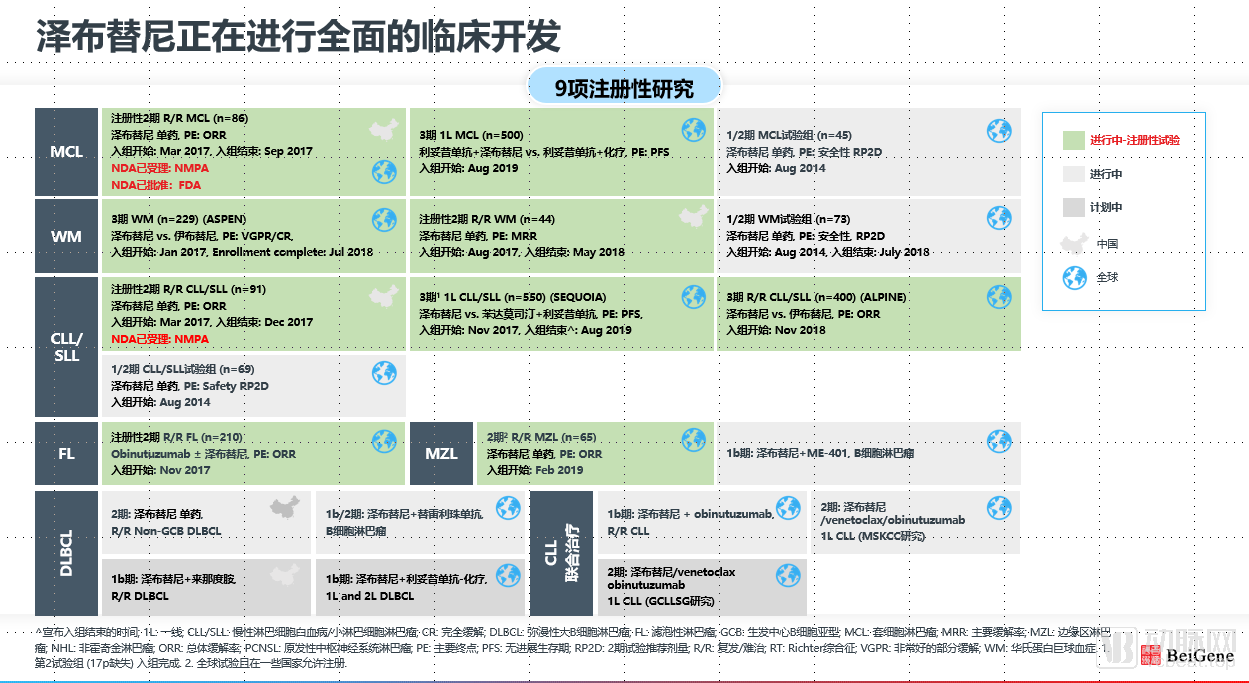
Zanubrutinib currently has more than 20 clinical trials underway. Among these, nine are registration-enabling clinical trials, including four Phase III trials. Meanwhile, zanubrutinib is undergoing two global head-to-head Phase III comparative studies against ibrutinib for the treatment of Waldenström’s macroglobulinemia and chronic lymphocytic leukemia, marking the first time a domestically developed novel drug in China has engaged in direct head-to-head research against a product developed by a foreign pharmaceutical company. To date, more than 1,600 patients or healthy subjects worldwide have received zanubrutinib.
Zanubrutinib is a BTK inhibitor with a completely novel chemical structure. Compared with ibrutinib, it exhibits three key characteristics: first, superior target selectivity; second, improved safety and tolerability; and third, favorable pharmacokinetics and higher systemic exposure due to its high target specificity, enabling complete and sustained inhibition of the target.
At the 2015 American Society of Hematology (ASH) Annual Meeting, Constantine Tam, principal investigator of the Australian Phase I clinical trial of zanubrutinib, delivered an oral presentation on the trial. This marked BeOne Medicines’ first oral presentation at a global conference.
“After I sat there and listened to him, I knew we had a very promising drug in hand,” said Wang Lai.
How difficult is mantle cell lymphoma to treat? Professor Zhu Jun described it as “relatively refractory, prone to relapse and progression, with currently unsatisfactory treatment outcomes.” As the lead institution, Peking University Cancer Hospital enrolled the first patient in the Phase II clinical trial of zanubrutinib (code name 206) and ultimately recruited 26 patients, the highest enrollment among the 14 hospitals participating in the “206” trial.
Ibrutinib: A Cross-Comparison with Other BTK Inhibitors
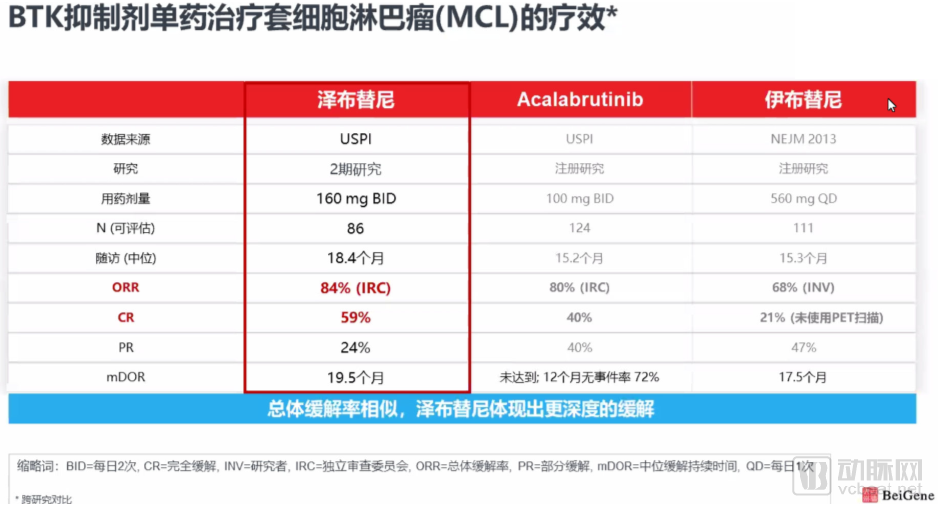
With a median follow-up of 18.4 months in the zanubrutinib “206” trial, the overall response rate reached 84% and the complete response rate approached 60%, significantly outperforming other BTK inhibitors in similar clinical trials.
Professor Zhu Jun stated, “In recent years, the clinical treatment and drug development for lymphoma in China have entered a period of rapid growth. In the past, we could only hope for new drugs from abroad to enter the Chinese market; today, the situation has changed dramatically. As a clinical oncologist, I am deeply gratified to have participated in and witnessed the first FDA approval of a novel drug independently developed in China. This signifies international recognition of our country’s innovation capabilities and research standards. We are not only developing new drugs for Chinese patients but also benefiting patients in many other countries, offering Chinese therapeutic solutions to the world. I feel sincerely proud of this progress.”
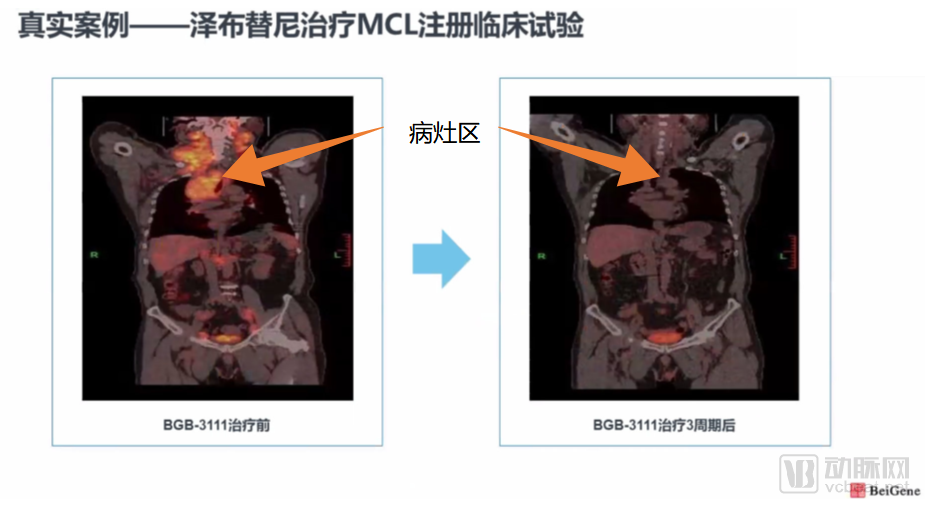
Patient Cases Receiving Zanubrutinib Treatment
Among the first few patients enrolled at the Affiliated Cancer Hospital of Zhengzhou University was a 75-year-old gentleman. General clinical studies typically require participants to be between 18 and 75 years of age, and this patient’s age had reached the upper limit for clinical trial enrollment.
The risk of complications increases with age, and this patient had previously undergone treatment with multiple chemotherapy agents and other targeted therapies. However, after three days of treatment with zanubrutinib, the patient’s tumor mass showed significant shrinkage, and no adverse reactions such as tumor lysis syndrome occurred.
Based on robust clinical trial results, BeOne Medicines submitted a marketing application for zanubrutinib to the NMPA in March 2019, followed by an application to the U.S. FDA in July 2019. Subsequently, from October 14 to 17, the U.S. FDA conducted inspections at Chinese hospitals participating in the “206” trial. “The five-day inspection schedule, originally planned from Monday to Friday, was concluded ahead of schedule on Thursday morning.”
“From raw materials to patient enrollment criteria and clinical manifestations, the inspection results were flawless, with no issues whatsoever. This greatly impressed the U.S. FDA,” said Professor Song Yongping.
This also marks the first time that a clinical trial site in China has undergone an inspection by the U.S. FDA. Previously, Chinese clinical trials had faced international criticism; however, the “206” trial has shattered long-standing global stereotypes.
Zanubrutinib is the first domestically produced anti-tumor drug approved by the U.S. FDA; however, this approval marks several other “firsts” for zanubrutinib as well.
The approval of zanubrutinib this time is primarily based on its Phase I clinical trial conducted in Australia and its Phase II clinical trial conducted entirely within China. “In previous global approvals, there were always some patients from the United States and Europe. However, this clinical trial involved exclusively Chinese patients, Chinese clinical institutions, and Chinese principal investigators (PIs). This represents a breakthrough from zero. It is not only a breakthrough in the mutual recognition of data under the International Council for Harmonisation (ICH) guidelines, but more importantly, our clinical data must be sufficiently robust.”
China has the largest patient population globally. Therefore, clinical trials in China not only help domestic innovative pharmaceutical companies accelerate patient enrollment but also gradually demonstrate the capabilities of Chinese clinical trials to major international pharmaceutical companies. In the past, these companies chose to conduct clinical trials in China primarily to expedite domestic market approval processes. However, in the future, including China in clinical trials will also significantly accelerate global market approval.
Developing a new drug typically requires $2 billion and takes 12 to 15 years. In contrast, zanubrutinib took only 7 years and 6 months from project initiation to approval, or just 6 years and 10 months if counted from the synthesis of the compound. Such a rapid completion of the entire regulatory submission and approval process was made possible not only by outstanding R&D personnel and strategic planners but also by a critical factor: BeOne Medicines’ exceptional Regulatory Affairs department.
In the preliminary results of the global Phase I clinical trial and the “206” trial of zanubrutinib, BeOne Medicines observed highly impressive efficacy. Consequently, BeOne Medicines began pursuing all possible accelerated approval pathways for zanubrutinib. Prior to its market approval, zanubrutinib secured all four FDA expedited review designations: Fast Track, Accelerated Approval, Breakthrough Therapy, and Priority Review. Among these, the Breakthrough Therapy designation is considered the most prestigious expedited review pathway.
Due to the high volume of drugs seeking Breakthrough Therapy designation, the FDA requires companies to submit a 1–2 page pre-request before formally applying for Breakthrough Therapy designation. If the pre-request is rejected, there will be no opportunity to pursue the formal Breakthrough Therapy application.
Yan Xiaojun recalled, “We filled two full pages with our submission. We filed the pre-application on September 27, 2018, and by November we had received an email from the FDA indicating that we could proceed with the formal application. As all required materials had already been prepared in advance, we submitted the formal application on the same day. On January 2, 2019, we received another email from the FDA requesting additional information on drug exposure. We were extremely excited at that point, sensing that success was within reach!” Finally, on January 11, zanubrutinib was granted Breakthrough Therapy Designation by the FDA.
“Technological innovation is transforming cancer into a chronic disease. Cancer exhibits significant heterogeneity, with thousands of tumor subtypes and considerable inter-individual variation. Therefore, our goal is to manage cancer as a chronic condition. Zanubrutinib exemplifies this approach by enabling the management of mantle cell lymphoma as a chronic disease, similar to hypertension or diabetes, thereby allowing patients to maintain a good quality of life. Furthermore, as an oral medication, zanubrutinib does not require hospitalization and offers better patient adherence.” Professor Ma Jun emphasized that zanubrutinib is not a cure for cancer.
For a long time, anticancer originator drugs marketed in China have relied heavily on imports, while pharmaceutical products exported from China to overseas markets have mostly been active pharmaceutical ingredients (APIs) or generic drugs, resulting in a relatively limited contribution to the global pharmaceutical innovation ecosystem.
As China deepens its reform and opening-up policies and strengthens its comprehensive national power, the pharmaceutical industry is accelerating its transformation and upgrading. Driven by favorable policies in drug regulation and healthcare reform, a wave of innovation has emerged in the pharmaceutical sector. A large number of scientists have returned to China to engage in new drug research and development, injecting sustainable vitality into the industry’s transition from imitation to innovation and from domestic markets to global expansion.
Dr. Wu Xiaobin, General Manager of BeOne Medicines’ China Region and President of the Company, stated: “In recent years, China’s continuous and in-depth reforms of drug review and approval systems, along with reforms to medical insurance payment mechanisms, have created a favorable macro environment for domestic new drugs to achieve historic breakthroughs in global expansion. Supported by national policies, innovative pharmaceutical companies represented by BeOne Medicines have maintained sustained investment and strived to catch up, now gradually entering a period of harvest. As a Chinese enterprise, we are encouraged by the nation’s reforms and look forward to their further deepening, so that the R&D achievements of Chinese scientists and enterprises can benefit more patients at an earlier stage, continuously promote industrial upgrading, and advance China toward its strategic goal of becoming a global ‘pharmaceutical powerhouse.’”
BeOne Medicines submitted new drug applications to the National Medical Products Administration (NMPA) of China in August and October 2018 for zanubrutinib in the treatment of relapsed or refractory mantle cell lymphoma (MCL) and relapsed or refractory chronic lymphocytic leukemia (CLL)/small lymphocytic lymphoma (SLL). Both applications were granted priority review, with the potential to benefit patients in China at an earlier date.
Following its approval in China, zanubrutinib will be commercially manufactured at BeOne Medicines’ small-molecule drug production facility located in the Sangtian Island Industrial Park in Suzhou. VCBeat will continue to monitor the situation and looks forward to observing zanubrutinib’s market performance post-launch.