One Year On, the 'AI Anti-Cancer Map' Continues to Expand Its Reach
YITU
Provider of Full-Stack Intelligent Healthcare Product Solutions
YITU Healthcare’s “AI Cancer Prevention Map” project was launched in November 2018. The project plans to invest RMB 100 million over the next five years to enhance medical service capabilities in grassroots areas with scarce medical resources, conduct patient education, and provide free screening. The ultimate vision of this initiative is to advance oncology diagnosis and treatment from a “disease-specific treatment” model toward “early screening, early diagnosis, and early treatment.”
Over the past year, the project has made significant progress. Within just one year, the “AI Cancer Prevention Map” has been launched in multiple provinces and municipalities, including Guangdong, Fujian, Henan, Zhejiang, Chongqing, Hubei, and Liaoning, serving hundreds of thousands of individuals. It has conducted over 5,000 intelligent early screenings for lung cancer, identifying more than 50 suspected high-risk patients.
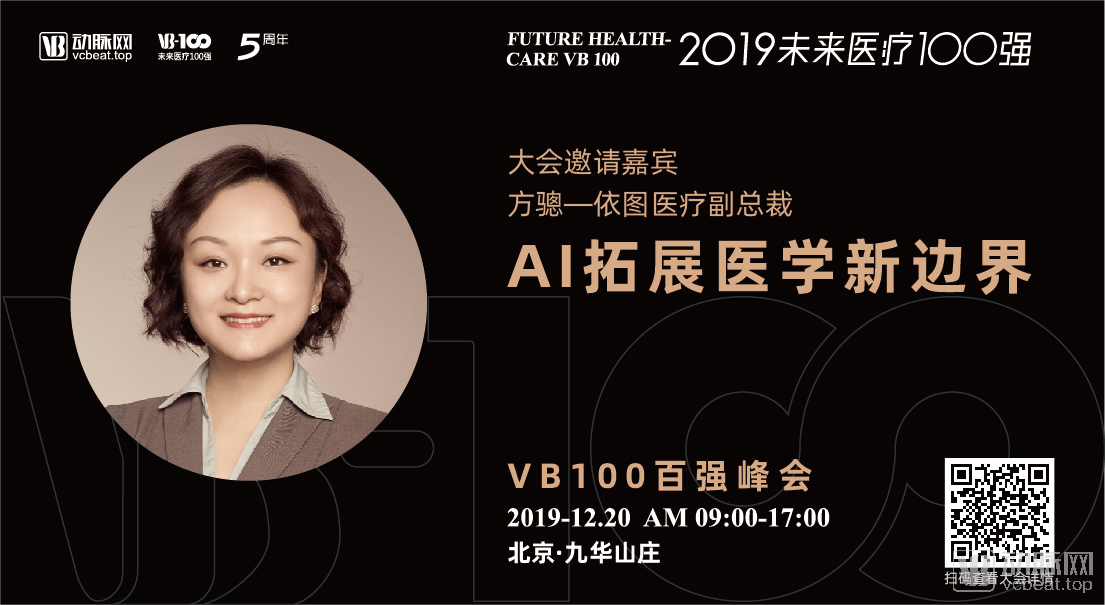
The advancement of screening and prevention initiatives has given Yitu a deeper understanding of the challenges facing primary healthcare. Recently, VCBeat interviewed Fang Cong, Vice President of Yitu Medical; no one is more acquainted with the trials and tribulations involved in creating the “Cancer Prevention Map” than she is.
“How difficult is it to promote the ‘Cancer Prevention Map’? The primary concern is cost. ‘Such a screening and prevention project often requires substantial medical resources: technical staff must be allocated for operation; CT scanners need to be reserved for these examinations; primary-care physicians are responsible for image acquisition; and senior physicians must interpret and review the images.... If these inputs are quantified, the cost per examination approaches 1,000 yuan. However, at the hospitals where we have implemented this program, the service is provided free of charge, with the aim of encouraging more patients to participate in early cancer screening,’ Fang Cong told VCBeat.”
However, capital investment is often the easiest part. The most difficult hurdle for the “Cancer Prevention Map” does not lie in the project design itself. Patient resistance to screening and prevention represents the most severe challenge in the outward expansion of the Cancer Prevention Map.
“A village doctor once told me that a problem she encountered after going to the countryside was patients’ distrust. ‘They all hide from us, believing they are not ill and that we intend to harm them.’ In the implementation of the Cancer Prevention Map initiative, although we have not encountered such intense rhetoric, this resistance becomes more pronounced as we move into poorer areas; even some patients who participated in the first round of screening refused subsequent follow-up after being found to have no issues, thereby preventing definitive diagnosis. Overall, many people lack awareness about cancer or other forms of disease,” explained Fang Cong.
Therefore, YITU’s support for early cancer screening initiatives follows a dual-track approach. One track involves collaborating with physicians to conduct community-based patient education, raising awareness about the importance of screening and prevention. The other track leverages AI and other technologies to enhance diagnostic and treatment capabilities at primary care hospitals, providing patients with screening results and recommendations once they consent to participate. Only by simultaneously advancing both public awareness and healthcare infrastructure can we hope to resolve the challenges facing primary care.
At the launch of the “AI Cancer Prevention Map,” Yitu Medical CEO Ni Hao explained the direction of the “Cancer Prevention Map” at the press conference.
“The AI Cancer Prevention Map primarily comprises two components. First, we aim to provide technical and financial support to hospitals conducting screening services, thereby enhancing their screening capabilities and accelerating the expansion of cancer screening coverage. Second, we will collaborate with hospitals on select research projects, such as establishing prospective cohorts to track cancer patients and attempting to derive insights from a genetic perspective to uncover patterns of disease among cancer populations. Through these research initiatives, we hope to guide and optimize the implementation of early cancer screening.”
These two directions imply the two goals of Yitu Medical's development.
The primary objective is to facilitate the initiation of cancer-related projects. Although numerous cancer-specific screening programs have been implemented in the past, there has been minimal integration of artificial intelligence. Therefore, Yitu Medical’s current endeavor will yield more real-world data, laying a solid foundation for the future approval of dedicated AI research initiatives.
The second objective is to expand into grassroots healthcare. After AI companies have fully penetrated tertiary hospitals, it has become evident that the value of AI should not be confined to these institutions, which boast high-quality physician resources and comprehensive medical record data. On the contrary, given China’s vast territory and abundant resources, many remote areas—even outlying towns within cities—severely lack auxiliary tools and health information technologies. Although these regions may not possess high-quality data, they have an inherent demand for such solutions.
Furthermore, cultivating residents’ awareness of screening and prevention will directly increase their demand for such services. One of the most significant advantages of artificial intelligence today lies in its ability to alleviate the screening and prevention workload in radiology departments through intelligent solutions, creating a win-win situation for both residents and physicians.
Therefore, Professor Jin Zhengyu, Chairman of the Chinese Society of Radiology and Director of the Department of Radiology at Peking Union Medical College Hospital, provided an assessment on the continued in-depth development of the “AI Cancer Prevention Map” following his participation in the summary meeting for the “Cancer Prevention Map.” He stated, “Radiologists are a crucial force in early cancer screening. The application of AI technology in early cancer screening is becoming increasingly sophisticated, with growing experience. I am confident that as the ‘AI Cancer Prevention Map’ is implemented in more provinces and municipalities across China, the level of early cancer screening, prevention, and treatment in the country will be further enhanced.”
2019 was not a friendly year for artificial intelligence. In contrast, YITU made simultaneous strides in both scientific research and product development, not only creating a public-benefit “Cancer Prevention Map” but also developing numerous hospital-deployed products, such as the care.ai multi-omics intelligent research platform and an intelligent one-stop solution for children’s growth and development.
Taking multi-omics intelligent research platforms as a case for horizontal comparison, many existing research platforms on the market either focus on radiomics or on textual data analysis. While these platforms have relatively low technical requirements, they are limited to conducting research within the dimensions of imaging or statistical analysis, failing to meet the increasingly complex demands of clinical research. Integrating multimodal massive data—including electronic health record texts, imaging data, and clinical information—as “fuel” for scientific research can facilitate high-level studies that are more closely aligned with clinical needs; however, this approach presents significant technical challenges.
In response to this scientific research trend and demand, the care.ai Multi-Omics Intelligent Research Platform integrates core technologies such as advanced image processing, natural language processing, and medical knowledge graphs. It consolidates massive, multi-dimensional data—including patient imaging, pathological data, genomics, and clinical information—to facilitate multi-omics research.
“The refinement and analysis of information permeate every stage of scientific research. Medical research often requires the integration of multi-dimensional data to achieve breakthroughs. The capability to integrate multi-dimensional data, extract high-dimensional information, and the level of intelligence in data analysis directly determine the efficiency and quality of scientific outcomes,” explained Shi Lei, Vice President of Yitu Healthcare, when discussing the original intention behind building this platform.
Furthermore, in Fang Cong’s view, the three dimensions of technological products, business strategy, and market strategy also help explain YITU’s current situation.
“The development trajectory of new technologies is invariably curved. Since AlphaGo propelled AI companies into the spotlight in 2016, the industry has been characterized by a bubble. Today, we are witnessing a return to rationality. Specifically, when physicians and investors evaluate AI products, they look beyond whether a product merely carries the ‘AI’ label; instead, they assess whether it embodies genuine AI technology—possessing true ‘AI DNA’ and delivering tangible value to clinicians. The AI industry has significant barriers to entry; a CAD team cannot transform into an AI team overnight. Therefore, YITU’s competitive strength lies in the data and experience accumulated through long-term collaboration with radiologists and clinicians. AI products that align with physicians’ workflows and meet clinical needs are taking root in major hospitals.”
Second, whether a company’s product capabilities are truly recognized by physicians depends not merely on its performance on public datasets, but rather on its adoption volume in top-tier tertiary hospitals and the reputation among clinicians. These physicians’ evaluations are crucial, as their endorsement can, to a certain extent, reflect the quality of YITU AI products.
Third, in terms of market strategy, YITU has developed a series of product solutions centered around the core capabilities of its products. For instance, with its bone age assessment software, YITU can partner with health examination centers to deploy SaaS-based services, catering to children in developed cities. Alternatively, it can be integrated into a one-stop bone age assessment solution for deployment at the grassroots level, thereby reaching cities not covered by SaaS offerings. Thus, YITU has been continuously exploring through practice the optimal form AI enterprises should adopt to enable target customers to access products that best match their needs at the lowest cost.
In addition to YITU’s internal strategic support, the external policy environment is also shifting in a favorable direction.
In November 2019, the National Development and Reform Commission (NDRC) issued the “Order of the National Development and Reform Commission of the People’s Republic of China” (No. 92), which included AI-assisted medical devices in Category 5 of the encouraged industries. As a result, a range of artificial intelligence companies, including YITU, are expected to receive greater support in the future.
Nevertheless, YITU, with its clear strategic deployment and alignment with policy directions, has not retreated from the “deep water” zone. In terms of commercialization and scientific research, YITU is examining the optimal fit with greater clarity. Going forward, the market will serve as the ultimate test of YITU’s product strength and commercial value.