

WoFu Tech Files IPO Prospectus: Pioneering RFID-Based IoT System for Single-Dose Narcotic Drug Traceability in Hospitals
“The state has attached increasing importance to the regulation of pharmaceuticals, particularly narcotic and psychotropic substances. From a policy perspective, their management has long been incorporated into national legislation. Currently, major medical institutions are actively aligning with these requirements, which indirectly validates the correctness of our decision in 2014.” The decision mentioned by Lv Jun, founder of Wofu Technology, during an interview can be traced back to the very beginning of his entrepreneurial journey.
Lu Jun did not come from a family with a medical background; on the contrary, he was deeply entrenched in the field of IT and informatization. Initially responsible for production scheduling at Shanghai Petrochemical, this experience later served as a reference for Lu Jun’s development of an Internet of Things (IoT) system for pharmaceuticals (drug scheduling). In 2002, Lu Jun left Shanghai Petrochemical to join Shanghai Jiehua, a company specializing in system integration services, where he was first exposed to RFID technology.

Lu Jun, Founder of WoFu Technology (Image provided by the company)
RFID, or Radio Frequency Identification, is a non-contact automatic identification technology that enables RFID devices to establish direct connections with tags through paper, wood, and various other obstacles, facilitating rapid data reading and writing. Furthermore, each RFID tag is unique; by leveraging the binding relationship between RFID tags and products, the subsequent circulation status of each product can be clearly tracked.
The most common applications of RFID technology in daily life are in the identification systems for public transit cards and access control cards; indeed, some smartphones with NFC functionality have themselves become RFID readers.
Although RFID technology is now commonplace, it was just gaining traction in China in 2005. That same year, Lv Jun joined Neology, a U.S.-based global leader in the RFID sector. There, he received systematic training in RFID, gradually recognizing its application value and vast growth potential. Lv Jun predicted that RFID would emerge as a sunrise industry in the future.
In 2007, while conducting a nationwide survey on RFID technology in China, Lu Jun discovered that this people-benefiting technology actually suffered from a break in the industrial chain. Although source technologies were available and end-user demand existed, there was a lack of basic components to connect the two, a shortage of corresponding application-level products, and very few enterprises engaged in related research and development.
“If a system can describe it, it can manage it.” This is a statement made by Lü Jun in an interview. RFID technology can identify information and help systems “describe” it. So, can a system equipped with RFID technology achieve management of target objects? The answer is yes. After extensive research and investigation across multiple fields, Lü Jun ultimately decided to apply RFID technology to the healthcare industry, which has extremely high management requirements.
In 2009, Lü Jun made his initial foray into the field of mobile nursing with handheld RFID terminal products, which were well received by major hospitals. By 2014, Lü Jun had transformed from an outsider in the healthcare industry into an innovator of medical application products. However, a standalone mobile nursing RFID product was not the ultimate goal he sought to achieve; rather, he aimed to further unlock the value of RFID to empower the healthcare industry.
“Sometimes, you will find that the opportunities in the industry gradually become apparent.” The opportunity referred to by Lv Jun is the increasing emphasis hospitals are placing on the management of pharmaceutical processes.
Integrating RFID technology into the entire process of in-hospital medication management was the original intention behind Lv Jun’s founding of Wofu Technology. While hospitals already have well-established automated management systems for conventional box- and bottle-packed medications, the management of single-dose injectables within hospitals still relies on manual operations. Human error in such manual processes is inevitable. Replacing manual handling with an automated single-dose injectable management system would not only free up labor resources but also reduce the incidence of medical accidents. Lv Jun stated, “The state has enacted specific legislation for the management of narcotic and psychotropic drugs. As single-dose injectables represent the primary form of these controlled substances, their management is more challenging than that of boxed oral or topical medications. What Wofu Technology aims to achieve is to streamline the upstream and downstream processes associated with the most difficult aspect of managing narcotic and psychotropic drugs.”
Founded Wofo Technology in 2014; completed the prototype production of the IoT system for narcotic and psychotropic drugs in 2015, and filed relevant patents; in 2017, Lianyungang First People's Hospital in Jiangsu Province tested and purchased the first batch of Wofo Technology’s products, and the evaluation experts gave high praise to the system during the hospital accreditation review.
What exactly is the form of Woofu Technology’s IoT system for controlled substances, which received high praise from the judges? And what makes it stand out? Lü Jun lifts the veil on this system for readers.
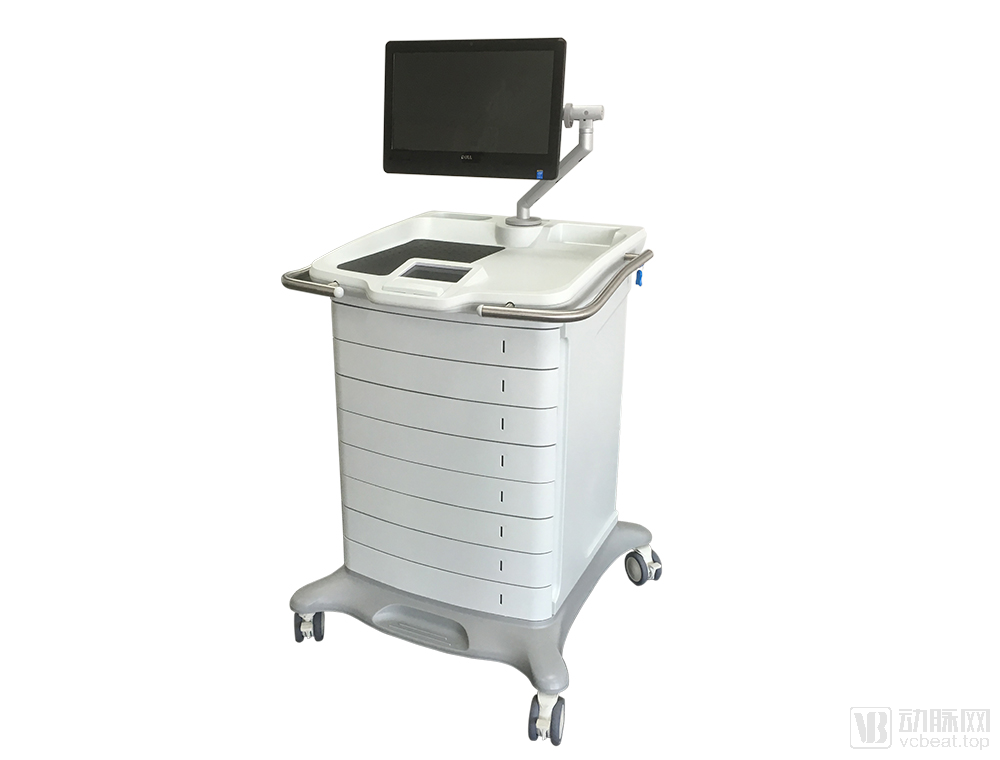
Intelligent Drug Workstation (Image provided by the company)
“Vivid understanding means that we place each ampoule into our RFID-tagged containers.” Unlike traditional pharmaceutical logistics management, which relies on externally affixed barcode labels, Lv Jun explained that their ampoule management system involves placing the ampoules inside containers equipped with RFID tags. This approach was adopted primarily for two reasons: safety and efficiency.
Lv Jun joked that when Wofo Technology first began building its IoT system for narcotic and psychotropic drugs, it had considered using externally attached barcode labels. However, field research revealed that most hospitals rejected this labeling approach for managing such drugs, as it required warehouse staff to manually apply each label individually, significantly increasing labor costs.
Second, if RFID electronic tags are used as single-use items, their metal components will result in significant heavy metal waste upon disposal, thereby creating new challenges for subsequent medical waste management.
Considering these two points, WoFu Technology ultimately adopted recyclable containers as RFID tags. When narcotic and psychotropic drugs are purchased by the hospital, warehouse staff only need to count the drugs once while unloading them from the truck and place them into the RFID-tagged containers, establishing a one-to-one binding relationship. Subsequently, each individual vial of narcotic or psychotropic injection can be directly managed through the system, eliminating the need for secondary counting.
Some may question whether the one-to-one binding between RFID-tagged containers and controlled substance injections could be manually severed. If this link is not secure, the entire system would be rendered futile.
“Narcotic and psychotropic injectables cannot be manually removed from RFID-tagged containers unless the containers are shattered.” This was Lü Jun’s response. “RFID-tagged containers securely lock narcotic and psychotropic injectables, providing a certain level of protection. We have obtained relevant patents for the container’s closure mechanism. The only way to open an RFID-tagged container is through system software operations, which allow medical personnel to retrieve the narcotic and psychotropic drugs from the container.”
Supported by Wofoo Technology’s Controlled Substance Management System, every instance of controlled substance retrieval by hospital medical staff is recorded by the computer system. The system also intelligently generates prescription orders based on these retrieval records, significantly saving physicians’ time and enhancing work efficiency.
On April 19, 2019, the National Medical Products Administration (NMPA) released two information technology standards: the Guidelines for the Construction of a Drug Information Traceability System and the Coding Requirements for Drug Traceability Codes (hereinafter referred to as the “Requirements”). The Requirements explicitly state that all levels of drug sales packaging units shall be assigned codes, and the carriers for drug traceability codes may include one-dimensional barcodes, two-dimensional barcodes, orRFID Tagetc., and must be simultaneously readable by both devices and the human eye.
Among these, the RFID tag—officially approved by the government as one of the carriers for building a drug traceability system—was already applied by Wofu Technology to its drug traceability management system five years ago. This foresight has contributed to Wofu Technology’s current success. The Internet of Things (IoT) system for narcotic and psychotropic drugs developed by Wofu Technology enables end-to-end process management, breaking away from the conventional mindset of single-link management. The product has initially gained popularity among medical institutions and has already achieved preliminary profitability.
However, Lü Jun emphasized that Wofu Technology’s next step is to formally promote its products nationwide through channel distribution, with only limited preliminary sales conducted thus far. Currently, Wofu Technology has completed its seed, angel, and Pre-A financing rounds. The company has also launched a new round of fundraising, aiming to raise RMB 10 million, which will be primarily used for nationwide product promotion and the subsequent research and development of complementary products.
Currently, WoFu Technology is seeking a new round of financing. Interested parties please contact VCBeat’s financing assistant, Xiao Yun: DongMai_Investent