

Seizing the Opportunity in Cardiothoracic Surgery Development: A Vision from Dr. Sun Lizhong at FTC2019
Among all human organs accessed by the surgical scalpel, the heart is undoubtedly the most unique. The heart beats continuously, supplying the body with the energy and oxygen necessary to sustain life. However, during cardiac surgery, the heart must be stopped and its blood evacuated.
The advent of cardiopulmonary bypass technology has enabled surgeons to perform cardiac procedures with precision after opening the patient’s heart. Professor Sun Lizhong (President-Elect of the Chinese Society of Cardiothoracic Surgery, Chinese Medical Association; Chairman of the Cardiac Surgery Committee, China Medical Education Association; Chairman of the Cardiovascular Surgical Technology and Engineering Branch, China Medical Biotechnology Association; Director of the Center for Cardiac Surgery, Beijing Anzhen Hospital) pointed out that the reliance on cardiopulmonary bypass is a major feature distinguishing cardiac surgery from other surgical specialties. “As a non-physiological process, cardiopulmonary bypass serves both as a protective measure and as a significant perturbation to the human body, inevitably causing trauma.”
Another characteristic of cardiac surgery is that the functional properties of the heart make these procedures extremely challenging. On one hand, the vast majority of cardiovascular surgeries are reconstructive rather than destructive, as is common in general surgery; after excising diseased tissue from the patient, surgeons must replace it with healthy tissue. On the other hand, the heart must resume function immediately after the procedure, necessitating that operative time be minimized.
“No other specialty relies as heavily on teamwork as cardiac surgery,” pointed out Director Sun Lizhong. Cardiac surgical procedures require robust team collaboration, involving multiple disciplines with distinct knowledge systems, including cardiac surgery, diagnostic imaging, surgical treatment, anesthesiology, and postoperative critical care.
In a sense, cardiovascular surgeons serve as the central link of the team. Preoperatively, they design surgical plans based on diagnostic data and inform relevant personnel from all participating departments; postoperatively, they communicate the patient’s specific conditions to the intensive care unit physicians to ensure a smooth recovery.
Despite the high investment and slow returns associated with cardiac surgery, as a leading specialty, its disciplinary development serves as a strong catalyst for the advancement of other hospital departments, making it an indispensable component of hospital growth. Director Sun Lizhong emphasizes that cardiac surgery constitutes a comprehensive system; it cannot be defined merely by a small group of physicians forming a minor department. Instead, it requires coordinated support from related departments to establish a truly functional cardiac surgery program.
In China, the development of cardiac surgery as a discipline remains significantly inadequate. Compared to the United States, with a population of 270 million and 600,000 to 1 million cardiac surgeries performed annually, China, with a population exceeding 1.4 billion, conducts only approximately 240,000 such procedures each year. This vast disparity in surgical volume highlights a substantial unmet need for cardiac surgical care. Although major hospitals in cities such as Beijing, Shanghai, and Wuhan perform over 10,000 cardiac surgeries annually, Director Sun Lizhong emphasizes that this is not the primary direction for professional development. Current healthcare system reforms aim to retain patients for treatment within their local regions. The “Systematic Project for the Standardization of Cardiac Surgery in China,” led by Director Sun Lizhong, is striving to extend cardiac surgical expertise and capabilities to hospitals in third-tier cities and below.
According to Director Sun Lizhong, interventional cardiology procedures are now widely available in county-level hospitals, whereas cardiac surgical capabilities remain relatively weak. “If a hospital does not offer cardiac surgery, performing interventional cardiology procedures carries inherent risks. Should intraoperative complications arise and timely cardiac surgical intervention is unavailable, patient care will be delayed. Therefore, the coordinated development of both cardiology and cardiac surgery is essential in discipline construction. If cardiac surgical expertise cannot be effectively disseminated to lower-tier institutions, the downward expansion of interventional cardiology services will also be hindered.”
Director Sun Lizhong presented data on cardiac surgery procedures in China from 2012 to 2017 during his keynote address at FTC 2019. The data revealed that although the volume of cardiac surgeries maintained a steady upward trend since 2012, the volume of cardiopulmonary bypass surgeries exhibited fluctuations inconsistent with this trend.
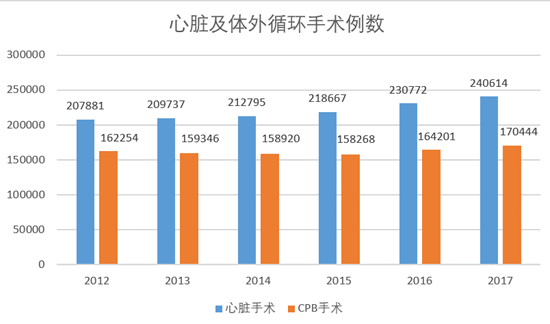
Number of Cardiac and Cardiopulmonary Bypass Surgeries in China, 2012–2017 (Data sourced from Dr. Sun Lizhong’s presentation)
As interventional stents and transcatheter aortic valve implantation (TAVI) continue to enter clinical application, less invasive cardiology procedures are replacing some cardiac surgeries that require cardiopulmonary bypass.
Furthermore, against the backdrop of an aging population, the spectrum of cardiovascular diseases in China has shifted, thereby driving new trends in the clinical practice of cardiac surgery.
On one hand, the patient demographic has shifted. Director Sun Lizhong introduced that in the early years, cardiac surgery primarily focused on treating congenital heart disease. With population aging, among approximately 240,000 cardiac surgeries performed nationwide in China in 2018, surgeries for congenital heart disease numbered about 77,000 cases, still accounting for the highest proportion; valvular heart disease surgeries were fewer than 70,000 cases, coronary artery disease surgeries fewer than 40,000 cases, and aortic diseases ranked fourth but showed an accelerating growth rate.
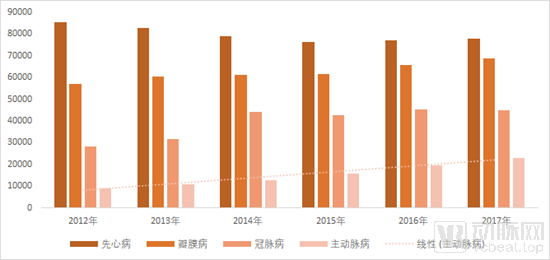
Number of Major Cardiac Surgical Procedures Performed in China, 2012–2017 (Data Source: Presentation by Director Sun Lizhong)
Furthermore, the proportion of heart failure patients undergoing surgical treatment is steadily increasing. In the past, pharmacological therapy was the mainstay for managing heart failure. However, since most heart failure patients in China present with advanced-stage disease resulting from various underlying conditions, there is now a growing trend toward device-assisted therapies, including artificial hearts and intra-aortic balloon counterpulsation. “Artificial hearts are likely to become a crucial modality in the future treatment of heart disease. The demand for cardiac assist devices will increase among both heart transplant candidates and non-transplant patients,” stated Director Sun Lizhong.
On the other hand, since patients with coronary heart disease and large-vessel diseases are mostly elderly, and the number of patients with comorbid cardiac conditions is increasing, a single surgical technique cannot ensure favorable patient recovery. For instance, in patients with coronary heart disease accompanied by diabetes, pulmonary dysfunction, or renal impairment, leading to an overall decline in organ function, the use of assistive devices is required during treatment.
“The changing disease spectrum and age structure have raised the bar for cardiac surgical treatment,” pointed out Director Sun Lizhong.
With the changing disease spectrum, the focus of cardiac surgery development must be adjusted accordingly. The iteration of equipment and consumables, coupled with advances in surgical techniques, will jointly drive the progress of cardiac surgery.
Over the more than 60-year development of cardiovascular surgery in China, surgical techniques have not been the sole limiting factor; often, inadequacies in materials or equipment at certain stages have prevented some patients from receiving treatment. Director Sun Lizhong believes that every surgical advancement in cardiovascular surgery over the past six decades reflects broader societal progress.
Director Sun Lizhong pointed out that the development of cardiac surgery requires a continuous shift in mindset. Traditionally, hospitals at all levels have primarily focused on treating patients requiring open-heart surgery. With the ongoing improvement of primary-care cardiac surgery infrastructure, while more patients with single-entity heart diseases can be managed and treated at the primary care level, tertiary hospitals should focus on developing new treatment protocols for emerging or complex disease entities.
Taking complications of coronary heart disease (CHD) as an example, hospitals have traditionally prioritized coronary artery bypass grafting (CABG) within cardiac surgery departments. However, they were often unable to provide effective treatment for ischemic cardiomyopathy, a late-stage complication of CHD that is refractory to both percutaneous coronary intervention and CABG. The development of ventricular assist devices has enabled the treatment of more patients with chronic heart failure. Director Sun Lizhong believes that tertiary hospitals and senior physicians should take the lead in innovating treatments for new refractory diseases, “actively managing conditions that were previously untreatable or rarely treated.”
Director Sun Lizhong told VCBeat that with the advancement of disciplines and technologies, future hospitals will exhibit a trend toward increasingly specialized techniques and increasingly blurred departmental boundaries. “This is most beneficial to patients, as they often do not know which treatment method suits them best. While physicians deepen their professional expertise, they formulate the most appropriate treatment plans for patients through cross-departmental collaboration.”
Furthermore, Director Sun Lizhong shared his insights on the global expansion of medical technologies and products. He believes that the growth in clinical volume is not merely about promoting technology domestically; rather, integrating with national strategies such as the “Belt and Road Initiative” to promote technology abroad will create greater opportunities. Director Sun pointed out, “Many countries require our technological and equipment support, which will provide a broader platform for cardiovascular surgery professionals. In the past, we primarily imported technologies and products from abroad. After years of effort, our product quality has significantly improved and innovated. Moving forward, expanding into overseas markets holds immense potential and is essential for domestic development.”