

Interdisciplinary Experts Gather in Beijing to Discuss the Future of Smart Healthcare at 'Smart Healthcare: Potential and Challenges Forum'
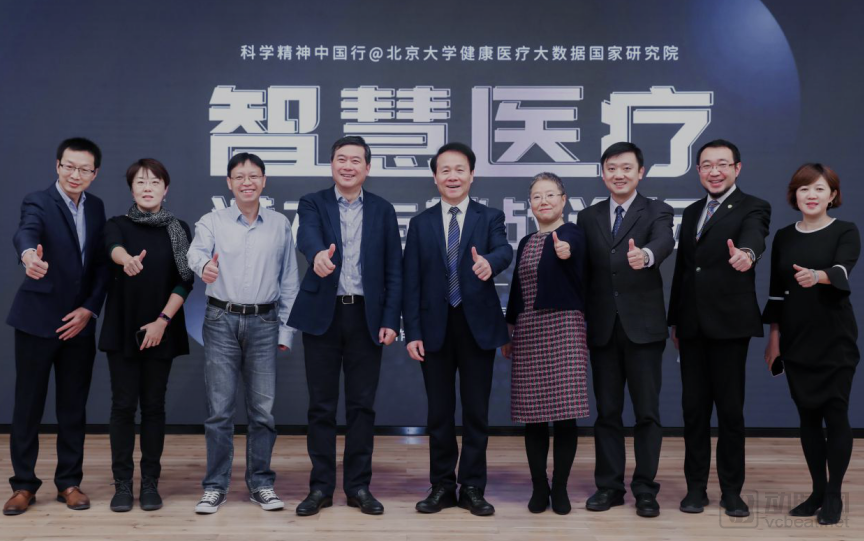
"Smart Healthcare: Potential and Challenges Forum" Held in Beijing
On November 22, the “Smart Healthcare: Potential and Challenges Forum” (hereinafter referred to as the “Forum”), jointly organized by the science-focused new media platform “The Intellectual” and the National Institute of Health Data Science at Peking University, and exclusively supported by Tencent’s Tengyun Think Tank, was held at the Peking University Health Science Center. Attendees included Professor Zhan Qimin, Academician of the Chinese Academy of Engineering, Executive Vice President of Peking University and Director of the Peking University Health Science Center; Professor Dong Jiahong, Academician of the Chinese Academy of Engineering, Dean of the School of Clinical Medicine at Tsinghua University and Director of the Institute for Precision Medicine at Tsinghua University; Professor Cong Yali, Director of the Center for Ethics and Law at the National Institute of Health Data Science at Peking University; and Dr. Zheng Yefeng, Director of Medical AI at Tencent Youtu Lab. The Forum was moderated by Professor Wang Haibo, Deputy Director of the Research Center for Health and Medical Big Data at Peking University.
At the outset of the conference, Academician Zhan Qimin extended a warm welcome to the attendees and emphasized that the forum’s theme—smart healthcare—is a highly significant topic. He noted that smart healthcare is not confined to a single domain but involves extensive interdisciplinary and cross-sector collaboration. “I look forward to this forum sparking innovative ideas and driving progress in this field,” he stated.
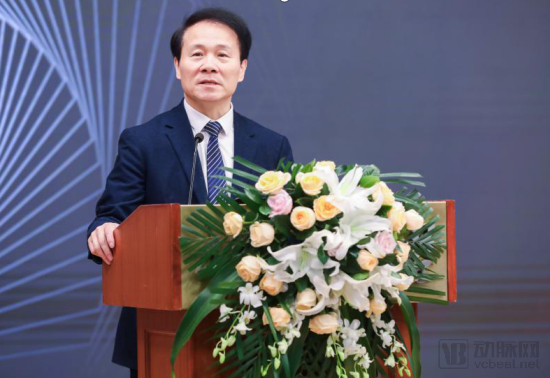
Academician Jian Qimin (Photo: Song Honghai)
Zhan Qimin stated that “Healthy China” is a current national strategy and an important approach to addressing public livelihood concerns and meeting the health needs of the general population. The year 2020 was a critical year for completing the building of a moderately prosperous society in all respects; however, there can be no comprehensive prosperity without universal health. Currently, the healthcare sector still faces significant challenges. Major diseases—such as malignant tumors, cardiovascular and cerebrovascular diseases, neurodegenerative disorders, rare diseases, birth defects, and infectious diseases—remain constrained by limited medical interventions and a lack of understanding of many underlying scientific issues. Moreover, clinical practice relying solely on manual labor is highly inefficient. In addition, the uneven distribution of medical resources across China remains a prominent issue, with inadequate healthcare resources in vast grassroots areas and impoverished mountainous regions. Addressing these challenges requires innovation-driven strategies that integrate advanced high-tech solutions into medical practice to advance medicine, thereby enabling the realization of smart healthcare.
Zhan Qimin believes that smart healthcare, as a new medical model, holds promise for addressing public health issues. It serves not only as a key lever for disease prevention and control but also as a vital driver for the development of the health economy, making it a priority area in national strategic planning. However, its development faces challenges related to personal data privacy, intellectual property rights, and ethics, necessitating interdisciplinary collaboration and dialogue.
Academician Dong Jiahong delivered a speech titled “Smart Healthcare: Big Health, New Ecosystem.” He pointed out that smart healthcare, grounded in the Fourth Industrial Revolution, is leading the integration of cutting-edge technologies into all levels of health and medical services. This integration will drive transformations in supply and demand as well as innovative models, ushering in a new era of smart healthcare.
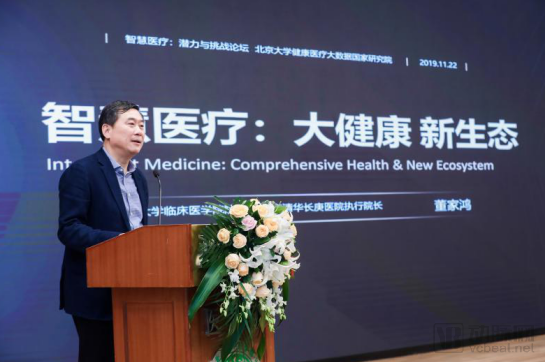
Academician Dong Jiahong (Photo: Song Honghai)
He stated that the application scenarios of smart healthcare include precision medicine, medical imaging diagnosis, clinical decision support, disease risk prediction, drug discovery, as well as mobile health management, hospital administration, and clinical research platforms. “As smart healthcare technologies become further integrated into various domains of medical practice, they will continue to unlock the innovative potential of smart healthcare,” said Academician Dong.
Subsequently, Academician Dong provided a detailed explanation of the significant efficacy of integrating smart healthcare into practice, using the “4 Es” as a framework. The “4 Es” refer to Enhancement, Efficiency, Experience, and Extension. These correspond respectively to strengthening the technical capabilities of health and medical services, improving the efficiency and effectiveness of healthcare delivery, optimizing the patient experience, and expanding the temporal, spatial, and geographical reach of medical services. In discussing how smart healthcare can drive the future development of medicine, Academician Dong further pointed out that “smart healthcare must be people-centric, integrate modern smart technologies, and deeply fuse with health and medical practices, aiming to create a new ecosystem for comprehensive health and medical care.”
At the conclusion of his speech, Academician Dong stated that smart healthcare would drive innovation across the entire ecosystem, with transformations on both the demand and supply sides reshaping China’s medical model and facilitating the transition of the health and medical industry. Within the smart healthcare framework, smart hospitals will deliver high-quality medical services to patients through cross-institutional interoperability, automated and efficient operations, end-to-end experience redesign, big data-driven decision-making, and continuous innovation mechanisms. By integrating a well-developed smart elderly care system, a smart prevention system, and personal health records, this approach will effectively address the longstanding challenges of difficult access, high costs, and disordered processes in seeking medical care for residents.
“Smart hospitals and smart medical consortia will align with the national Healthy China strategic plan. By adopting a grid-based layout for medical consortia, they will deliver integrated, continuous smart healthcare services through urban medical groups and county-level medical communities. This approach will provide network support for healthcare services across all five levels—province, city, county, township, and village—thereby promoting and delivering comprehensive coverage of smart healthcare services,” summarized Academician Dong.
Dr. Zheng Yefeng drew on the practical experience of Tencent’s YouTu Laboratory to provide a detailed overview of various applications of artificial intelligence (AI), represented by deep learning, in healthcare settings. Taking speech recognition as an example, Dr. Zheng pointed out that AI can now structure medical records and digitize them, thereby significantly simplifying the process of searching through case histories. AI can assist physicians in making diagnoses by providing scientific and rational diagnostic recommendations based on clinical guidelines, scientific literature, and large volumes of real-world case data. Furthermore, triage services and computer-aided analysis of medical imaging are among other practical applications of AI in the healthcare sector.
Zheng Yefeng noted that AI applications in the field of medical imaging have been quite successful and hold immense potential. He introduced that there is substantial demand for medical imaging equipment in China, which is projected to grow at a near double-digit rate over the next few years. While the volume of medical imaging data will also increase significantly, the annual growth rate of radiologists is only 4%. AI-assisted imaging technology can effectively address this supply-demand imbalance. To achieve this, it is necessary to overcome challenges such as the scarcity of training samples and the need for professional annotation of medical data. Currently, promising approaches include developing transfer learning techniques and building open-source platforms to mitigate the issue of insufficient sample sizes. Meanwhile, Tencent Youtu Lab has open-sourced a series of pre-trained models specifically developed for deep learning applications in 3D medical imaging, thereby promoting industry development.
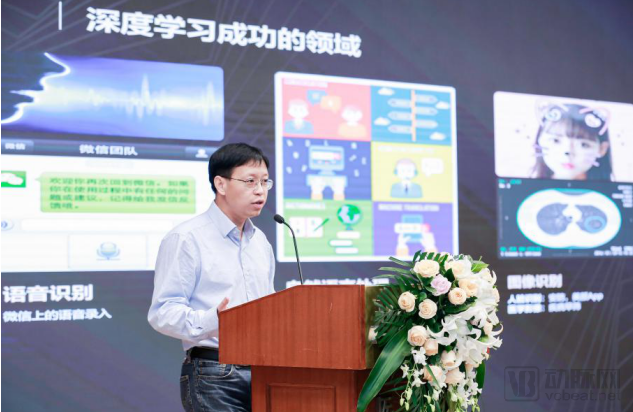
Dr. Yefeng Zheng (Photo: Li Lei)
Professor Cong Yali raised ethical concerns regarding smart healthcare, particularly the AI technologies employed within it. “How should we ethically approach artificial intelligence? If we view AI positively and recognize its benefits, we can proceed with its development; but if a fatal error occurs, who will be held accountable? Should we then halt its development?”
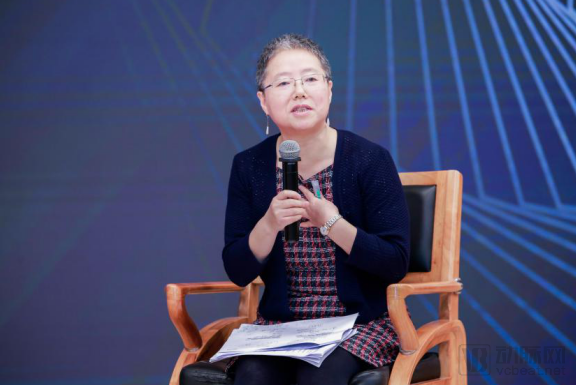
Prof. Cong Yali (Photo by Li Lei)
Professor Cong Yali’s remarks also sparked further discussion among several panelists. Academician Dong Jiahong pointed out that the issue should be considered from both scientific and ethical perspectives. First, the human body is highly complex, and diseases are extremely intricate. Therefore, errors are inevitable in healthcare services for humans. Medicine has developed through a process of trial and error, continuously refining the principles, methods, and techniques of diagnosis and treatment. While advanced technology can indeed help physicians make more accurate judgments, better decisions, and more precise interventions, it cannot completely eliminate errors. Technological development may take detours, and artificial intelligence (AI) is no exception. Since physicians often rely on technological tools as the basis for their decision-making, and AI already provides sophisticated technical support in this area, there is a risk that physicians could be misled by AI. Of course, this is an unavoidable challenge in the course of human and technological advancement; nevertheless, physicians remain the ultimate decision-makers. With technological progress, physicians should strengthen their training and learning to better understand the supportive role and limitations of AI-assisted decision-making, enabling humanity to leverage AI more effectively and accurately at a higher level of wisdom. The development of science also imposes higher demands on modern physicians.
Dong Jiahong stated that due to the complex variability of individual diseases and normal inter-individual differences, physicians must ultimately make the final decisions. “If we require doctors to follow machine-driven decisions, numerous problems will arise. Robotics can enhance the precision and controllability of surgical procedures, but it is imperative that physicians remain in control of the robotic systems. Therefore, we must recognize that AI serves as an assistant to physicians, rather than acting as an ‘AI doctor.’” He further elaborated, “I believe human–machine collaboration is the inevitable path forward. Uncertainty always exists; while machines seek certainty, they enable physicians to more accurately grasp those certain elements. However, uncertainty persists indefinitely, and managing this uncertainty relies on physicians’ experience. Thus, medicine is both a science and an art. We rely on artificial intelligence, yet we cannot depend on it entirely.”
Dr. Zheng Yefeng stated, “At this stage, the development of artificial intelligence technology should focus on addressing specific problems, improving algorithmic accuracy, and enabling collaboration with physicians to enhance the healthcare environment. There are many areas in this field that require our vigorous promotion.”
Regarding the boundaries of future “strong artificial intelligence,” several panelists agreed that the positioning and assessment of AI—including the potential establishment of “red lines” for AI to safeguard humanity’s overall interests—should be determined through interdisciplinary collaboration among experts in science, technology, law, ethics, and other fields. Broad participation from all sectors of society in these discussions is essential to build a wide consensus, which will ultimately define the trajectory and limits of artificial intelligence.