

Apostle Bio Launches IPO: Pioneering Nanomagnetic Bead Technology for Liquid Biopsy and Early Cancer Detection
In Zeng Wenqi’s view, it is the dedication to scientific research and the rigorous pursuit of originality that have forged Apostle’s “Southern University of Science and Technology Journey.”
In 2017, a team of high-tech talents from Silicon Valley, USA, led by Dr. Ge Dongliang (Founder and CEO of Nanku Zhengtu), returned to China from across the Pacific Ocean, dedicated to technological innovations in applying liquid biopsy technology to areas such as early cancer screening and birth defect intervention.
In just one year since its founding, Nanke Zhengtu was selected as one of the Top 20 Emerging Biopharmaceutical Companies in the United States. This year, Nanke Zhengtu entered into an exclusive global partnership with Beckman Coulter, a leader in the international life sciences sector.
Liquid BiopsyLiquid biopsy involves the sampling and analysis of non-solid biological tissues (primarily blood). It utilizes cell-free DNA (cfDNA) as a biomarker to screen for, diagnose, monitor, and study various diseases, such as tumors. Compared with traditional biopsy, the primary advantage of liquid biopsy is its non-invasive nature, thereby enabling earlier, more efficient, cost-effective, and accurate detection.
Nanke Zhengtu's Proprietary Nanomagnetic Beads, having obtained a PCT international patent. Its registered cell-free DNA extraction kit, together with the matching Apostle MagTouch 1000 automated nucleic acid extractor, can be effectively applied in liquid biopsy applications such as early cancer screening and non-invasive prenatal testing, as reported in Science, 2019;364(6441):696, New Products section.
With multiple proprietary technologies and distinctive products, Nanke Zhengtu has garnered widespread attention from the industry.How Did Nanké Zhengtu Achieve This? How Strong Is the Capability of Nanké Zhengtu, Which Brought Its Technology Back to China?Recently, VCBeat conducted an exclusive interview withZeng Wenqi, Co-founder of Nanke Zhengtu, provided a detailed interpretation of the above issues.
Amid the rapid development of precision medicine, targeted therapies, and immunotherapy, liquid biopsy has garnered significant attention and taken center stage in early cancer screening.
Zeng Wenqi pointed out,# Early Cancer Screening Is Currently a Hot Field. It Faces the Following Major Challenges:
I.Early screening, which primarily relies on endoscopy and tumor markers, has certain limitations., such as poor patient compliance with endoscopic techniques, and insufficient sensitivity or specificity of tumor markers.
II.Early Cancer ScreeningDatabases Requiring Large-Scale Screening of the General PopulationAs a foundational support, it is necessary to integrate resources from various sectors to launch relevant early screening programs.
III. Early screening requires aCost-effective, easily scalable technology platforms and precise computational modelsAs backend support, it is currently under further development.
“Given the aforementioned pain points, how can we elevate early cancer screening to a new level? This is the direction we are currently pursuing and need to break through,” said Zeng Wenqi.
Early cancer screening requires innovative technological advancements, which are fundamentally different from traditional tissue biopsies.Non-Innovative Liquid Biopsy Technology, undoubtedly representing a new opportunity for early cancer screening. In 2017, Nanke Zhengtu was established in Silicon Valley, USA, committed to advancing liquid biopsy technology to new heights.
The Positioning of Nanke ZhengtuTo establish global leadership in the fields of biological sample preparation and clinical diagnostic products, fundamentally enhancing the sensitivity and specificity of liquid biopsy technologies.
Of course, establishing such a positioning is inseparable from its strong team background.
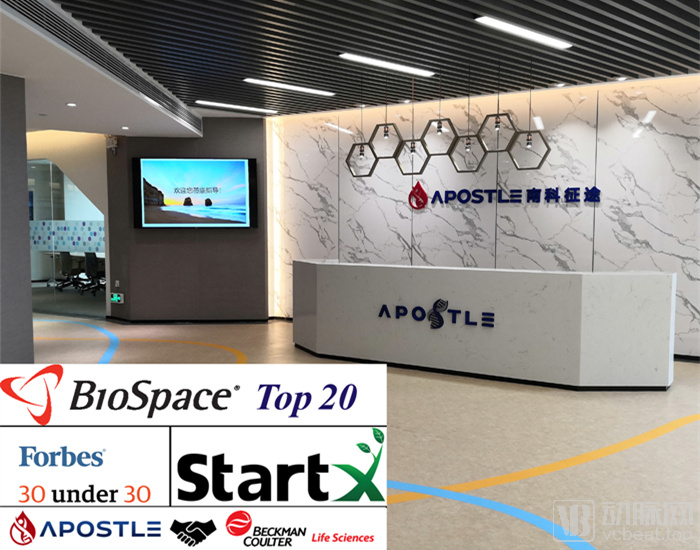
(Caption: Apostle’s China Operations Headquarters for the Southern University of Science and Technology Journey)
Zeng Wenqi introduced that the core team of Nanke Zhengtu consists of 11 overseas-returnee PhDs. Among them, the four founders are all outstanding figures in the industry.Dr. Ge Dongliang, CEO and Founder of Nanke ZhengtuFormer Professor at Duke University, former Director at Gilead Sciences (a Fortune 500 pharmaceutical company), and former President of Vasolens Diagnostics; recognized as one of the “Top 50 Global Pharmaceutical Big Data Influencers” by UK-based phaciliate and named a “Rising Star” by US-based Genome Technology.
Zhang Bo, Co-Founder and Senior Vice President of MedicineHe holds a Ph.D. in Chemistry from Stanford University and was named to the Forbes 30 Under 30 list in 2017. He has authored more than 30 scientific publications, including two articles in Nature Medicine, with his monographs focusing on the diagnosis of human diseases.
Co-Founder and Senior Vice President of Medicine, Wenqi ZengPostdoctoral Fellow at Harvard Medical School; former Senior Director of Clinical Molecular Diagnostics at Quest Diagnostics; former Director of Clinical Laboratory at Ambry Genetics; former Chief Medical Officer at Simcere Diagnostics; and appointed Expert Team Leader for the College of American Pathologists (CAP). Holds certification from the American Board of Medical Genetics and Genomics (ABMGG), CAP/CLIA Molecular Laboratory Director license, and laboratory director licenses in multiple U.S. states, including California, New York, Florida, and Maryland.
Co-founder and Vice President of Bioinformatics, Xin GuoHe holds a Ph.D. from Duke University in the United States, formerly served as Research Group Leader at Gilead Sciences, Inc., and previously held the position of Vice President at Prior Sound Diagnostics. He has authored multiple monographs on AI, including one as the first author published in PNAS.
Meanwhile, Nanke Zhengtu also possessesPowerful Scientific Advisory Board. The scientific advisors include six distinguished scholars, such as Professor Charles Cantor, a member of the U.S. National Academy of Sciences; Professor Dean Felsher from Stanford University School of Medicine; and Professor David B. Goldstein, Dean of the Institute for Genomic Medicine at Columbia University Vagelos College of Physicians and Surgeons.
“With such a strong research team, we position ourselves to develop cutting-edge international technologies, address clinical pain points and challenges, and create the most valuable products,” introduced Zeng Wenqi.
Liquid biopsy refers to the systemic analysis of tumors by detecting biomarkers through the collection of non-solid biological tissues, such as blood samples. The “liquid” in liquid biopsy primarily consists of blood, but also includes urine, saliva, and other bodily fluid samples.
Currently, the biomarkers for liquid biopsy mainly include circulating tumor DNA (ctDNA), circulating tumor cells (CTCs), extracellular vesicles (EVs, primarily exosomes), cell-free RNA (cfRNA), and circulating tumor RNA (ctRNA, with miRNA and cfRNA collectively constituting this category).
“For liquid biopsy, it is crucial to isolate, enrich, and analyze cell-free DNA (cfDNA), which is present at extremely low levels in body fluids.Liquid biopsy currently faces a bottleneck, which isHow to Extract High-Quality and High-Yield ctDNA from Patient Peripheral Blood Plasma.” said Zeng Wenqi.
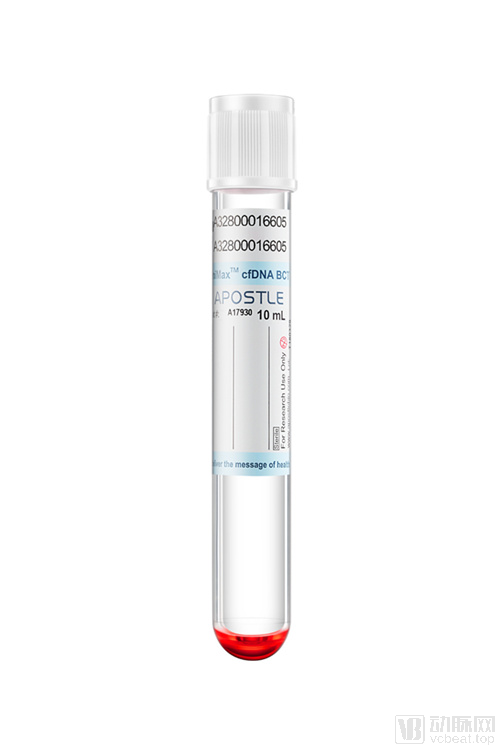
(Figure Caption: Apostle MiniMaxTM Cell-Free DNA Collection Tube)
Scientific research is an arduous journey of exploration. In Zeng Wenqi’s view, the achievements made by Nanke Zhengtu today are inseparable from the team’s countless days and nights spent in the laboratory, as well as their unwavering commitment to innovation.
“At first, we rented a single workbench in Silicon Valley, USA, under very poor conditions. Dr. Zhang Bo spent more than a year immersed in the laboratory; in the absence of an ischemic source, he drew his own blood for experiments, as did Dr. Ge Dongliang.”>1000 mL” said Zeng Wenqi.
Recounting this near-mad behavior, Zeng Wenqi remained calm. He stated that blood samples had been drawn from the founder and each core team member—a routine practice for them as innovators in scientific research.
“Of course, we have also purchased reference standards, refining our products through continuous optimization and validation to gain peer recognition,” said Zeng Wenqi. Hard work pays off.After more than a year of research and development, the innovative technology with international patents originally created by Nanke Zhengtu—nanomagnetic beads—has finally been launched.
What Are Magnetic Nanobeads?In layman's terms, magnetic nanoparticles act like scouts, rapidly capturing cell-free DNA derived from cancer cells in human blood."Nano Magnetic Beads" developed by Nanke Zhengtu,Its core competitiveness lies in its proprietary internal composition and surface chemistry—fundamentally different from conventional superparamagnetic technologies, surpassing mainstream paramagnetic magnetic bead products that have been on the market for 30 years.。
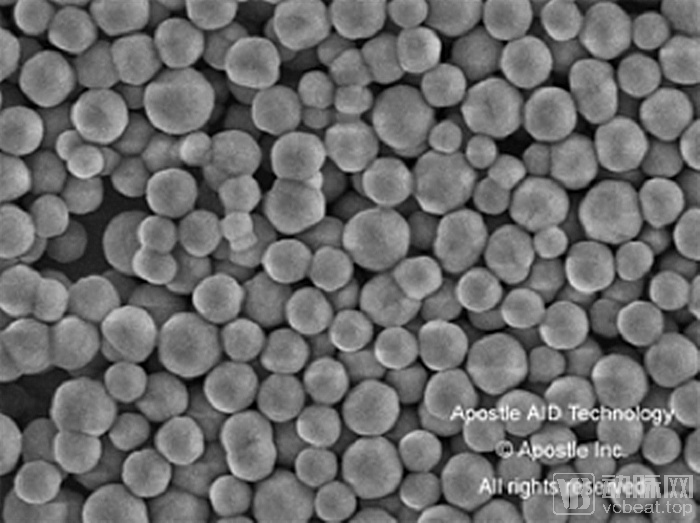
(Figure caption: Apostle Southern University of Science and Technology magnetic beads)
It includes the following key features:I. Smaller Magnetic Bead Particle Size, significantly reducing the interference of magnetic bead aggregation on free nucleic acid extraction;II. Larger specific surface area,To provide more space for sample binding and modification sites;III. Uniform Particle Size Distribution, highly reproducible and efficient enrichment and isolation of cell-free nucleic acids;IV. Outstanding Magnetic Responsiveness, rapid magnetic response enables more effective separation of samples such as free nucleic acids;V. Optimized Surface Chemistry, efficiently adsorbing and separating nucleic acids, proteins, cells, exosomes, and other components from complex biological samples;VI. Enhanced Resistance to Particle Aggregation, significantly reducing the interference of magnetic bead aggregation on free nucleic acid extraction.
“Unlike the single-layer structure of magnetic bead products currently on the market, our developed nanomagnetic beads feature a complex onion-like structure,”The structure consists of four layers from the outside in, offering the advantages of better inhibiting the adsorption and aggregation of non-target cell-free nucleic acids, protecting the magnetic core, and enhancing stability.。“Magnetic bead-based kits can enrich and isolate small fragments of cell-free DNA, a technology that currently leads the field internationally,” Zeng Wenqi told VCBeat.
He introduced that, leveraging this independently developed core patent, they have created a solution for processing cell-free nucleic acid samples in liquid biopsy, which can be applied to clinical testing in various areas such as early cancer screening, early diagnosis, monitoring, treatment guidance, and non-invasive prenatal testing.
Outstanding innovative achievements have become the hallmark brand that enabled Nanke Zhengtu to rapidly penetrate the market.
Since the advent of nanomagnetic beads, Nanke Zhengtu has accelerated the research and development of a series of technologies for early cancer screening, including: Apostle MiniMax® high-efficiency cell-free nucleic acid preservation technology, Apostle MiniMax® high-efficiency cell-free nucleic acid extraction and purification technology, Apostle MiniGenomics® genomic DNA extraction and purification technology, Apostle MagTouch automated nucleic acid extraction platform, Apostle Triton artificial intelligence bioinformatics platform, and Apostle SMA-T. SMN1Exon Deletion Detection and Apostle SMA-T HuiCe SMN2Clinical molecular diagnostic techniques such as gene copy number detection.
This year, the two flagship products, the Apostle MagTouch 1000 Automated Nucleic Acid Extraction System and the Cell-Free DNA Extraction Kit, have entered the stages of commercialization and industrial production.
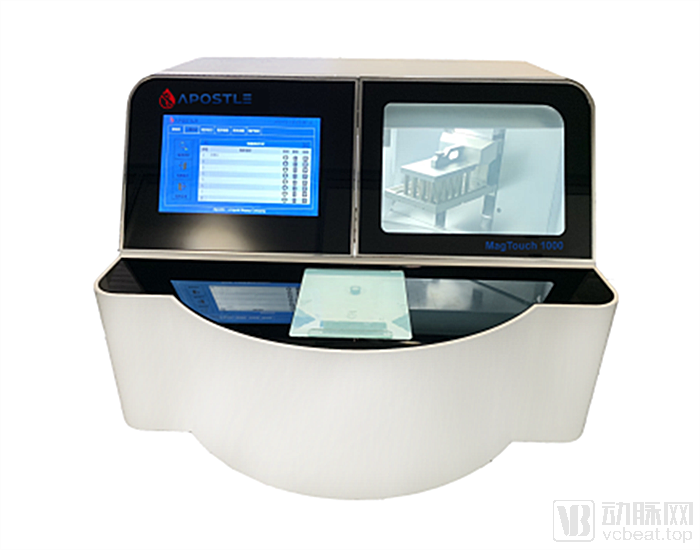
(Figure Caption: Apostle MagTouch 1000 Automated Nucleic Acid Extraction Instrument)
Extraction Instrumentis a high-throughput magnetic bead-based nucleic acid extraction platform, compatible with Apostle MiniMaxTMHigh-Efficiency Cell-Free DNA Enrichment and Isolation Reagent Series and Apostle MiniGenomics Sensitivity BaseTMGenomic DNA Extraction and Purification Reagent Series: Compatible with high-throughput extraction of 24 large-volume samples and 96 small-volume samples, dedicated to providing stable and efficient automated nucleic acid extraction solutions.
Briefly summarized,Test KitIt is a set of chemical reagents that, when mixed with human plasma and used in conjunction with an extraction instrument, enables the enrichment and extraction of cell-free nucleic acids from plasma. The extracted cell-free nucleic acids can then be utilized for various applications, including early cancer screening, tumor companion diagnostics and real-time monitoring of drug efficacy, non-invasive prenatal diagnosis, and monitoring of organ transplant rejection.
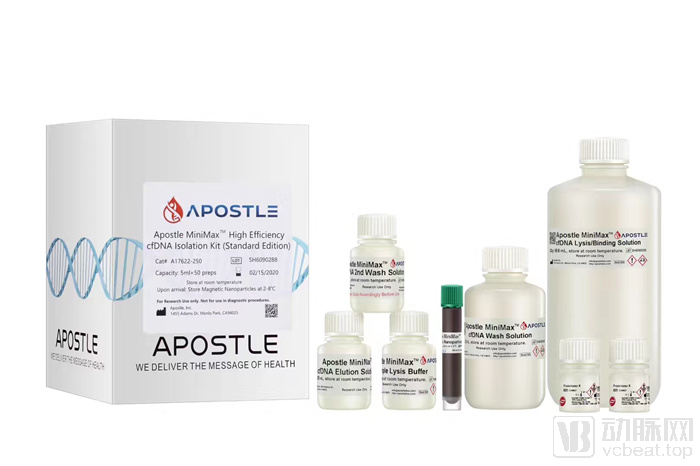
(Figure caption: Apostle MiniMax™ High-Efficiency Cell-Free DNA Enrichment and Isolation Kit (Standard Version))
Cell-free DNA Preservation Tubes and Kits serve as reagents and consumables for the preservation and extraction of cell-free DNA. The extraction instrument, acting as an automated platform for the kits, provides an independent, controllable, and stable operational environment for innovative and efficient nucleic acid extraction technologies. This establishes a complete workflow for cell-free DNA preservation, extraction, and automation, ultimately enhancing the quality of ctDNA.
“The combined use of the kit and the extraction instrument represents an ideal process for biological sample preparation and is currently the recommended method for cell-free nucleic acid sample preparation."Zeng Wenqi introduced."
He stated that, leveraging its leading technological advantages, Nanke Zhengtu entered into a global exclusive sales partnership with Beckman Coulter, a top-three globally ranked life sciences company, in February this year. Furthermore, Nanke Zhengtu has established collaborations with several renowned hospitals in China, and its product technologies have received widespread acclaim within the industry.
“We have established R&D and production centers in both the United States and Shenzhen. In the next phase, we will focus on promoting our products to medical and research institutions worldwide, providing original products and innovative technologies for areas such as early cancer screening and non-invasive prenatal testing,” said Zeng Wenqi.
He stated,In the global fields of biospecimen preparation and clinical testing, Nanke Zhengtu will become an internationally leading provider of innovative technical products, serving a vast global market.
Currently,NanKe ZhengTu is seeking a new round of financing for new product R&D and market expansion.Interested investment institutions may contact them.