

Xiaobai Century Files IPO Prospectus: Pioneering AI-Powered Precision Medicine with Customized Medical Imaging Algorithms
The Yellow Emperor’s Inner Canon states: “The twelve meridians are internally connected to the zang-fu organs and externally linked to the joints and limbs.” This highlights the close, interdependent relationship between the twelve meridians of the human body and the five zang and six fu organs. The human body is an organic whole composed of these organs; internal viscera, limbs, sensory orifices, skin, muscles, tendons, and bones are all interconnected through the meridian network. Thus, a disturbance in one part can affect the entire body, with mutual influence among all components.
Human organs are interconnected, and disease diagnoses are mutually influential. This is the insight gained by Du Qiang, founder of Xiaobai Century, after transitioning from the visual industry to the healthcare sector to engage in the research and development of AI-assisted imaging diagnostic systems. “Diseases themselves are interrelated, and various assisted diagnostic and medical informatics systems are also interconnected. Upon recognizing this, Xiaobai Century gradually expanded from AI-assisted imaging diagnostics into other medical fields, establishing a landscape where AI empowers precision medicine.”
“AI-Empowered Precision Medicine” is regarded as the development goal of Xiaobai Century. In addition to AI-based imaging screening, it encompasses AI-driven gene sequencing, immunotherapy diagnostics, and automation of traditional Chinese medicine. Xiaobai Century is also implementing related products in line with this strategic direction.
Hardcore AI Modeling Capabilities: Sumavision’s Chief Engineer Assembles a Highly Qualified R&D Team
After serving as a senior executive at the listed company Sumavision for eight years, a career that should have been smooth sailing with financial security assured, Du Qiang, founder of Xiaobai Century, jokingly remarked, “What’s the point of working for someone else? Only entrepreneurship can prove one’s capabilities.” Coinciding with the national rollout of the “Mass Entrepreneurship and Innovation” policy, Du Qiang rode this wave of momentum to embark on his entrepreneurial journey.

Du Qiang, Founder of Xiaobai Century
Du Qiang comes from a family of medical professionals. He holds a Master’s degree in Software Engineering from Harbin Institute of Technology, an Executive MBA from the Hong Kong University of Science and Technology, and a Ph.D. in Finance from the Chinese Academy of Social Sciences. Throughout his career, Du has long served as Chief Engineer of the Strategic Research Institute at Sumavision Technologies (300079), concurrently holding the position of Director of its First Research Institute. He previously founded TV Fen and served as CEO of Beijing Xiaoyi Interactive. Du has accumulated extensive experience in the field of internet-based visual technologies. As artificial intelligence began to emerge, the first wave of applications focused on security and surveillance, while the second wave turned toward healthcare. Leveraging his core competencies in medical imaging, Du ultimately chose AI-powered imaging as his entry point into the healthcare sector.
In addition to Dr. Du Qiang, Xiaobai Century boasts another notable expert: Dr. Huang Gao, the inventor of the fifth-generation convolutional neural network. His paper on the Multi-Scale Network (MSN-Net) ranked third at ICLR, a top-tier artificial intelligence conference. As the first author, he proposed the DenseNet architecture, which received the Best Paper Award at CVPR 2017. Dr. Huang holds a Ph.D. in machine learning from Tsinghua University and Cornell University, where he also completed his postdoctoral research. He currently serves as the Chief Scientist at Xiaobai Century.
“With exceptionally robust R&D capabilities, he led Xiaobai Century to secure four world-first achievements in less than two months.” The individual who even drew admiring remarks from Dr. Du Qiang is Guo Yuchen, the company’s Algorithm Director. An expert in the field of artificial intelligence (AI), Guo has focused on AI since his undergraduate studies. He earned his Ph.D. from the School of Software at Tsinghua University and completed his postdoctoral research in the Department of Automation, consistently conducting research in the areas of artificial intelligence, machine learning, and computer vision.
Dr. Guo Yuchen led the AI algorithms developed by Xiaobai Century to win championships in four internationally renowned artificial intelligence competitions, achieving technological breakthroughs and continuously breaking world records in areas such as prostate lesion prediction, fetal head circumference measurement, tracheal segmentation, and fundus vessel extraction.
Xiaobai Century boasts an impressive lineup of experts. Prominent figures such as Nie Fangxing, former senior architect at Sogou; Chai Hui, former HR Director at Xiaomi; Professor Wang Yang, Dean of the School of Science at the Hong Kong University of Science and Technology; and Academician Zheng Quanshui of the Chinese Academy of Sciences have all joined the Xiaobai Century team. Over 70% of the core team members hold master’s degrees or higher from prestigious universities such as Tsinghua University.
Covering AI imaging, gene sequencing, and immunotherapy systems, with thyroid cancer image recognition accuracy exceeding 96%
Xiaobai Century primarily engages in deep collaborations with healthcare institutions, customizing AI algorithm models based on their substantive needs to achieve the goal of precisely empowering healthcare with AI. Currently, Xiaobai Century has established in-depth partnerships with more than ten renowned Grade-A tertiary hospitals, including collaborating with The First Affiliated Hospital of Sun Yat-sen University on AI imaging and with Xiangya Hospital of Central South University on cardiovascular care.
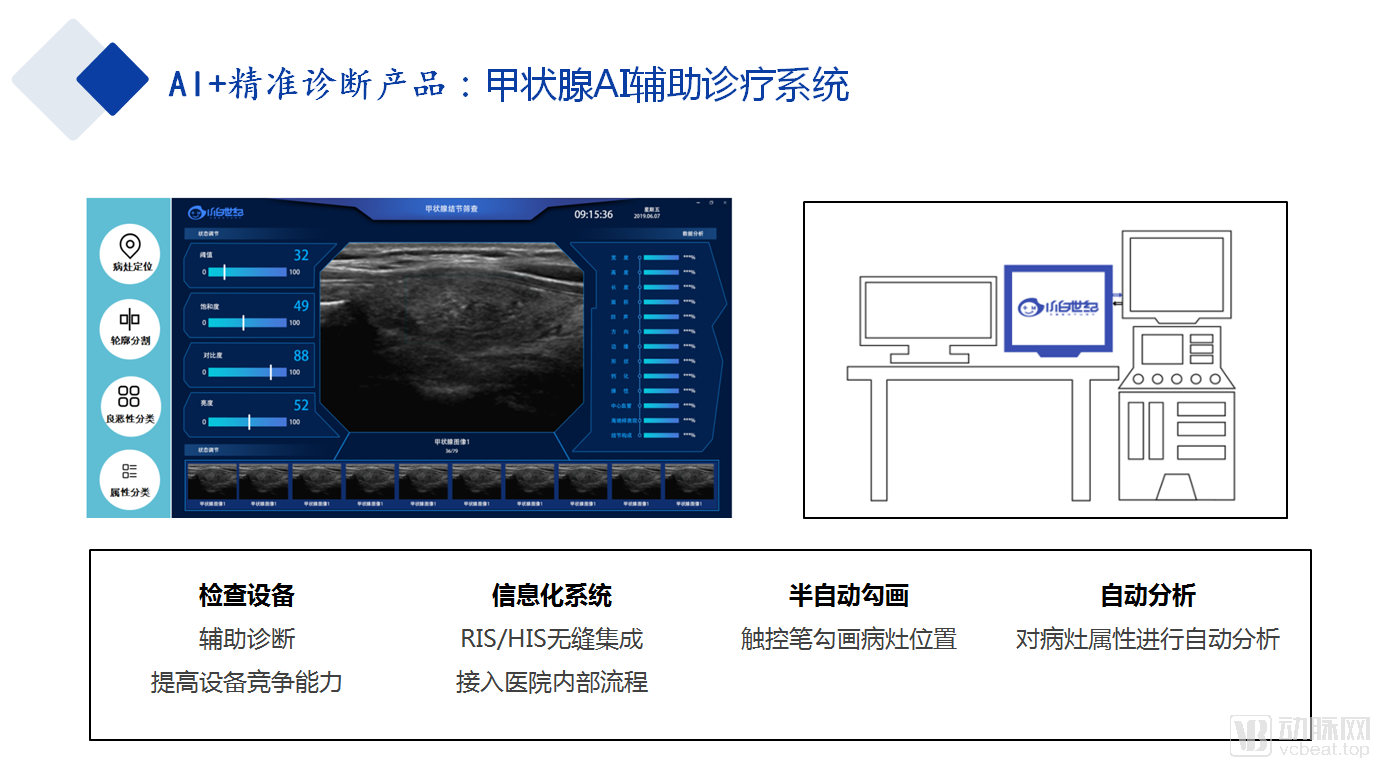
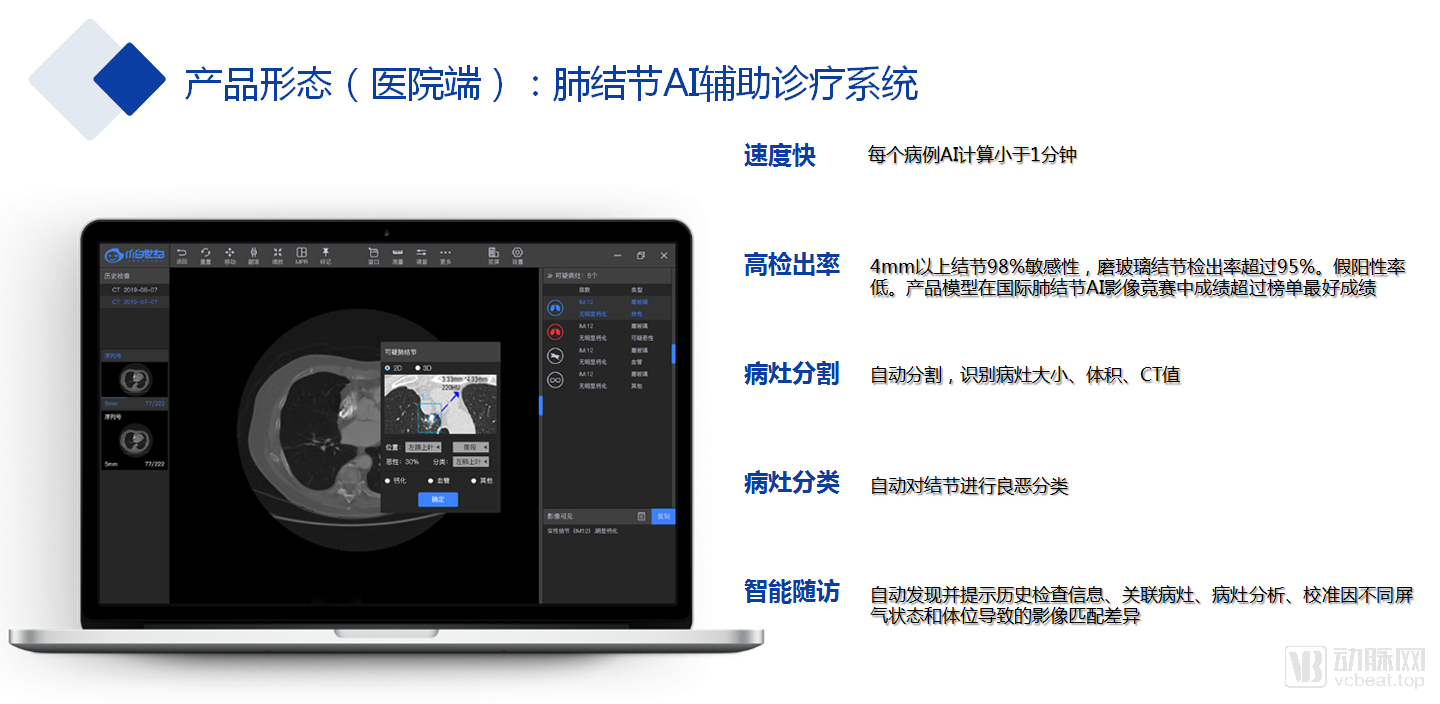
However, among the numerous AI healthcare initiatives developed by Xiao Bai Century, the fastest progress has been made in AI imaging and AI pathology, both of which are currently at the stage of applying for clinical registration certificates. Specifically, AI imaging enables AI-based image interpretation and AI-assisted diagnosis, helping physicians save time on preliminary diagnoses. It has already achieved assisted diagnosis for organs such as the breast and thyroid. Du Qiang revealed that the team is most likely to achieve a breakthrough first in thyroid cancer, with an accuracy rate of approximately 96%. Meanwhile, AI pathology can provide clearer image interpretation, assisting physicians in making fundamental pathological image-based diagnoses; however, specific application products have not yet been disclosed.
Du Qiang told VCBeat that Xiaobai Century has over a dozen AI healthcare R&D directions. Currently, its official website only showcases the more advanced areas: AI-assisted diagnosis for thyroid conditions, AI-assisted diagnosis for microvascular invasion in liver cancer, and an AI-assisted diagnostic system for pulmonary nodules. The remaining R&D directions are still under confidentiality, but the fastest-moving product is expected to launch in 2020.
Currently, Xiaobai Century’s commercially launched product is “AI + Handheld Ultrasound,” which can be used for ultrasound screening and health checkups. “AI + Handheld Ultrasound has recently become one of the hottest trends in smart medical devices,” said Du Qiang. “Xiaobai Century has chosen this niche entry point to integrate AI with miniaturized medical devices. If this model proves successful, we will progressively deploy all our future AI products into actual devices and systems.”
There are numerous R&D enterprises engaged in AI-based imaging pathology analysis. Beyond its core competency in advanced AI modeling, Xiaobai Shiji holds another advantage: the volume of data underpinning its algorithms. For AI algorithms, the richer the underlying foundational data, the more accurate the resulting AI model. By collaborating with medical institutions, Xiaobai Shiji has acquired primary healthcare data from multiple sources. Du Qiang disclosed that the company’s pathological dataset comprises tens of thousands of cases and already covers the vast majority of cancer types.
In addition to AI imaging, Xiaobai Century’s business lines have expanded into areas such as AI-based genomic sequencing and AI-driven immunotherapy. Du Qiang explained, “AI-based genomic sequencing primarily involves the artificial intelligence interpretation of genetic information obtained after testing. The company is also attempting to integrate AI directly with genetic testing, although this poses significant challenges. AI-driven immunotherapy mainly refers to the use of artificial intelligence to automatically identify certain tumor markers, thereby guiding immunotherapy medication.” Currently, Xiaobai Century has established an in-depth collaboration with He Jie’s team at the National Cancer Center in the field of AI-based genomic sequencing.
Although it operates across numerous fields, it is worth noting that Xiaobai Century’s core business output remains AI algorithm models. The company generates revenue by customizing AI healthcare systems to meet the specific needs of medical institutions. Furthermore, Xiaobai Century can collaborate with these institutions to bring its developed AI healthcare systems to market, sharing both intellectual property rights and profits.
It is reported that Xiaobai Century has completed its Pre-A and Series A financing rounds, raising over RMB 100 million. The company is currently conducting a new Series A+ round of financing. The proceeds will be used for promotional preparations prior to the market launch of mature products, as well as to accelerate the research and development of new products.