

JunLian Healthcare Global New Drug Insights Weekly – Issue 32: IPO Filing Submitted
Nov 26, 2019 00:03
CST Updated
00:03

This week, there were 9 new drug data entries, including 2 in rheumatology and immunology, 2 in oncology, 2 in neurology, 1 in hematology, 1 in hepatology, and 1 in cardiovascular disease.
❖ The FDA granted early approval for Alnylam’s Givlaari (givosiran) for the treatment of acute hepatic porphyria (AHP) in adults, marking the second RNAi therapy to receive FDA approval worldwide (the first approved RNAi therapy, patisiran, was also developed by Alnylam). Additionally, inclisiran, co-developed by Alnylam and The Medicines Company, is expected to file for regulatory approval this year and has the potential to become the first RNAi therapy for lowering “bad” cholesterol. Meanwhile, Novartis announced its acquisition of The Medicines Company for $9.7 billion to bolster its cardiovascular drug portfolio. Although RNA-based therapeutics have been in the public eye for many years, the field has experienced significant fluctuations; only recently has it shown signs of substantial breakthrough after prolonged accumulation—a trajectory that may well be the fate of innovative therapies. From the current perspective, gene therapies may follow a similar spiral upward path.
❖ Zanubrutinib, a BTK-targeting agent developed by BeiGene, was recently approved for the treatment of chronic lymphocytic leukemia (CLL). CLL accounts for approximately 25%–30% of all leukemia cases in Europe and the United States. Although it affects a broad patient population, there had previously been no particularly effective therapies. The emergence of BTK inhibitors has rapidly created a blockbuster market. As the first-in-class BTK inhibitor, ibrutinib has demonstrated somewhat limited target specificity and is associated with side effects such as rash and diarrhea; nevertheless, its annual sales quickly surpassed US$6 billion. This success has prompted numerous domestic and international companies to rapidly follow suit, including InnoCare Pharma, which is preparing to file for marketing approval based on Phase II clinical data. In the field of hematologic malignancies, CD20 and CD19 are two major classic targets. Currently, BTK is poised to become the third such major target, with BCMA potentially emerging as the fourth in the future.
Alnylam’s RNAi Therapy Givlaari Receives FDA Approval for Market Launch
U.S. FDA Announces Approval of Alnylam’s RNAi Therapy Givlaari (givosiran) for the Treatment of Adults with Acute Hepatic Porphyria (AHP)
Givlaari is a subcutaneously injected RNAi therapeutic that targets the degradation of mRNA encoding the ALAS1 protein.
Phase 3 clinical trial, in which patients with AHP were randomized to receive monthly subcutaneous injections of Givlaari (2.5 mg/kg) or placebo, with the primary endpoint being the composite rate of porphyria attacks
Compared with the placebo group, patients treated with Givlaari experienced a 74% reduction in disease attacks.
GivlaariMechanism of Action
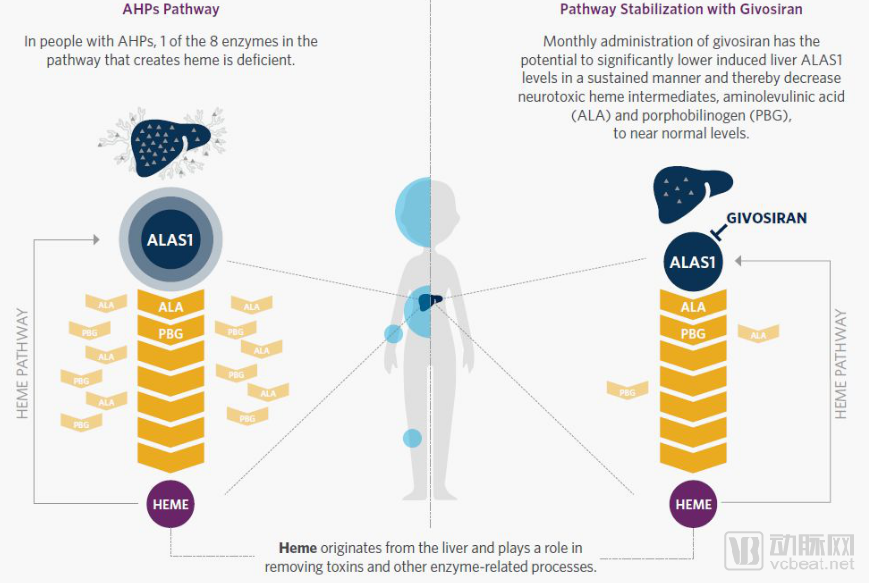
Data source: Alnylam
SK Life Sciences’ Epilepsy Therapy Receives FDA Approval
The U.S. FDA Approves Xcopri (cenobamate tablets), Developed by SK Life Sciences, for the Treatment of Partial-Onset Seizures in Adults
Xcopri reduces the repetitive firing of electrical impulses in neurons by inhibiting voltage-gated sodium currents and positively modulating GABAA receptor activity through allosteric mechanisms.
A randomized, double-blind, placebo-controlled clinical trial in which patients received treatment with varying doses of Xcopri or placebo
Compared with baseline levels, different doses of Xcopri reduced seizure frequency by 36% (100 mg), 55% (200 mg), and 55% (400 mg), respectively, whereas the reduction in the placebo group was 24%. The recommended maintenance dose of Xcopri is 200 mg/day.
Karuna Therapeutics’ Psychiatric Drug Meets Phase 2 Clinical Endpoints
Karuna Therapeutics Announces Positive Results from Phase 2 Clinical Trial of Investigational Drug KarXT for the Treatment of Psychosis in Patients with Schizophrenia, Demonstrating Efficacy in Acute Psychotic and Related Symptoms
KarXT consists of two active ingredients, xanomeline and trospium chloride, designed to activate muscarinic acetylcholine receptors in the brain while minimizing effects on peripheral muscarinic acetylcholine receptors.
Randomized, double-blind study in which enrolled patients received either placebo or KarXT; the primary endpoint was the total score on the Positive and Negative Syndrome Scale (PANSS) after 5 weeks of treatment.
The trial met its primary endpoint. At 5 weeks, the KarXT group demonstrated a significant reduction from baseline in the total score on the Positive and Negative Syndrome Scale (PANSS) compared with placebo (-11.6).
Kiniksa Pharmaceuticals’ IL-1 Inhibitor Receives FDA Breakthrough Therapy Designation
Kiniksa Pharmaceuticals Announces FDA Grants Breakthrough Therapy Designation to Its Investigational IL-1 Signaling Pathway Inhibitor, Rilonacept, for the Treatment of Recurrent Pericarditis (RP)
Rilonacept is a subcutaneously administered soluble fusion protein that inhibits IL-1 signaling by acting as a receptor capable of binding to IL-1α and IL-1β, thereby blocking their interaction with cell-surface IL-1 receptors.
Phase 2, randomized, double-blind study observing the incidence of pericarditis, pain-related quality of life (QoL), C-reactive protein (CRP) levels, pericardial effusion, changes in cardiac activity, and other clinical manifestations of pericarditis
Trial results showed that during the 6-month treatment period, the rate of pericarditis in patients receiving rilonacept decreased from 3.9 episodes per year to less than 0.18 episodes per year, compared with the natural history of the disease.
Mechanisms of IL-1-Mediated Inflammation in RP
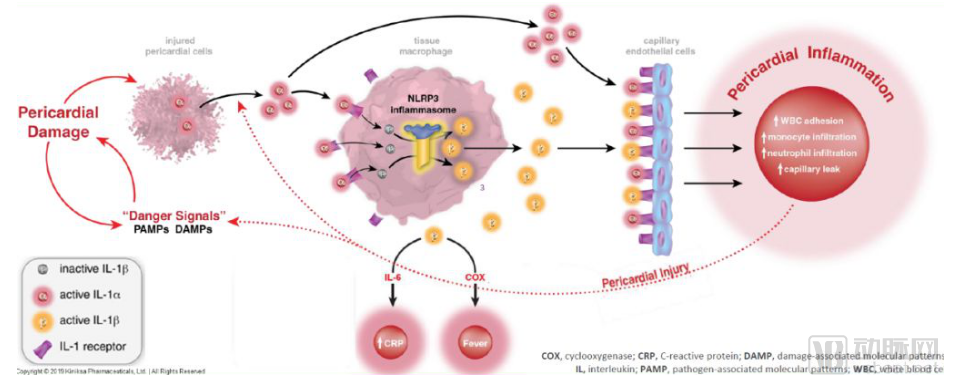
Data Source: Kiniksa
Myovant Sciences’ New Oral Drug for Prostate Cancer Meets Primary Endpoint in Phase 3 Trial
Myovant Sciences Announces That Its Investigational GnRH Receptor Antagonist Relugolix Met the Primary Endpoint and All Key Secondary Endpoints in a Phase 3 Study in Patients with Advanced Prostate Cancer
Relugolix is a GnRH receptor antagonist that binds to and blocks GnRH receptors in the anterior pituitary, reducing the release of luteinizing hormone and follicle-stimulating hormone, thereby lowering estrogen levels produced by the ovaries in women and testosterone production in men.
Randomized, double-blind, placebo-controlled trial, with the primary endpoint being testosterone levels and key secondary endpoints including prostate-specific antigen (PSA) levels, etc.
Within 48 weeks of treatment, 96.7% of patients receiving relugolix achieved sustained suppression of testosterone to castrate levels (≤50 ng/dL), meeting the primary endpoint of the trial.
Bayer’s Chronic Heart Failure Drug Vericiguat Meets Primary Endpoint in Phase 3 Study
Bayer Announces That Phase 3 Clinical Trial VICTORIA Met Its Primary Endpoint; The Study Evaluated the Efficacy and Safety of Vericiguat in Combination with Existing Heart Failure Therapies for Patients with Worsening Chronic Heart Failure with Reduced Ejection Fraction (HFrEF)
Vericiguat is a soluble guanylate cyclase (sGC) stimulator.
A randomized, placebo-controlled, parallel-group, multicenter, double-blind Phase 3 study evaluating the efficacy of vericiguat versus placebo, added to standard heart failure therapy, in patients with worsening chronic heart failure with reduced ejection fraction following a decompensation event; the primary endpoint was the time to the first occurrence of the composite of cardiovascular death or hospitalization for heart failure.
Compared with placebo, vericiguat can reduce the risk of the composite endpoint of heart failure hospitalization or cardiovascular death in these patients.
AstraZeneca's BTK Inhibitor Approved for the Treatment of Chronic Lymphocytic Leukemia
U.S. FDA, Australian Therapeutic Goods Administration, and Health Canada Approve AstraZeneca’s BTK Inhibitor Calquence (acalabrutinib) as Initial or Subsequent Therapy for Adult Patients with Chronic Lymphocytic Leukemia or Small Lymphocytic Lymphoma
Calquence is a BTK inhibitor developed by AstraZeneca that covalently binds to BTK and inhibits its activity.
A randomized, active-controlled Phase 3 clinical trial enrolling treatment-naïve and previously treated patients with chronic lymphocytic leukemia (CLL)
Compared with standard therapy, Calquence monotherapy and combination therapy can significantly prolong patients' progression-free survival (PFS).
BioMarin Submits Marketing Authorization Application for Hemophilia Gene Therapy to the European Union
BioMarin Pharmaceutical Announces Submission of Marketing Authorization Application (MAA) to the European Medicines Agency (EMA) for Gene Therapy Valoctocogene Roxaparvovec for the Treatment of Adults with Severe Hemophilia A
Valoctocogene roxaparvovec is a gene therapy that uses an AAV5 viral vector to deliver a transgene expressing factor VIII.
Interim Data Analysis of Phase III Clinical Trials, and the Latest 3-Year Efficacy Data from Phase I/II Clinical Trials
Over the 3-year treatment period, ABR and factor VIII utilization both decreased by an average of 96%. The patient no longer required prophylactic factor VIII injections.
UCB’s IL-17A/F Dual Inhibitor Meets Phase 3 Endpoint
UCB Announces That Its Investigational IL-17A/F Monoclonal Antibody Bimekizumab, for the Treatment of Chronic Moderate-to-Severe Plaque Psoriasis, Met Both Co-Primary Endpoints and All Secondary Endpoints in a Pivotal Phase 3 Trial
Bimekizumab is a fully humanized monoclonal antibody that specifically neutralizes the cytokines IL-17A and IL-17F, preventing their interaction with IL-17 receptors expressed on the cell surface.
To evaluate the efficacy and safety of bimekizumab versus placebo in the treatment of chronic moderate-to-severe plaque psoriasis, with the primary endpoints being the proportion of patients achieving a 90% reduction in the Psoriasis Area and Severity Index (PASI 90) and those achieving an Investigator’s Global Assessment (IGA) score of 0 or 1.
Bimekizumab demonstrated statistically significant superiority over placebo across all primary and secondary endpoints. The specific results of the BE READY trial will be presented at medical conferences in 2020.
Schematic Diagram of the Mechanism of Action of Bimekizumab
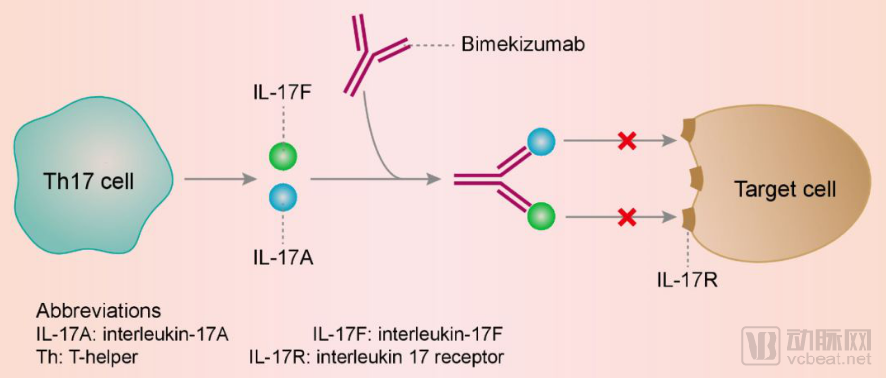
Data Source: Creative Biolabs
❖ BMS Announces Partial Primary Endpoint Data from the Phase III CheckMate-915 Clinical Trial. The study compared the combination of Opdivo and Yervoy (OY combination) with Opdivo monotherapy as adjuvant therapy in patients with completely resected stage IIIB/C/D or IV melanoma. The results showed that the OY combination did not meet the primary endpoint of recurrence-free survival in patients with tumor PD-L1 expression <1%.
❖The Medicines Company recently presented detailed data from the Phase III ORION-10 clinical trial of the siRNA-based lipid-lowering drug inclisiran at the American Heart Association’s 2019 Annual Scientific Sessions held in Philadelphia. The results demonstrated that subcutaneous administration of 300 mg inclisiran twice yearly met all primary and secondary endpoints, with good tolerability and safety profiles.
❖ Boehringer Ingelheim- At the American Heart Association’s 2019 Annual Scientific Sessions held in Philadelphia, the Lilly Diabetes Coalition presented the latest analysis of three-year data from the large-scale, real-world EMPRISE study. The results showed that, compared with DPP-4 inhibitors and GLP-1 receptor agonists, Jardiance was associated with a reduced risk of hospitalization for heart failure and a similar risk of nonfatal atherosclerotic cardiovascular events.
❖Janssen, a subsidiary of Johnson & Johnson, announced the launch of its first fully“Virtual” clinical trials will use patients’ personal smartphones and wearable devices to monitor them, eliminating the need for participants to visit clinical trial sites in person for examinations. This clinical trial, named CHIEF-IHF, aims to collect real-world evidence to support a new cardiovascular indication for the company’s SGLT2 inhibitor, canagliflozin.