

New Player Enters China's Public Hospital Physical Examination Market with IPO Filing

With the rise in national consumer spending power and heightened public health awareness, the demand for and market size of health checkups have further expanded. In 2017, China recorded approximately 500 million health checkup visits, with a penetration rate of about 33%. In 2018, the number of health checkup visits reached 575 million, accounting for 42% of the total population.
In terms of market size, China’s health checkup market is sufficiently large, with its penetration rate increasing year by year. It is estimated that the market size of China’s health examination industry will reach RMB 180 billion in 2019, representing a growth rate of approximately 15%.
However, hospitals remain the mainstay of the health checkup market, with non-public health checkup institutions serving as a valuable supplement. Data show that public hospitals account for 70.8% of the overall health checkup market share, while private health checkup institutions hold a 21.5% market share.
In July 2019, the State Council issued the "Opinions on Implementing the Healthy China Action" (hereinafter referred to as the "Opinions"). The "Opinions" clearly outlined the guiding principles for Healthy China and the overall objectives of China's healthcare sector from 2022 to 2030. It specified 15 special actions across three key areas, including "strengthening early intervention" and "enhancing prevention and control of major diseases," which are beneficial to the health check-up industry and other medical service segments.
With national support for preventive medicine, a wider variety of medical institutions—including public, primary-care, and private facilities—will engage in market education across the industry. The sector is expected to advance under more standardized testing guidelines, thereby serving residents in both first-tier cities and grassroots communities and further increasing penetration rates.
Hospitals Remain the Mainstay of the Health Checkup Market
The development of the health checkup industry is inseparable from policy support. With health promotion and disease prevention elevated to the level of national strategy, the focus has shifted from disease treatment to health-centric care. The health concept of “early detection, early treatment, early prevention, and early wellness” has gained significant traction, driving robust market demand for the health checkup industry and resulting in explosive growth.
Among the numerous participants in the health checkup market, public hospital checkup centers, compared with non-public institutions, boast comprehensive hardware facilities, benefit from national preferential policies and support, and operate at lower costs. Moreover, due to traditional mindsets, the general public tends to rely on and trust public hospitals more.
According to a report by Pacific Securities Research Institute, in terms of patient visit distribution, primary healthcare institutions accounted for approximately 50%, showing an overall upward trend from 2008 to 2017; the hospital system accounted for around 45%, demonstrating a general downward trend over the same decade, which corroborates the logic of health checkup services shifting toward grassroots levels. However, in terms of the number of medical institutions, primary care facilities constitute as high as 95% of the total, yet their average patient visits per institution are far lower than those of hospitals, making it difficult to achieve economies of scale. Therefore, hospitals remain the main force in the health checkup market.
According to data from the “2019 Online Health Checkup Consumption Report” by CNBData and AliHealth, the number of products and market size for health checkups offered by public hospitals have been continuously growing, with sales revenue increasing by 56%, outpacing the overall market. The average transaction value is higher than that of private checkup centers, indicating strong consumer demand for public hospital health checkups in the online channel. This suggests that the service models and offerings of public hospital health checkups warrant deeper exploration and expansion. Particularly in the context of gradual market share diversion to private providers, it is crucial to address the capacity expansion and upgrading of public hospital health checkup centers.
Against this broad industrial backdrop, the “2019 Internet + Health Management Summit,” jointly organized by AliHealth, the First Affiliated Hospital of Zhejiang University School of Medicine, and the Internet Health Management Branch of the Chinese Health Management Association, was held at Alibaba’s Xixi Campus in Hangzhou on November 23–24. The conference highlighted the latest advances made by branch members and related institutions in applying internet, big data, and artificial intelligence technologies to health management, fostering innovative development in internet-based health management and supporting the substantive growth and technological upgrading of health management centers and physical examination centers.
Standardizing and Personalizing Health Checkups to Enhance Accessibility and Affordability
During the summit, to better leverage Internet Plus experience and practical tools, explore implementation methods for “Internet Plus,” and deliver comprehensive health checkup services to the entire population—particularly the elderly, individuals at high risk for cancer, women, and those with limited financial capacity—Alibaba Health initiated a proposal advocating active efforts in “Internet Plus Health Management” practices along three key dimensions: standardization, personalization, and inclusivity and affordability.
Standardization involves popularizing health checkup knowledge and establishing standard or basic health checkup packages, enabling consumers to navigate the myriad of options with clarity and select a relatively standardized and suitable package with minimal effort. Personalization entails on-demand customization and precise matching of supply with demand. Inclusivity and affordability aim to reduce the financial burden of health checkups for consumers and explore “public-welfare health checkups.” Ultimately, by leveraging Alibaba’s platform traffic, communication resources, and Huabei’s interest-free installment payment service, we promote the health concept of “early treatment for existing conditions and prevention for those without disease.”
Among them, the first batch of partner institutions includes The First Affiliated Hospital, Zhejiang University School of Medicine (Zhejiang First Hospital), The Second Affiliated Hospital, Zhejiang University School of Medicine, The Second Affiliated Hospital of Nanchang University, Zhejiang Provincial People’s Hospital, Union Hospital Affiliated to Tongji Medical College of Huazhong University of Science and Technology, Nanjing Drum Tower Hospital, The Second Affiliated Hospital of Chongqing Medical University, Hangzhou Third People’s Hospital, Wenzhou Physical Examination Center, and Hangzhou Xixi Hospital. Specifically, Phase I practices include:
1. The “National Health Program” campaign from December 2019 to March 2020, jointly launched by AliHealth and major health examination centers, aimed to popularize knowledge about health check-ups and promote screening items recommended by the state and in urgent demand by the public;
2. Since January 2020, in response to consumer trends in online health check-up services, Ali Health, together with major health check-up centers and ecosystem partners it has collaborated with, has explored relatively standardized health check-up packages to better align supply with demand;
3. Since January 2020, Alibaba Health, in partnership with Huabei Installments under Ant Financial, has fully supported the use of Huabei installment payments at public hospitals. Additionally, interest-free six-month installment plans for medical examination fees at public hospitals will be offered on an irregular basis during promotional periods, thereby reducing the financial burden of health screenings for the general public and further promoting the health concept of “early treatment for illnesses and prevention for the healthy.”
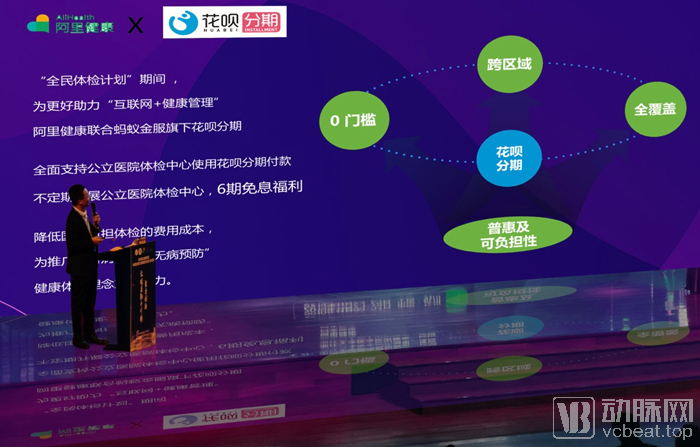
“Internet + Health Management Practice” will rely on the “National Health Plan” to continuously carry out various forms of activities; it also invites more physical examination centers to participate, share Internet-based health checkup consumption trend analysis, share “Internet +” technology and practices, and share the benefit policies of Huabei installment payments, so as to better serve the population undergoing health checkups.
Ali Health’s Layout in the Physical Examination Industry
Shifting the focus back to the health checkup industry, horizontally, in addition to traditional first- and second-tier cities, the lower-tier markets (third- and fourth-tier cities) are experiencing rapid growth. The clear logic of market penetration makes these segments promising opportunity markets worth attention. Moreover, the rise in per capita consumption power has driven a swift enhancement of service capabilities in primary healthcare institutions, which is the fundamental reason for their accelerated expansion.
Vertically, both public and private institutions are pursuing connotative growth, with a particular emphasis on the beneficial impact of internet integration and online services on the industry. The online health checkup market has maintained steady growth for three consecutive years.
In terms of internet integration, beyond traditional private chain institutions, public hospital health examination centers are also accelerating their online presence to enhance the accessibility of preventive medicine. By leveraging “Internet+” to optimize workflows and enrich services across all stages—pre-examination, during examination, and post-examination—they are improving the overall service experience.
Data indicates that online health checkup offerings are primarily categorized into cancer screening, checkups for middle-aged and elderly individuals, gender-neutral checkups, and female-specific checkups. Moreover, the premium segment priced above RMB 1,000 is expanding rapidly. The average transaction value (ATV) of online health checkup products has shown continuous growth over the past three years, with sales in the high-end market (RMB 1,369 and above) surging by 110%. In terms of online repurchase rates, nearly 40% of consumers have purchased health checkup services two or more times within the past year.
As a key niche sector in Alibaba’s strategic layout, the health checkup industry has achieved comprehensive supply-side collaboration with industry players, including major private chain operators and public hospital health checkup centers, while also expanding partnerships with industry Independent Software Vendors (ISVs).
Earlier this year, Alibaba’s Taobao, along with Suning.com (in which Alibaba holds an investment) and other parties, jointly funded the privatization of all shares of iKang Healthcare Group, another major player in the health checkup industry, in a deal valued at $1.5 billion. On the evening of October 27, Meinian Onehealth announced that Alibaba had become its second-largest shareholder, thereby securing the largest offline traffic gateway for health checkups.
On the consumer side, leveraging Alibaba’s ecosystem capabilities and integrating Tmall, Alipay, and DingTalk, we comprehensively serve the health checkup needs of individuals and small and medium-sized enterprises.
In addition, Alibaba Health has actively participated in industry development by strengthening engagement with professional academic institutions. It co-hosted the “Internet + Health Management” Summit with the Internet Health Management Branch of the Chinese Health Management Association and The First Affiliated Hospital, Zhejiang University School of Medicine, and launched the “Initiative for Internet + Health Management Practices.” In collaboration with numerous health examination centers, it has conducted proactive explorations in areas such as “standardization and personalization,” “accessibility,” and “affordability” of health examinations.
We believe that as more public hospitals participate, the "National Health Plan" will effectively disseminate health examination knowledge and provide comprehensive health check-up services for the entire population. By leveraging "Internet Plus" to enhance capabilities and efficiency, it will help accelerate the realization of the "Healthy China 2030" initiative.