

Under the Pressure of 'One-Invoice System': A Chain-Wide Innovation and Commercial Reconfiguration in China's Pharmaceutical Industry
Criticism of Drug Price Intermediaries Has Long Been a Concern.
“Pharmaceutical Manufacturer – National General Distributor – Provincial Distributor – Drug Tendering and Procurement – Municipal/District/County-Level Distributor – Pharmaceutical Company – Hospital – Patient” represents the traditional pharmaceutical distribution model. After leaving the manufacturer, a drug must pass through multiple distribution stages and change hands among several commercial enterprises before finally reaching hospitals and patients.
Each stage of distribution incurs costs such as personnel salaries, fees for pharmaceutical agents, bidding fees, advertising expenses, public relations costs, and agent profits. As these costs accumulate at each level, the final retail price of pharmaceuticals diverges significantly from the ex-factory price. Furthermore, under this distribution model, some enterprises have even engaged in illicit practices such as issuing invoices without actual transactions and using invoice trafficking for money laundering.
In 2011, CCTV’s “Weekly Quality Report” reported that price markups at certain intermediate stages of the pharmaceutical supply chain exceeded 6,500%. Reducing the number of distribution links has undoubtedly become a key measure to address artificially high drug prices. In recent years, the government has introduced numerous policies to tackle this issue, such as the “4+7” centralized volume-based procurement program.
In 2019, reducing drug prices remained one of the key policy focuses.
In October 2019, Shandong Province issued the “Implementation Plan (Trial) for Promoting the ‘Two-Invoice System’ in Drug Procurement by Public Medical Institutions in Shandong Province,” which stated thatPilot the “single-invoice system” for selected drugs with high consumption and simple market supply channels in Grade A tertiary general hospitals in pilot cities., encourage regions with the necessary conditions to adopt joint procurement and centralized payment at the municipal and county levels, and explore the implementation of a "single-invoice system" for drug procurement.
On November 15, 2019, the State Council issued the “Notice on Further Promoting the Experience of Fujian Province and Sanming City in Deepening the Reform of the Pharmaceutical and Health Care System.” The notice pointed out that, in accordance with the national unified deployment, the scope of drug varieties subject to centralized procurement and use organized by the state would be expanded in 2020.Pilot provinces for comprehensive healthcare reform shall take the lead in implementing direct settlement of drug payments by medical insurance handling agencies with pharmaceutical manufacturers or distributors, while other provinces should also actively explore this approach.This means that the “single-invoice system” will be gradually rolled out across provinces.
The “single-invoice system” for pharmaceuticals refers to a model in which the number of distribution transactions for a drug is limited to no more than one. Under this system, hospitals settle payment for drugs directly with pharmaceutical manufacturers, while manufacturers settle distribution fees directly with logistics companies. This approach can significantly reduce pharmaceutical distribution costs, purify the distribution environment, promote industry information transparency, and facilitate regulatory oversight and drug traceability.
Prior to this, numerous provinces had already introduced relevant policies to encourage or initiate pilot programs for the “one-invoice system” for pharmaceuticals, including Guangdong Province, Zhejiang Province, Hubei Province, Shanxi Province, Shaanxi Province, Beijing, and Tianjin. As a pioneer, Fujian Province explicitly required hospitals as early as 2016 to settle payments directly with pharmaceutical manufacturers when procuring basic intravenous infusions, strictly implementing the “one-invoice system.”
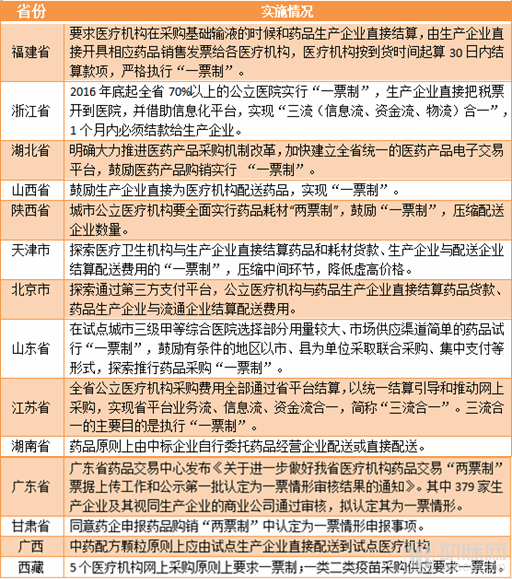
Source: Internet; Graphic by VCBeat
Currently, the cities that have launched pilot programs are all implementing the “one-invoice system” for selected drugs in selected hospitals. Shandong Province’s policy also opts forSome products with high usage volumes and simple market supply channelsThe “single-invoice system” is being piloted for certain pharmaceutical products. No province has yet implemented the “single-invoice system” across all pharmaceuticals and all regions. However, many industry insiders believe that the comprehensive rollout of the “single-invoice system” for pharmaceuticals may be just around the corner.
Under the “single-invoice system,” how commercial companies can seek new profit growth points, and how pharmaceutical manufacturers can build brands and establish marketing networks, have become key topics of discussion in the industry.
VCBeat interviewed Jiang Qiang, CEO of Mingyi Zhonghe; Xiao Lingfei, CEO of Yaofei Network; and Dian Canghe, founder of Yiyao Yunduan, among other healthcare industry experts, yielding the following insights:
1. Commercial companies possess extensive networks and resources, enabling them to create new profit growth points by establishing retail channels and acquiring pharmaceutical manufacturers and active pharmaceutical ingredient (API) producers;
2. In the short term, the “single-invoice system” will be difficult to extend to grassroots medical areas, pharmacies, and small medical institutions; commercial companies can continue to exert efforts in these three markets;
3. Pharmaceutical companies lacking innovation capabilities and commercial distributors without end-channel access will be eliminated, leading to further increased industry concentration;
4. Pharmaceutical companies need to establish their own commercial teams and marketing networks, which will increase labor costs;
5. Whether medical insurance funds have the capacity to advance payments for pharmaceuticals is one of the key factors determining the smooth implementation of the “single-invoice system” for drugs;
6. Big data, artificial intelligence, and information technology can facilitate the smooth implementation of the “one-invoice system” for pharmaceuticals.
“The Single-Invoice System” is an advanced version of the “Two-Invoice System.”
It took just over two years to move from the full implementation of the “two-invoice system” for pharmaceuticals to pilot programs for the “one-invoice system.”
At the end of 2016, the State Council’s Office of Healthcare Reform, together with other ministries and commissions, jointly issued the “Implementation Opinions on Promoting the ‘Two-Invoice System’ in Drug Procurement by Public Medical Institutions,” requiring medical institutions to verify that the invoice, goods, and accounts are consistent before drugs can be accepted into inventory and used.
On January 9, 2017, the National Health and Family Planning Commission issued the “Implementation Opinions on Promoting the ‘Two-Invoice System’ in Drug Procurement by Public Medical Institutions (Trial),” marking the nationwide launch of the “Two-Invoice System.”
“The Two-Invoice System” refers to the practice whereby pharmaceutical manufacturers issue one invoice to distributors, and distributors issue another invoice to medical institutions. This system aims to reduce distribution links, standardize distribution order, improve distribution efficiency, lower artificially inflated drug prices, and crack down on illegal practices such as affiliation borrowing, commercial bribery, and tax evasion. Following the implementation of the “Two-Invoice System,” commercial companies of all sizes are the first to be impacted.
Commercial Companies: Transitioning to CSOs and Strategically Entering the Primary Healthcare Market
Commercial companies with terminal distribution channels have responded to the “Two-Invoice System” by transforming into Contract Sales Organizations (CSOs). By operating as CSOs, they shed their roles as national or provincial general distributors, engage directly with pharmaceutical manufacturers in specific regions, secure terminal resources, and collaborate with manufacturers to maintain local commercial channels. This model involves no handling of invoices or goods, requiring only the execution of consulting agreements with pharmaceutical manufacturers.
In addition, some large commercial companies have responded to the “Two-Invoice System” by strategically positioning themselves in primary care markets, pursuing mergers and acquisitions (M&A) for consolidation, and expanding into pharmaceutical retail. For example, China Resources Pharmaceutical completed multiple M&A projects at the prefecture-level city level and successfully entered the markets in Jiangxi, Qinghai, and Xinjiang through acquisitions. The group’s annual report shows that in the first half of 2017, its distribution business achieved a year-on-year growth rate of 16%, with M&A activities contributing 2 percentage points, while its direct hospital sales business grew by 20% year on year.
Pharmaceutical Companies: Establishing In-House Commercial Teams and Sales Networks
For pharmaceutical companies that operate in a standardized manner, own their brands, and have self-built teams for terminal development, neither the “Two-Invoice System” nor the “One-Invoice System” will have a significant impact. However, for pharmaceutical companies that lack both terminal channels and brand recognition, it is necessary to establish an in-house commercial team and build a sales network to manage order fulfillment, invoicing, and payment collection.
"The Two-Invoice System" Has Not Significantly Reduced Drug Prices
In actual implementation, many industry insiders have found that the “Two-Invoice System” has not played a significant role in reducing drug prices.
In the past, with the assistance of invoice-passing companies, the two primary objectives for pharmaceutical enterprises to issue invoices at base prices were to reduce invoicing costs and mitigate withdrawal risks.
Prior to the VAT reform, the invoicing costs for pass-through invoicing companies were significantly lower than those for manufacturers. Consequently, manufacturers opted to issue invoices at base prices and directed distributors to obtain invoices from these pass-through entities, thereby reducing costs. Furthermore, expenses related to commission-based sales required cash-out channels. As most manufacturers were unwilling to assume the associated risks, distributors were left to resolve this issue independently. Thus, pass-through invoicing companies also assumed the role of facilitating cash withdrawals.
Following the replacement of business tax with value-added tax (VAT), invoicing companies no longer hold a cost advantage over enterprises in issuing invoices. Consequently, enterprises have ceased engaging these intermediaries and have shifted to directly issuing inflated invoices, making an increase in costs inevitable. On the other hand, the demand for cash withdrawal persists. Due to risk considerations, most enterprises still delegate this task to distributors, who must either engage invoicing companies or establish their own entities to handle cash withdrawals. This leads to increased costs and risks associated with cash withdrawal, both of which are ultimately reflected in drug prices.
In addition, *Jingji* magazine reported that after the implementation of the “Two-Invoice System,” some small commercial companies “rebranded” as pharmaceutical company departments to engage in invoice reselling for distribution fees, with instances of tax evasion also occurring.
By comparison, the introduction of the “single-invoice system” can more effectively ensure drug pricing and purify the pharmaceutical distribution environment.
Terminal channels and innovation capabilities will become the foundation for commercial companies and pharmaceutical enterprises.
In the traditional distribution model, commercial companies assume two major functions: advancing funds and delivery. After the implementation of the “single-invoice system,” it is no longer feasible for commercial companies to transform into Contract Sales Organizations (CSOs). Since medical insurance payments are settled directly with manufacturers, bypassing commercial distributors, these companies no longer serve a role in advancing funds and retain only the function of product delivery.
In layman’s terms, under the “single-invoice system,” pharmaceutical distributors have been reduced to the role of couriers, retaining only distribution functions while their profit margins are squeezed. Dian Canghe, founder of Yiyao Yunduan, remarked, “Under the ‘single-invoice system,’ third-party logistics providers may seize the opportunity to enter the pharmaceutical distribution market, offering pharmaceutical companies more options for drug delivery.” This adds further competitive pressure on traditional pharmaceutical distributors.
Commercial Companies: Actively Transform, Expand Business, and Seek New Profit Growth Points
Xiao Lingfei, CEO of Yaofei Network, stated: “The purpose of the ‘single-invoice system’ reform is to further optimize health insurance payments and promote rational drug use. This will drive greater industry consolidation and impose stricter cost-control requirements on commercial companies. Those lacking service capabilities and distribution networks will be eliminated, leaving only a few large-scale commercial players in the market.”
Some industry insiders believe that demise is not the only fate for small commercial companies. They can choose to partner with pharmaceutical enterprises and become regional managers, or transform into service providers for institutions such as hospitals, breaking away from their existing business models to become consulting firms. Additionally, they can leverage their previously accumulated valuable resources to collaborate with social logistics enterprises, helping them expand their markets and achieve win-win outcomes.
An interviewee told VCBeat that after the implementation of the “single-invoice system,” pharmaceutical companies tend to choose commercial distributors with lower delivery prices, shifting the competitive focus among distributors to delivery fees and resulting in thinner profit margins. In response, Xiao Lingfei argued that delivery fees would not be the sole source of profit for commercial distributors.
Xiao Lingfei stated, “Enterprises with large scale, high warehouse turnover rates, sound management systems, and strong distribution capabilities will indeed hold a competitive advantage,”However, commercial companies can also leverage industry connections and resources to create new profit growth points through mergers and acquisitions, supply chain extension, and the acquisition of pharmaceutical enterprises.”
For example, Shanghai Pharmaceuticals acquired the distributor Cardinal Health and the pharmaceutical company Lepu Pharmaceutical; Sinopharm Group is actively expanding into the medical device sector and strengthening its own device distribution channels; Jointown Pharmaceutical has shifted the focus of its direct sales to the primary healthcare market and launched its FBBC business model (where “F” refers to upstream pharmaceutical manufacturers, the first “B” refers to Jointown, the second “B” refers to terminal pharmacies and clinics, and “C” refers to consumers), thereby positioning itself in the internet healthcare sector. These measures can, to some extent, mitigate the negative impacts brought about by the “One-Invoice System.”
In addition, Jiang Qiang, CEO of Mingyi Zhonghe, believes that China’s primary healthcare market is fragmented, with a large number of institutions and low demand for individual products at each facility. Therefore, it is difficult to fully implement the “one-invoice system” across the primary healthcare market, clinics, and small medical institutions in the short term. Commercial companies still play an irreplaceable role in these three sectors and can continue to focus their efforts on them.
Pharmaceutical Companies: Building In-House Teams and Marketing Networks; Those Lacking Innovation Capabilities Will Be Eliminated
The implementation of the “single-invoice system” for pharmaceuticals has clearly had a less severe impact on pharmaceutical manufacturers than on commercial distributors. Under the “single-invoice system,” to interface and exchange information with the vast number of healthcare institutions, pharmaceutical manufacturers must establish business development teams and build marketing networks to connect with hospital endpoints.
In addition, a representative from an innovative drug R&D company stated that products are the core competitiveness of pharmaceutical enterprises; regardless of whether the “two-invoice system” or the “one-invoice system” is implemented, market demand for innovative drugs will not diminish. Xiao Lingfei also remarked, “Currently, many pharmaceutical companies are selling me-too drugs.”Under the “single-invoice” system, the difficulty of routing invoices and making transfer payments through commercial distributors has further increased, leading to the widespread exit of pharmaceutical companies lacking innovation capabilities and product advantages.“Therefore, pharmaceutical companies need to focus on building product quality and innovation capabilities.”
“Single-Invoice System” Still Has a Long Way to Go for Nationwide Implementation
Diancang He stated that implementing the “One-Invoice System” nationwide would not proceed as smoothly as the “Two-Invoice System,” and several key issues still need to be resolved.
Issue of Medical Insurance Advance Payment.Previously, commercial companies served as financial intermediaries by advancing funds to ensure that pharmaceutical manufacturers received payments in a timely manner. Following the implementation of the “One-Invoice System,” the timeliness of payment collection by pharmaceutical manufacturers has become a key focus of industry attention.
Industry insiders believe that the challenges pharmaceutical companies face in collecting payments may draw lessons from the “one-invoice system” implemented for medical consumables.
For example, in November 2017, the Zhejiang Provincial Drug and Medical Device Procurement Center launched a new platform for the procurement of medical consumables in Zhejiang Province. The platform achieved the integration of information flow, commercial flow, and capital flow (“three flows in one”), encouraging a change in the direction of purchase order transmission by having medical institutions send orders directly to manufacturers, thereby reducing distribution links. On the day the platform went live, the Second Affiliated Hospital of Wenzhou Medical University placed ten purchase orders for medical consumables, six of which were delivered on the same day. Eight days later, the supplier, Wenzhou Int’l Pharmaceutical Co., Ltd., successfully received payment, significantly accelerating the reimbursement process.
Some respondents believe that the widespread adoption of subsequent medical insurance advance payments will properly resolve the difficulty pharmaceutical companies face in collecting receivables. However, Jiang Qiang is not optimistic about the comprehensive rollout of the “one-invoice system” in the hospital market: “Due to disparities in economic development across regions, the “single-invoice” settlement model requires that medical insurance funds have the capacity to promptly pay all outstanding amounts to hospitals or settle payments directly with pharmaceutical manufacturers., if only a portion is advanced, it will be difficult to thoroughly resolve the issue of delayed payments to pharmaceutical companies.”
In this regard, Canghe believes: “With the prepayment of drug costs by medical insurance, the repayment for pharmaceuticals is significantly secured. If payment terms could be stipulated as in the ‘4+7’ centralized procurement program, the repayment cycle would be substantially shortened, greatly alleviating the financial pressure on pharmaceutical companies.”However, it is worth noting whether the direct settlement of drug payments between pharmaceutical manufacturers and distributors and the medical insurance system implies that there are drug transactions between pharmaceutical companies and medical insurance.—This is fundamentally different from the current model, in which medical insurance purchases services from designated healthcare institutions. Does the medical insurance system need to establish a specialized company for settling drug payments? Should this company obtain a Drug Operation License? Does this comply with relevant laws and policy requirements? All these issues warrant careful scrutiny.”
Drug Supply Issues in the Primary Healthcare Market.Jiang Qiang stated, “China’s primary healthcare market is vast. Under the ‘single-invoice system,’ whether the drug supply to this sector can be guaranteed remains a question worth considering.”
Stakeholders object.One interviewee remarked, “The ‘single-invoice system’ will undoubtedly encroach on certain vested interests.” For instance, Guangdong Province was among the first to propose the “two-invoice system” as part of its pharmaceutical distribution reform initiatives in 2007, but the proposal was shelved after pharmaceutical companies jointly submitted letters of opposition. It was not until late 2017 that relevant implementation guidelines for the “two-invoice system” were finally issued.
Addressing the aforementioned issues, Jiang Qiang stated: “Big data, artificial intelligence, and informatization represent one potential solution; however, their efficacy remains to be evaluated. Whether superior alternatives exist still requires exploration in practice.”
Xiao Lingfei stated, “The ‘single-invoice system’ holds positive significance for reducing drug prices and purifying the distribution environment. However, it is premature to discuss its comprehensive implementation at this stage. Moving from pilot programs to nationwide rollout will require prolonged exploration and refinement.”