

AvataCapital Files IPO Prospectus to Empower Chinese SMEs' Global Listings with Accessible Advisory Services
On November 26, Alibaba rang the opening bell at the Hong Kong Stock Exchange (HKEX), surpassing another star listed company, Tencent Holdings, with a total market capitalization of HK$3.9993 trillion, thereby ranking as the eighth-largest company globally by market value. This marks the third major interaction between Alibaba and the HKEX; twelve years ago, Alibaba made its spectacular debut in the capital markets on the HKEX. With this return, Alibaba no longer engages in the past dynamics of deference and strategic maneuvering, but instead stands firmly behind the HKEX.
In fact, as the offshore financial center closest to the Chinese mainland, the Hong Kong Stock Exchange (HKEX) has long been a preferred destination for mainland enterprises seeking overseas listings. Statistics show that in October 2019, prior to Alibaba’s secondary listing, HKEX welcomed 22 new listings, 15 of which were from mainland China, accounting for 68.2%. Meanwhile, these 15 companies, all listed on the Main Board of HKEX, raised a combined total of HK$13.749 billion through their initial public offerings (IPOs), representing 92.4% of the total HK$14.874 billion raised in October. HKEX expects that at least 16 mainland enterprises will complete their IPOs in November, further increasing the proportion to over 70%.
On the other side of the globe, within the U.S. stock market—the world’s hottest hub for technology stocks—Chinese companies are also making a significant presence. Data shows that as of November 16, 2019, 29 Chinese concept stocks had been listed in the United States, with at least another 25 companies in the process of applying for listings. Given the collective absence of internet unicorns in the U.S. market this year, it has instead become an important window of opportunity for small and medium-sized enterprises.
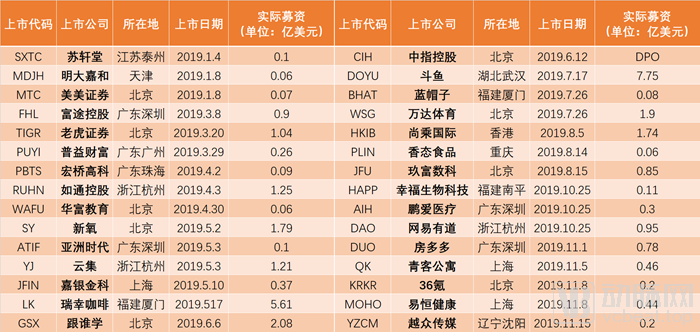
As of November 15, 2019, Data on U.S.-Listed Chinese Concept Stocks. Compiled by AvataCapital.
Since the first wave of Internet fever sparked a startup boom, overseas listings have remained a hot topic for domestic innovative enterprises. In July 2019, a survey conducted by Tsinghua University among more than 1,200 Chinese business leaders found that Chinese CEOs remain keen on global expansion. Notably, although their focus is gradually shifting from the United States to Southeast Asia, Europe, and Africa, nearly 40% of respondents still indicated they would prefer Hong Kong and the U.S. markets as their primary listing destinations.
Founding Partner, Avata CapitalAndrew YongMr. [Name] believes that the strong enthusiasm among domestic enterprises for overseas expansion is mainly driven by two factors. On one hand, in the current capital environment, it has become more difficult for companies to secure financing from financial investors than through IPO channels. Moreover, for certain specific projects, the listing thresholds in the U.S. and Hong Kong stock markets are lower than those in mainland China. “This is also a key reason why SMEs have shown particularly strong IPO demand this year.” On the other hand, compared with mainland China, overseas IPOs offer a clear advantage in terms of listing timeline. Typically, the U.S. IPO process takes about six months, Hong Kong’s takes approximately 9–12 months, while the average time for an IPO in mainland China exceeds 12 months.
Around the year 2000, several well-known Chinese internet portals listed on U.S. securities markets. At that time, Chinese enterprises lacked internal expertise in the complex regulatory frameworks governing mature overseas capital markets. The professional intermediaries they engaged—such as investment banks, law firms, and accounting firms—often devised listing strategies independently from their respective perspectives, leading to frequent setbacks in the IPO process. As a result, companies incurred substantial costs while missing optimal windows for going public.
An IPO advisory industry has emerged to provide holistic strategic planning for listing-related matters from a corporate perspective, with some professionals experienced in overseas IPOs beginning to work on a fragmented basis to help enterprises objectively assess the feasibility of proposals submitted by intermediary service providers.
Since then, an increasing number of companies with mature governance structures have chosen to hire externally a chief financial officer (CFO) with overseas IPO experience shortly before their listing, specifically to oversee IPO-related matters. However, given the substantial workload and intricate details involved in overseas IPOs, some companies also engage third-party IPO advisors. IPO advisory is a technology-driven financial engineering role that, unlike other listing intermediaries which emphasize breakthroughs in specific areas, requires practitioners to possess the ability to coordinate and integrate various financial and legal details.
Mr. Andrew Yong, Founding Partner of AvataCapital, is a former Executive Director at Morgan Stanley in New York, having participated in projects such as Alibaba’s U.S. IPO, the privatization of Focus Media, and the merger of Youku and Tudou. Mr. Yong told VCBeat that IPO advisors primarily provide two types of services.
Category 1: Standardized Delivery.“As outlined in the ‘Holographic Diagnostic Report for Overseas Listing,’ which helps companies undergo a comprehensive health check before pursuing an overseas listing, IPO advisors will conduct target market diagnostics based on thorough due diligence, clarifying the stage, jurisdiction, timeline, and costs of the listing. ‘Typically, domestic enterprises do not meet overseas listing requirements in terms of equity structure and accounting standards, necessitating adjustments. The IPO advisor will clearly specify the costs associated with aligning the equity structure and accounting systems as part of the standardized deliverables. The complete ‘Holographic Diagnostic Report for Overseas Listing’ is generally delivered to the company within approximately three to four weeks,’ pointed out Mr. Andrew Yong.”
Taking the selection of listing venue as an example, IPO advisors help companies identify their target capital markets through multi-dimensional analysis. The dimensions they consider include: the company’s business and industry sector (whether it operates in an industry favored by investors, such as the new economy, internet, big health, and consumption upgrade sectors at the current stage), local listing rules, investor operational fundamentals (financials, legal compliance, business model, etc.), corporate brand image, timing of capital needs, local regulatory environment, post-IPO lock-up periods, listing costs, and the company’s equity structure.
Category 2: One-on-One Listing Advisory Services.Corporate initial public offerings (IPOs) can be broadly divided into three stages: pre-IPO, during the IPO, and post-IPO. Investment banks typically engage to provide services during the second stage. In the pre-IPO phase, IPO advisors offer hands-on strategic planning and comprehensive lifecycle support, including analyzing the choice of listing venue and timing, designing equity structures, connecting with venture capital (VC) and private equity (PE) resources, and assisting with financial and tax compliance. During the IPO execution phase, they design the IPO prospectus strategy and introduce appropriately matched investment banks at various tiers, as well as domestic and international legal and accounting firms. In the post-IPO phase, services include market capitalization management, legal advisory, and wealth allocation solutions for founders and senior executive teams.

Investment banks play a pivotal role in corporate initial public offerings (IPOs), as they determine the ultimate scale of capital raised. Furthermore, overseas listings involve four law firms with distinct functions, whose coordination dictates whether the IPO can proceed smoothly. “The workload involved is excessively complex; general corporate managers typically lack the specialized expertise and time required to unravel the underlying logic,” emphasized Mr. Andrew Yong. In China, talent capable of providing IPO advisory services is scarce, forcing companies to incur substantial costs to purchase such services. This poses an insurmountable barrier for small and medium-sized enterprises (SMEs) that often face constrained cash flows. Aivota Capital attempts to operate under an asset-light model, bringing cost-effective IPO advisory services down to the SME market.
Ivota Capital was established in 2012. Its core team, boasting extensive experience in investment banking, overseas listings, and mergers and acquisitions, is dedicated to building a bridge connecting high-quality domestic assets with capital sources.
According to Mr. Liu Bingxin, the IPO advisory team at Aiwota Capital comprises professionals from international investment banks, audit firms, and law firms, all possessing extensive experience in overseas listings. The IPO advisors have successfully guided numerous high-profile overseas initial public offerings (IPOs) for foreign enterprises and are well-versed in the listing process. They aim to democratize access to U.S. and Hong Kong stock markets through relatively standardized services, enabling small and medium-sized enterprises (SMEs) in China to secure financing via public listings even during periods of relative capital market drought.
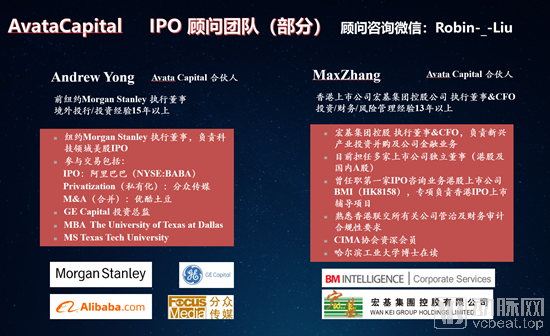
Part of the IPO Advisory Team at Aiwota Capital
“We found that during the IPO process for small and medium-sized enterprises (SMEs), it is not necessary for IPO advisors to provide on-site services on a daily basis. This means that one IPO advisor can simultaneously serve three to four companies, achieving greater efficiency and cost-effectiveness compared to a CFO dedicated to serving a single enterprise.” By leveraging this breakthrough, Aivota Capital has been able to provide high-quality overseas IPO advisory services while making them affordable for SMEs.
To date, Aivota Capital has facilitated IPOs on overseas capital markets—including NASDAQ, the Hong Kong Stock Exchange, and the New York Stock Exchange—for nearly 20 small and medium-sized enterprises (SMEs) in China, spanning multiple sectors such as culture, sports and entertainment, internet, healthcare, manufacturing, and high-end services.
In addition to its high cost-effectiveness, Mr. Liu Bingxin believes that Aiwota Capital possesses two distinct advantages. On one hand, the firm’s core partners have long been involved in international mergers and acquisitions (M&A), having participated in major cross-border transactions such as Alibaba’s IPO, Focus Media’s listing, and the merger of Youku and Tudou. They also have experience assisting companies with listings on the Hong Kong Stock Exchange and are well-versed in capital exit mechanisms. “Serving SMEs in their IPO processes essentially means extending our services to the lower-tier market; through continuous refinement, our operational efficiency has become quite high.”
On the other hand, through Iwota Capital’s business of assisting domestic USD-denominated funds in fundraising, the company has accumulated extensive resources among U.S. fund-of-funds investors. These investors can serve as cornerstone investors prior to a company’s overseas listing, thereby ensuring a successful IPO at an ideal offering price.
In fact, an overseas initial public offering (IPO) enables companies to secure financing while establishing an international corporate governance structure and gaining high liquidity in the secondary market.
“For prospective unicorn companies, overseas IPOs serve another critical purpose: securing a first-mover advantage in their respective sectors,” pointed out Mr. Liu Bingxin. Competition among small and medium-sized enterprises (SMEs) in niche markets is intensely fierce; against the backdrop of limited differentiation in products and business models, listing on overseas capital markets ahead of rivals can help rapidly widen the gap with competitors.
Taking a domestic internet-based medical aesthetics platform that listed on the NASDAQ this May as an example, it has established three core business segments: a medical aesthetics community, a medical aesthetics content media platform, and an online appointment service. The company generates revenue by charging service providers information service fees, achieving remarkable performance with an average annual revenue growth rate of 255% over two consecutive years. After its rapid entry into the NASDAQ market, it quickly gained investor recognition and built a brand effect far surpassing that of competitors with similar fundamentals.
Mr. Liu Bingxin pointed out that, with the further refinement of listing rules in various capital markets and the accumulation of the team’s service cases and capabilities, Aiwota Capital is able to provide IPO advisory services more efficiently to a greater number of small and medium-sized enterprises (SMEs) in specialized sectors within China.