

97 Medicines Successfully Included in China's 2019 National Reimbursement Drug List (NRDL) Negotiations: Key Trends and Implications for Pharmaceutical Companies
This morning, the National Healthcare Security Administration held a press conference to announce the list of drugs approved for inclusion in the National Reimbursement Drug List through the 2019 price negotiations. A total of 150 drugs were subject to negotiation, with 97 successfully reaching agreements. Among these, 70 newly added varieties were successfully negotiated, and 27 varieties under renewal negotiations were also successfully included.
Following this round of adjustments, the 2019 National Reimbursement Drug List for Basic Medical Insurance, Work-Related Injury Insurance, and Maternity Insurance includes a total of 2,709 drugs. Compared with the 2017 edition, 218 drugs were added, 154 were removed, resulting in a net increase of 64 drugs. The new list will officially take effect on January 1, 2020.
The negotiated access drugs section in the new edition of the catalog has completed the largest-scale negotiation since the establishment of China's medical insurance system, with both the number of newly added negotiated drugs and the total number of negotiated drugs reaching record highs; andFollowing the issuance of the new catalog, local authorities shall no longer adjust Class B drugs, except where special provisions apply., whether a drug can be included in the National Reimbursement Drug List is crucial to the market landscape. Therefore, this negotiation has also drawn significant attention from the industry.
What are the characteristics of the drugs included in this round of negotiation-based market access? What trends do they reflect? VCBeat has compiled an overview.
Added 70 Varieties, Focusing on More Than 10 Clinical Therapeutic Areas
It is understood that, through expert review and voting selection, a preliminary list of 128 drugs was proposed for negotiation. After confirming the companies’ intention to negotiate, 119 drugs were finalized as new candidates for negotiation. In addition, among the drugs granted market access through negotiation in 2017, 31 required renegotiation to determine whether their contracts could be renewed. Combined, these two categories totaled 150 drugs subject to negotiation this time, with both the number of newly added negotiated drugs and the total number of negotiated drugs reaching record highs.
Ultimately, 97 negotiations were successful. Among these, 70 newly added varieties successfully completed negotiations (52 Western medicines and 18 proprietary Chinese medicines), while 27 varieties under renewal negotiations were successful (22 Western medicines and 5 proprietary Chinese medicines).
All 97 of these drugs will be included in the Category B list of the National Reimbursement Drug List.
The medicines successfully negotiated in this round cover more than 10 clinical therapeutic areas, including cancer, rare diseases, hepatitis, diabetes, multidrug-resistant tuberculosis, rheumatology and immunology, cardiovascular and cerebrovascular diseases, and gastroenterology.
In key therapeutic areas, negotiations were successful for all five essential medicines, 22 anticancer drugs, seven drugs for rare diseases, 14 drugs for chronic conditions (including diabetes, hepatitis B, and rheumatoid arthritis), and four pediatric drugs.
This demonstrates a significant optimization in the structure of drugs included in the National Reimbursement Drug List (NRDL), along with a marked enhancement in coverage capabilities. Meanwhile, key disease areas prioritized by the NRDL—such as critical illnesses, chronic diseases, and pediatric conditions—have, to some extent, provided direction for pharmaceutical companies’ research and development efforts.
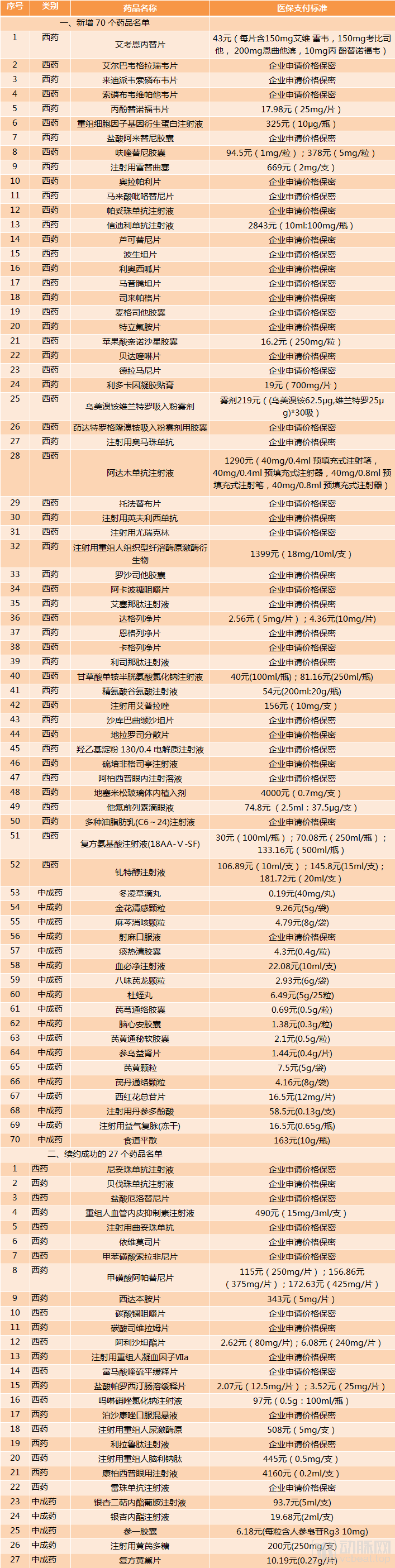
97 Drugs Successfully Negotiated and Partial Medical Insurance Payment Standards, Chart by VCBeat
Eight Major Innovative Drugs Successfully Negotiated, Pressuring Companies to Increase Innovation Efforts
The negotiations underscored the encouragement of innovative drugs. Eight out of twelve major domestically produced innovative medicines were successfully included. The vast majority of the medicines that succeeded in the negotiations were new drugs launched in recent years, many of which entered the market in 2018. These newly launched drugs were rapidly incorporated into the reimbursement list, sending a clear signal of support for innovation.
In recent years, state encouragement of innovative drugs has blossomed comprehensively. Large-scale reforms in the review and approval of drugs and medical devices have already been implemented, with a batch of innovative drugs granted priority market approval. According to the “2018 Annual Drug Review Report” published by the Center for Drug Evaluation (CDE), the CDE accepted 25 new drug applications (NDAs) for Class 1 innovative drugs in 2018, representing a 150% increase compared to 2017. Among these, 16 NDAs were for Class 1 innovative chemical drugs, a 100% increase over 2017; and 9 NDAs were for Class 1 biological products, a 4.5-fold increase compared to 2017. The newly revised Drug Administration Law, effective from December 1, has added a dedicated chapter on drug development and registration to specifically encourage the research and creation of new drugs.
The aforementioned measures primarily target the research and development (R&D) and approval stages of pharmaceuticals. As domestic innovative drug companies mature, their R&D pipelines are progressively reaching the market, ushering in a period of commercial returns. The emphasis placed on innovative drugs in the National Reimbursement Drug List (NRDL), coupled with the successful price negotiations for numerous major domestically produced innovative drugs, signifies that state support for these innovations has extended into the sales phase. This mechanism serves to incentivize pharmaceutical enterprises to intensify their innovation efforts.
The National Healthcare Security Administration has also introduced a confidentiality mechanism, under which prices for which enterprises have requested confidentiality are not disclosed in the medical insurance payment standards, thereby demonstrating protection for businesses.
Drug Prices Plunge, Pharma Companies Must Weigh Price-Volume Trade-offs
Drug prices in this round of negotiations also saw significant reductions. The average price reduction for the 70 newly added drugs was 60.7%. The average price reduction for three hepatitis C treatments exceeded 85%, while that for oncology and diabetes medications was approximately 65%. Of the 31 drugs up for renewal, 27 were successfully negotiated, with an average price reduction of 26.4%.
The press conference also highlighted that, through volume-based price negotiations, several globally renowned “premium drugs” have been priced at “affordable levels,” with imported medications generally offered at the lowest prices worldwide. For patients, out-of-pocket expenses will be reduced to less than 20% of the original cost, and for certain drugs, to below 5%.
For enterprises, it is necessary to balance the relationship between price and volume to recoup upfront R&D costs.
Among the four popular PD-1 monoclonal antibodies, only Innovent Biologics’ sintilimab was included in the current National Reimbursement Drug List (NRDL), with a reimbursement price of RMB 2,843 per vial (10 mL:100 mg/vial). The recommended dosage of sintilimab is 200 mg every three weeks. Based on a 52-week year, the estimated annual cost amounts to approximately RMB 98,000.
Following the pre-negotiation patient assistance program (PAP) for sintilimab, the annual cost was RMB 159,000, representing a price reduction of approximately 39.4% based on the PAP calculation; based on the non-PAP price of RMB 260,000 per year, the price reduction was approximately 62.3%.
However, the National Reimbursement Drug List (NRDL) also specifies restricted indications for covered drugs. Sintilimab is limited to “patients with relapsed or refractory classical Hodgkin lymphoma who have received at least two prior lines of systemic chemotherapy.” In accordance with current standardized requirements for hospitals to submit claims to the National Healthcare Security Administration (NHSA) for reimbursement review, the actual volume of sintilimab use within the NRDL-covered scope remains uncertain. Whether the price reduction will ultimately translate into increased sales volume remains to be seen.
Therefore, whether a drug is included in the National Reimbursement Drug List (NRDL) presents a dual-sided scenario. For drugs included in the list, pharmaceutical companies must still prioritize R&D, monitor drug safety, and expand indications. For those not included, companies need to increase market share by ensuring quality, building brand reputation, expanding indications, and exploring new distribution channels.
This round of national medical insurance drug price negotiations focused on including medications for cancer, rare diseases, chronic conditions, and pediatric use. Drug costs have been significantly reduced, with imported medicines largely offered at their lowest global prices, thereby alleviating the financial burden on patients and indicating an overall enhancement in the coverage capacity of the medical insurance system. The negotiated formulary also incorporated a batch of newly launched drugs with high clinical value and strong market recognition, sending a clear signal of state support for innovation. The validity period of the negotiation agreements is two years, expiring on December 31, 2021. Over the next two years, new drugs will continue to enter the market, and existing indications may be expanded. Future adjustments to the National Reimbursement Drug List (NRDL) are expected to continue encouraging innovative drugs, providing more opportunities for new therapies to gain access.
Appendix:Complete Catalogue of Medicines Subject to National Medical Insurance Negotiations(Click to view)