

NVIDIA Unveils Clara Federated Learning at RSNA 2019 to Bring AI to Hospitals While Safeguarding Patient Data
NVIDIA
Artificial Intelligence Computing Service Provider
At the annual meeting of the Radiological Society of North America (RSNA), more than 100 exhibitors adopted NVIDIA’s technology to integrate AI into radiology. The year 2019 appears poised to become a turning point for the application of AI in healthcare. Despite its immense potential, AI still faces a critical challenge: how to obtain the vast amounts of data needed to train AI models while safeguarding patient privacy. Through collaboration with industry partners, NVIDIA has developed a solution to address this issue.
At this year’s RSNA conference, NVIDIA launched NVIDIA Clara Federated Learning, which leverages distributed collaborative learning technology to keep patient data within healthcare institutions. NVIDIA Clara Federated Learning runs on NVIDIA’s recently released NVIDIA EGX intelligent edge computing platform.
Federated Learning—AI That Protects Privacy
Clara Federated Learning is a reference application for distributed, collaborative AI model training that safeguards patient privacy. These distributed client systems run on edge-oriented, NVIDIA NGC-Ready servers built by global system manufacturers, enabling local deep learning training and collaborative development of more accurate global models.
Its working principle is as follows: The Clara Federated Learning application is packaged into a Helm chart to simplify deployment on Kubernetes infrastructure. The NVIDIA EGX platform securely configures the federated server and collaborative clients, providing everything needed to launch a federated learning project, including application containers and the initial AI model.
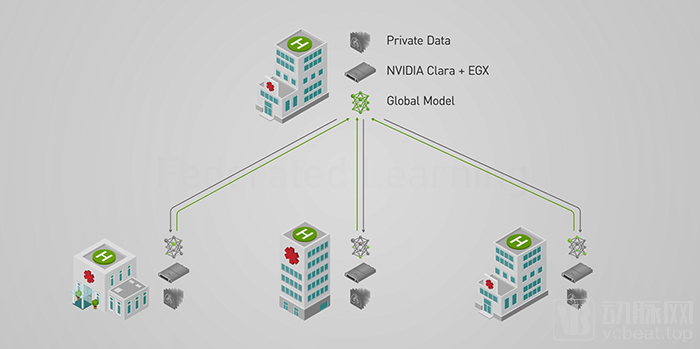
NVIDIA Clara Federated Learning adopts distributed training to develop AI models across hospitals without sharing personal data
Participating hospitals used the NVIDIA Clara AI-assisted annotation SDK to label their own patient data. This SDK is integrated into medical imaging platforms such as 3D Slicer, MITK, Fovia, and Philips IntelliSpace Discovery. By leveraging pre-trained models and transfer learning techniques, NVIDIA AI assists radiologists in the labeling process, reducing the time required for complex 3D studies from hours to minutes.
For each hospital participating in the project, their EGX servers train the global model using local data. The results of local training are shared back to the federated learning server via secure links. This approach shares only model weight updates rather than patient cases, thereby preserving privacy and enabling the construction of a new global model through federated averaging.
This process is repeated until the AI model achieves the desired accuracy. This distributed approach delivers superior deep learning performance while ensuring the security and privacy of patient data.
UK and US Healthcare Institutions Lead the Adoption of NVIDIA Clara Federated Learning
Leading global healthcare institutions, including the American College of Radiology (ACR), Massachusetts General Hospital, and UCLA Medical Center, are racing to adopt this technology. They are committed to developing personalized AI applications for their physicians, patients, and medical facilities, even as their medical data, applications, and devices continue to expand, all while ensuring the protection of patient privacy.
ACR is piloting NVIDIA Clara Federated Learning within its national medical imaging platform, AI-LAB. AI-Lab will empower ACR’s 38,000 medical imaging members to securely build, share, fine-tune, and validate AI models. For healthcare institutions seeking to leverage AI-Lab, a range of edge-oriented NVIDIA NGC-Ready systems are available from vendors including Dell, HPE, Lenovo, and Supermicro.
The Department of Radiology at the University of California, Los Angeles (UCLA) is also leveraging NVIDIA Clara Federated Learning to harness the power of AI in radiology. As a premier academic medical center, UCLA is well-positioned to validate the efficacy of Clara Federated Learning and expand its deployment across the broader University of California system in the future.
Partners HealthCare, the US-based healthcare system in New England, has also announced a new initiative adopting NVIDIA Clara Federated Learning. The Clinical Data Science Center at Massachusetts General Hospital and Brigham and Women’s Hospital will leverage the data assets and clinical expertise within the Partners HealthCare system to pioneer this effort.
In the United Kingdom, NVIDIA is collaborating with King’s College London and Owkin to build a federated learning platform for the National Health Service (NHS). The Owkin Connect platform, powered by NVIDIA Clara, enables algorithms to be transferred from one hospital to another and trained on each hospital’s local datasets. The platform provides each hospital with a blockchain-based distributed ledger to capture and track all data used for model training.
The project initially connected four leading teaching hospitals in London, providing them with AI services to accelerate work in areas such as cancer, heart failure, and neurodegenerative diseases, and was set to expand to at least 12 UK hospitals by 2020.
Making Everything in Hospitals Smart
With the rapid proliferation of sensors, medical centers such as Stanford Hospital are striving to imbue every system with intelligence. However, to make sensors smart, the devices require a powerful, low-power AI computer.
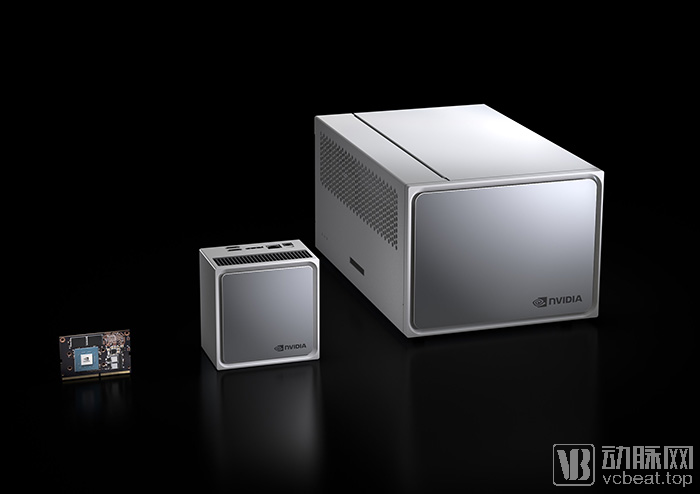
This is precisely why NVIDIA is launching the NVIDIA Clara AGX, an embedded AI development kit that enables image and video processing at high data rates, bringing AI inference and 3D visualization technologies to the point of care.
Clara AGX is powered by the NVIDIA Xavier SoC, the same system-on-chip used in autonomous vehicle control processors. With a power consumption of only 10W, it is well-suited for integration into medical devices or deployment in compact edge systems.
The revolutionary HyperFine is a perfect use case for Clara AGX, marking the world’s first portable point-of-care MRI system. HyperFine will be showcased at the NVIDIA booth during this week’s RSNA conference.
The HyperFine system is among the first to adopt Clara AGX across a wide range of medical instruments, surgical kits, patient monitoring devices, and smart medical cameras. NVIDIA is witnessing the dawn of the AI-powered healthcare Internet of Things (IoT).
The NVIDIA Clara SDK will soon be released through NVIDIA’s Early Access Program. It includes two common reference applications: AI inference for endoscopic video and software beamforming for ultrasound.