

China Unveils 15 Measures and 7 Implementation Milestones to Expand National Centralized Drug Procurement
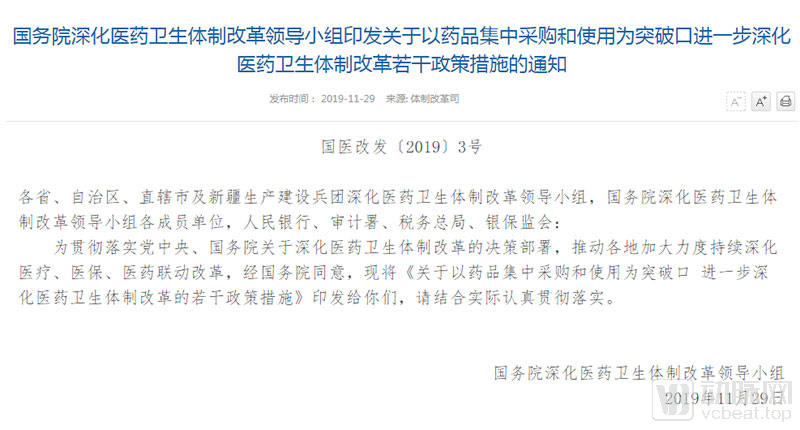
VCBeat (WeChat ID: vcbeat) has learned that the Leading Group for Deepening the Reform of the Medical and Healthcare System under the State Council recently issued the “Several Policy Measures on Further Deepening the Reform of the Medical and Healthcare System, with Centralized Drug Procurement and Use as the Breakthrough Point.” The document clarifies the need to comprehensively deepen the reform of state-organized centralized drug procurement and use, and proposes 15 measures covering key areas such as drug procurement, supply, quality, pricing, medical insurance payment, and informatization. Some of these measures specify an implementation timeline, involving a total of seven milestone dates (highlighted in bold in the original text).
Key points and critical implementation milestones involved in the measures include:
The scope of drug varieties subject to national centralized volume-based procurement and use will be expanded in an orderly manner, building on the lessons learned from pilot programs;
Leverage provincial-level centralized drug procurement platforms to establish a unified and open national public drug procurement market;
Accelerate the development of an informatized drug traceability system, and take the lead in achieving “one item, one code” for vaccines and drugs included in the national centralized volume-based procurement and use by the end of December 2020;
Ensure a stable supply of pharmaceuticals; in cases where enterprises fail to deliver as per contract, or cannot guarantee quality and supply, corresponding measures for compensation, disciplinary action, market exit, backup alternatives, and emergency safeguards shall be implemented;
From 2020 to 2022, all regions shall seize the window of opportunity presented by centralized procurement of drugs and medical consumables and the elimination of markups on medical consumables—measures aimed at reducing costs for these items—to conduct annual assessments of medical service price adjustments.
Promote the reform of the compensation system in public hospitals to motivate medical personnel. By the end of February 2020, all regions shall comprehensively advance the reform of the compensation system in public hospitals in light of local conditions;
By the end of December 2020, the National Healthcare Security Administration, in conjunction with the National Health Commission, formulated a plan for a big data-based supervision and management system for medical insurance in public hospitals. The plan was piloted in selected large and medium-sized cities across China to accumulate experience and gradually promote its nationwide implementation.
Full Text of the Measures:
Since the launch of the national pilot program for centralized drug procurement and use, overall operations have remained stable and orderly, effectively driving drug prices back to reasonable levels. This reform represents a significant overhaul of the drug procurement mechanism; it not only helps reduce artificially inflated drug prices and alleviate the financial burden on the public, but also plays a positive role in deepening healthcare reform, consolidating the achievements of public hospitals in eliminating the practice of subsidizing medical services with drug profits, and promoting the healthy development of the pharmaceutical industry. Currently, the pilot program is being expanded nationwide. All regions and relevant departments should seize this opportunity for reform, take centralized drug procurement and use as the breakthrough point, summarize reform experiences, and advance the implementation of the following policy measures. These efforts aim to promote coordinated development among healthcare services, health insurance, and the pharmaceutical industry, amplify the impact of the reforms, and better address the public’s challenges in accessing medical care.
Based on the summary and evaluation of the pilot experience in promoting national centralized drug procurement and usage across China, and on the basis of further improving relevant policies and measures, we will adhere to the combination of market mechanisms and government intervention. We will establish and continuously optimize a national centralized drug procurement model characterized by volume-based procurement, integration of bidding and procurement, quality priority, guaranteed usage volumes, and assured payment settlement. In light of patients’ clinical medication needs, progress in the consistency evaluation of generic drug quality and efficacy, and advancements in the approval process for new registration classifications of chemical drugs, we will orderly expand the scope of drug varieties included in national centralized procurement and usage. Priority will be given to including in the centralized procurement scope those varieties whose originator drug prices are higher than those in major countries worldwide and neighboring regions, those with significant price gaps between originator and generic drugs, as well as essential medicines that have passed the consistency evaluation of generic drug quality and efficacy. Policy documents will be studied and issued to reform and improve the drug procurement mechanism. While ensuring the effective implementation of centralized drug procurement, we will explore the gradual inclusion of high-value medical consumables into the scope of national or local centralized procurement. (Led by the National Healthcare Security Administration, in collaboration with the National Health Commission, the National Medical Products Administration, etc.; the first-listed entity is the lead unit, as applies below.)
Relying on provincial-level centralized drug procurement platforms, we will establish a unified and open national public drug procurement market with consistent coding, standards, and functional specifications. We will promote interconnectivity and resource sharing of drug pricing and other relevant information to facilitate nationwide coordination of drug prices. For drugs not included in the scope of national centralized volume-based procurement and use, all regions shall leverage provincial-level centralized drug procurement platforms, draw on the experience gained from national centralized drug procurement and use, and intensify reforms and innovations in areas such as the scope of procured drugs, eligibility criteria, and forms of centralized procurement, adopting approaches such as standalone or cross-regional alliance procurement. This will foster a mutually reinforcing work pattern between national and local efforts. We encourage exploring methods such as group purchasing, joint procurement by specialized hospitals, and procurement by medical consortia to achieve reasonable pricing. Non-public medical institutions and social pharmacies are encouraged to actively participate, jointly promoting the formation of a market-led drug pricing mechanism. (Responsible entities: National Healthcare Security Administration, National Health Commission, National Medical Products Administration, etc.)
Actively advance the quality and efficacy consistency evaluation of generic drugs, implement localized regulatory responsibilities for drugs that have passed the consistency evaluation, and strengthen supervision and inspection. Accelerate the construction of an informatized drug traceability system,Develop unified standards for information-based traceability by the end of December 2019, and achieve “one item, one code” for vaccines and drugs included in the national centralized volume-based procurement and use by the end of December 2020., gradually covering all pharmaceutical products, with traceability data available for public verification. Strengthen supervision, inspection, and product sampling of drugs awarded in centralized procurement, urge winning enterprises to enhance quality management standards and effectively fulfill their primary responsibilities, so as to ensure the quality and safety of pharmaceutical products. (Responsible entities: National Medical Products Administration, National Health Commission, National Healthcare Security Administration)
Establish a comprehensive system for investigating, evaluating, assessing, and monitoring the supply capabilities of pharmaceutical manufacturers. Starting with drugs included in the national centralized volume-based procurement and usage programs, gradually establish a reporting system for winning bidders’ emergency reserves, inventory levels, and production capacity. Pharmaceutical manufacturers shall independently select distribution enterprises for delivery; local administrative departments and medical institutions are prohibited from designating specific distributors. Strictly penalize breaches of trust in drug procurement in accordance with the law, and improve the market exit mechanism. In cases such as failure to supply goods as contracted or inability to guarantee quality and supply, timely measures including compensation, penalties, market exit, activation of alternative suppliers, and emergency safeguards shall be implemented. For enterprises engaging in illegal or irregular practices such as bid rigging, collusive bidding, price-fixing alliances, price manipulation, or malicious supply disruptions, measures such as disqualification from participating in centralized procurement and removal from online procurement platforms shall be taken in accordance with laws and regulations. (The National Development and Reform Commission, the Ministry of Industry and Information Technology, the National Health Commission, the People’s Bank of China, the State Administration for Market Regulation, and the National Healthcare Security Administration shall each take the lead within their respective areas of responsibility, with the participation of the National Medical Products Administration. “Each taking the lead” means that each unit shall spearhead efforts according to its designated duties, as applied below.)
Encourage medical insurance handling agencies to settle drug payments directly with drug manufacturers or distributors. In regions where conditions are not yet met, medical insurance handling agencies may advance a portion of medical insurance funds to medical institutions as agreed upon in contracts. Encourage the exploration of more efficient methods for settling drug payments to ensure that medical institutions pay for drugs in accordance with procurement contracts. Encourage eligible regions to explore centralized settlement of drug payments by payers on provincial-level centralized drug procurement platforms. Strengthen real-time monitoring of drug payment settlements. Each province (autonomous region, municipality) shall regularly rank and appropriately disclose the status of drug payment settlements across its cities and prefectures. Regularly issue circulars of criticism within the province against heads of medical insurance handling agencies who fail to disburse medical insurance funds on time without justified reasons, and against heads of medical institutions who fail to settle drug payments on time. Strengthen audit supervision over medical insurance payments for drugs, settlement of medical expenses, and drug payments made by medical institutions. (The National Healthcare Security Administration, the National Health Commission, the National Audit Office, and the National Administration of Traditional Chinese Medicine are respectively responsible.)
Promote fair and orderly market competition, break down market segmentation and local protectionism in the pharmaceutical product market, facilitate cross-regional and cross-ownership mergers and reorganizations among drug manufacturing and distribution enterprises, cultivate a group of large enterprise groups with international competitiveness, and accelerate the formation of a drug production and distribution landscape dominated by large backbone enterprises and supplemented by small and medium-sized enterprises. In drug procurement, local governments shall not restrict the operation, purchase, or use of goods and services provided by specific manufacturers and distributors; shall not restrict non-local manufacturers and distributors from entering the local market; shall not exclude, restrict, or compel non-local manufacturers and distributors to invest or establish branches locally; and shall not illegally grant preferential policies to specific manufacturers and distributors. Any such violations discovered shall be publicly exposed, and relevant departments shall seriously handle them in accordance with laws and regulations upon verification. Conduct routine supervision over the implementation of the “Two-Invoice System.” Severely crack down on tax evasion behaviors by pharmaceutical companies, such as inflating promotion fees and service fees through intermediary organizations. (The Ministry of Industry and Information Technology, the Ministry of Commerce, the National Health Commission, the State Taxation Administration, the State Administration for Market Regulation, the National Healthcare Security Administration, and the National Medical Products Administration are respectively responsible.)
All regions should draw on and promote the experience of the “Three-Medical” linkage reform, which focuses on “creating fiscal space, adjusting structures, and ensuring continuity.” Fiscal space should be created through various measures, such as reducing the costs of pharmaceuticals and medical consumables, and these resources should be coordinated to advance the “Three-Medical” linkage reform while ensuring that the public benefits. On the premise that the overall burden on the public does not increase, pilot programs should be steadily and orderly implemented to explore the optimization of medical service pricing.From 2020 to 2022, all regions shall seize the window of opportunity presented by centralized procurement of drugs and medical consumables, as well as the elimination of markups on medical consumables, to reduce costs, and conduct annual assessments for price adjustments.Prices meeting the initiation criteria shall be adjusted in a steady and orderly manner. The intensity of dynamic adjustments to medical service prices shall be increased. In principle, additional costs incurred due to adjustments in medical service prices shall be included within the scope of medical insurance payment, ensuring close alignment with the coordinated reforms of healthcare, medical insurance, and pharmaceuticals (the “Three Medicals”). Guiding documents for the dynamic adjustment of medical service prices shall be formulated to promote the establishment of pricing and price-adjustment rules and procedural methods tailored to the characteristics of the healthcare industry across various regions. In accordance with the principles of “aggregate control, structural optimization, balanced increases and decreases, and gradual implementation,” the relative price relationships among medical services shall be continuously optimized. All regions shall reform and improve the procedures for setting and adjusting medical service prices in accordance with laws and regulations. The review process for new medical service price items shall be accelerated by improving review systems and standardizing review procedures, thereby fostering technological innovation and clinical application in medicine. All regions shall strictly implement regional health planning, fulfill investment responsibilities for public healthcare institutions that comply with regional health plans as required, and provide appropriate preferential support to traditional Chinese medicine hospitals. (Responsible entities: Secretariat of the State Council Leading Group for Healthcare Reform, National Healthcare Security Administration, National Health Commission, Ministry of Finance, and National Administration of Traditional Chinese Medicine)
All regions must implement the “Two Permissibles” requirement, promptly and effectively utilize the increased disposable income of hospitals resulting from reduced costs of drugs and medical consumables and adjusted prices for medical services, and actively advance the reform of the compensation system in public hospitals to motivate healthcare professionals. We should actively explore and improve the performance-based pay policy for public institutions, establish a compensation system and a scientifically sound and reasonable distribution mechanism that reflect the specific characteristics of the healthcare industry, and ensure that public healthcare institutions have autonomy in income distribution. Localities and public healthcare institutions are encouraged and permitted to carry out reforms and innovations based on their actual conditions, and relevant local governments and departments shall provide active support and strengthen guidance.By the end of February 2020, all regions shall comprehensively advance the reform of the compensation system in public hospitals, taking into account local conditions.Implement and improve policies related to performance-based pay in primary healthcare institutions.In 2020, the National Health Commission, the Ministry of Human Resources and Social Security, the Ministry of Finance, and other departments jointly formulated specific measures to align the scope of medical service revenue with the compensation system.(The Ministry of Human Resources and Social Security, the Ministry of Finance, the National Health Commission, and the National Administration of Traditional Chinese Medicine shall each be responsible for their respective duties, with the participation of the National Healthcare Security Administration.)
Uphold the dominant position of essential medicines and promote the optimization of medication structures. All localities shall strengthen the management and standardization of drug formularies in medical institutions in accordance with national requirements. Based on summary evaluations, they shall promote the priority procurement and use of National Essential Medicines and drugs listed in the Medical Insurance Catalogue by medical institutions, and promptly adjust and optimize institutional drug formularies. The role of Pharmacy and Therapeutics Committees in drug procurement and use within medical institutions shall be strengthened. Efforts shall be made to ensure the adequate staffing, training, and development of pharmacists; local practices that demonstrate the value of pharmaceutical care shall be summarized and promoted, thereby leveraging the critical role of pharmacists in promoting rational drug use. (The National Health Commission, the National Healthcare Security Administration, and the National Administration of Traditional Chinese Medicine shall be respectively responsible.)
On the basis of ensuring drug quality and efficacy, starting with drugs included in the national centralized volume-based procurement and use programs as well as negotiated drugs, medical insurance payment standards shall be established for drugs listed in the National Reimbursement Drug List (NRDL) by generic name, and a dynamic adjustment mechanism shall be instituted. In principle, the same payment standard shall apply to originator drugs, reference listed drugs, and generic drugs that have passed the consistency evaluation of quality and efficacy, provided they share the same generic name, dosage form, and strength. Generic drugs that have passed the consistency evaluation shall be included in the list of drugs interchangeable with originator drugs. Publicity efforts shall be strengthened to highlight the high quality and affordability of such generics, thereby encouraging and guiding physicians and patients to utilize them. When prescribing, if both an originator drug and a generic drug that has passed the consistency evaluation are available under the same generic name, physicians shall truthfully inform patients of relevant information, including drug costs, to ensure patients’ right to know and right to choose. Medical institutions participating in the national reform on centralized volume-based procurement and use of drugs shall prioritize the use of drugs selected through centralized procurement. Pharmacists shall conduct prescription reviews in accordance with relevant regulations and requirements. (The National Health Commission and the National Healthcare Security Administration shall be responsible respectively.)
Accelerate the establishment of a diversified and composite health insurance payment system to guide medical institutions to proactively control costs, prioritize the use of high-quality, affordable drugs, consumables, and technologies, and reduce medical expenses. Launch national pilot programs for Diagnosis-Related Group (DRG) based payment, promptly summarize experiences, and steadily expand the scope of reform. Encourage localities to actively explore payment methods that better leverage the distinctive advantages of Traditional Chinese Medicine (TCM) based on local conditions. For designated medical institutions that reasonably use selected drugs, fulfill procurement contracts, and meet the volume targets for drugs included in national centralized procurement and usage, the global budget caps will not be reduced due to the decrease in costs associated with centrally procured and used drugs. (Responsible entities: National Healthcare Security Administration, National Health Commission, National Administration of Traditional Chinese Medicine, Ministry of Finance)
Comprehensively implement intelligent monitoring of medical security and improve the mechanism for exit due to breach of contract. Establish a credit evaluation system and an information disclosure system for the supervision of medical insurance funds. Medical insurance departments shall investigate and punish, in accordance with the law, acts discovered during supervisory inspections—such as excessive medical treatment, irrational drug use, and other violations of laws and regulations—that result in the loss of medical insurance funds. Implement and consolidate city-level pooling of basic medical insurance, and encourage regions with appropriate conditions to actively and prudently explore and advance provincial-level pooling. Encourage commercial insurance institutions and other social forces to participate in the administration of basic medical insurance, critical illness insurance, medical assistance, and other medical security services, thereby enhancing management and service levels. (Responsible entities: National Healthcare Security Administration, China Banking and Insurance Regulatory Commission)
Deepen the performance assessment of tertiary public hospitals, initiate the implementation of performance assessments for secondary and lower-level public medical institutions, continuously optimize the performance assessment indicator system, strengthen information support, and improve policies regarding the analysis, application, and publication of assessment results. Gradually establish a precise, informatized, and normalized performance assessment system for public medical institutions, ensuring effective alignment with the regulation of non-public medical institutions. Strengthen monitoring of the procurement and use of drugs selected in national centralized volume-based procurement, non-selected drugs with the same generic name, and substitutable varieties of selected drugs.By the end of June 2020, establish and implement a monitoring indicator system for rational drug use, and regularly publish monitoring results.Promote the implementation of the physician interview system. (The National Health Commission and the National Administration of Traditional Chinese Medicine are respectively responsible.)
Improve the national drug price monitoring and early warning system, strengthen dynamic monitoring of domestic procurement prices and tracking of foreign drug prices, and collect international prices of imported drugs as a reference for entry into China’s public drug procurement market. Conduct negotiations on inclusion in the National Reimbursement Drug List for imported and innovative drugs that meet specified criteria. Comprehensively employ measures such as written inquiries and regulatory interviews, cost investigations, credit evaluations, and information disclosure to establish and improve a normalized mechanism for drug price regulation. Strengthen oversight of drug pricing practices, strictly investigate and punish price violations and monopolistic conduct in accordance with the law, and accept reports and leads through the 12315 hotline to effectively maintain orderly drug markets. (Responsibility lies with the National Healthcare Security Administration, the State Administration for Market Regulation, and other relevant authorities.)
All regions shall, in accordance with the national unified plan, actively promote the interconnectivity and information sharing of medical institution prescriptions, medical insurance settlements, healthcare service supervision, drug traceability, budget management, and tax supervision. Efforts are encouraged to explore and implement the coordinated application of standardized coding across drug procurement, usage, and payment processes. Pilot provinces for comprehensive healthcare reform shall take the lead in breaking down industry barriers and vigorously promoting the interconnection and sharing of regulatory information in areas such as medical insurance fund supervision and healthcare service supervision.By the end of December 2020, the National Healthcare Security Administration, in conjunction with the National Health Commission, shall formulate a plan for a big data-based system for the supervision and administration of medical insurance in public hospitals. The plan shall be piloted in selected large and medium-sized cities across China to accumulate experience and be gradually rolled out nationwide.(Respectively undertaken by the National Healthcare Security Administration, the National Health Commission, the Ministry of Finance, the State Taxation Administration, the National Administration of Traditional Chinese Medicine, and the National Medical Products Administration)
All localities and relevant departments must fully recognize the importance and urgency of advancing healthcare reform by leveraging centralized drug procurement and utilization as a breakthrough point, and must earnestly strengthen organizational leadership and implementation. All provinces (autonomous regions, and municipalities directly under the Central Government) shall timely refine and implement measures tailored to local conditions, clarify responsibilities, and ensure diligent execution. Relevant departments shall carefully study and address new situations and issues arising during the reform process, promptly summarize and promote reform experiences, intensify supervision in regions with lagging progress, and guide all localities to synchronously advance healthcare reform tasks such as tiered diagnosis and treatment and family doctor contract services. The Secretariat of the State Council’s Leading Group for Healthcare Reform shall, in coordination with relevant departments, closely monitor reform developments, incorporate key tasks into the healthcare reform ledger for scheduling, and issue quarterly notifications to all provinces (autonomous regions, and municipalities directly under the Central Government), member units of the State Council’s Leading Group for Healthcare Reform, and relevant departments. Efforts should be strengthened to publicize and interpret policies, proactively respond to public concerns, guide rational social expectations, and create a favorable environment for the reform.
Source: National Health Commission