

AI Empowers Cardiovascular Care: Joint Report by Alibaba Cloud Tianchi and Artery Network Reveals Market Opportunities Across 290 Million Patients and a Trillion-Yuan Market
Recently, Alibaba Cloud Tianchi and VCBeat jointly released the "Report on AI Empowering Cardiovascular Care." Focusing on innovative applications of artificial intelligence in cardiovascular care, this report leverages VCBeat’s research and analysis to examine the current status of cardiovascular disease progression, the policy environment, and innovative developments by various enterprises in the field of cardiovascular AI. It analyzes specific AI-driven innovation models in the cardiovascular sector and highlights three major future trends. At the macro level, we propose development recommendations; at the micro level, we dissect innovative applications of artificial intelligence in the screening, diagnosis, and treatment of cardiovascular diseases.
This report is divided into four sections: the current state of cardiovascular disease, drivers and innovation landscape of AI in cardiology, specific innovative application scenarios of AI in cardiovascular care, and future development trends. The following is a brief overview of the report.
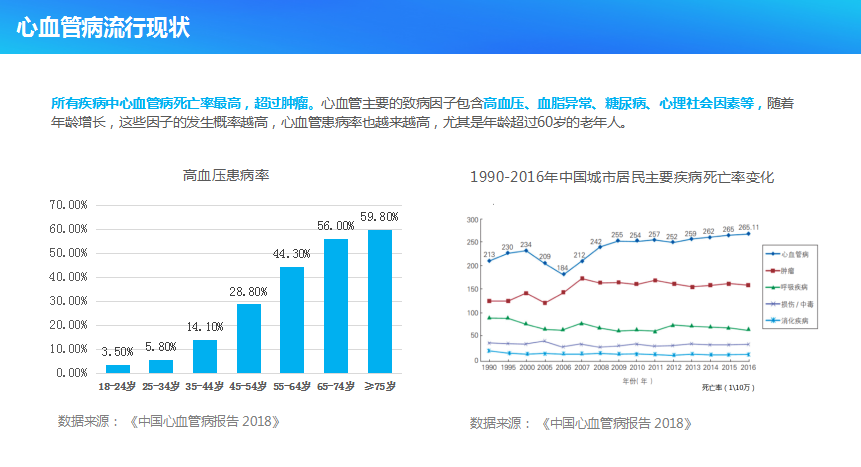
Cardiovascular disease is the leading cause of death across all disease categories. The high incidence of cardiovascular disease is attributed to major risk factors such as hypertension, smoking, dyslipidemia, diabetes, and psychosocial factors, which are difficult to control. For instance, encouraging individuals to quit smoking or lose weight to reduce the risk of hypertension poses significant challenges. Furthermore, the prevalence of these risk factors increases with age, leading to a higher prevalence of cardiovascular disease, particularly among adults aged 65 years and older. According to data from the "Report on Cardiovascular Diseases in China 2018," the prevalence of hypertension exceeds 50% in this population.
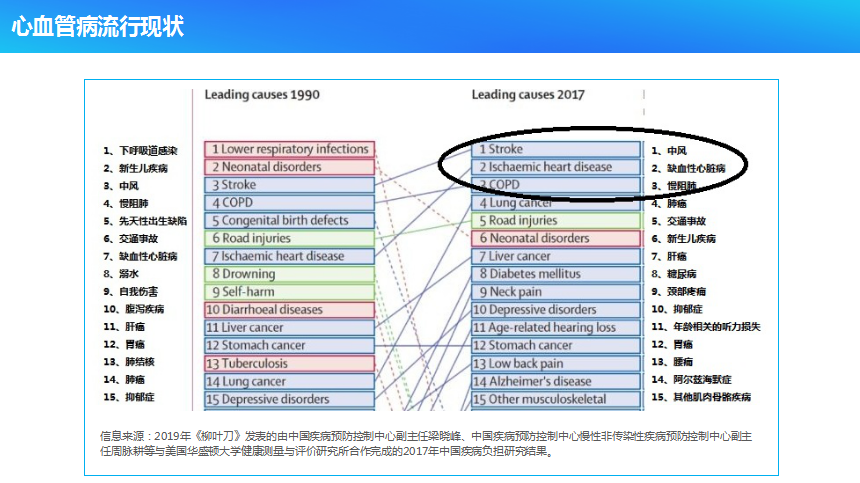
The vast patient population gives rise to a substantial disease burden and a large cardiovascular disease market. The 2019 Lancet publication of the 2017 Global Burden of Disease Study in China showed that stroke and ischemic heart disease were the two conditions with the highest burden, while lung cancer ranked fourth among all cancers.
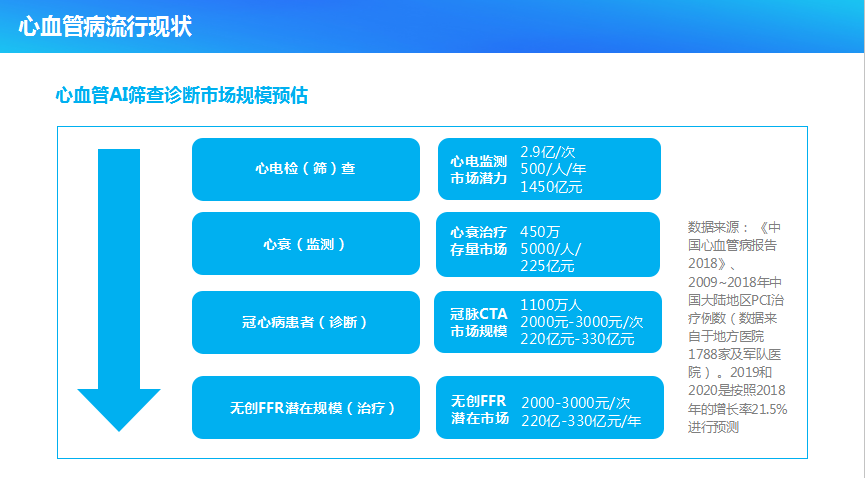
Based on the "China Cardiovascular Disease Report 2018" and current diagnosis and treatment costs, we estimate that the potential market size for cardiovascular screening, monitoring, and diagnosis ranges from tens of billions to hundreds of billions of yuan. For instance, in the ECG monitoring market, with 290 million patients who basically require ECG monitoring at an approximate annual cost of 500 yuan per person, the annual potential market size exceeds 100 billion yuan. As home monitoring devices become more widespread, the market penetration rate continues to rise. Similarly, regarding the market size for coronary CTA, there are 11 million patients with coronary heart disease; with each coronary CTA scan costing between 2,000 and 3,000 yuan, the annual potential market size is at least 20–30 billion yuan. Additionally, areas such as heart failure monitoring and non-invasive FFR testing are sectors poised for explosive growth following the emergence of AI.
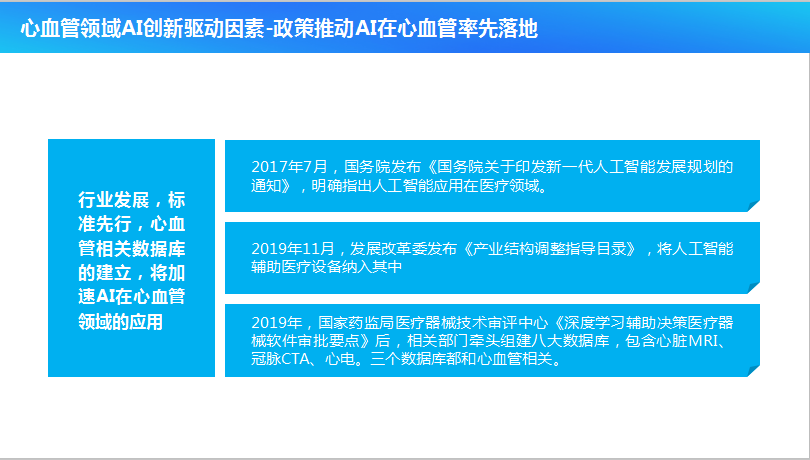
Policy guidance is crucial for industry development.
In July 2017, the State Council issued the "Notice of the State Council on Printing and Distributing the Development Plan for the New Generation of Artificial Intelligence," explicitly highlighting the application of artificial intelligence in the medical field. In November 2019, the National Development and Reform Commission released the "Guidance Catalog for Industrial Structure Adjustment," which included AI-assisted medical devices. In addition to industry policy guidance, industry standards are also crucial. In 2019, following the issuance of the "Key Points for Approval of Medical Device Software with Deep Learning-Assisted Decision-Making" by the Center for Medical Device Evaluation of the National Medical Products Administration, relevant departments took the lead in organizing major enterprises within the industry to establish eight major databases, three of which are related to cardiovascular diseases, including cardiac MRI, coronary CTA, and electrocardiogram (ECG). The establishment of standardized databases helps promote industry development and accelerate product approval, thereby facilitating faster implementation.
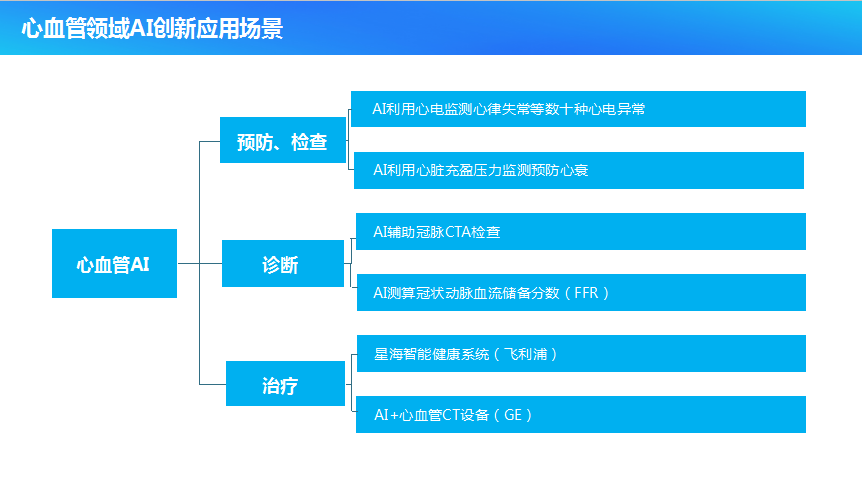
VCBeat has mapped out innovative application scenarios for AI in cardiovascular care. Currently, AI primarily empowers certain aspects of cardiovascular prevention, monitoring, diagnosis, and treatment.
AI primarily plays a role in cardiovascular prevention and monitoring in two key scenarios. First, AI leverages ECG monitoring to detect arrhythmias and dozens of other ECG abnormalities. Representative companies include Lepu Medical, Zhengxin Medical, PulseFlow Technology, and Palm ECG. Second, AI utilizes cardiac filling pressure monitoring to prevent heart failure. Heart failure is often referred to as the "final battlefield" of cardiovascular disease. Although heart failure can only be managed rather than cured, early detection and intervention can slow its progression. The leading domestic company in this field is Daerma.
There are numerous scenarios for the application of AI in cardiovascular diagnosis, with two currently gaining significant traction. The first is AI-assisted coronary CT angiography (CTA). Both Shukun Technology and Alibaba DAMO Academy are conducting research in this area. Currently, Shukun Technology’s coronary CTA analysis software has entered the NMPA’s green channel for expedited approval of Class III medical devices.
Second, non-invasive FFR testing is conducted using technologies such as AI and hemodynamics. There are approximately 13 companies in this field, including Keya Medical, Shukun Technology, Bodong Medicine, Xingmai Technology, and PulseFlow Technology. Among them, Keya Medical’s “DeepVessel FFR” has entered the NMPA’s green approval channel.
Of course, AI applications in cardiovascular diagnosis extend far beyond these examples, encompassing the assessment of numerous cardiovascular diseases and parameters, such as left ventricular ejection fraction and acute coronary syndrome (ACS). Currently, the most prominent areas of interest are AI-assisted coronary CTA and non-invasive FFR testing.。
Part III primarily focuses on treatment, such as GE’s CardioGraphe™, a CT scanner specifically designed for the imaging diagnosis of cardiovascular diseases.
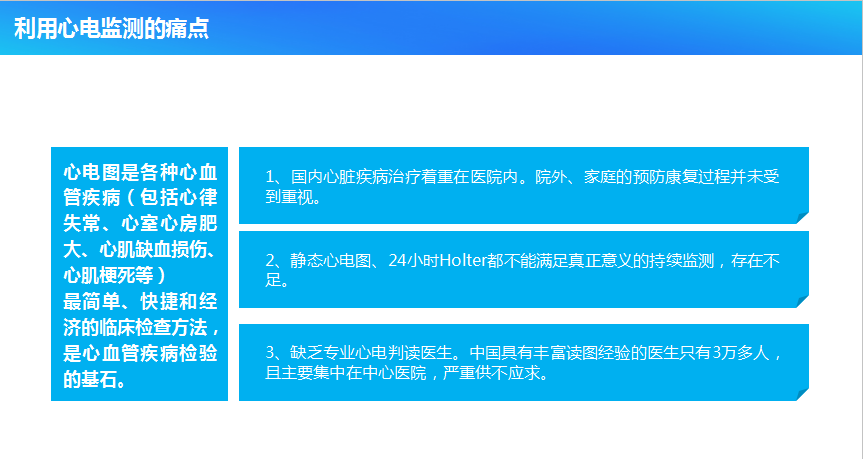 AI-ECG integration has already achieved commercial application.
Electrocardiography is the simplest, fastest, and most cost-effective clinical examination for various cardiovascular diseases—including arrhythmias, ventricular and atrial hypertrophy, myocardial ischemia and injury, and myocardial infarction—and serves as the cornerstone of cardiovascular disease diagnosis.
Currently, there are three pain points in ECG monitoring:
1. In China, the treatment of heart disease is primarily focused on in-hospital care, while out-of-hospital and home-based prevention and rehabilitation processes have not received adequate attention.
2. Neither static ECG nor 24-hour Holter monitoring can fulfill the requirements of true continuous monitoring, as they have inherent limitations. Cardiac abnormalities are often intermittent; therefore, many individuals now prefer 14-day (14×24-hour) ECG monitoring for detection.
3. Shortage of professional ECG interpretation physicians. China has only over 30,000 physicians with extensive experience in ECG reading, and they are primarily concentrated in central hospitals, resulting in a severe supply-demand imbalance.
To address these challenges, many ECG device manufacturers are currently developing AI-assisted ECG examination systems to aid cardiologists in interpreting electrocardiograms. These systems can be integrated with both ambulatory and resting ECG devices. After patient testing, data is uploaded to the cloud for system analysis; any identified abnormalities are then referred to physicians for confirmation. This workflow reduces physicians’ ECG interpretation workload by approximately 80%. This benefit is particularly significant in ambulatory ECG monitoring, where the large volume of 24-hour data makes manual interpretation time-consuming and labor-intensive. With AI assistance, the burden on physicians can be substantially alleviated.
There are currently many companies in this field, such as Lepu Medical, Zhengxin Medical, PulseFlow Technology, and Palm ECG. Lepu Medical is the only company to have received FDA clearance for its AI system to date; by integrating its static ECG solution (Kaiwoer) and dynamic ECG solution (Youjiali), it has already begun commercial implementation.
In addition, PulseFlow Technology’s product model is unique. Its DeepECG® system is an intelligent analysis platform based on 12-lead electrocardiograms (ECGs). By simply capturing a single ECG image, the system leverages artificial intelligence algorithms to identify abnormalities and provide rapid preliminary screening for cardiac diseases in patients, rather than merely performing conventional one-dimensional ECG recognition.
Diagnosis of Cardiovascular Diseases Is the Most Important Area Empowered by AI。
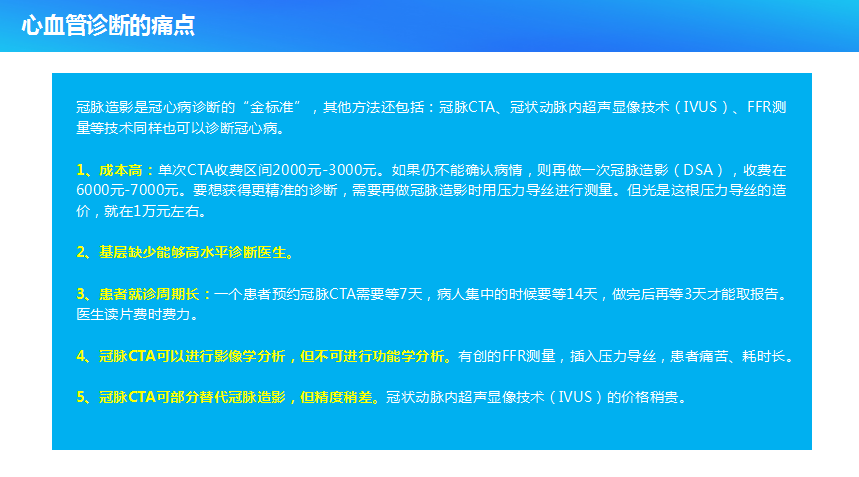
Coronary angiography is the “gold standard” for diagnosing coronary artery disease (CAD). Other diagnostic modalities include coronary computed tomography angiography (CTA), intravascular ultrasound (IVUS), and fractional flow reserve (FFR) measurement. Current pain points in the diagnosis of cardiovascular diseases include:
1. High costs: A single CT angiography (CTA) is priced between RMB 2,000 and RMB 3,000. If the diagnosis remains inconclusive, a coronary angiography (DSA) is required, costing between RMB 6,000 and RMB 7,000. To achieve a more precise diagnosis, pressure wire measurements must be performed during the coronary angiography. However, the cost of the pressure wire alone is approximately RMB 10,000.
2. There is a shortage of highly skilled diagnostic physicians at the primary care level.
3. Prolonged patient consultation cycle: Image interpretation by physicians is time-consuming and labor-intensive.
4. Coronary CTA allows for imaging analysis but not functional analysis. Invasive FFR measurement requires the insertion of a pressure wire, causing patient discomfort and being time-consuming.
5. Coronary CTA can partially replace coronary angiography, but with slightly lower accuracy. Intravascular ultrasound (IVUS) is somewhat more expensive.
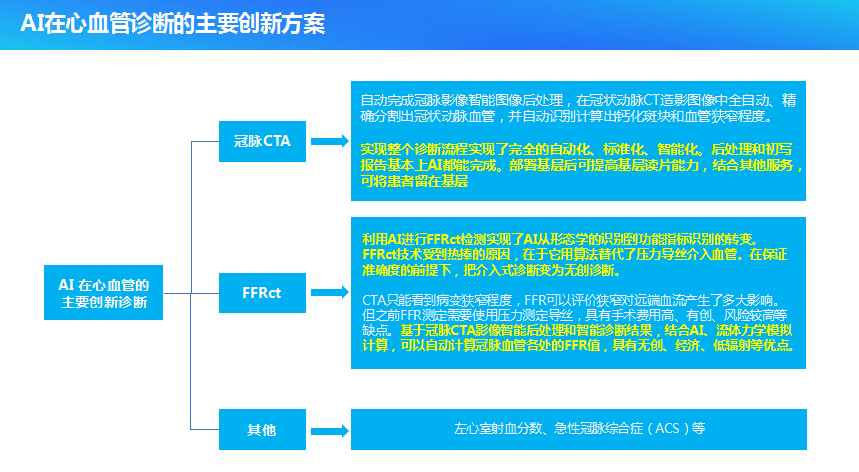
Currently, the most prevalent applications of AI in cardiovascular diagnosis are coronary computed tomography angiography (CCTA) and non-invasive fractional flow reserve (FFR). CCTA-assisted systems can automatically perform intelligent post-processing of coronary images, fully and precisely segmenting coronary vessels from coronary CT angiography scans, while automatically identifying and quantifying calcified plaques and the degree of vascular stenosis. This achieves complete automation, standardization, and intelligence throughout the entire diagnostic workflow.
FFR, or Fractional Flow Reserve, is the ratio of maximal blood flow distal to a coronary stenosis to the theoretical maximal blood flow in the absence of that stenosis. FFR serves as an indicator of myocardial oxygen supply-demand balance and can be measured invasively in clinical practice using a pressure wire.
CTA can only visualize the degree of luminal stenosis, whereas FFR assesses the hemodynamic impact of the stenosis on distal blood flow. For instance, although the Qutang Gorge of the Three Gorges is narrow with rapid flow, and the Wu Gorge is wide with slower flow, their actual water volumes are comparable. Therefore, relying solely on CTA to determine the need for stent implantation is not particularly accurate.
However, conventional FFR measurement requires a pressure-sensing guidewire, which is associated with high procedural costs, invasiveness, and elevated risks. Leveraging intelligent post-processing and diagnostic results from coronary CTA images, combined with AI and computational fluid dynamics simulations, enables automatic calculation of FFR values at various locations along the coronary arteries. This approach offers advantages such as being non-invasive, cost-effective, and involving low radiation exposure.
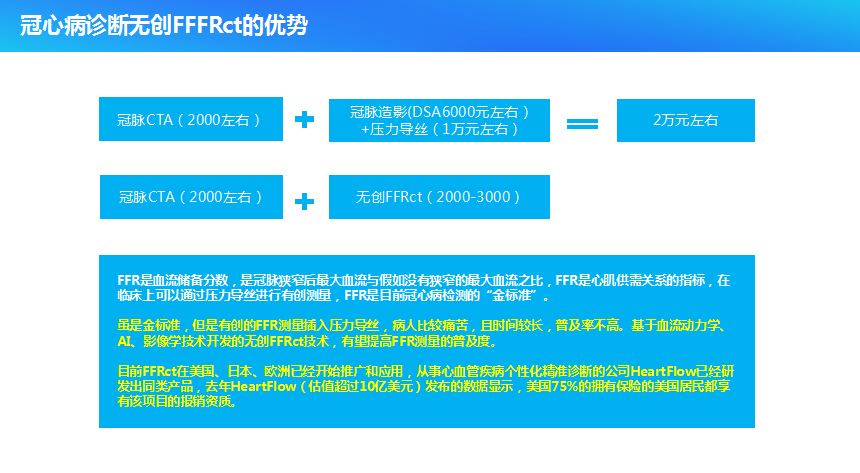
In the diagnostic workflow for coronary heart disease, the current standard involves a single CT angiography (CTA) scan, priced between RMB 2,000 and RMB 3,000. If the diagnosis remains inconclusive, a subsequent coronary angiography (DSA) is performed, costing between RMB 6,000 and RMB 7,000. To achieve a more precise diagnosis, pressure wire measurements are required during the coronary angiography. However, the cost of the pressure wire alone is approximately RMB 10,000, bringing the total expense to around RMB 20,000.
With non-invasive FFR, costs can be reduced by more than 10,000 yuan, and many additional tests are avoided. Currently, the estimated cost of non-invasive FFR is 2,000–3,000 yuan, as national pricing guidelines have not yet been issued.
Currently, FFRct has begun to be promoted and applied in the United States, Japan, and Europe. HeartFlow, a company engaged in personalized precision diagnosis of cardiovascular diseases, has developed similar products. Data released by HeartFlow (valued at over $1 billion) last year showed that 75% of insured U.S. residents are eligible for reimbursement under this program.
Additionally, many domestic enterprises are engaged in R&D in this field. For detailed case studies of these companies, please refer to the full report.
According to population data released by the National Bureau of Statistics: As of the end of 2018, China’s latest elderly population figures were as follows: The population aged 60 and above reached 249.49 million, accounting for 17.9% of the total population; the population aged 65 and above stood at 166.58 million, representing 11.9% of the total population.
Currently, cardiovascular disease is the leading cause of death among both urban and rural residents, accounting for 45.01% of deaths in rural areas and 42.61% in urban areas. Old age represents the peak period for the incidence of cardiovascular diseases. Cardiovascular diseases in the elderly mainly include hypertension, coronary heart disease, atrial fibrillation (AF), valvular heart disease, and heart failure.
China faces a severe shortage of cardiovascular specialists, failing to meet the current and potential demands for prevention and treatment among patients. Currently, only 30,000 physicians in China possess proficient electrocardiogram (ECG) interpretation skills, while primary care physicians largely lack the ability to interpret coronary computed tomography angiography (CCTA) images. Therefore, AI-driven medical products in cardiology can standardize and replicate the expertise of specialist physicians, thereby assisting in improving diagnostic accuracy and enhancing the overall capacity of cardiovascular healthcare services.
Therefore, the severe situation in the prevention and treatment of cardiovascular diseases will accelerate the development of AI in cardiology.
As of July, more than 4,100 hospitals across 31 provinces in China have initiated the construction of Chest Pain Centers. To date, 1,063 institutions have been accredited by the Chest Pain Center Headquarters, yielding an accreditation rate of less than 25%.
The construction standards for Chest Pain Centers require an electrocardiogram (ECG) to be obtained within 10 minutes of patient contact. The rapid interpretation of ECGs demands high accuracy and speed, which are strengths of artificial intelligence.
The establishment of Chest Pain Centers will, in turn, facilitate the market adoption of upstream AI-based ECG monitoring; abnormalities detected by AI can be rapidly addressed through these centers.
Currently, medical device companies such as GE and Lepu Medical are leveraging AI to empower their equipment, thereby enhancing its competitiveness. In the future, the integration of devices with AI systems will become the standard for screening and diagnostic equipment.
GE’s CardioGraphe™, a CT system specifically designed for cardiovascular imaging diagnosis. GE Healthcare was the first to submit to the U.S. FDA a general-purpose CT design featuring a deep learning platform.
Currently, Lepu Medical is leveraging its AI-ECG assisted diagnostic system to upgrade the static and dynamic electrocardiogram (ECG) products under its Kaiwoer and Youjiali brands, thereby enhancing their competitiveness in the industry.
In the future, Lepu Medical will build a comprehensive ECG industry ecosystem centered on its AI-ECG technology, encompassing a wide range of ECG hardware acquisition devices, an automated analysis software platform, and expert services.
In 2019, following the issuance of the “Key Points for the Approval of Medical Device Software with Deep Learning–Assisted Decision-Making” by the Center for Medical Device Evaluation of the National Medical Products Administration, relevant authorities spearheaded the establishment of eight major databases, including those for cardiac MRI, coronary CTA, and electrocardiography. All three databases are related to cardiovascular diseases.
Industry development, standards first. A standard database serves as a benchmark; with it, medical AI products can be more effectively evaluated. Once a product obtains certification from the National Medical Products Administration (NMPA, formerly CFDA), it becomes eligible to enter public hospitals through tendering processes.
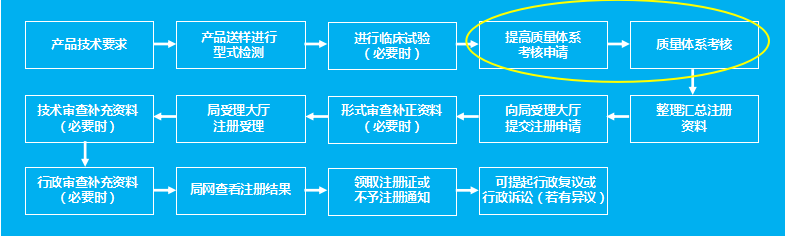
As shown in this flowchart, system certification must be obtained prior to receiving approval from the National Medical Products Administration (NMPA), a process that takes 3–6 months. Certification for Class III medical devices requires 2–3 years, and approval is contingent upon the establishment of a standards database, which entails a certain lead time.