

Chinese Medical AI Pioneer Pushes into Ethiopia Along the Belt and Road

Infervision
Artificial Intelligence Product Developer
In August 2017, drones operated by the California-based company Zipline began flying over Tanzania. Their mission is routine yet vital: delivering blood products, emergency vaccines, HIV medications, antimalarial drugs, and other critical medical supplies across Tanzania.
Under existing conditions, it is hard to imagine using drones for logistics services in urban areas, but Africa’s unique environment has given rise to this market—technology is transforming the daily lives of people in underdeveloped regions in its own distinctive way.
Nowadays, artificial intelligence (AI) is gaining global popularity, with a surge in healthcare-related applications. In African regions where medical infrastructure is severely lacking, AI has the potential to create an atypical market, much like drones have done. It can establish foundational platforms for medical information dissemination to enhance disease prevention, and deploy digital physicians to assist in patient diagnosis, thereby compensating for the shortage of medical resources. After all, AI holds a comparative advantage in remote areas.
This vision is becoming a reality.
Almost overnight, Ethiopia became a trending topic on the Chinese internet. On November 26, the Ethiopian government signed a master framework agreement with Alibaba Group on cooperation under the World Electronic Trade Platform (eWTP), with Jack Ma attending the signing ceremony. On November 29, 2019, the China-Ethiopia Industrial Cooperation Matchmaking Conference, co-hosted by China’s Ministry of Industry and Information Technology and Ethiopia’s Ministry of Trade and Industry, was held in Addis Ababa. The conference brought together approximately 150 representatives from around 100 Chinese and Ethiopian enterprises. The two sides exchanged views and explored cooperation in areas such as industrial parks, power, construction, raw materials, and manufacturing, while jointly advancing the development of a collaborative ecosystem involving think tanks, academic institutions, and other stakeholders across government, industry, academia, and research.
“China-Ethiopia industrial and trade cooperation has made significant progress in the past. Looking ahead, we hope that Chinese enterprises will seize the opportunities presented by China-Africa strategic cooperation, make full use of the historical opportunity offered by the joint construction of the Belt and Road Initiative, effectively implement the outcomes of the Forum on China-Africa Cooperation (FOCAC) and the Beijing Summit, uphold the spirit of extensive consultation, joint contribution, and shared benefits, support Ethiopia’s economic transformation, and achieve the goals of win-win results and common development,” said Wang Jiangping, Vice Minister of the Ministry of Industry and Information Technology of China, in his address at the conference.
As a key strategic planning project in China, artificial intelligence naturally became the focal point of this matchmaking event. Many Chinese tech companies brought their flagship projects to the negotiating table in Addis Ababa.
Infervision, a Beijing-based startup specializing in medical AI, was among the notable participants and achieved significant outcomes at the matchmaking event. During the conference, Infervision signed a memorandum of understanding with the Ethiopian government to jointly build the “National Artificial Intelligence Infrastructure” (NAIF) in Ethiopia. This collaboration aims to advance cooperation in areas such as AI infrastructure, algorithm research, data application, multi-scenario development, and scientific incubation, thereby introducing multi-scenario AI application technologies to Ethiopia and Africa. Notably, this agreement marks the first international cooperation pact on artificial intelligence signed by the Ethiopian government. In the presence of several ministerial-level officials from both China and Ethiopia, Chen Kuan, Founder and CEO of Infervision, and Ato Sise Tola, Deputy Minister of the Ethiopian Ministry of Innovation and Technology, signed the agreement on site.
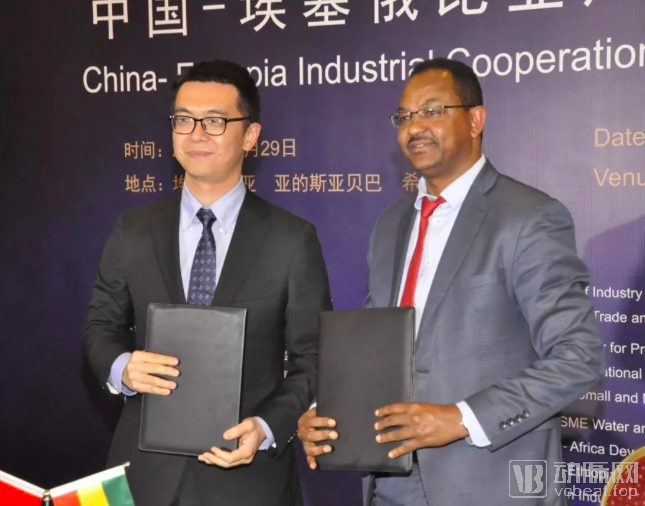
Infervision CEO Chen Kuan and Ethiopian Minister of State for Innovation and Technology Ato Sise Tola at the signing ceremony
“Artificial intelligence has been widely applied in various life scenarios, including healthcare, transportation, and supermarkets, permeating every aspect of people’s lives. As the core driving force of the new round of global technological revolution and industrial transformation, AI is triggering the Fourth Industrial Revolution, accelerating the transition of economic and social sectors from digitalization and networking to intelligentization, and playing a significant role in enhancing productivity, optimizing efficiency, and facilitating industrial transformation. We thank China’s Ministry of Industry and Information Technology for providing us with this opportunity, enabling Ethiopia to introduce AI technology and profoundly reshape its development trajectory,” said Ato Sise Tola, Deputy Minister of the Ethiopian Ministry of Innovation and Technology.
In the field of medical artificial intelligence, following rapid development over the past two years, domestic medical AI products have gradually matured, with the Chinese market largely divided among major companies. To keep pace with advanced technologies in the United States in real time and expand into new markets, Chinese medical AI companies are increasingly venturing overseas. Chinese medical AI firms have established a presence in the United States, Japan, Southeast Asia, India, and Europe. However, AI has rarely penetrated markets lacking basic internet infrastructure, such as Africa.
The same holds true for Infervision, whose expansion into Africa represents a bold new endeavor. Over the past few years, Infervision has extensively deployed its AI products in developed countries such as the United States, Germany, and Japan. Professor Eliot Siegel, a renowned expert in medical imaging AI at the Radiological Society of North America (RSNA), expressed astonishment during his visit to the Department of Radiology at Shanghai Changzheng Hospital, noting that Infervision’s products had been fully integrated into radiologists’ workflows. He further stated that China’s medical imaging AI has taken the lead over the United States in terms of “clinical application.”
Two years have passed, and Infervision has achieved comprehensive coverage of the heart, lungs, mediastinum, and bones. The newly released Infervision One-Stop Chest Multi-System, Multi-Organ, and Multi-Disease Solution on CCR leverages deep learning technology to achieve full coverage of chest CT imaging information. Closely aligned with the diagnostic logic and usage habits of radiologists, it enables AI-based intelligent discrimination of numerous diseases across multiple organs and systems—including the lungs, heart and major vessels, mediastinum, and musculoskeletal structures—under multi-mode conditions such as lung windows, mediastinal windows, and bone windows. This provides physicians and patients with genuine, comprehensive intelligent assistance.
Leveraging Infervision’s one-stop solution for multi-system, multi-organ, and multi-disease chest imaging, radiology departments can achieve intelligent support across the entire workflow—including screening, diagnosis, analysis, prediction, structured report generation, and follow-up tracking for various chest diseases. When combined with Infervision’s powerful AI-based chest radiography product, InferRead DR Chest, this forms the industry’s first truly comprehensive AI solution for chest imaging.
Currently, the specific cooperation model has not been disclosed. However, given the current situation in Ethiopia, it is inferred that for Infervision to conduct business there, it must first select a suitable location to establish an imaging center and assist surrounding hospitals in setting up qualified cloud PACS systems. Infervision will have a series of tasks to undertake. Of course, for this Chinese company, the most important objective is to export its cutting-edge AI capabilities to the local market to help improve the region’s underdeveloped healthcare standards.
Although certain details remain to be clarified, the strategic significance of this collaboration cannot be overlooked. Against the backdrop of China and the United States racing to develop AI and capture application markets, Infervision’s initiative may well set a promising precedent for numerous domestic AI enterprises. Moving forward, more companies are likely to pivot their focus toward Africa, an untapped treasure trove. Undoubtedly, in the realm of AI’s global expansion and internationalization, Infervision has consistently played a pioneering role, extending its reach from North America, Europe, and Asia-Pacific to Africa.
Certainly, this collaboration is likely to bring more job opportunities for the people of Ethiopia. Chen Kuan, CEO of Infervision, stated at the conference, “In the future, Infervision will actively promote cooperation in Ethiopia and across Africa in areas such as the transfer of AI incubator technologies, development of AI infrastructure, establishment of an AI talent pool, and support for the growth of local innovative enterprises, thereby providing innovative technological assistance for Ethiopia’s industrial transformation.”