Kuaiyi Secures Two National Invention Patents: Empowering Cross-Industry Innovation Through Medical Big Data
VCBeat (WeChat ID: vcbeat) has learned that Kuaiyi recently received authorization from the China National Intellectual Property Administration for two invention patents, titled “A Standardized Method and System for Disease Nomenclature” and “A Standardized Database for Disease Nomenclature and Its Establishment Method,” with patent numbers ZL 201810647287.5 and ZL 201810647291.1, respectively.
Kuaiyi, with seven years of accumulated experience in medical services and core medical resources, has carved out an internet healthcare pathway tailored to the unique characteristics of China’s healthcare system by aligning user needs with market opportunities. Kuaiyi’s R&D team has long been dedicated to research in artificial intelligence, machine learning, and natural language processing, focusing on the effective analysis and application of big medical data to generate both social and economic benefits.
To this end, VCBeat (WeChat ID: vcbeat) conducted an exclusive interview with Hua Ming, Head of Technology at Kuaiyi, to explore how Kuaiyi is standardizing medical information in the era of big healthcare data and applying it extensively across various medical scenarios.
Hua Ming stated that due to the heavy workload of medical professionals in healthcare institutions, it is difficult to standardize the coding of patient diagnostic results during clinical encounters. Furthermore, variations in personal habits among different medical personnel lead to inconsistent descriptions of the same disease, including the use of abbreviations or shorthand for diagnoses. Consequently, the nomenclature for the same condition often varies across different healthcare institutions and among different providers, imposing a significant burden on diagnostic structuring and standardization, as well as on subsequent health insurance cost containment efforts.
Kuaiyi’s R&D team conducted a detailed analysis of the International Classification of Diseases (ICD-10), the 2016 Chinese National Standard, the Beijing Clinical Version, and more than ten other versions commonly used in China. They found that the ICD coding system is not suitable for colloquial disease names. With the rapid development of information technology, the real-time storage and processing of massive volumes of small internet files generated by exploding internet data have become increasingly challenging for many internet applications. Therefore, there is an urgent need for a standardized database of disease nomenclature to convert colloquial terms into standardized descriptions, thereby improving the efficiency of disease name recognition.
Technology serves as the foundation for making big data in healthcare information usable. The deep integration of healthcare and technology plays a crucial role in promoting the standardization of medical information. To standardize disease descriptions, transform disorganized diagnostic narratives into standardized formats, and enhance data usability, Kuaiyi’s R&D team has been actively exploring various solutions, only to find that there were no effective tools available on the market to address this issue. Undeterred by these challenges and committed to creating solutions even when conditions were not ideal, the Kuaiyi technical team embarked on the development of a standardized database of disease names, ultimately securing authorization for a national invention patent.
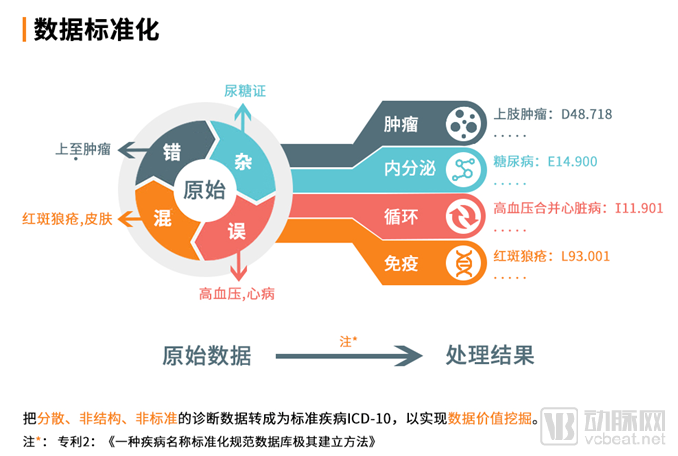
Patents are the fruit of researchers’ ingenuity. Kuaiyi’s two national invention patents make the standardization of medical information more convenient. Take the common condition “type 2 diabetes” as an example: its ICD code is E11.900. However, in physicians’ original diagnostic or medical record entries, there are nearly a hundred different descriptions, such as “type 2 diabetes,” “type 2 diabetic ketoacidosis,” “glycosuria,” “type II diabetic foot,” “type II diabetic erythema,” and “2DM,” causing significant inconvenience for downstream data users. By leveraging Kuaiyi’s standardized disease database, chaotic, fragmented, and heterogeneous diagnostic data can be rapidly converted to ICD-10 codes, thereby unlocking the value of the data.
From a technological development perspective, technological innovations in the medical big data industry and the standardization of medical information have made cross-sector integration of patent big data possible. Hua Ming noted that the advent of the medical big data era has laid a solid technical foundation for enhancing patent information services and promoting the integrated development of patent big data. This enables more effective matching of patent big data with other data resources, as well as parameter design, analytical computations, and model building, thereby providing service support and decision-making assistance across diverse application scenarios for various innovation factors.
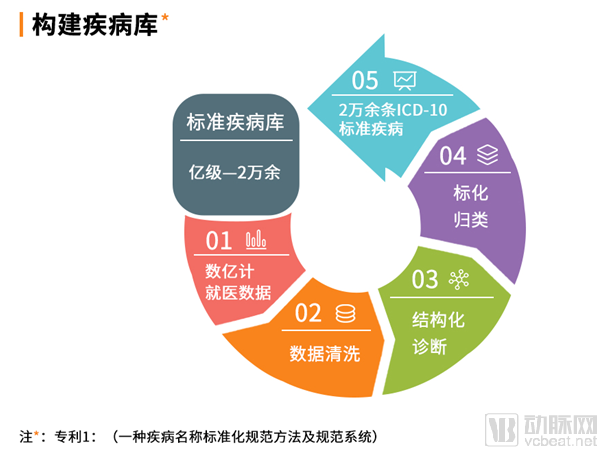
In the commercial insurance sector, raw medical data has low direct usability for insurers due to the prevalence of irrelevant information. By leveraging Kuaiyi’s patented big data technology, large volumes of useless and erroneous data are first cleaned and consolidated. The data then undergoes information segmentation, standardization, and categorization, followed by matching and integration of standardized diagnostic categories with a standard disease database to output ICD-10 standards at all levels. This process standardizes disease types and nomenclature, resolving the chaos in disease category management, enhancing data usability, and enabling insurers to directly utilize the data with high credibility.
Regarding the application of patents in more scenarios, Hua Ming stated that Kuaiyi’s R&D team continues to strive for broader implementation of their patented technology. In the future, this technology will evolve into an “input method,” allowing medical personnel to simply enter disease diagnoses using everyday colloquial language. The system will then automatically match and code these entries against standardized disease names, thereby reducing the burden of subsequent data organization for healthcare providers. For hospitals, diagnostic data entered by medical staff can be directly accessed without the need for further data cleaning or processing, facilitating more efficient data analysis and disease research. For pharmaceutical companies, access to real-world data enables experimental studies that ultimately benefit a larger patient population.