Medtronic's Tri-Ad™ 2.0 Adams Tricuspid Annuloplasty Band Receives NMPA Approval

Medtronic
Medical Device Manufacturer

Heart Future
Recently,MedtronicAnnounced its joint development with internationally renowned cardiac surgery expertsTri-Ad™ 2.0 Adams Tricuspid Annuloplasty BandOfficially approved for marketing by the National Medical Products Administration (NMPA), with the registration certificate numberCN Medical Device Registration Import 20263130014。
The approval of this product marks a new option in the field of tricuspid valve surgical repair in China, and also provides a more physiologically compatible repair solution for complex and high-risk patients.
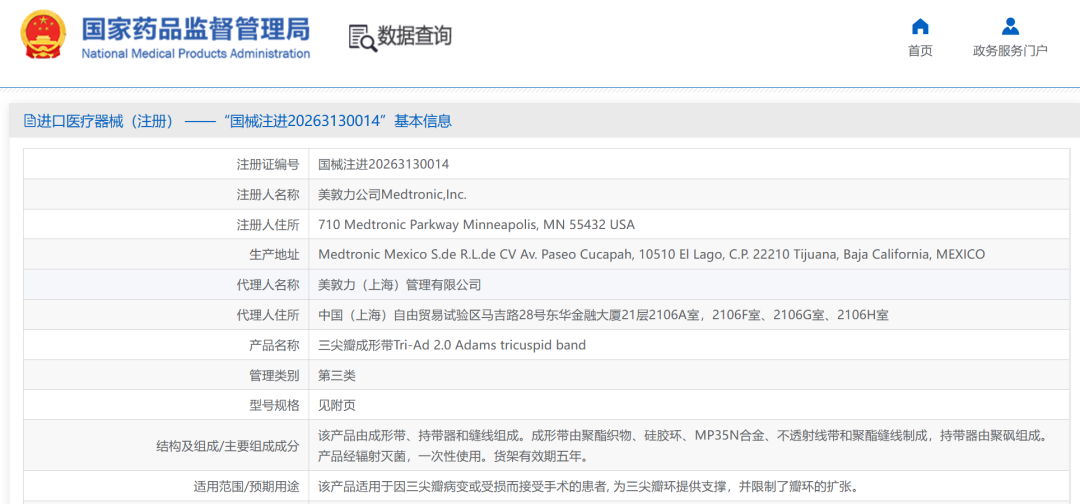
# ApprovedDetails
Tricuspid Annuloplasty BandTri-Ad™ 2.0 Adams is mainly used for tricuspid valve repair surgery, aiming to address pathological changes such as annular dilation. By providing stable and physiologically motion-compatible annular support, it helps restore the normal coaptation function of the tricuspid valve and improve the surgical treatment outcomes of related conditions like tricuspid regurgitation.
In terms of structural design, the product maintains reliable forming capabilities while accommodating the three-dimensional dynamic movement requirements of the annulus and has been optimized to protect the conduction system.
Tri-Ad™ 2.0 Adams The approval occurred during a phase where the concept of diagnosing and treating tricuspid valve disease in China is gradually being updated. With the advancement of multidisciplinary collaboration (MDT) The development of the model, as well as the increased emphasis on right heart function, tricuspid valve repair is gradually transitioning from a "supplementary approach" to a more proactive treatment strategy. At the device level, products that better align with anatomical and physiological characteristics have also provided surgeons with more technical options in complex cases.
# Research Background
From"Neglected Valve" Becomes Clinical Focus
In the long-term clinical practice of heart valve diseases, tricuspid valve disease has been in a relatively marginal position for a long time. Compared with the aortic valve and mitral valve,Tricuspid valve disease is often secondary to left heart system diseases or pulmonary hypertension, with a relatively insidious progression and late onset of symptoms, leading to delayed intervention timing.
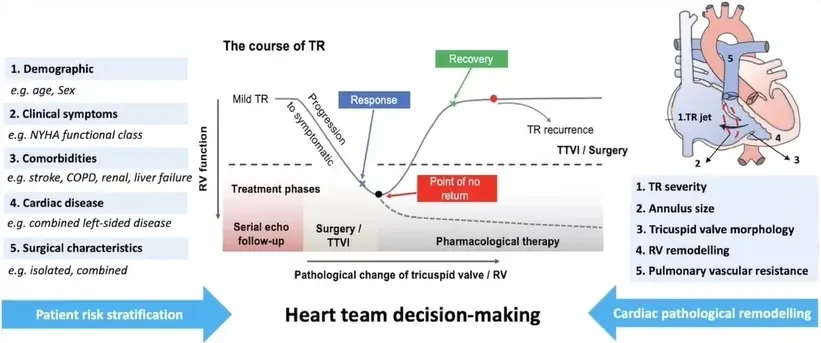
▲Determine the Optimal Timing for Treating Tricuspid Regurgitation
However, recent studies have gradually shown that moderate to severe tricuspid regurgitation is not a benign condition.Persistent tricuspid regurgitation can lead to right ventricular dilation, right heart failure, hepatic congestion, and systemic edema., significantly affecting the long-term prognosis and quality of life of patients. Multiple follow-up studies have shown that in patients with moderate to severe tricuspid regurgitation who do not receive effective intervention, mortality and rehospitalization risks are significantly increased.
With the improvement in imaging assessment capabilities and updates in surgical concepts, tricuspid valve disease is gradually being incorporated into earlier and more proactive treatment decision frameworks.
The Core Challenge of Tricuspid Valve Plasty
Although tricuspid valve repair is considered theoretically superior to valve replacement, it still faces multiple challenges in actual surgical procedures:
Complex anatomical structure:The tricuspid annulus is an asymmetric, non-planar three-dimensional structure that undergoes continuous dynamic changes during the cardiac cycle;
Conduction System Proximity:The atrioventricular node and conduction bundle have a close anatomical relationship with the septal leaflet region of the tricuspid valve, and even slight inadvertence during surgery can lead to conduction block;
High long-term stability requirements:It needs to provide sufficient annular support to prevent re-dilation while avoiding excessive restriction of the annulus's physiological movement.
Against this background, how to"Balancing 'stable forming' and 'physiological compliance' has become the core proposition in the design of tricuspid valve repair devices."
Joint R&D Background
Tri-Ad™ 2.0 Adams The development of the tricuspid annuloplasty band stems from the deep integration of clinical practice and engineering design. The product is based on the work of Professor [Name], from the Department of Cardiovascular Surgery at Mount Sinai Hospital in New York.David Adams Based on long-term experience in the field of valve repair, especially in tricuspid valve surgical treatment, combined with Medtronic's engineering research and development and industrialization capabilities in cardiac surgical instruments.
David Adams The professor has long been committed to promoting the concept of functional valve repair, the core idea of which emphasizes:
Valve repair is not only"Morphological correction" should aim to restore and preserve normal physiological movement patterns as much as possible.
This concept is also directly reflected inTri-Ad™ 2.0 Adams The design logic of the forming belt - by adopting differentiated structures in different anatomical regions, it achieves the transition from "anatomical repair" to "physiological repair."
# Product Introduction
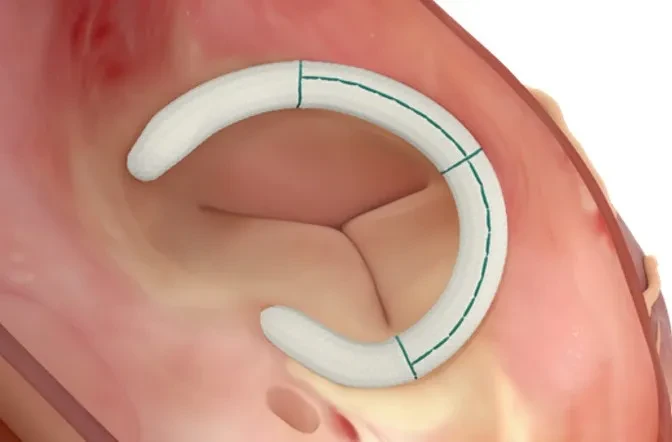
I."Soft and Hard Composite" Structural Design
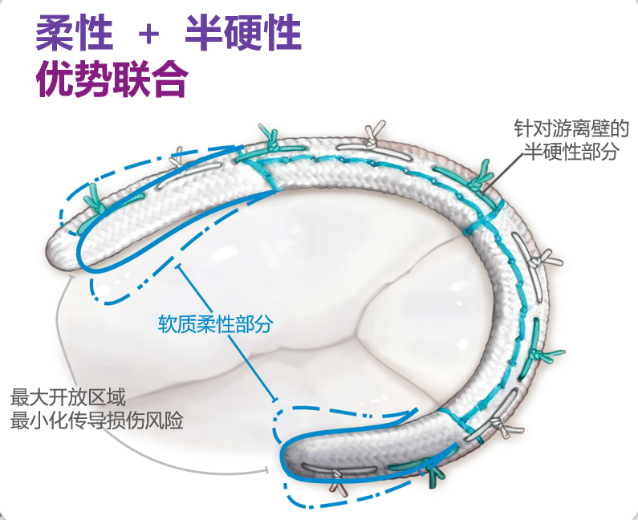
Tri-Ad™ 2.0 Adams The tricuspid annuloplasty band adopts a composite structural design, distinct from traditional fully rigid or fully flexible annuloplasty rings:
Semi-rigid part:Mainly located in the posterior and anterior leaflet annulus areas, providing reliable shaping support for significantly dilated annuli and restricting further expansion.
Flexible Part:Covering the septal side and key active areas, it can be flexibly adjusted according to individual patient differences, better accommodating the dynamic changes of the atrioventricular annulus during the cardiac cycle.
This"The design concept of 'combining hardness and softness' aims toWhile ensuring repair stability, reduce abnormal stress on the valve leaflets and surrounding tissues.
2. Adjustable opening on the septal side, enhanced protection for the conduction system
Regarding the potential issue of atrioventricular block after tricuspid valve repair,Tri-Ad™ 2.0 Adams The forming belt features a larger, freely adjustable opening structure designed in the area corresponding to the septal leaflet.
This design allows surgeons to more flexibly avoid critical areas of the conduction system during suturing and implantation, minimizing mechanical interference with the conduction bundle while completing annuloplasty, thereby reducing the risk of postoperative permanent pacemaker implantation.
3. The shaping concept that fits three-dimensional anatomy
The tricuspid annulus is not a planar structure; its three-dimensional morphology and dynamic changes have an important impact on the repair outcome.Tri-Ad™ 2.0 Adams The shaping band fully considers this feature in the overall contour design, allowing the shaping band to fit more naturally with the anatomical shape of the annulus and maintain coordinated movement during heartbeats.
# RelevantClinical Research
Tri-Ad™ Adams The safety and effectiveness of the forming band have been verified in multiple clinical practices. Among them, a single-center retrospective study from Korea systematically evaluated its clinical performance.
Research Overview
Study Time:2016 Year8 Month to2021 Year10 Month
Research Object:248 ExampleAcceptTri-Ad Adams Patients undergoing tricuspid annuloplasty ring surgery
Study Type: Single-center, Retrospective Analysis
Main Results
Median Trans-tricuspid Mean Pressure Gradient at DischargeFor1.3(1.0–2.0)mmHg;
At the last follow-upFor1.1(0.9–1.8)mmHg;
Postoperative4 Annual Overall Survival Rate96.9%;
Proportion Without Moderate to Severe Tricuspid Regurgitation91.6%。
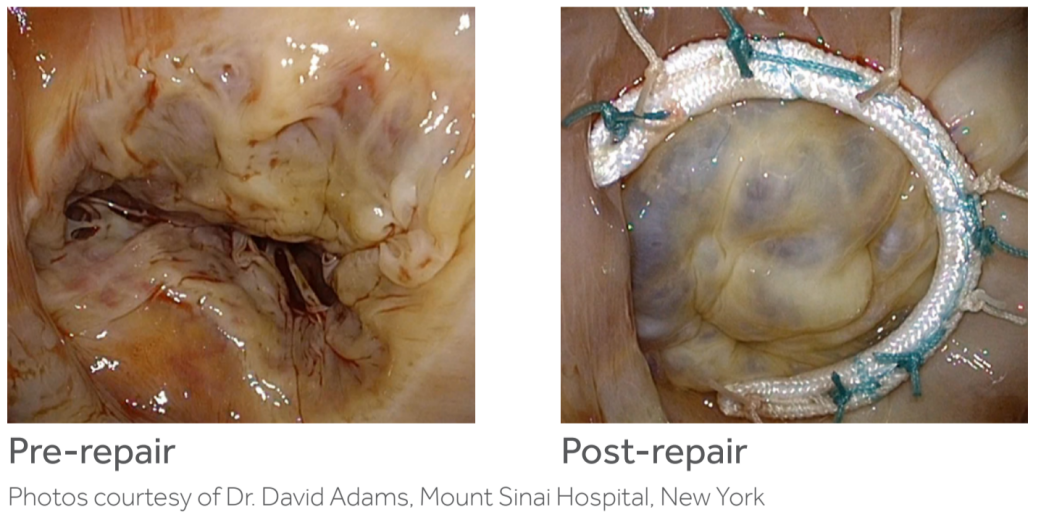
No cases of repeat tricuspid valve surgery, annuloplasty ring structural failure, or significant tricuspid stenosis were observed during the study period, with an overall low complication rate.
# Company Introduction

Medtronic's main businesses includeCardiovascular, Medical Surgery, Neuroscience, and DiabetesFour business segments, includingThe highest proportion is cardiovascular.。
In the fields of cardiac surgery and structural heart disease, Medtronic has long been committed to the development of valve repair and replacement technologies, continuously advancing device design towards safer, more minimally invasive, and more physiologically compatible solutions.

GCC2025


Cardiovascular Device Full Disease Solution


Statement

Content Declaration:"Heart Future" tracks global medical technology advancements, aiming to deliver technical and industry knowledge. All content is for industry exchange and academic discussion only, and does not constitute medical advice or commercial promotion. Information regarding companies, products, and registrations mentioned in the text is sourced from publicly available materials or verified channels. If there are any errors or omissions, please contact us for corrections. Email: jacky@suribot.com
Copyright Statement:The original article "Heart Future" is copyrighted by Beijing Siyu Bot Technology Co., Ltd. Without authorization, it cannot be reproduced, excerpted, or mirrored on other websites, official accounts, or commercial platforms. For reproduction, please contact the backend to obtain authorization. This platform reserves the right to pursue legal responsibility for unauthorized full-text reproduction, rewriting, or paraphrasing.