

Healthcare Disruptor Jianke Bets Big on Hospital-to-Home Strategy with IPO Filing
On the day before Thanksgiving in 2019, although the solar term of Light Snow had already passed, a hint of warmth still lingered in the air in Guangzhou. At the Hilton Guangzhou Baiyun Hotel (note: corrected from "Huangpu District's Emerald Hilton" as there is no such hotel; assuming reference to a major Hilton property in Guangzhou), Guangdong Jianke Medicine Co., Ltd. held its Annual Partners Conference. During this annual event, CEO Xie Fangmin presented to more than 400 partner representatives from academic institutions, hospitals, expert communities, pharmaceutical companies, and commercial enterprises across China, the United States, Singapore, South Korea, and Hong Kong. He unveiled Jianke’s Hospital-to-Home (H2H) smart healthcare ecosystem strategy, which had been in development for nearly a year.
From hospitals to households, Jianke’s new strategy has achieved near-complete coverage of the pharmaceutical distribution ecosystem. Leveraging its quietly built and rapidly expanding internet hospital business, Jianke is increasingly assuming the role of an industry consolidator. Resource integration represents a high-level strategic approach that remains out of reach for most market players. After a decade of volatility and multiple strategic iterations in the pharmaceutical e-commerce sector, Jianke has finally begun to boldly move toward this position.
In 2009, the Jianke team obtained Guangdong Province’s first license for online drug trading, embarking on its entrepreneurial journey in Dongguan. Two years later, after relocating to Guangzhou, Jianke began exploring what would become a true pharmaceutical e-commerce model. At that time, domestic pharmaceutical distribution channels had been experimenting with the internet for over a decade. The first wave of pharmaceutical e-commerce companies, backed by either internet or pharmaceutical industry expertise, gradually entered the market, establishing clearly defined B2B and B2C models. Holding the Class C License for Internet Drug Transaction Services (which was abolished after 2017), Jianke opted for the latter. This move laid the groundwork for building “Jianke Online Pharmacy,” a key vehicle for its H2H strategy.
In 2016, Jianke expanded beyond Guangdong Province and embarked on a new journey in mobile healthcare from its office adjacent to Beijing University of Chinese Medicine. Two years later, Jianke upgraded its mobile healthcare model to a dual-engine strategy of “Healthcare + Pharmaceuticals,” establishing a closed-loop chronic disease management system that spans medical consultation, electronic prescriptions, medication selection and ordering, delivery and pickup, and long-term patient management. This move laid the foundation for “Jianke Doctors,” another key component of its H2H (Hospital-to-Home) strategy.
As we entered 2019, after more than a decade in the pharmaceutical business, Xie Fangmin realized that the dual-drive model of “medical care + pharmaceuticals” alone was no longer sufficient to meet patients’ health management needs. In an era marked by dramatic policy and technological shifts, everyone must continually consider how to seize opportunities while mitigating risks—and such reflection must be patient-centric.
At the partner conference, Xie Fangmin revealed that Jianke achieved new rapid growth in its business in 2019. It is this growth that has enabled Jianke to integrate internal and external resources to address patients’ differentiated health management needs.
“Jianke Internet Hospital broke into the top three in the industry in just one year. Its pharmaceutical e-commerce business has maintained the No. 1 position among B2C vertical apps in China, with strategic partnerships exceeding 500 pharmaceutical companies across its platform. The platform’s traffic has ranked first nationwide for seven consecutive years, its cumulative consumer membership has surpassed 21 million, and its annual revenue growth reached 110%, outperforming the entire industry.” The data presented by Xie Fangmin excited everyone present.
Beyond the data, he also shared his new insights. H2H is essentially a scenario shift driven by new ideas and technologies, migrating medical services, pharmaceutical services, chronic disease management, and patient education from hospitals to patients’ homes. This improves patients’ healthcare experience, enhances the timeliness of medical services and the accessibility of pharmaceutical services, thereby improving the quality of life for each patient, allowing them more time to enjoy life, and promoting better health for everyone.
The business modules comprising Jianke Doctors, Jianke Online Pharmacy, Jianke Chronic Disease Management Center, and Jianke New Media serve as the functional carriers supporting the H2H strategy.
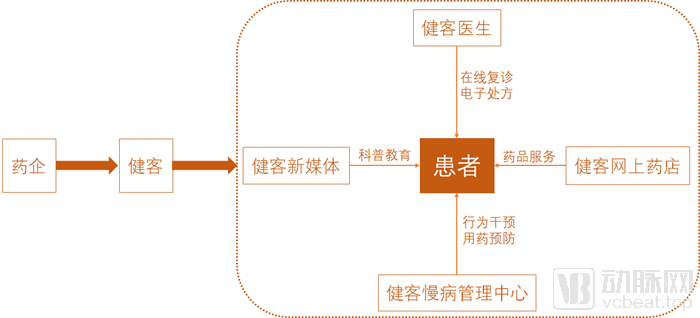
Four Major Functional Modules of the H2H Strategy
Jianke Doctor Platform.As a convenient platform for follow-up consultations, the Jianke Doctor App serves as a force multiplier for physician productivity, enhancing consultation efficiency and fostering harmonious doctor-patient relationships through digital multimedia tools. It is the first platform encompassed by the H2H strategy.
Jianke Online Pharmacy.Since its inception, Jianke has operated as an e-commerce platform offering a vast selection of pharmaceutical products, gradually establishing and refining capabilities such as centralized drug storage and management, end-to-end blockchain-based traceability, and timely home delivery. With drug safety as its paramount priority, Jianke Online Pharmacy is fundamentally addressing regional disparities in medical resource distribution and alleviating the shortage of medical services and medications in remote areas.
Jianke Chronic Disease Management Service Center.Jianke’s intelligent chronic disease management service platform employs proactive interventions to modify patients’ unhealthy lifestyle habits, consolidate treatment outcomes, and enhance patient adherence, thereby reducing or delaying the onset of complications.
Jianke New Media.Leveraging cross-platform multimedia digital content, Jianke has built a new media matrix for patient education, delivering health consultations, disease prevention, and safe medication knowledge to end users, thereby enhancing patients’ health awareness and understanding of diagnosis and treatment.
Under the H2H strategy, doctors and patients conduct online follow-up consultations and issue electronic prescriptions via the internet hospital platform. Meanwhile, leveraging the Jianke Chronic Disease Management Center, physicians can develop personalized chronic disease management plans tailored to each patient’s condition. Finally, based on Jianke’s diversified sales channels, medication delivery services are provided directly to patients’ homes.
After breaking down the barriers between medical care and pharmaceuticals by leveraging its physician platform and online pharmacy, Jianke’s H2H initiative is now working to dismantle silos across different business segments. It aims to intelligently integrate its four major business platforms, using digital tools to enable the rapid and orderly implementation of traditional family doctor and tiered diagnosis and treatment models at a low cost. In Xie Fangmin’s view, this process will unlock immense potential: “In the future, more doctors and patients will embrace the internet in the mobile era, engaging in online follow-up consultations, prescription issuance, chronic disease management, and overall health improvement. Each doctor will be able to fully leverage their expertise within their specialized field, providing precise services to every household.” According to Xie Fangmin’s vision, Jianke plans to further incorporate elements such as health check-ups, insurance, home-based elderly care, and healthcare finance, thereby creating greater market opportunities.
The operational data of Jianke Internet Hospital, announced on-site by Xie Fangmin, was the biggest highlight of this year’s Jianke Partner Conference. Over the past year (from October 2018 to October 31, 2019), Jianke Internet Hospital established collaborations with 500 pharmaceutical companies, issued a total of 1.59 million online prescriptions, grew its online drug sales from RMB 450,000 to RMB 45 million, and increased its number of online doctors from 3,872 to 100,000.
Internet hospitals are a crucial component of the H2H design philosophy in building smart health service platforms, specifically addressing the challenges associated with follow-up visits. Xie Fangmin pointed out that while initial consultations at hospitals are indispensable, follow-up visits often merely involve simple inquiries to physicians regarding medication usage and recovery status. “If patients live far from the hospital, it causes significant inconvenience.” Through the Jianke Doctor platform, patients can undergo initial consultations at the hospital and conduct follow-up visits from home via an app to communicate with their doctors, thereby improving diagnostic efficiency and patient satisfaction.
After the initial consultation, physicians require patients to scan a QR code generated by the Jianke Doctor app to establish a long-term one-on-one doctor-patient relationship. For follow-up visits, patients can communicate remotely with their assigned physicians from home via the Jianke Internet Hospital platform. Medication needs are addressed through online prescriptions issued by the physician, with the Jianke Online Pharmacy platform responsible for delivering the medications to the patient’s home. This end-to-end process, spanning from hospital to home for follow-up care and medication management, not only improves the efficiency of follow-up visits but also optimizes the overall patient healthcare experience.
Internet hospitals are nothing new, and Xie Fangmin does not hesitate to describe her carefully designed internet healthcare model as “very simple.”
From dark explorations to clear policy encouragement, many models have been envisioned and attempted, yet no suitable monetization method has ultimately been found. Just as traffic giants such as Alibaba, JD.com, and Pinduoduo crossed over into Jianke’s early stronghold of pharmaceutical e-commerce, Jianke has become an intruder in the internet hospital sector.
However, Jianke is not a reckless intruder; it has designed a sophisticated model for its market entry. More importantly, its over decade-long experience in pharmaceutical e-commerce has made it possible to establish a complete closed-loop internet healthcare ecosystem. Perhaps precisely because Jianke possesses many capabilities lacking in the broader internet healthcare sector, filling key links that enable value creation for all participants, it has achieved remarkable growth speed.
Furthermore, leveraging a product and technology team of over 200 members, Jianke is building an efficient technical platform based on cutting-edge technologies such as the Internet, big data, AI, and blockchain to support the operation of its H2H strategy.
On one hand, as the foundational application for integrating pharmaceutical resources, Jianke has developed four intelligent systems over the past two years: an Intelligent Big Data Analytics System, an Intelligent User Profiling System, an Automated Drug Data Modeling System, and an Intelligent Diagnostic Assistance System. Jiang Chonghao, Executive Vice President of Jianke, presented a comprehensive overview of the Jianke Smart Health Service Platform based on these four intelligent systems from the perspectives of product development and mobile healthcare. By building the Jianke Internet Hospital platform and onboarding physicians—requiring them to register and file records on the platform—the company binds physicians’ initial offline patients to its online services.
Big Data Intelligent Analysis System: By analyzing and learning from massive amounts of de-identified data authorized by users, it provides robust data support and decision-making assistance to three other systems.
Automatic Drug Data Modeling SystemBy learning from and analyzing specialized pharmaceutical data, the system performs automatic data modeling for over 80,000 drugs in the Jianke Drug Database. It structures information on active ingredients, pharmacology, toxicology, dosage and administration, indications, adverse reactions, and drug interactions, thereby elevating drug information from simple package inserts to well-organized, interconnected informational nodes within a comprehensive pharmaceutical database.
Intelligent Diagnostic Assistance System: By leveraging knowledge of disease diagnosis and treatment, supplemented by expert guidance from specially appointed specialists and in-house medical teams, the system provides valuable decision-support information to tens of thousands of online physicians when formulating chronic disease management plans. This is a feature welcomed by clinicians.
Intelligent User Profiling System. Jiang Chonghao introduced that Jianke has built precise profiling models for tens of millions of patients, enabling physicians to gain a clearer understanding of patients’ comprehensive conditions and thereby formulate more appropriate chronic disease management plans.
On the other hand, since 2018, Jianke has established a blockchain technology team and leveraged the tamper-proof distributed ledger features of blockchain to develop blockchain solutions for drug circulation traceability, thereby upgrading the quality and safety management of its pharmaceutical e-commerce business.
Under this solution, every node in the entire process from pharmaceutical manufacturing to consumer purchase can transmit data immutably to the blockchain via smart devices, making it accessible for inquiry by consumers, pharmaceutical companies, and relevant regulatory authorities.
Jiang Chonghao pointed out that another application scenario for blockchain solutions has emerged in collaborations with pharmaceutical companies, helping them manage the sales of high-value and key drugs. In 2019, a drug launched through Jianke’s corporate partnership recorded over 130,000 boxes uploaded to the blockchain, covering a total of 400,000 user interactions on the chain, and involving nearly 200 pharmacies and 70 distributors.
Chronic disease management is regarded as a key future direction for internet hospitals. Compared with daily consumer spending, both medical consultations and medication purchases are extremely low-frequency activities. While Tmall’s Double 11 Shopping Festival can generate nearly RMB 300 billion in transactions within 24 hours, internet hospitals are absolutely incapable of achieving such volume. By shifting from creating high-frequency demand to capturing it, chronic disease management and specialization enable internet hospitals to proactively identify users who maintain a certain level of consumption frequency.
Jianke has elevated chronic disease management to a status equal to its traditional pharmaceutical e-commerce business.
Jiang Chonghao demonstrated the operation of a common chronic disease management workflow within the H2H system on-site. The management process begins with the patient’s initial consultation. Subsequently, the doctor and patient are linked via the internet hospital, enabling the doctor to tailor a highly suitable chronic disease management plan for the patient through the chronic disease management platform and the physician’s workstation.
Based on this chronic disease management plan, the H2H system automatically sends relevant pharmaceutical education information to patients at each scheduled time point. Meanwhile, the AI assistant automatically engages with patients via phone calls and WeChat, inviting them to complete health status questionnaires and collecting feedback on their medication usage. Unlike traditional family doctors, whose services are triggered irregularly by patients, online family doctors proactively deliver health services according to the milestones set in the chronic disease management plan, thereby achieving two-way communication.
On the patient side, individuals can use the platform to conduct online consultations, follow-up visits, and obtain electronic prescriptions with physicians. Throughout the entire process and cycle of chronic disease management, patients can achieve relief and control of general conditions without frequent hospital visits.
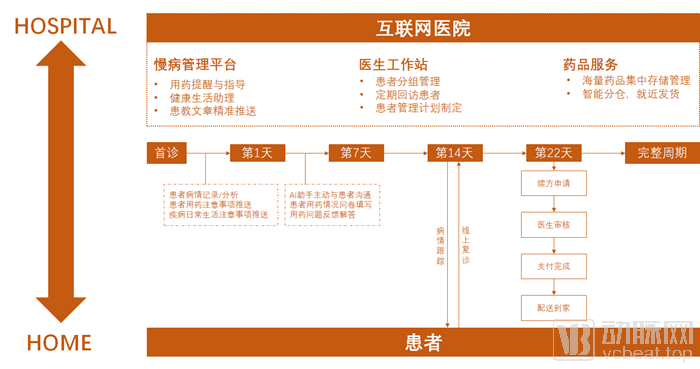
Jianke Chronic Disease Management Process
In the H2H system, physicians can personalize and customize specialized chronic disease management plans. Based on the specific disease and patient conditions, doctors can define key time points within the periodic management workflow on the platform. At each time point, physicians can address various patient inquiries by recording videos or audio messages, disseminate relevant articles, and collect real-time patient data.
In 2019, leveraging its H2H system, Jianke established an IBD Center to explore the institutionalization of specialized chronic disease management. IBD is a distinct form of chronic inflammatory bowel disease. Jianke invited Professor Wu Xiaoping, a renowned authority in China, to serve as the Chief Advisor of the IBD Center. According to Jiang Chonghao, the Jianke IBD Center aims to address current challenges—including poor doctor-patient communication, low patient adherence, and insufficient continuing education for primary care physicians—through comprehensive online system-based management.
Under the authoritative guidance of Professor Wu Xiaoping, Jianke has developed internet-assisted solutions to address common issues faced by patients with inflammatory bowel disease (IBD). To date, it has supported more than 230 gastroenterologists across China in providing professional follow-up consultations and disease management services to over 12,000 IBD patients nationwide.
In a post-conference interview, when asked about the future of pharmaceutical e-commerce, Xie Fangmin maintained his characteristic caution and resolve. He stated, “The wave of the Internet is historic; no one can reverse it, and everyone is a driving force.”