

Anyeep's Prospectus: Breaking Through a 95% Import-Dominated Mass Spectrometry Market with Ultra-High Cost-Performance Instruments
In 2009, China imported 3,731 mass spectrometers; by 2018, this figure had risen to 12,617 units. (Source: General Administration of Customs of China)
“Imported products account for a share nearly equivalent to the size of the domestic market, while the share of domestically produced products is negligible,” said Zhang Xiaohua, co-founder of Analytik. “During the most intense phase of the China-U.S. trade dispute, China imposed the lowest tariff increases on imported high-end U.S. instruments (mass spectrometry).”
This is because the domestic production rate of high-end instruments, such as mass spectrometers, is extremely low. Yet mass spectrometry plays an irreplaceable role in fields including life sciences, precision medicine, biopharmaceuticals, materials science, food safety, environmental monitoring, the nuclear industry, and national defense.
Against this backdrop, Dr. Zhang Xiaohua and Professor Xu Wei co-founded Suzhou Anyeep Precision Instrument Co., Ltd. in 2016, with the mission of developing high-quality domestically produced mass spectrometers by pursuing civil-military integration and commercializing scientific research outcomes. In early 2018, Anyeep secured investment from FreeS Fund to accelerate product development. To date, the company has launched multiple mass spectrometry products with independent intellectual property rights, including the Anyeep 7600 GC-MS, Anyeep 7700 GC-MS, compact ion trap mass spectrometer, and portable quadrupole mass spectrometer (military-grade), all of which have achieved successful commercial sales. The company has recorded annual sales growth exceeding 50% for three consecutive years.
Faced with challenges such as weak foundations in precision machining, insufficient experience, and a shortage of high-end talent, how can domestic instrument companies catch up with international giants like Agilent, Thermo Fisher, Waters, and AB SCIEX, which boast over 30 years of manufacturing expertise? VCBeat interviewed Zhang Xiaohua, co-founder of Suzhou Anypure Precision Instruments Co., Ltd.
Mass spectrometry boasts a century-long development history, and this technology has earned numerous scholars the Nobel Prize. However, its research and development (R&D) history in China is relatively young. Zhang Xiaohua stated, “Before 2004, there were virtually no individuals in China engaged in the development of mass spectrometry instruments. Between 2004 and 2019, driven by the Ministry of Science and Technology’s instrument projects, a number of R&D teams dedicated to mass spectrometry instruments emerged in China.”
It was in 2004 that Zhang Xiaohua joined the mass spectrometry research team at the National Institute of Metrology, China, embarking on his work in mass spectrometry. Another co-founder, Professor Xu Wei from Beijing Institute of Technology, studied under Professor Graham Cooks of Purdue University, a member of the U.S. National Academy of Sciences and an international advocate for mass spectrometer miniaturization. During his time in the United States, Professor Xu directly participated in cutting-edge mass spectrometry research. Upon returning to China, he has long been dedicated to the development of miniature mass spectrometers.
Having cultivated deep expertise in the mass spectrometry instrument industry for many years, Zhang Xiaohua believes that while China’s mass spectrometry sector remains heavily reliant on imports, the domestic market for mass spectrometers is continuously expanding, with an increasing number of application areas gradually emerging. The Ministry of Science and Technology’s “13th Five-Year Plan for Scientific and Technological Innovation in Medical Devices” listed novel medical mass spectrometers as a key focus for major product development, reflecting the state’s emphasis on cutting-edge scientific instruments. As a typical high-end scientific instrument, it is imperative to break the monopoly held by foreign manufacturers over high-end analytical instruments and to increase the localization rate of such equipment in China.
Standing at the dual juncture of technological iteration in the mass spectrometry industry and domestic substitution, Aiyipu aims to develop products that are independently controllable and offer ultimate cost-performance ratio.
Currently, Aiyipu has finalized two models of laboratory quadrupole gas chromatography-mass spectrometry (GC-MS) instruments and two models of portable mass spectrometers.
Quadrupole gas chromatography-mass spectrometry (GC-MS) instruments are the most common type of mass spectrometer, featuring outstanding quantitative capabilities and a wide dynamic range; they account for a significant proportion of the total mass spectrometry market.
Zhang Xiaohua stated, “Our Anyeep 7700 GC-MS has reached an internationally advanced level, with a limit of detection as low as 10 fg. Furthermore, unlike similar foreign products, our portable GC-MS can directly adopt national standard laboratory methods, enabling seamless integration; currently, we are the only ones capable of achieving this.”
What makes Zhang Xiaohua most proud is that the company has drawn lessons from its past research experiences, adhering to market-oriented innovation based on the industrial chain, and placing extreme emphasis on R&D investment by allocating 80% of its resources to research and development. Since its inception, all products developed by Aimspure have achieved commercial sales, which not only demonstrates Aimspure’s self-sustaining financial capability but also signifies market recognition of its products. The cumulative sales of Aimspure’s gas chromatography-mass spectrometry (GC-MS) instruments for laboratory use have exceeded 90 units, with annual sales growth surpassing 50%.
In the future, Annai Pu will also conquer triple quadrupole mass spectrometry (QQQ) instruments. While retaining the strong quantitative capabilities of its existing systems, it will provide tandem MS functionality and offer excellent qualitative performance. Currently, the main manufacturers of triple quadrupole mass spectrometers are Agilent, Thermo Fisher, Waters, AB SCIEX, Shimadzu, and Bruker. There are not yet any commercial-grade domestically produced LC-MS/MS triple quadrupole products available.
Currently, Analytical is steadily advancing the development and commercialization of new products through an R&D pathway encompassing GC-MS, GC-MS/MS, and LC-MS/MS.
AimSpec’s optimism toward triple quadrupole mass spectrometry stems from its confidence in the growth potential of clinical mass spectrometry. Data from Instrument Information Network shows that in the first half of 2019, research institutes accounted for the largest share of mass spectrometry procurement expenditures, reaching RMB 179 million, followed by regulatory agencies, while hospital procurement amounted to RMB 85.5 million.
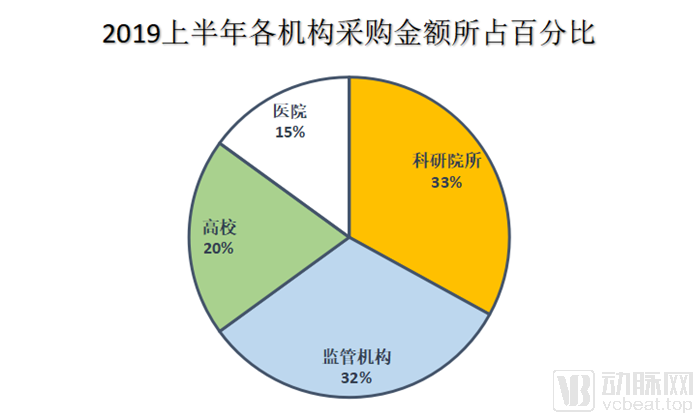
Data source: Instrument Information Network
The proportion of hospitals has risen from less than 10% in the past to 15%, reaching RMB 85.499 million. The types of mass spectrometry systems won by hospitals include MALDI-TOF, triple quadrupole LC-MS/MS, and mass spectrometry imaging systems. With the promotion of clinical mass spectrometry projects, hospitals are bound to become the main force in mass spectrometry procurement in the future.
According to Zhiyin Capital’s estimates, mass spectrometry testing accounts for approximately 15% of the medical testing market in the United States. Applying a 10% share to the Chinese market, where the total size of the medical laboratory testing market reached RMB 276 billion in 2017, the market potential for clinical mass spectrometry testing in China amounts to RMB 27.6 billion.
In the clinical mass spectrometry market, China is still in the early stages of development. The most significant growth at this stage comes from third-party independent laboratories.
Zhang Xiaohua stated, “As competition among third-party independent laboratories intensifies, greater emphasis will be placed on the cost-effectiveness of products. We aim to leverage our cost-effectiveness advantage to secure a certain share of this market.”
Zhang Xiaohua explained to VCBeat that the development of mass spectrometers typically begins with theoretical research and numerical simulations to model ion motion within the instrument, thereby obtaining optimal theoretical design parameters. This is followed by mechanical structure and circuit design, and then iterative optimization of the model to adjust key parameters and improve the instrument design. This approach represents the core technical advantage of Annipu, which has always adhered to forward-engineering R&D.
Zhang Xiaohua stated, “The core components of the mass spectrometry instruments manufactured by Anyipu Company—including the mass analyzer, ion source, circuit control system, control software, and data processing software—have all been fully localized in China, with the exception of electron multipliers used for signal amplification.”
Taking the mass analyzer, a core component, as an example, its machining precision is extremely high, with comprehensive assembly errors required to be within two micrometers. International mass spectrometry manufacturers each have their own exclusive suppliers or maintain in-house production capabilities. Through development, Aiyipu has cultivated an exclusive supplier locally.
The journey from a mass spectrometry prototype to commercialization is far from simple. Anyeepu remains committed to this path because its core team believes that mass spectrometry, as a high-end analytical technology, can not only be deployed in space to decipher the origins of life but also be widely applied in everyday scenarios such as public security, food safety and hygiene, clinical diagnostics, environmental protection, and biopharmaceuticals. By offering instruments with exceptional cost-performance ratios, Anyeepu is driving broader adoption of domestically produced mass spectrometers. In a market where import dependence reaches 95%, Anyeepu is dedicated to meticulous development and manufacturing high-quality Chinese mass spectrometers.