

Innovative Collaboration Model Between Private Clinics and Public Tertiary Hospitals: A Case Study by Kong Xiangjun, Founder of Taibao Pediatrics
Continuous policy deregulation has spurred rapid growth in the clinic sector. How should clinics be established and innovated in the current landscape? On November 30, the 2019 Clinic Development Alliance, themed “Heartfelt Connections, New Leapforward,” and organized by the digital health company DXY, grandly opened in Shanghai.
At the meeting,Kong Xiangjun, founder of Taibao Pediatrics, delivered a speech on “Exploring Collaboration Models Between Private Clinics and Public Grade 3A Hospitals”. This article compiles its highlights.
The following is a transcript of the speech (abridged):
I am Kong Xiangjun, 56 years old. I previously worked as a pediatrician at a tertiary hospital. After leaving the public healthcare system, I engaged in pharmaceutical sales, children’s product development, and internet operations, but ultimately chose to return to pediatrics.
My primary motivation for specializing in pediatrics is my genuine affection for children. I believe that a deep love for children is essential to excelling in this field, as it is only through such devotion that one can truly provide high-quality pediatric care.
After three years of preparation and meticulous development, Taibao Pediatric Clinic was established.On December 1, 2018, Taibao Pediatric Clinic commenced its soft opening. After a six-month period of operational refinement, we officially opened for business on June 1, 2019.
A major highlight of Taibao Pediatric Clinic is its service. As a specialized pediatric clinic with technical support from Nanjing Children’s Hospital, it features senior experts from Nanjing Children’s Hospital who provide common disease management and child healthcare services to select families.
Furthermore, the clinic operates on an appointment-only basis and provides “one-on-one” comprehensive consultation services, addressing issues such as long waiting times and difficulty in securing appointments with specialists. Finally, Taibao Pediatrics has recruited experts from Taiwan and fully integrated Taiwan’s “Five-Heart” medical service philosophy, allowing patients to experience a distinctive Taiwanese approach to healthcare.
In fact, before founding Taibao Pediatrics, we took a detour. As professional pediatricians, when I first considered establishing a clinic, I explored two models: one involved collaborating with other physicians. We spent a year on this initiative; although everyone began with great enthusiasm, it ultimately fizzled out without any tangible results. The second option was to partner with a hospital. Fortunately, we succeeded in pursuing this path. With favorable national policies and the hospital director’s interest, the collaboration proved successful.
Taibao Pediatrics' current business primarily focuses on pediatric diagnosis and treatment, as well as child healthcare.We hold four “firsts”: 1. The first specialized pediatric clinic in Nanjing; 2. The first collaboration between Nanjing Children’s Hospital and a private healthcare institution; 3. The first quality-driven clinic in China to introduce Taiwan’s service philosophy; 4. The first clinic in China to incorporate interactive games for children.
Our experts are all top-tier, offering exceptional medical expertise, service quality, and patient-centered care philosophy. In addition to physicians from Nanjing Children's Hospital, we have also recruited doctors from Taiwan.
We seek out experts from Taiwan and study their healthcare service models because their services are more advanced and their service philosophies are reliable.Customer satisfaction surveys have shown generally positive feedback. In addition to the introduction of experts,Building on the service philosophy of Taiwanese clinics, we have integrated a five-star service model characterized by compassion, thoughtfulness, meticulousness, patience, and warmth.
In addition to our highly qualified expert team, we have introduced several innovations. For instance, in terms of facility design, we have created an interactive gaming area. Children are naturally drawn to interactive games, and physicians can make clinical assessments based on their interactions, thereby achieving a seamless integration with medical care.
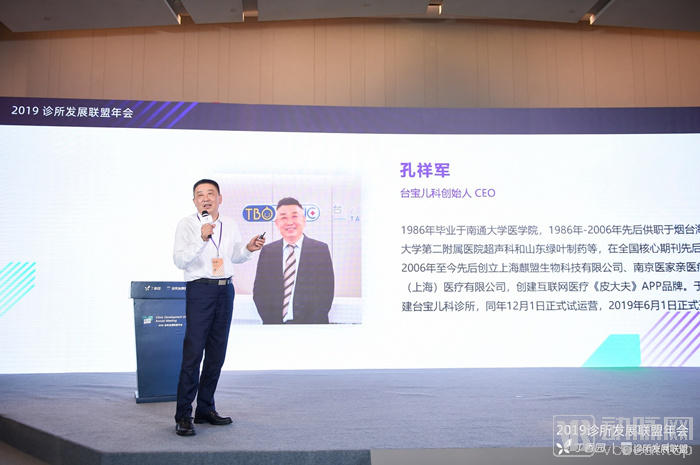
(The photo shows Kong Xiangjun, founder of Taibao Pediatric Clinic)
Although we are currently pursuing relatively traditional business operations,In the future, we will establish a pediatric clinic specializing in child healthcare.
What is the collaboration model with Nanjing Children’s Hospital, a public tertiary A hospital? How is it implemented?
Typically, collaboration models with public hospitals encompass the following directions: 1. Resource-sharing model: brand sharing, expert sharing, equipment sharing, pharmaceutical sharing, green channels, and medical consortiums.
2. Operational Guidance: Public hospitals export management and technical expertise to private clinics, extending the utilization of their advantageous resources; 3. Shared Management and Co-governance: Models including public hospital trusteeship of private clinics and joint-stock cooperative partnerships.
Our collaboration with Nanjing Children's Hospital adopts a resource-sharing model., we sponsored their brand. The collaboration with the hospital has been quite smooth. For instance, in the early stages when a mature team of physicians was not yet in place, specialists from the Children’s Hospital helped address the need for expert consultations.
Our collaboration model is progressive. In the first phase, we engage in brand sharing, expert resource sharing, equipment sharing, and green channel access, with plans to extend our partnership to a medical consortium in subsequent stages. The prerequisites for this collaboration are: national policy support, an established foundation from prior cooperation, and endorsement from hospital leadership who are keen to explore new healthcare service models.
In summary,Current collaboration efforts are primarily reflected in the following areas:: 1. Title sponsorship with technical support from Nanjing Children's Hospital; 2. Independent practice by retired experts who meet the clinic's requirements; 3. Sharing of laboratory and diagnostic equipment; 4. Technical backup and referral services; 5. Authorization to use the designation "Technical Support Unit of Nanjing Children's Hospital" in promotional materials.
Under this collaborative model, the mutual benefits for both parties are significant. The clinic provides its partners with returns in the form of naming rights fees, expert consultation fees, and influence over the clinical philosophies of practicing specialists. The clinic’s gains include enhanced brand influence, increased patient trust, attraction of higher-quality talent, adoption of benchmark-worthy systems, and advancement of discipline construction.
SoWhat are the key points of collaboration? I believe they are as follows:1. Obtain recognition from local government authorities; 2. Sign a framework agreement with partners; 3. Maintain patient communication with relevant local functional departments.
Our collaboration with Nanjing Children's Hospital has significantly met market demands, promoted the optimized allocation and effective utilization of medical resources, supported and driven the development of private clinics, eased previous tensions between private clinics and public hospitals, partially alleviated the patient burden on public hospitals, and improved doctor-patient relations.
Finally, regarding reflections on the cooperation model, I believe the following key terms should be emphasized: government relations, mutual recognition, patient communication, respect for the client (Party A), and expectation management.