

Luye Pharma's Acquisition of Bio-Thera Solutions: A Strategic Move to Accelerate Biologics Transformation
Recently, Luye Pharma announced the acquisition of a 98% equity stake in Boan Biotech. The latter is an integrated biopharmaceutical company dedicated to the development of antibody products and has already ranked among the leaders in domestic large-molecule drug R&D. In addition to continuously strengthening its established advantages in novel formulation technology platforms, Luye Pharma has also been actively exploring technological transformation and upgrading in recent years. This acquisition of Boan Biotech may represent a critical step in its strategic transition. A closer examination of this deal reveals many noteworthy aspects.
The transformation and upgrading of traditional pharmaceutical companies is nothing new; Hengrui Medicine and Chia Tai Tianqing are prime examples of successful innovation-driven upgrades. According to Xia Xiaoyan, Partner and Managing Director at Boston Consulting Group, the shift from small-molecule drugs to biologics is an inevitable trend, driven by the broader dynamics of the pharmaceutical industry.
Biopharmaceuticals represent the fastest-growing segment of the global healthcare industry. According to a report by Frost & Sullivan, the global market size for biological drugs grew from $194.4 billion in 2014 to $261.8 billion in 2018, representing a compound annual growth rate (CAGR) of 7.7% from 2014 to 2018. In 2018, China’s pharmaceutical market reached RMB 1,533.4 billion, with the biological drug market accounting for RMB 262.2 billion. Driven by rising affordability, an expanding patient population, and broader medical insurance coverage, the market size for biological drugs in China is projected to further expand to RMB 641.2 billion by 2023, reflecting a CAGR of 19.6% over the same period.
Compared with Europe and the United States, China’s biopharmaceutical market is still in its early stages of development, offering substantial room for growth. Currently, the Chinese biopharmaceutical market demonstrates strong growth potential, with its expansion rate outpacing that of the overall pharmaceutical market. For R&D-focused enterprises such as Luye Pharma, whose core competency lies in “innovative small-molecule formulations,” this may present a valuable opportunity to reach new heights.
Luye Pharma is widely recognized and regarded as an industry leader in “innovative small-molecule formulations” and “globalization.” For instance, the New Drug Application (NDA) for its risperidone sustained-release microspheres for injection (LY03004), submitted via the 505(b)(2) pathway in the United States, has successfully passed the FDA’s Pre-Approval Inspection (PAI). As other innovative formulation pipelines reach maturity, Luye Pharma is not only continuing to strengthen its established advanced formulation technology platforms but also actively pursuing technological transformation and upgrading by strategically expanding into major therapeutic areas, including innovative biological antibodies, cell therapy, and gene therapy.
“As the window of opportunity draws ever closer, positioning in biologics has become a critically important strategic choice,” stated Xia Xiaoyan.
The total consideration for this transaction amounts to RMB 1.447 billion, which, pursuant to the agreement, shall be paid in three installments. Through this transaction, Luye Pharma not only acquires all of Boan Biotech’s products under development but also brings under its control a series of assets, including its antibody screening platform, intellectual property rights, and antibody generation platform.
Boan Biologics is defined by three core pillars: biosimilars, innovative antibodies, and an antibody screening platform, which together constitute the company’s “3D Ecosystem.” Biosimilars represent commercial viability, characterized by well-defined targets and low risk, enabling faster commercialization. Innovative antibodies signify the degree of innovation, serving as a corporate moat built upon R&D capabilities. The antibody discovery platform represents sustainability; akin to a springhead, it enables the company to continuously identify candidate products for further development.
Nevertheless, even for a target with such a multi-dimensional product portfolio, Luye Pharma did not proceed with a rash acquisition. We note that Luye Pharma had already engaged in in-depth discussions with Boan Biotech as early as 2017, acquiring two monoclonal antibody drugs from Boan Biotech in August of that year. Two years have elapsed since that initial transaction to the current acquisition, indicating that Luye Pharma must have given the matter careful and deliberate consideration.
Let us further examine Boan Biotech’s R&D pipeline. Among its biosimilar products, LY01008 and LY06006 are currently the most advanced. Their respective reference biologics are Avastin and Prolia, which reported annual sales of USD 6.151 billion (2018) and USD 2.29 billion (2018). Both biosimilars are currently in Phase III clinical trials and are expected to be launched in 2021 and 2022, respectively. Two other products, LY01011 and LY09004, are in Phase I clinical trials. Their reference products, Xgeva and Eylea, recorded annual sales of USD 1.934 billion and USD 6.746 billion, respectively, with both biosimilars anticipated to reach the market in 2023. In other words, these four biosimilar candidates alone are poised to start generating returns for Luye Pharma from 2021 onward.
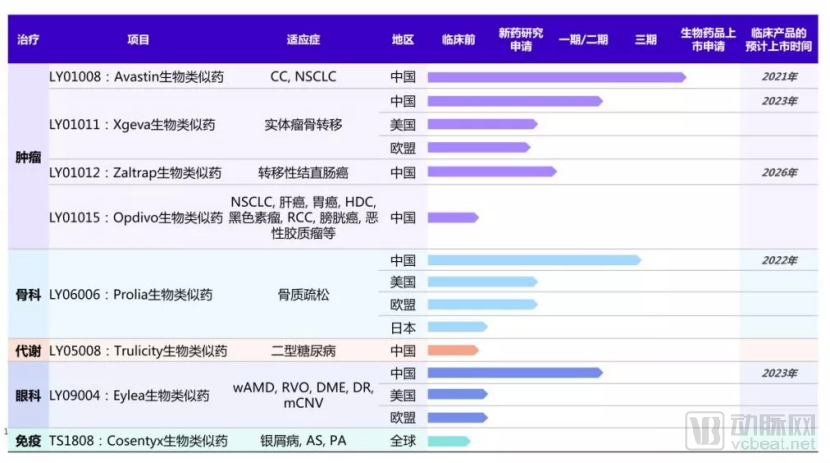
Boan Biotech's Biosimilar Product Portfolio
In the biosimilar product pipeline, there are also products such as the PD-1 inhibitor nivolumab (Opdivo), the IL-17A inhibitor secukinumab (Cosentyx), and the GLP-1 receptor agonist dulaglutide (Trulicity), offering significant market potential.
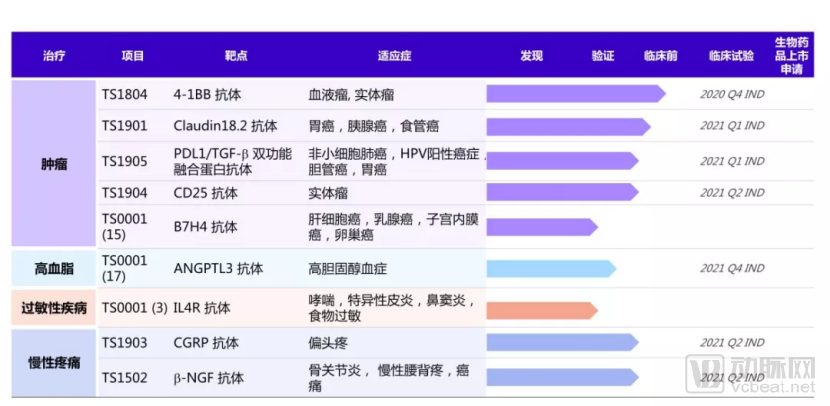
Boan Biotech's Innovative Antibody Product Pipeline
Next, let’s examine the innovative antibody pipeline. Currently, Boan Biotech has more than ten candidate bio-innovative products in development, including a 4-1BB antibody and a PD-L1/TGF-β bifunctional fusion protein antibody in the field of tumor immunotherapy; a Claudin18.2 antibody for the treatment of gastric cancer; and antibodies targeting newer targets such as CGRP and β-NGF for the treatment of migraine.
By securing commercial returns from biosimilars in a short timeframe while simultaneously deepening its R&D efforts in innovative antibodies, and further leveraging its antibody discovery platform to continuously generate new candidate products, Luye Pharma has integrated these advantages of Boan Biotech through acquisition.
“Biologics entail greater R&D investment and higher risks; conducting rigorous screening before project initiation can minimize these risks to the greatest extent,” stated Xia Xiaoyan.
Beyond its product portfolio, another valuable asset Luye Pharma may acquire from Boan Biotech is intellectual property (IP) and talent. At their core, both R&D and commercialization are competitions driven by talent and IP. Boan Biotech possesses proprietary technologies, including fully human antibody transgenic mouse technology, phage display technology, and a nanobody platform, along with nearly 30 IP rights and a large pool of talented professionals with extensive experience in R&D and manufacturing. In addition to enhancing Luye Pharma’s R&D capabilities and production management standards, these talent resources and IP assets are expected to further strengthen the company’s overall competitiveness in product development and manufacturing.
“In addition, compared with small startups, large companies also have significant advantages in commercialization experience and talent networks,” she added.
However, expanding into the biologics sector is only part of Luye Pharma’s self-upgrading strategy. The company has mapped out multiple strategic directions, including protein-based therapeutics, tumor immunotherapy, and cell therapy. It has already established strategic collaborations with several cutting-edge U.S. biotechnology companies, such as Excel Biopharm and ELPIS Biopharm, to jointly develop novel bispecific antibodies, therapeutic antibodies for next-generation cancer immunotherapies, and CAR-T therapies, among other projects.
If biologics represent a strategic bet on the next five years, then cutting-edge biological therapies such as gene therapy are more akin to positioning for the distant future. Xia Xiaoyan refers to this strategy as a “combined approach,” which entails making long-term investments while simultaneously focusing on immediate opportunities.
This strategic approach was vividly demonstrated in the recent acquisition of Boan Biologics, which sought to balance risk while pursuing long-term benefits. However, Luye Pharma’s actual strategic planning extends far beyond what is evident from this acquisition and was initiated much earlier.