

Six Pilot Cities Launch AI Commercialization Initiatives with $3B Combined Funding, Unlocking Four Major Opportunities for AI in Healthcare
Recently, Hangzhou held a mobilization meeting for the construction of the National New Generation Artificial Intelligence Innovation and Development Pilot Zone, proposing multiple support policies for the artificial intelligence industry, including financial funding.
Hangzhou is one of the six cities designated by the Ministry of Science and Technology (MOST) to support the establishment of National New-Generation Artificial Intelligence Innovation and Development Pilot Zones (hereinafter referred to as the “Pilot Zones”), with the other five being Beijing, Shanghai, Tianjin, Shenzhen, and Hefei. According to MOST’s plan, approximately 20 Pilot Zones will be established by 2030. Institutions, enterprises, teams, and other entities in these cities can receive support from MOST in terms of policies and resources, as well as investment from local governments.
Healthcare is also a key application area for artificial intelligence. So, what impact will the establishment of pilot zones have on the healthcare industry? VCBeat (WeChat ID: vcbeat) consulted multiple AI companies in the medical sector, most of which indicated they were either unaware of or had only a superficial understanding of the relevant policies. Therefore, through extensive research, we have compiled an overview of the policy framework for pilot zone development, the strategic directions of various cities, and supportive measures, aiming to provide practical insights for the industry.
After more than 60 years of development, artificial intelligence has entered a new stage characterized by deep learning, cross-disciplinary integration, and human-machine collaboration, and has been elevated to the level of national strategy in China.
As early as 2017, the State Council issued the "Development Plan for New Generation Artificial Intelligence." The plan proposed a three-step strategic goal:
By 2020,Cultivate several globally leading backbone enterprises in artificial intelligence, with the scale of the core AI industry exceeding RMB 150 billion, driving the scale of related industries to surpass RMB 1 trillion, and making the application of AI technologies a new avenue for improving people's livelihoods;
By 2025,New-generation artificial intelligence has been widely applied in fields such as smart manufacturing, intelligent healthcare, smart cities, smart agriculture, and national defense construction. The core AI industry has exceeded RMB 400 billion in scale, driving related industries to surpass RMB 5 trillion, making artificial intelligence a primary driver of China’s industrial upgrading and economic transformation;
By 2030,The scale of the core artificial intelligence industry exceeds RMB 1 trillion, driving the scale of related industries to over RMB 10 trillion. China has become a major global innovation center for artificial intelligence, with significant achievements realized in the intelligent economy and intelligent society.
It is evident that artificial intelligence boasts diverse application scenarios and broad market prospects, necessitating concerted efforts in theoretical research, achievement transformation, and industrial advancement. The current stage of the industry, as well as the phase it is about to enter, corresponds to the aforementioned goal of leveraging AI to improve people’s livelihoods and drive industrial upgrading and economic transformation. In this phase, the translation of research outcomes into practical applications and commercialization is of paramount importance.
In February and May of this year, with the support of the Ministry of Science and Technology, Beijing and Shanghai respectively launched the construction of pilot zones, gearing up for innovations in institutional mechanisms and the in-depth development of application scenarios.
In order to encourage leading regions to take the lead in pilot initiatives and develop a set of replicable and scalable best practices, the Ministry of Science and Technology issued the “Guidelines for the Construction of National New-Generation Artificial Intelligence Innovation Development Pilot Zones” this September.
The Implementation Guidelines specify key application areas for artificial intelligence, including carrying out AI technology application demonstrations in manufacturing, agriculture and rural development, logistics, finance, commerce, smart homes, healthcare, education, government services, transportation, environmental protection, security, urban management, assistance for persons with disabilities and elderly care, and domestic services, so as to expand application scenarios and accelerate the deep integration of AI with the real economy.
Following the issuance of the construction guidelines, on October 17 this year, the Ministry of Science and Technology replied on the same day to Tianjin, Hangzhou, Shenzhen, and Hefei, supporting their establishment of pilot zones. This brings the total number of cities building such pilot zones to six. These cities will leverage their respective advantages and distinctive features to further explore the deep integration of industry, academia, and research in artificial intelligence.
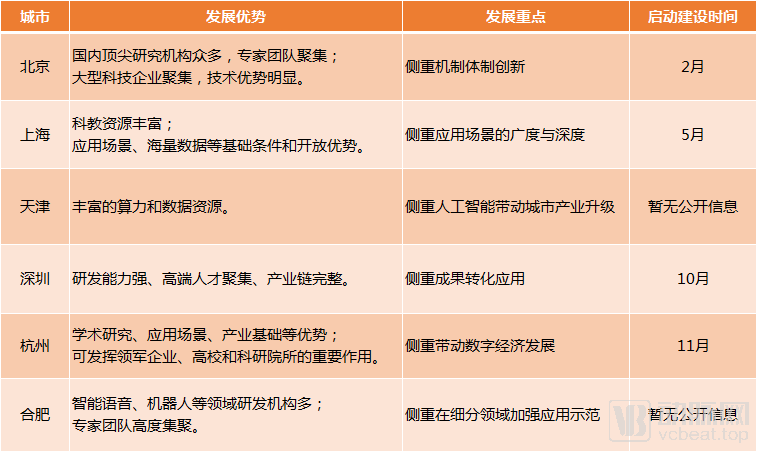
Six cities took the lead nationwide in launching pilot zone construction, each leveraging its unique strengths. Consequently, their development focuses and directions vary. Based on publicly available information, VCBeat has summarized the details as follows:
Source: Public reports
According to media reports, Beijing is now home to more than 1,000 artificial intelligence (AI) enterprises and nearly 40,000 AI-related professionals. It also hosts a number of research institutions, including the Institute for Artificial Intelligence at Tsinghua University, the Institute of Artificial Intelligence at the University of Science and Technology Beijing, and the Beijing Frontier International Academy of Artificial Intelligence.
As a key component of the pilot zone construction, Beijing has formulated the Zhiyuan Action Plan. The Beijing Municipal Science & Technology Commission and the Haidian District Government have promoted the establishment of the Beijing Academy of Artificial Intelligence (BAAI) to cultivate high-end core AI talent and provide data services for researchers. Leveraging these advantages, Beijing will take institutional and mechanistic innovation as its breakthrough point to build a collaborative innovation system integrating government, industry, academia, research, finance, and application.
Modern service industries in Shanghai, including information services, business services, scientific research services, and cultural and creative industries, are developing rapidly. The city has also established the World Artificial Intelligence Conference, accumulating substantial industrial resources. Abundant industrial factors and diversified demands driven by a diverse population structure provide rich application scenarios for artificial intelligence, thereby promoting technological innovation and adoption from the demand side.
Currently, Shanghai has released two batches of “AI Application Scenarios,” covering sectors such as public security, healthcare, education, government services, and manufacturing, attracting numerous enterprises—including Microsoft, Huawei, Sensetime, and Yitu—to provide solutions. By 2020, Shanghai aims to establish 60 in-depth application scenarios and six innovative application demonstration zones, at which point it will also solicit additional solutions.
Tianjin boasts abundant computing power and data resources, home to leading enterprises such as Phytium, Kylin, Sugon, and Gbase, covering four major categories of foundational products: chips, operating systems, servers, and databases.
Tianjin will implement the integration of industry and innovation across seven artificial intelligence industrial chains, including autonomous and controllable information systems, intelligent security, big data, advanced communications, intelligent connected vehicles, industrial robots, and smart terminals. As a historic industrial city, Tianjin will be driven by AI technological innovation, leveraging intelligence as the second curve for industrial development to promote the transformation and upgrading of its urban industries.
Shenzhen boasts strong R&D capabilities, a concentration of high-end talent, and a complete industrial chain in the field of artificial intelligence, with its AI industry already taking shape.
Shenzhen’s “Action Plan for the Development of New-Generation Artificial Intelligence (2019–2023)” proposes that by 2020, the scale of the core AI industry will exceed RMB 10 billion, driving the related industries to reach RMB 300 billion; and by 2023, the scale of the core AI industry will surpass RMB 30 billion, with related industries reaching RMB 600 billion. Therefore, Shenzhen will leverage its industrial ecosystem advantages and strong capability in translating research outcomes into practical applications to establish commercialization demonstrations.
Hangzhou boasts advantages in artificial intelligence academic research, application scenarios, and industrial foundation, hosting innovative research institutions such as Zhejiang Lab, the Advanced Institute of Information Technology at Peking University, and Alibaba DAMO Academy. Leading enterprises including Alibaba Group, Hikvision, Dahua Technology, Ant Group, NetEase, and Hundsun Technologies hold prominent positions in fields such as data processing, computer vision, intelligent security, smart finance, and autonomous driving.
On November 28 this year, Hangzhou held a mobilization meeting for the construction of the pilot zone, releasing relevant plans and support policies, and proposing eight special tasks, including basic theoretical research, key technology R&D, integrated application demonstration, talent cultivation and introduction, industrial innovation and development, ecological environment creation, spatial layout optimization, and institutional mechanism innovation.
In recent years, Hangzhou has witnessed rapid development in its digital economy. As the two pillar industries of Hangzhou, the digital economy and manufacturing sector are of paramount importance, with artificial intelligence serving as a key technological driver and thus holding a pivotal position.
In the field of artificial intelligence, Hefei boasts advantages such as a high concentration of R&D institutions specializing in intelligent voice technology and robotics, along with a highly aggregated team of experts. Public data shows that China Speech Valley, located in Hefei and led by iFlytek, has attracted more than 600 enterprises to settle in the park, incubating and cultivating over 130 AI software and hardware products across sectors including education, healthcare, services, automotive, and smart home. In the first half of 2019, China Speech Valley achieved an output value of RMB 41 billion.
As part of the integrated development of the Yangtze River Delta region, Hefei’s in-depth application demonstrations in niche sectors such as intelligent voice and robotics will foster more efficient industrial synergy with other cities in the region.
Accelerating Large-Scale Implementation and Commercialization Is the Main Theme
In the new wave of industrial transformation, artificial intelligence will serve as a powerful driver of economic development, reshaping multiple stages including production, distribution, and consumption. However, it will also bring new challenges, such as shifts in employment structures amid the trend toward intelligentization, as well as uncertainties regarding legal and social ethics and personal privacy.
Of course, we should not shy away from artificial intelligence due to potential risks; instead, we should encourage innovation and accelerate its implementation while simultaneously exploring policy and institutional constraints. Therefore, although the six pilot zones mentioned above have different development directions, they share a common feature: they explore and demonstrate best practices in areas such as policies and regulations, ethical standards, talent cultivation and introduction, data openness and sharing, and commercial applications. Among these, commercial application is particularly important; a new technology is meaningful only if it can meet real-world needs and deliver tangible value.
The “Guidelines for the Construction of National New Generation Artificial Intelligence Innovation and Development Pilot Zones” also point out that the construction of pilot zones will focus on promoting the deep integration of artificial intelligence with economic and social development, innovating institutional mechanisms, and deepening the integration of industry, academia, research, and application.
Furthermore, the National New Generation Artificial Intelligence Innovation and Development Pilot Zone is spearheaded by the Ministry of Science and Technology (MOST). As orchestrating major technological breakthroughs and demonstration applications of achievements, as well as promoting the transfer and commercialization of scientific and technological outcomes and fostering industry-academia-research collaboration, are key functions of MOST, this move signals an acceleration in the practical deployment of advanced AI achievements. This will not only promote the development of core industries but also drive growth in related sectors.
In accordance with the plan, the Ministry of Science and Technology will provide support for the development of the pilot zones in terms of policy and resources. Local governments shall increase financial investment in the construction of the pilot zones, formulate sound policy frameworks, and actively encourage enterprises and social forces to participate in their development. Therefore, the primary entities responsible for implementing financial support are at the local level.
Source: Official websites of relevant local departments; graphic by VCBeat
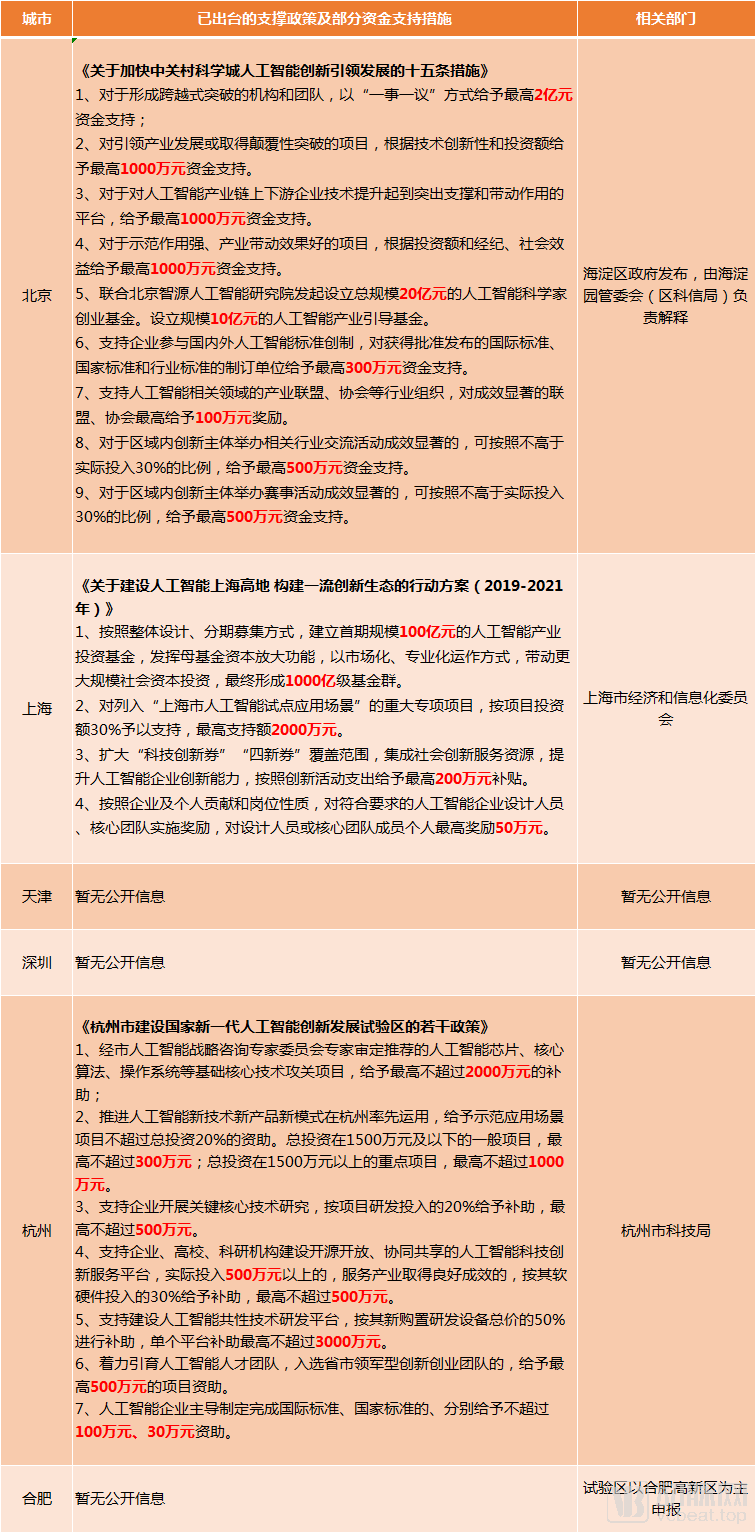
According to officially released information, Beijing, Shanghai, and Hangzhou have introduced corresponding supportive policies following the launch of their pilot zone initiatives. In the table above, we have compiled these details comprehensively and highlighted key data points.
As Haidian District in Beijing is home to a large concentration of artificial intelligence (AI) enterprises, accounting for nearly 20% of the national total, with AI unicorn companies representing 65% of the country’s total, it has become a core force in Beijing’s establishment of the pilot zone. To support the development of this pilot zone, the Haidian District Government released the “Fifteen Measures on Accelerating AI Innovation and Leading Development in Zhongguancun Science City” in May this year, introducing multiple financial support initiatives:
Institutions and teams that achieve leapfrog breakthroughs will be granted up to RMB 200 million in financial support on a case-by-case basis. In addition, a venture capital fund for AI scientists with a total size of RMB 2 billion will be established jointly with the Beijing Academy of Artificial Intelligence (BAAI). An AI industry guidance fund with a scale of RMB 1 billion will also be set up, adopting a “fund-of-funds plus direct investment” model to support early-stage and major AI projects while extending the support period, and to facilitate the establishment of AI sub-funds focused on early-stage and long-term investments.
In September this year, the Shanghai Municipal Commission of Economy and Informatization issued the Action Plan for Building Shanghai into an AI Highland and Establishing a First-Class Innovation Ecosystem (2019–2021), which also includes multiple measures for financial support. For instance, major special projects included in the “Shanghai AI Pilot Application Scenarios” list will receive subsidies covering 30% of their investment amounts, with a maximum cap of RMB 20 million.
In November this year, Hangzhou announced support policies at the mobilization conference for the construction of pilot zones. The policies state that key technological breakthrough projects in foundational core technologies—such as AI chips, core algorithms, and operating systems—recommended by experts from the Municipal Artificial Intelligence Strategic Advisory Expert Committee and approved by them, will receive subsidies of up to RMB 20 million. Support will also be provided for the establishment of AI common technology R&D platforms, with subsidies covering 50% of the total cost of newly purchased R&D equipment; the maximum subsidy per platform is capped at RMB 30 million. Currently, Hangzhou has established an expert committee to provide advisory services for related deployments.
It is evident that the key areas of support in various regions are closely aligned with their respective AI development strategies. Beijing prioritizes research, offering substantial support to scientists and research teams; Shanghai focuses on real-world implementation, providing strong backing for application scenario projects; Hangzhou emphasizes integration with the digital economy and manufacturing sector, delivering significant support for related technologies and equipment.
Data Source: VCBeat Knowledge Base
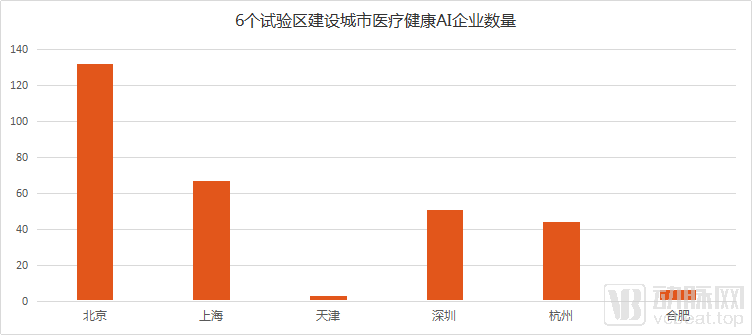
Healthcare is a key application area for artificial intelligence. According to data from the VCBeat knowledge base, among the six cities currently designated as pilot zones, AI-related healthcare enterprises are predominantly concentrated in Beijing, Shanghai, Shenzhen, and Hangzhou. It is evident that these cities possess multifaceted advantages in the healthcare sector.
For instance, Beijing and Shanghai boast a concentration of high-quality medical resources, providing a robust data foundation and application environment for medical AI. Additionally, the clustering of innovative pharmaceutical companies in these cities allows AI to enhance drug R&D efficiency. Hangzhou is home to numerous healthcare IT enterprises, where the integration of AI with healthcare information technology can better serve medical institutions and businesses. Shenzhen has a well-developed AI industrial ecosystem covering multiple stages, including design, development, manufacturing, services, and applications. Major tech giants such as Tencent, Huawei, and Ping An have already established their presence in medical AI, playing a leading role in the sector.
Meanwhile, the high prevalence of AI mindset, vibrant entrepreneurial atmosphere, and developed economies in these four cities are also key reasons for the concentration of medical AI enterprises.
In the healthcare sector, artificial intelligence has been applied across multiple subfields, including medical imaging, medical devices, drug discovery, surgical robotics, and health insurance. However, medicine itself is characterized by high professional barriers and strong policy orientation, making it distinct from other industries. Consequently, AI faces numerous challenges in this domain, which are primarily manifested at four levels.
Policy Level:Relevant laws and regulations governing how the artificial intelligence industry acquires and utilizes medical data remain inadequate; furthermore, approval standards for computer-aided diagnosis systems have not been fully established, and pricing structures have yet to be defined, thereby hindering the commercialization progress of enterprises.
Technical Level:Some industry insiders believe that the current state of artificial intelligence (AI) algorithms fails to meet the demands of today’s healthcare environment for this technology. What medical AI lacks is the ability to analyze small sample sizes and provide interpretable results. Without these capabilities, AI may demonstrate impressive performance in laboratory settings, but its accuracy will significantly decline once deployed in hospitals. Therefore, further refinement is needed for AI technology to truly address clinical healthcare challenges.
Market Level:Due to constraints in the approval process, AI-based medical auxiliary diagnostic tools have not yet been widely incorporated into the reimbursement systems of public hospitals, nor has consumer-side payment been extensively adopted. Consequently, a sustainable business model for medical AI has not yet been established.
Capital Level:The absence of sustainable business models and the uncertainty surrounding profitability cycles have, to some extent, dampened investor confidence in the industry. The era of fervent capital market activity has passed, giving way to more rational investment decisions.
In response to these issues, what promising improvements can medical artificial intelligence bring to the development of pilot zones? We believe the following points are key:
1. When formulating AI-related policies and standards, authorities may prioritize considerations such as safety and ethics. Medical AI enterprises often analyze these aspects and propose corresponding solutions, which could help drive the establishment of policy frameworks. Innovation and pilot initiatives in institutional mechanisms, policies and regulations, and standard specifications are also among the key tasks in the development of pilot zones.
2. Promoting AI research and technological iteration is also a key task in the development of the pilot zone. Medical AI is expected to achieve technological breakthroughs in this process.
3. For products that do not involve the core of medical diagnosis, sustainable and in-depth exploration can be pursued; for instance, by identifying integration points for public welfare applications and intelligent terminals within Shanghai’s advanced application scenarios or Shenzhen’s well-developed industrial ecosystem.
4. Several pilot cities have introduced corresponding financial support policies, including direct funding for projects and teams, as well as venture capital and industrial funds; medical AI projects are also eligible to apply for such support.
In accordance with the plan of the Ministry of Science and Technology, approximately 20 pilot zones will be established by 2023. In addition to possessing abundant scientific and educational resources, a solid industrial foundation, sound infrastructure, and clear support measures from local governments, these pilot zones must serve and support national regional development strategies. The layout will focus primarily on major regional development strategies, including the coordinated development of the Beijing-Tianjin-Hebei region, the development of the Yangtze River Economic Belt, the construction of the Guangdong-Hong Kong-Macao Greater Bay Area, and the integrated development of the Yangtze River Delta region, while also taking into account the coordinated development of the eastern, central, western, and northeastern regions.
According to VCBeat, as a component of the Guangdong-Hong Kong-Macao Greater Bay Area, Dongguan will also promote the integration of artificial intelligence with manufacturing and strive to establish a pilot zone.
Despite significant breakthroughs in research and technology, the artificial intelligence industry remains in its nascent stage. It is bound to experience twists and turns as well as growing pains, with new entrants constantly joining while established players exit. Nevertheless, the trend of bringing infinite opportunities is certain.
Artificial Intelligence: A Promising Future, and So Is Medical AI.