

Squeezing Out Capital Bubbles: How Innovative Drugmakers Navigate Market Volatility on STAR Market and National Reimbursement Drug Negotiations
“The performance of innovative pharmaceutical companies in the secondary market has already taught primary market investors a lesson.” As winter approached in 2019, an investor from a fund of funds offered this summary while commenting on the performance of the STAR Market. She believed that the bubble accumulated by innovative drug projects over the past several years would gradually be squeezed out over the next two to three years.
As of December 6, 2019, a total of eight biopharmaceutical companies had their stocks listed and traded on the STAR Market. Among them, the share prices of six companies fell to varying degrees below their first-day opening prices, while only two companies saw a slight increase in their stock prices after listing.
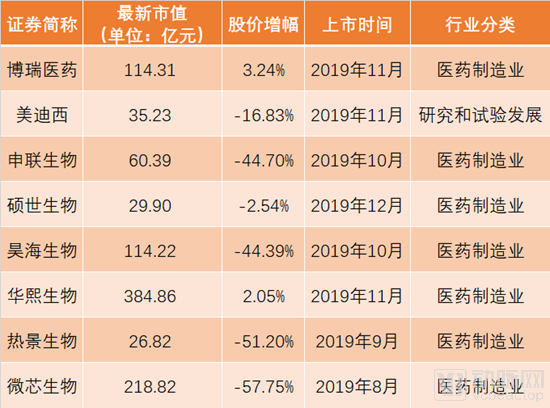
Market Performance of Biopharmaceutical Companies on the STAR Market as of December 6, 2019
At the 2019 Annual Conference on Biologics, VCBeat met with Mr. Yuan Quanhong, President of CCB Capital, at the Beijing International Convention Center. CCB Capital had invested in Chipscreen Biosciences and BrightGene Bio-Medical Technology during their private equity stages. As the first biopharmaceutical company to list on the STAR Market, Chipscreen Biosciences experienced a precipitous drop in its stock price immediately after its IPO. Mr. Yuan shared a more optimistic perspective.
Through interviews with multiple professionals from the capital and industrial sectors, VCBeat will explore in this article the perceptions and response strategies of domestic innovative pharmaceutical companies under new historical conditions, such as the establishment of the STAR Market and the centralized procurement of drugs, and summarize the following key points:
1. Price fluctuations on the STAR Market should be left to market forces;
2. Companies with core hard technologies can opt for a dual-listing strategy on the Hong Kong Stock Exchange and the STAR Market;
3. Centralized drug procurement and dynamic health insurance negotiations benefit innovative pharmaceutical companies on the market front;
4. Industry reshuffling brings new opportunities for innovative pharmaceutical companies;
5. Whether it is entrepreneurship or investment, an international perspective is required.
Developing innovative drugs requires support in terms of capital, talent, and policy. In the area of talent, rapid progress has been made through a combination of domestic cultivation and international recruitment, while new breakthroughs are being achieved in funding and policy support.
Investment in the pharmaceutical industry is characterized by early-stage entry, long cycles, and substantial capital requirements. Genuine innovation in core technologies requires joint efforts from all sectors of society. Since last year, biopharmaceutical investment in the primary market has entered a cooling-off period. “However, the ecosystem for biopharmaceutical investment is improving, including the exit channels for capital that early-stage investors hope to see,” pointed out Mr. Yuan Quanhong. The launch of the STAR Market has brought significant changes to the capital market. With nearly 100 innovative companies going public one after another and the first revenue-less biotech company successfully completing its registration, the diversification of capital exit channels will continue to promote industry development.
Upon listing, biotechnology enterprises enter a market economy environment where their market capitalization is determined by the free choices of investors. In contrast to the STAR Market, which is still in its early stages and features relatively simple investor structures, market mechanisms, and regulatory frameworks, the Hong Kong Stock Exchange represents a more mature capital market.
As of August 13, 2019, 12 Chinese biopharmaceutical companies had listed in Hong Kong, including nine innovative drug developers and three CROs, with prominent players such as Ascletis Pharma, WuXi AppTec, Innovent Biologics, and Junshi Biosciences among them.
The market capitalization performance of these listed companies can be categorized into three groups: the first group saw their stock prices rise steadily, with some companies leveraging this momentum to complete new public market financings; the second group had issue prices that were largely aligned with market prices; and the third group experienced declines, with some companies’ stock prices falling even 30% below their issue prices.
“Drawing on the experience of the Hong Kong Stock Exchange, it is normal for STAR Market stocks to experience price volatility at this stage,” explained Mr. Yuan Quanhong. “Although the capital market assesses a company’s value based on criteria such as its R&D pipeline and clinical development stages, discrepancies between fundamentals and market performance do occur from time to time. This reflects the ongoing interplay between long-term value and short-term price.”
Three factors contributed to the high volatility of the STAR Market at its inception. First, the float of tradable shares was very small. Second, individual investors accounted for a significant proportion of the investor base. Third, due to the relatively limited supply of STAR Market stocks, investors assigned high valuations at the time of listing driven by scarcity. Typically, a capital market tends to mature only after accommodating nearly 1,000 listed companies. The U.S. NASDAQ market alone has more than 70 biotechnology companies, whereas the total number of companies listed on the STAR Market is currently fewer than 100.
When VCBeat interviewed Mr. Yuan Quanhong in late 2018, he predicted that China would see the emergence of large innovative pharmaceutical companies with market capitalizations exceeding RMB 100 billion over the next decade. “In mature capital markets, the full integration of capital and industry can nurture small companies into large ones; for example, enterprises such as Alibaba and Tencent experienced rapid growth after their IPOs.” Mr. Yuan believes that the STAR Market has the potential to cultivate major pharmaceutical companies.
Regarding the price volatility of biopharmaceutical companies listed on the STAR Market, Mr. Cheng Jie, Head of the Healthcare Industry at CITIC Securities’ Investment Banking Division, who has advised numerous companies through their IPOs, believes that secondary market investors are rather pragmatic, placing greater emphasis on future cash flows and commercialization prospects. “In fact, during the IPO application process, regulatory bodies such as the China Securities Regulatory Commission (CSRC) and the stock exchanges also evaluate the robustness of a company’s core technologies from multiple dimensions.”
For biotechnology companies with core proprietary technologies, Mr. Cheng Jie believes that a combined strategy of listing on both the Hong Kong Stock Exchange (HKEX) and the STAR Market can be adopted. The HKEX attracts a large number of professional international investors who hold significant influence in the capital markets. Projects that gain recognition from international investors are also highly favored in China’s domestic capital markets.
In addition to exit channels, another critical consideration in biopharmaceutical investment is whether market access can be secured after product approval. Inclusion in the National Reimbursement Drug List (NRDL) facilitates rapid entry into the hospital market. In recent years, with continuous adjustments to medical insurance policies, innovative drugs with high clinical value have been able to quickly enter the medical insurance system through price negotiations.
From November 10 to 14, 2019, the National Healthcare Security Administration (NHSA) conducted a new round of negotiations for the inclusion of drugs in the national reimbursement drug list. A total of 150 products participated in the negotiations, with 97 successfully reaching agreements. Seventy newly added varieties gained access to the National Reimbursement Drug List through centralized negotiations (including 52 western medicines and 18 proprietary Chinese medicines), while 27 varieties under renewal negotiations were successfully renewed. The updated national reimbursement policy took effect nationwide on January 1, 2020, with a validity period of two years. As local reimbursement drug lists are gradually phased out, these negotiations will influence the clinical prescribing choices of millions of physicians across China.
VCBeat has noted that the drugs newly included in the national medical insurance reimbursement list are predominantly innovative medicines launched in recent years, with 8 out of 12 major domestically developed innovative drugs successfully passing price negotiations. Mr. Yuan Quanhong pointed out that prior to the implementation of dynamic medical insurance negotiations and centralized drug procurement, product promotion often posed an unbearable burden for innovative pharmaceutical companies.
“Although the decline in per-unit drug prices has compressed profit margins, exchanging price for volume will lead to optimization of production costs. ‘China possesses the world’s second-largest pharmaceutical demand market, and this market continues to expand.’ National reimbursement drug negotiations and centralized volume-based procurement emphasize considerations of clinical efficacy and clinical need, which will gradually marginalize adjuvant medications with insignificant therapeutic benefits.”
In meeting clinical needs, the shortened time lag for imported innovative drugs to enter the Chinese market will indeed exert pressure on domestic innovative pharmaceutical companies in the short term. Mr. Yuan Quanhong believes that domestic innovative pharmaceutical companies can only achieve rapid growth within an international competitive environment. “The process of opening up brings competition and also provides learning opportunities for domestic enterprises. Companies lacking competitiveness will be eliminated; this constitutes a healthy industrial ecosystem.”
Moreover, in the long run, there will be a continuous process of fluctuating negotiations between innovative products and medical insurance/commercial insurance, eventually finding a good balance point after multiple rounds of negotiation.
Currently, the domestic pharmaceutical market in China is primarily composed of three major forces: traditional generic drug manufacturers, multinational pharmaceutical companies, and innovative drug developers. The stratification of capital markets, along with adjustments to medical insurance and drug regulatory policies, will undoubtedly have a significant impact on the market behavior of these three participants.
Generic drug manufacturers will face the largest-scale industry reshuffle, with industry consolidation, product price reductions, and innovation-driven transformation becoming the new normal. Changes in the pricing system and the shrinking space for excess profits are forcing companies to prioritize cost control and industrial upgrading. Industry experts believe that actively pursuing innovative transformation, achieving a combination of generic and innovative drugs, expanding the R&D pipeline, and enriching the product portfolio to reduce reliance on single products are key elements for generic drug companies to build competitive advantages in the new objective environment.
“Large enterprises with product barriers and cost advantages are expected to ultimately prevail,” pointed out Mr. Yuan Quanhong. He noted that major domestic pharmaceutical companies, such as Hengrui Medicine, Chia Tai Tianqing, and CSPC Pharmaceutical Group, are intensifying their efforts in the consistency evaluation of generic drugs for blockbuster products, aiming to establish an oligopolistic competitive landscape with two to three players per product.
For multinational pharmaceutical companies, the gap between domestic and international launch timelines for originator drugs is narrowing, creating a new sustained growth driver for their performance. Drugs included in the list of overseas new drugs urgently needed for clinical use can directly submit marketing applications and enter an accelerated review pathway, thereby reducing or even eliminating the time lag between domestic and international launches. Furthermore, these drugs can gain rapid access to the National Reimbursement Drug List through price negotiations. However, imported originator drugs with expired patents will face intense competition from domestic generics, leading to price reductions; high-priced imported drugs will be subject to tiered price cuts.
In China, R&D innovation among innovative pharmaceutical companies has entered a phase of rapid development. On one hand, reforms in the new drug review and approval system encourage domestic innovation and promote alignment between China’s drug R&D and global standards. On the other hand, diversified capital market support provides more opportunities for early-stage R&D enterprises to go public and raise funds, with continuous financial backing at various stages becoming an essential driver for corporate growth. Furthermore, product and technology collaborations among enterprises, as well as mergers and acquisitions by large pharmaceutical companies, offer innovative drug developers multiple pathways for expansion. Through price negotiations, the inclusion of innovative drugs in the national medical insurance scheme is being accelerated to drive rapid volume growth.
However, the simultaneous launch of new drugs in domestic and international markets compels companies to adopt more forward-looking R&D strategies, thereby increasing innovation risks. This trend places higher demands on innovative pharmaceutical enterprises regarding strategic planning from R&D to commercialization.
When discussing how domestic innovative pharmaceutical companies can establish differentiated advantages, Mr. Chen Zhui, Deputy General Manager of Abbisko Therapeutics, pointed out that from the perspective of drug development, there is no need to be overly concerned with the definition of “me-too” drugs. “This is a definition crafted to cater to external expectations.”
Mr. Chen Wei stated that drug developers must consider two aspects: first, whether there is a genuine unmet need in patient care and clinical practice; otherwise, even the most promising molecules and antibodies would be meaningless. Second, the drug must deliver substantial commercial value to ensure a sufficiently large market, thereby supporting the valuation of an individual company or even the entire industry. “In this process, the distinctions between ‘me-too’ and ‘me-better’ concepts will become blurred.”
Taking small-indication targeted therapies listed in the U.S. as an example, the market share of the second entrant is often less than 10% of that of the first. In contrast, for drugs with substantial clinical demand, such as PD-1 inhibitors, each indication can accommodate four to eight competing products. Therefore, when selecting targets, it is essential to choose drug candidates with viable market opportunities both domestically and internationally. For follow-on indications, the goal should be to rank first or second globally; for major indications, ranking third globally is acceptable, but differentiation is imperative. Mr. Chen Zhong believes that local teams, leveraging their experience from multinational pharmaceutical companies, can achieve R&D capabilities and quality comparable to those of multinational giants by combining appropriate basic research resources with concerted capital support.
For investors, the new landscape and environment necessitate a reevaluation of investment strategies. In the past, due to the short-term difficulties in importing foreign drugs, investing in innovative drugs that achieved a leading position in China could yield substantial returns. At present, it is essential to consider whether drugs under development and innovative enterprises have the potential to expand beyond China within the next three to five years and compete in global markets, including Southeast Asia, the Middle East, Japan, South Korea, Europe, and the United States. This has made innovative pharmaceutical companies with an “in China for Global” strategy highly favored.
“Both entrepreneurship and investment require foresight; it is difficult to wait until all conditions are perfectly in place before taking action, as this would only intensify competition,” emphasized Mr. Yuan Quanhong. He noted that China’s biopharmaceutical industry, particularly the field of new drug development, remains in its early stages. He predicts that, despite fluctuations, the domestic biopharmaceutical industry will be on an upward trajectory over the next five to ten years.