

InferRead CT Coronary AI Model Demonstrates Superior Accuracy Over Traditional Methods in Predicting Obstructive Coronary Stenosis, Published in JACC: Cardiovascular Imaging

Infervision
Artificial Intelligence Product Developer
Recently, the Journal of the American College of Cardiology: Cardiovascular Imaging (IF: 10.793), a top-tier subspecialty journal in the field of international cardiovascular medicine, published a paper on predicting coronary artery disease (CAD) using an artificial intelligence model. The study confirmed that the AI model demonstrated superior calibration and risk discrimination capabilities compared to traditional models. Titled “Machine learning for pretest probability of obstructive coronary stenosis in symptomatic patients,” the paper represents a collaborative research achievement by Professor Lü Bin’s team from Fuwai Hospital, Chinese Academy of Medical Sciences, and the research team at Infervision. This publication stands as one of the few high-impact scientific achievements in China’s cardiovascular AI sector, underscoring Infervision’s strong capabilities in this field.
Coronary Artery Disease (CAD), also known as coronary heart disease, is a serious cardiac condition that poses a significant threat to human health and is the leading cause of death worldwide. This study proposes an artificial intelligence model that discriminates and predicts suspected obstructive CAD in patients based on multiple recorded clinical data points, using coronary computed tomography angiography (CCTA) imaging results as the reference standard. Obstructive CAD is defined as luminal stenosis ≥ 50% in at least one coronary artery segment on CCTA.
A total of 6,274 symptomatic patients with suspected obstructive CAD (3,309 men and 2,965 women; mean age, 57.83 years) were included in the final analysis. All patients underwent coronary computed tomography angiography (CCTA) between January 2016 and November 2017.
This artificial intelligence machine learning (ML) model was constructed using an enhanced ensemble algorithm (eXtreme Gradient Boosting, XGBoost) and processed with ten-fold cross-validation. The ML model predicted that 1,531 patients (24.40%) had obstructive coronary artery disease (CAD). The presence of obstructive CAD showed a stronger correlation with male sex, older age, typical angina symptoms, and traditional cardiovascular risk factors (excluding dyslipidemia and family history).
As shown in the figure, this model demonstrated significantly higher discriminative ability for obstructive CAD: the area under the ROC curve was 0.801 (95% CI: 0.790–0.810), compared with 0.673 (95% CI: 0.662–0.685; p < 0.001) for the Modified Diamond-Forrester (MDF) method, 0.697 (95% CI: 0.685–0.708; p < 0.001) for the CAD Consortium score, and 0.669 (95% CI: 0.657–0.681; p < 0.001) for the CONFIRM score.
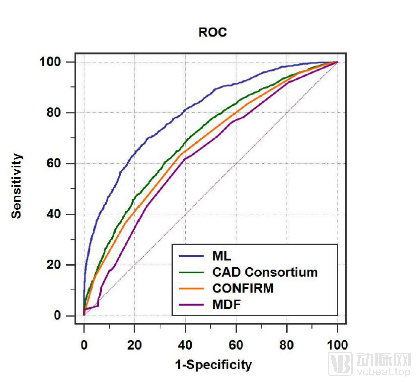
As shown by the ROC curves of the four models, the artificial intelligence machine learning (ML) model demonstrated significantly higher discriminative ability for obstructive CAD (p < 0.001).
Furthermore, the discrepancy (+0.53%) between the AI model’s predictions and the observed prevalence of obstructive CAD was significantly lower than that of the other three methods (MDF: +27.79%; CAD Consortium: −58.61%; CONFIRM score: −29.63%; p < 0.001).
More importantly, in addition to traditional variables, this study incorporated the duration of exposure to conventional risk factors and quantified biochemical outcomes to construct an artificial intelligence model. The study utilized 23 factors to conduct a hypothesis-agnostic exploration of nonlinear patterns across all available data, leveraging these data to generate individualized probabilistic predictions. This approach represents a significant departure from the traditional hypothesis-driven methods used in conventional assessments.
Infervision’s powerful AI research platform, InferScholar Center, along with its team of scientists, provided robust support for this study. The integrated InferScholar Center platform streamlines the entire workflow—from annotation, modeling, and training to data management and computational resource provision—significantly shortening the research cycle while substantially saving physicians’ time and effort. Through InferScholar Center, physicians can achieve highly customized deep learning, machine learning, and omics models across multimodal data such as imaging and text, delivering solid AI-driven research capabilities for all departments and disease types, including thoracic and pulmonary, cardiovascular, neurological, and hepatobiliary conditions.
Leveraging the extensive experience of Director Lü Bin’s team at Fuwai Hospital and Infervision’s cutting-edge medical AI research capabilities, the artificial intelligence model developed in this study demonstrates superior accuracy and discriminative power compared to traditional prediction models such as the MDF recommended by clinical guidelines. Furthermore, it better guides risk assessment and subsequent management decisions, reduces unnecessary downstream examinations, and improves diagnostic yields for both non-invasive and invasive tests. The paper indicates that, compared with the guideline-recommended MDF model, this AI model correctly alters the clinical pathways for 22.2% of patients. Net reclassification improvement analysis reveals that the model can prevent 19.7% of low-risk patients from undergoing unnecessary downstream examinations.