

Yikon Genomics: Empowering Reproductive Genetics with Innovative Technologies, Helping Over 100,000 Families Overcome Fertility Challenges
Dr. Lu Sijia is highly engaging; he likens the three core services in the field of reproductive genetics to seeds, soil, and sunlight, drawing an analogy between all genetic preparations prior to fetal birth and the entire process of sowing and fertilizing carried out by farmers before seeds break through the soil.
Dr. Lu Sijia is the Co-founder and CEO of Yikon GENOMICS. Against the backdrop of China’s national advocacy for eugenics and healthy childbirth, his team serves as “farmers” for millions of Chinese families—screening for high-quality embryos (seeds), identifying suitable endometrial linings (soil), and assessing risks of hereditary diseases in offspring (sunlight).

Dr. Lu Sijia, Co-founder and CEO of Yikon GENOMICS
When discussing the achievements Yikon GENOMICS has made along its journey, they are truly too numerous to list. Yikon GENOMICS has successfully applied its independently developed advanced technologies to the clinical field of reproductive genetics, achieving multiple global firsts and life-saving miracles. For instance: the world’s first IVF baby born after MALBAC-PGD was used to block familial hereditary multiple osteochondromas was delivered at Peking University Third Hospital (2014); the world’s first healthy twins born after MALBAC-PGD was used to prevent familial hereditary deafness were delivered at the Chinese People's Liberation Army General Hospital (2015); the world’s first IVF baby born after NICS (Non-Invasive Chromosomal Screening) technology was used to block balanced translocation was delivered at the Wuxi Maternal and Child Health Care Reproductive Center (2016); the world’s first baby born after MALBAC-PGD was used to block hereditary polycystic kidney disease, in collaboration with Yikon GENOMICS, was delivered at Shanghai Changzheng Hospital (2016); and the world’s first healthy baby born after MaReCs technology was used to prevent the transmission of chromosomal balanced translocation from carrier parents to offspring was delivered at the First Affiliated Hospital of Zhengzhou University.
Blocking the transmission of hereditary multiple exostoses, spinal muscular atrophy, and congenital multiple arthrogryposis... To date, Yikon GENOMICS has successfully prevented the familial transmission of over 400 monogenic disorders, resolving reproductive challenges for more than 100,000 families affected by genetic diseases or infertility. As a third-party medical laboratory, Yikon GENOMICS has made its unique contribution to China’s eugenics and healthy birth initiatives, earning widespread coverage from prominent domestic media outlets such as CCTV.
Tracing the Origins: VCBeat Interviews Dr. Lu Sijia, Co-Founder of Yikon GENOMICS, to Review the Company’s Development Journey, Its Rise as a Leader in Reproductive Genetics, and Its Core Products and Recent Developments
Harvard University Research Achieves Precise Linear Amplification of Single-Cell Whole Genomes
In 2007, WuXi AppTec went public in the United States, and Alibaba appointed its current CEO, Daniel Zhang. At that time, Dr. Lu Sijia, CEO of Yikon Genomics, was conducting research on single-cell amplification technology at Harvard University under her mentor, Professor Xie Xiaoliang, an academician of the U.S. National Academy of Sciences (currently Dean of the School of Life Sciences at Peking University and Director of the Beijing Advanced Innovation Center for Genomics at Peking University). It was this experience that endowed Yikon Genomics with its initial valuable asset—the MALBAC technology.
MALBAC is a single-cell whole-genome amplification technology, with its full name being “Multiple Annealing and Looping-based Amplification Cycles.” First published in Science magazine in 2012, it has been hailed as “the most advanced whole-genome amplification technology” and was recognized by the journal as one of the six most promising scientific breakthroughs of 2013. It has subsequently been featured in top-tier scientific journals such as Cell and PNAS.
During traditional whole-genome amplification, any minor errors occurring during replication are continuously amplified in subsequent exponential replication cycles, ultimately making it impossible to distinguish whether such errors originated from the “copy” or the “parental template.” In contrast, MALBAC technology avoids this pitfall by employing a unique DNA polymerase with strand-displacement activity for quasi-linear pre-amplification of the whole genome. This step locks in the replication of copies, which are then subjected to exponential amplification via PCR. This ensures that all resulting copies derive exclusively from the parental template, thereby significantly reducing the probability of erroneous replication during amplification.
“Any great invention may stem from a simple idea, and this holds true for the development of MALBAC technology. ‘Frankly speaking, our initial motivation in developing MALBAC was not to address the challenges faced by patients with genetic disorders, but rather to push next-generation sequencing technology to its limits—specifically, to achieve more accurate whole-genome sequencing of single cells and ensure sufficient precision even when sample quantities are extremely limited,’ said Dr. Lu Sijia. ‘When the technology was truly developed, its application scenarios proved to be very broad.’”
As one of the inventors of the MALBAC technology, Dr. Lu Sijia was eager to translate this innovation into practical applications for public benefit. How could it be more closely aligned with human health? Fortuitously, Dr. Lu encountered Professor Qiao Jie from Peking University Third Hospital. Inspired by Professor Qiao, he decided to apply MALBAC technology to the field of reproductive genetics, aiming to assist tens of millions of genetic disease patients in China and prevent the birth of children affected by hereditary disorders.
In 2012, Yikon GENOMICS was established and obtained the exclusive global license for MALBAC technology. Facing the challenge of analyzing 3 billion DNA base pairs in a single human cell, MALBAC technology achieves higher amplification accuracy compared to other whole-genome amplification technologies available on the market. It enables 93% coverage in single tumor cell DNA detection, whereas conventional amplification techniques only achieve 50%–70% coverage.
The Story of Seeds, Soil, and Sunlight: Focusing on the Reproductive Genetics Industry, with Business Expansion to Over 20 Countries
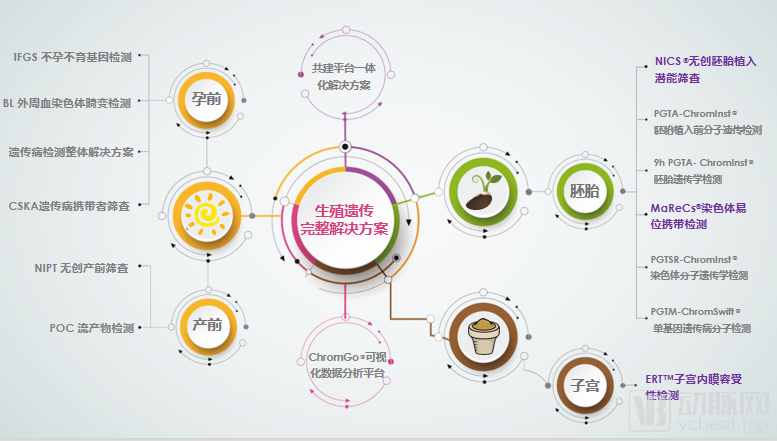
Schematic Diagram of Yikon GENOMICS' Comprehensive Solution for Reproductive Genetics
“Yikon GENOMICS’ strategic layout in the field of reproductive genetics is centered around the ‘seed’,” said Dr. Lu Sijia. The term “seed” refers to embryo screening: for families with a history of genetic diseases, genetic testing for specific disorders is conducted; for families without such a history, individual carrier screening is performed. Yikon GENOMICS’ ultimate goal is to help couples select a healthy zygote free from genetic diseases for embryo transfer, thereby improving the success rate of assisted reproductive technology (ART), reducing the risk of various diseases, and ultimately achieving eugenics and healthy childbirth.
Furthermore, Yikon GENOMICS has independently developed the NICS (Non-Invasive Chromosomal Screening) technology for assessing embryo implantation potential. This technique performs non-invasive testing by analyzing embryo culture media, achieving a detection success rate close to 100%. By leveraging the high-sensitivity ChromInst single-cell one-step library preparation reagent and the ChromGo automated visualization analysis software, the technology can deliver results in as little as 7.5 hours, significantly reducing patient waiting times. Notably, through machine learning and AI analysis of large-scale sample data, we can assign scores and ratings to embryos, with higher scores indicating greater implantation potential. During pre-implantation chromosomal screening, the negative predictive value exceeds 90%, while in chromosomal diagnosis, it surpasses 97%. The advent of NICS has substantially reduced the operational time and risks associated with pre-transplant screening, providing a scientific and effective basis for determining the order of embryo transfer.
Notably, on March 15, 2016, the world’s first “test-tube baby” conceived following Non-Invasive Chromosome Screening (NICS) of embryos was born healthy at the Reproductive Medicine Center of Wuxi Maternal and Child Health Care Hospital, with the participation of Yikon GENOMICS. This milestone marked China’s indigenous R&D capabilities as ranking among the world’s leading forces. After three years of technological optimization and data accumulation, clinical research findings on NICS have been successively published in prestigious international academic journals, including *PNAS*, earning widespread acclaim from experts and scholars both domestically and internationally. To promote standardized implementation of this technology, a multicenter clinical trial for the NICS non-invasive embryo chromosome testing technique, led by Professor Qiao Jie’s team from Peking University Third Hospital and jointly participated in by Yikon GENOMICS, is about to be launched. Currently, the company’s NICS testing services have successfully expanded to 12 countries, serving over 1,000 families each month.
Building on its core “seed” concept, Yikon GENOMICS has expanded its offerings to include preimplantation endometrial receptivity testing (the “soil” for the seed), assessments of patients’ risks for genetic disorders and infertility (the “sunlight” for the seed), and an integrated solution for tumor screening that guides personalized medication and enables familial risk interruption.
Prior to embryo transfer, Yikon GENOMICS conducts genetic disease screening for couples, enabling them to gain a clear understanding of their respective risks and thereby select an appropriate assisted reproductive technology (ART) plan. Subsequently, endometrial receptivity is assessed, as this factor is critical to the success of embryo transfer. “Embryo implantation follows a cyclical pattern, and the window of implantation is not fixed,” explained Dr. Lu Sijia. “By evaluating endometrial receptivity, we can accurately determine the optimal implantation window, guide the timing of embryo transfer, and improve the success rate.”
Furthermore, Yikon GENOMICS has expanded into the field of cancer screening, starting with hereditary cancers to help patients undergo genetic screening and prevent the transmission of cancer-predisposing genes to the next generation. For cancer patients who do not pursue reproduction, Yikon GENOMICS collaborates with relevant medical institutions to provide medication guidance based on their specific gene mutations.
To date, Yikon GENOMICS has established collaborations with more than 400 renowned medical institutions both in China and abroad, with its business spanning over 20 countries. We partner with leading domestic reproductive and obstetrics/gynecology hospitals, such as Peking University Third Hospital, the First Affiliated Hospital of Zhengzhou University, the Reproductive Hospital Affiliated to Shandong University, and the Shanghai International Peace Maternity and Child Health Hospital. Yikon GENOMICS provides these partners with embryonic and prenatal testing services, or assists them in jointly establishing relevant testing platforms while offering personnel training support. We are committed to continuously optimizing our testing technologies and operational models to better serve patients.
According to VCBeat’s “2018 Industry Research Report on Assisted Reproductive Technology,” approximately 7.42 million people in China have a potential need for assisted reproductive technology (ART). The existing market size for artificial insemination is estimated at RMB 30 billion, while that for in vitro fertilization (IVF) stands at approximately RMB 542 billion. With the trend toward later ages at first marriage and first childbirth, coupled with the impact of the “two-child” policy and the resulting increase in advanced maternal age, the number of couples requiring ART to conceive is expected to rise significantly in the future. Against this backdrop, the emergence of Yikon GENOMICS aligns well with China’s broader market ecosystem for eugenics and healthy childbearing. The company boasts a strong R&D team with robust capabilities—comprising 78% bachelor’s degree holders, 34% master’s degree holders, and 8% doctoral degree holders—and is committed to expanding its international cooperation.
It is reported that Yikon GENOMICS has completed three rounds of financing, with the most recent being a C-round raise of RMB 220 million in November 2019. Dr. Lu Sijia stated that the company will always adhere to its mission of “Mastering Extraordinary Technology, Empowering Health for Billions,” bringing the benefits of “sunshine, seeds, and soil” to more families in need around the world.