

Cathay Biotech Files for STAR Market IPO, Drawing Attention to Synthetic Biology and Bio-Based Materials
VCBeat has learned that Cathay Biotech submitted its prospectus for listing on the STAR Market on December 10, raising RMB 4.699 billion in this financing round. Cathay Biotech is a high-tech enterprise grounded in disciplines such as synthetic biology, leveraging biomanufacturing technologies to engage in the research and development, production, and sales of novel bio-based materials. The company has mastered a series of biomanufacturing patents, technologies, and processes for the large-scale production of bio-based long-chain dicarboxylic acids, bio-based pentamethylenediamine, and bio-based polyamides.
As a revolutionary production paradigm, biomanufacturing utilizes biomass as raw materials or employs biological methods for large-scale material processing and transformation, providing industrial commodities (such as new material products) for societal development. This process is characterized by its environmental friendliness, mild reaction conditions, and economic viability. By replacing chemical synthesis with biological production, biomanufacturing offers an effective solution to humanity’s excessive reliance on traditional petrochemical and chemical products, as well as associated challenges such as environmental pollution and safety risks, thereby holding immense potential for future growth.
Traditional petrochemical and chemical production activities have led to the continuous depletion of fossil resources, with human reliance on these resources growing day by day. Meanwhile, environmental pollution and safety risks have increasingly become matters of significant societal concern. Against this backdrop, synthetic biology emerged in the early 21st century, following the rise of genomics and systems biology in the 1990s. By integrating engineering principles and strategies into modern biology and systems biology, scientists have fostered the development of synthetic biology—a highly interdisciplinary field that has become one of the most rapidly advancing emerging frontiers in recent years.
Cathay Biotech — A Star Enterprise in the Field of Synthetic Biology
Cathay Biotech’s currently commercialized products are primarily focused on the polyamide industry chain, encompassing bio-based polyamides and raw materials for their production, including bio-based long-chain dicarboxylic acids such as DC12 (dodecanedioic acid) and DC13 (brassylic acid), as well as bio-based pentamethylenediamine. The company is one of the global leaders in the large-scale biological manufacturing of novel materials.
The polymerization of dicarboxylic acids and diamines yields polyamides, which also serve as synthetic raw materials for fragrances, hot-melt adhesives, lubricants, coatings, and other applications. Currently, the company’s bio-based long-chain dicarboxylic acid series, bio-based pentamethylenediamine, and bio-based polyamide products—developed along the polyamide industry chain—are widely used in automotive, electronics and electrical appliances, textiles, pharmaceuticals, fragrances, and other sectors. The company has established strong business partnerships with internationally renowned enterprises such as DuPont, EMS-Grivory, Evonik, and Novo Nordisk. Cathay Biotech’s bio-based long-chain dicarboxylic acid series holds a dominant position in the global market and was recognized as a “Manufacturing Single Champion” by the Ministry of Industry and Information Technology in 2018.
Cathay Biotech is currently in a period of rapid development, with multiple capacity expansion projects under construction or planned for implementation. These include the 40,000-ton-per-year bio-based sebacic acid project by Jinxiang Cathay and the 30,000-ton long-chain dicarboxylic acids and 20,000-ton long-chain polyamides project by Wusu Technology. As of the date of signing the prospectus, Cathay Biotech’s bio-based pentamethylenediamine (currently used primarily internally as a monomer for the company’s bio-based polyamide production, with partial supply to downstream customers for application development) and bio-based polyamide products have completed pilot-scale trials. The large-scale production lines at the Wusu plant are undergoing equipment commissioning. The mass production of these products is expected to resolve the bottleneck of reliance on imports for core raw materials in China’s diamine-based polyamide industry, providing the market and customers with new “bio-manufactured” materials derived from renewable biomass resources.
Cathay Biotech, established in 2000, has accumulated extensive experience in the field of bio-manufacturing through nearly two decades of R&D investment and technological expertise. It has developed into a globally renowned platform for the research, development, and manufacturing of theoretical technologies and industrialization methods in bio-manufacturing. The company boasts R&D teams specializing in synthetic biology, cell engineering, biochemical engineering, polymer materials, and engineering, and holds hundreds of patents. Cathay Biotech’s core products, including bio-based long-chain dicarboxylic acids, bio-based pentamethylenediamine, and bio-based polyamides, are all bio-manufactured materials.
The actual controller of Cathay Biotech is Liu Xiucai, who collectively holds a 31.50% equity interest in the company. Mr. Liu holds a Bachelor of Science degree from the Department of Modern Chemistry at the University of Science and Technology of China (USTC), a Master of Science degree from the Institute of Soil Science, Chinese Academy of Sciences, and pursued doctoral studies at USTC. He earned his Ph.D. in Biochemistry from the University of Wisconsin–Milwaukee, and completed postdoctoral fellowships in the Department of Pharmacology at Yale School of Medicine and in the Department of Biochemistry and Biophysics at Columbia University Vagelos College of Physicians and Surgeons. From July 1994 to December 1996, Mr. Liu served as Chief Executive Officer of Peking University Sifang Biomedicine Co., Ltd. and as a postdoctoral supervisor at Peking University, where he conducted mechanistic research on anti-liver cirrhosis, anti-sepsis, and anti-cancer drugs. From April 1997 to April 2011, he served as Chairman of Beijing Cathay Biotechnology Co., Ltd. (the predecessor of Shanghai Taitexian). From November 2000 to August 2019, he served as Chairman and Chief Executive Officer of Cathay Biotech Limited. Since August 2019, he has been serving as Chairman and President of Cathay Biotech.
Cathay Biotech has accumulated extensive R&D achievements in disciplines such as synthetic biology, cell engineering, biotechnology, and polymer materials and engineering. Furthermore, the company has gained substantial experience through trial-and-error processes in industrialization, which effectively reduces subsequent R&D costs. In terms of patented technologies, Cathay Biotech has achieved significant breakthroughs by leveraging modern genetic engineering editing tools (such as CRISPR/Cas9) in areas including industrial microbial metabolic pathway engineering, microbial metabolic regulation, high-efficiency microbial conversion technologies, separation and purification technologies for bioconversion/fermentation systems, polymerization processes, and downstream application development.
Traditional specialty polyamides on the market are predominantly composed of even-numbered carbon chains, offering excellent corrosion resistance and low-temperature performance, along with high product added value. The primary raw material for bio-based pentamethylenediamine is starch-containing crops such as corn. Cathay Biotech has developed long-chain polyamide 5X based on its proprietary bio-based pentamethylenediamine, breakthroughly introducing odd-carbon diamines. This alteration in molecular structure leads to changes in hydrogen bonding, thereby enhancing performance. Furthermore, high-temperature polyamide products derived from long-chain dicarboxylic acids are expected to address challenges in material processing, demonstrating strong competitiveness. By leveraging Cathay Biotech’s proprietary dicarboxylic acids and pentamethylenediamine, polyamide 5X with diverse performance characteristics can be synthesized through polycondensation. The company is currently expanding its production capacity for bio-based long-chain polyamide 5X.
Long-chain dicarboxylic acids have traditionally been produced primarily through chemical methods. Cathay Biotech produces its series of long-chain dicarboxylic acid products using biosynthesis, which not only meets the quality standards required for downstream polymerization but also offers significant advantages in cost-effectiveness and environmental sustainability. The primary raw material for bio-based long-chain dicarboxylic acids is alkanes, which are mainly sourced through three methods: petroleum extraction, vegetable oil extraction, and coal-to-liquids technology. In recent years, traditional chemically synthesized long-chain dicarboxylic acids (primarily dodecanedioic acid, DC12), represented by Invista, have gradually exited the market. Cathay Biotech has increasingly dominated the market with its bio-based production of long-chain dicarboxylic acids and has established strong, stable partnerships with major downstream customers, including DuPont, EMS-Chemie, Evonik, and Novo Nordisk.
Cathay Biotech Revenue Data
Cathay Biotech’s core products focus on the polyamide industry chain. Its bio-based long-chain dicarboxylic acid series primarily includes dicarboxylic acid monomers with varying carbon chain lengths, as well as mixed acids composed of several monomers. The bio-based polyamides are predominantly PA56, and also include high-performance long-chain polyamides such as PA510 and PA512.
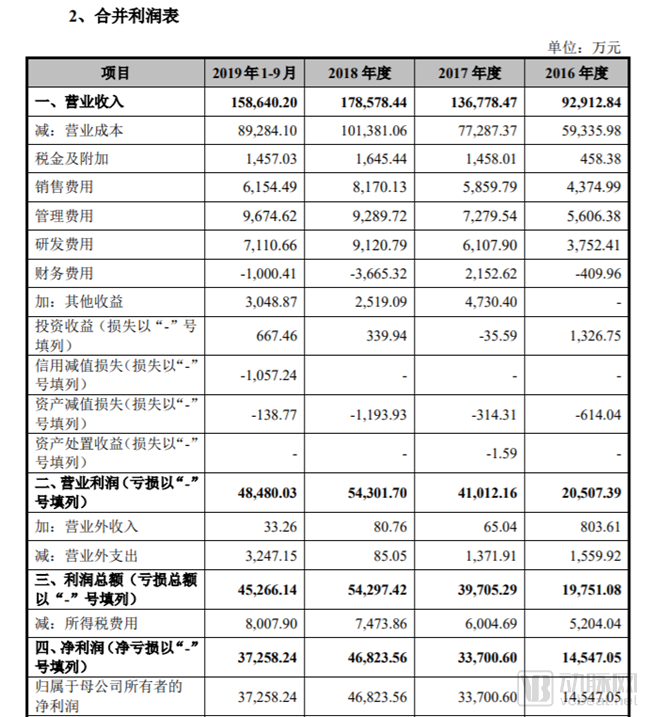
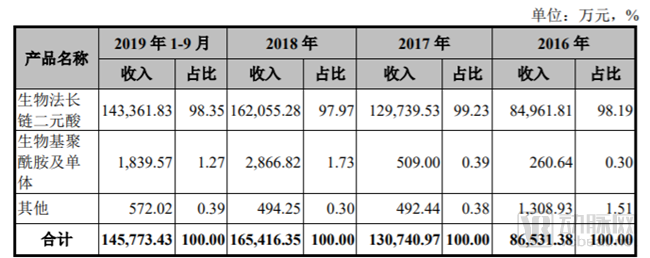
As disclosed in the prospectus, Cathay Biotech generated operating revenues of RMB 929.1284 million, RMB 1,367.7847 million, RMB 1,785.7844 million, and RMB 1,586.402 million in 2016, 2017, 2018, and January–June 2019, respectively, with net profits of RMB 145.4705 million, RMB 337.006 million, RMB 468.2356 million, and RMB 372.5824 million, respectively. Bio-based long-chain dicarboxylic acids constitute the primary revenue source for Cathay Biotech, accounting for 98.35% of sales in January–September 2019.
The biomanufacturing industry is technology-intensive. Companies operating in this sector must maintain experienced R&D and technical teams across disciplines such as synthetic biology, cell engineering, bioprocess engineering, and polymer materials and engineering. During the scale-up for industrial production, key technical challenges include optimizing processes, developing large-scale production equipment, and enhancing both economic efficiency and environmental sustainability. With the rapid advancement of modern biotechnology, significant progress and major breakthroughs have been achieved in fields including synthetic biology, cell engineering, and bioprocess engineering. In the long term, biomanufacturing, as a revolutionary production paradigm, will gain further market recognition and demand.