

Aibo Medical's IPO Application Accepted: Domestic High-End Intraocular Lenses Break International Monopoly
On December 10, 2019, the listing application submitted to the STAR Market by Aierbo Nuode (Beijing) Medical Technology Co., Ltd. (hereinafter referred to as “Aierbo Nuode”), an ophthalmic medical device company, was accepted. Aierbo Nuode’s products cover two major fields: surgical and optometric. The company has mastered core technologies for intraocular lenses (IOLs) and possesses complete independent intellectual property rights, with all R&D and production processes completed domestically. This has broken the monopoly held by international manufacturers in the technology and market for high-end intraocular lenses.
As Aierbode’s competitors are primarily foreign companies, its products offer a higher cost-performance ratio compared to imported alternatives, enabling rapid market penetration; the company has already achieved profitability.
Aierbode was founded by Dr. Xie Jiangbing, a distinguished expert under Beijing’s “Haiju Project,” and specializes in the independent research and development, manufacturing, sales, and related services of ophthalmic medical devices.
Jie Jiangbing holds a Master’s degree in Chemical Fiber Engineering from Donghua University and a Ph.D. in Agricultural and Environmental Chemistry from the University of California, Davis. He serves as the principal investigator for the National Key R&D Program of the Ministry of Science and Technology, as well as for multiple major national and Beijing municipal research projects. He is a distinguished expert under Beijing’s “Haiju Engineering” program and Vice Chairman of the Ophthalmology Branch of the China Medical Equipment Association.
Jiangbing Jie previously served as a Postdoctoral Research Fellow at Lawrence Berkeley National Laboratory, Senior Scientist at Abbott Medical Optics (AMO), and Principal Scientist at AbbVie.
In April 2010, Mr. Xie Jiangbing founded Aibo Limited (the predecessor of Aier Medical). From April 2010 to June 2019, he served as Chairman and General Manager of Aibo Limited. Since June 2019, he has been serving as Chairman, General Manager, and Chief Scientist of the Company, taking full responsibility for its operation and management.
Since its inception, Aierbo Nuode has successively secured venture capital investments from renowned domestic and international institutions, including Tsinghua Tus-Holdings Venture Capital Fund, Fidelity Investments (USA), and the Yingfu Taike National Emerging Industry Venture Capital Guidance Fund.
However, the medical device industry is characterized by long development cycles and is both technology- and capital-intensive. Substantial financial investment is required throughout the entire product lifecycle, including research and development, clinical trials, product registration, manufacturing, and market promotion. The scale of available capital directly impacts a company’s production capacity and economies of scale. There remains significant room for growth in the Company’s current business operations, necessitating expansion of business scale, diversification of business scope, and development of sales channels.
Currently, the reliance on a single financing channel is insufficient to meet the substantial capital investment required for the company’s future development. The company needs to actively diversify its financing sources to satisfy the funding demands of its business expansion, thereby achieving its projected business development goals more rapidly.
The funds raised in this offering will be primarily used for projects to expand production capacity and enhance automation for ophthalmic lenses and related products, R&D and experimental projects for high-end ophthalmic medical devices and high-value consumables, and the development of Aierbode’s marketing network and information systems.
Aibonode’s main products cover two major fields: surgical and vision care, primarily targeting cataracts and refractive errors, the two leading causes of blindness and visual impairment. Currently, Aibonode’s surgical product portfolio includes various intraocular lenses (IOLs), capsular tension rings, IOL implantation systems, ophthalmic viscoelastic devices, microsurgical instruments for ophthalmology, and ophthalmic surgical blades; its vision care products include orthokeratology lenses (overnight wear), rigid gas permeable contact lenses (daily wear), and tear film test strips.
Among these, the core product in the surgical field is intraocular lenses (IOLs), while the core product in the optometry field is orthokeratology lenses (OK lenses), along with a series of supporting products developed and manufactured around these two core offerings.
High-End Intraocular Lenses Break the Monopoly of International Manufacturers
Aierbode is the first domestic manufacturer of high-end refractive intraocular lenses (IOLs) and one of the largest manufacturers of foldable IOLs in China in terms of production and sales volume. Possessing core technologies for IOLs and complete independent intellectual property rights, the company has mastered key technologies including material preparation, optical and structural design, and process manufacturing. By completing the entire R&D and production process domestically, Aierbode has broken the monopoly held by international manufacturers in the technology and market for high-end IOLs.
Since the Company launched China’s first foldable aspheric intraocular lens (IOL) in July 2014, its IOL product portfolio has expanded to include 19 models. Among these, the toric IOL, recognized as an “innovative product,” has received registration approval from the National Medical Products Administration (NMPA). The NMPA stated on its official website that this product is “a first among domestically produced IOLs and represents a significant advancement for Chinese medical devices in the high-end IOL sector.” The Company’s patent for a posterior chamber intraocular lens (Patent No. ZL201210017055.4) was awarded the “Excellence Award” at the 21st China Patent Awards.
Since the launch of the company’s intraocular lens (IOL) products, they have been adopted by more than 1,000 hospitals across over 30 provinces, autonomous regions, and municipalities directly under the central government in China. The products have also been exported to countries including Germany, France, the Netherlands, Italy, Austria, Luxembourg, Thailand, and Pakistan, with cumulative sales nearing one million units.
Since 2015, the company’s products have been frequently selected for the “Bright Journey” medical aid initiative launched by the Chinese government in Africa and Belt and Road Initiative (BRI) countries, restoring vision to patients in more than 20 nations and breaking the previous reliance on imported intraocular lenses in China’s overseas cataract treatment assistance programs.
Orthokeratology Lenses Granted Invention Patents in China and the United States
In March 2019, Aierbode obtained the product registration certificate for orthokeratology lenses, becoming the second manufacturer in China to secure such certification.
Orthokeratology lenses are another core product developed by the company based on its intraocular lens technology. The company has innovatively designed and manufactured orthokeratology lenses with aspheric base curves, aiming to leverage the "peripheral defocus" effect of the aspheric design to better slow the progression of myopia. This design method has already been granted invention patents in China and the United States, while patent applications in Europe, Asia, and other countries and regions are currently undergoing substantive examination.
Orthokeratology lenses hold strong market prospects in addressing the increasingly severe issue of myopia among adolescents. Building on the company’s established ophthalmic sales channels, marketing and sales efforts for this product are rapidly expanding.
It is worth noting that in the years following the introduction of orthokeratology lenses to China in 1998, serious adverse events occurred due to non-standardized fitting practices and inadequate hygiene care by wearers. In response, the former State Food and Drug Administration and the Ministry of Health issued a series of laws and regulations to strictly regulate orthokeratology as a medical procedure. Consequently, enterprises and the industry place high importance on the quality and safe use of orthokeratology lenses.
Aierbode prioritizes R&D innovation, consistently investing in product development and technological advancement. While solidifying its leading position in domestically produced intraocular lens technology, the company continuously expands its product portfolio to develop a comprehensive range of ophthalmic medical products, including implantable ophthalmic consumables, surgical instruments, surgical equipment, vision care products, and ophthalmic pharmaceuticals. These offerings cover various fields such as cataracts, refractive errors, glaucoma, and fundus diseases, thereby enhancing the value of Chinese independent brands. Consequently, Aierbode maintains a high proportion of R&D expenditure; however, with the successive market launches of its core products, its R&D costs have been gradually decreasing in recent years.
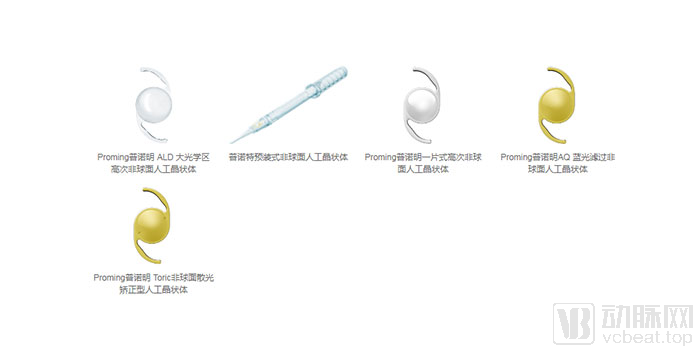
Aierbode's Intraocular Lens Products, Source: Company Official Website
Aierbode’s intraocular lens (IOL) products offer a high cost-performance ratio, with technology reaching internationally advanced levels. Priced significantly lower than comparable imported products and backed by independent intellectual property rights, these products align with China’s policy direction for healthcare reform of high-value medical consumables, thereby holding a competitive advantage in bidding processes at all levels.
The Company has established and implemented stringent quality control procedures in accordance with relevant standards across all stages, including research and development, clinical trials and regulatory registration, procurement, manufacturing, sales, and after-sales services. Its products demonstrate reliable and consistent quality, have gained widespread recognition from clinicians since market launch, rapidly captured market share, and broken the monopoly held by imported products in the mid-to-high-end intraocular lens (IOL) sector.
Furthermore, Aibonode’s intraocular lenses (IOLs), designed based on the Q-value of the Chinese cornea, have been optimized for aberration correction, making them more suitable for Chinese patients. The company’s orthokeratology lenses feature an innovative aspheric base curve design with global patent coverage, providing optimized peripheral defocus to achieve more stable myopia control.
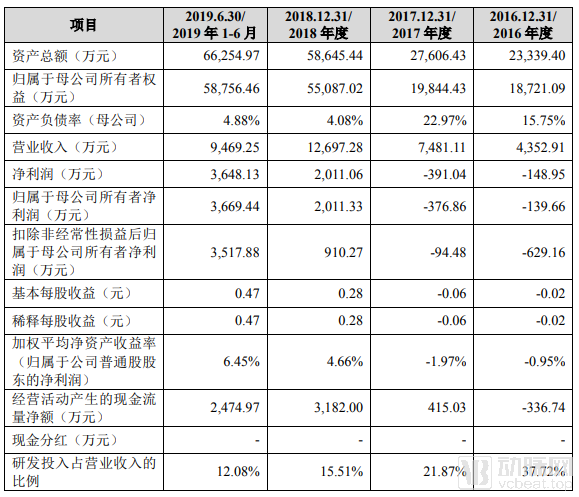
Aierbode’s Financial Data, Source: Prospectus
In 2018, Aierbo Nuode achieved a net profit of RMB 20.11 million. However, the accumulated deficit on the consolidated financial statements at the end of 2018 stood at RMB 13.11 million, primarily attributable to operating losses incurred from sales channel development and continuous R&D investment since the company’s inception, as well as share-based payment expenses. In the first half of 2019, the company reported a net profit of RMB 36.48 million. Nevertheless, as of the end of June 2019, there was an accumulated deficit of RMB 18.81 million on the consolidated financial statements. This was mainly because, upon the parent company’s restructuring into a joint-stock limited company, its retained earnings were transferred to capital reserves, and unrealized internal gains were reversed in the consolidation process, resulting in cumulative accumulated deficits on the consolidated financial statements at the reporting date.
Meanwhile, Aierbo Medical has established long-term collaborations with large medical institutions and medical device distribution companies. Huaxia Eye Hospital Group and its subsidiaries are among Aierbo Medical’s key customers. In 2017, 2018, and the first half of 2019 (January–June), sales revenue generated from Huaxia Eye amounted to RMB 4.06 million, RMB 11.04 million, and RMB 5.44 million, respectively, accounting for 5%–9% of the company’s total operating revenue during the corresponding periods.
China is one of the countries with the largest number of blind and visually impaired individuals worldwide. The number of outpatient and emergency visits to hospital ophthalmology departments rose from 66.43 million in 2011 to 103.60 million in 2017, representing a compound annual growth rate (CAGR) of 7.69%. Currently, the prevalence of age-related eye diseases is increasing, problems such as refractive errors among adolescents are becoming increasingly prominent, and cataract-induced blindness among the impoverished rural population has not yet been fully resolved. Issues such as insufficient total volume, suboptimal quality, and uneven distribution of ophthalmic medical resources persist, and primary eye care services still need to be strengthened. With improvements in living standards, consumer demand in the field of optometry and vision care is also growing.
The “Outline of the Healthy China 2030 Plan” proposes strengthening innovation capabilities in high-end patented medical devices, vigorously developing high-performance medical devices, accelerating the transformation and upgrading of the medical device industry, and enhancing the international competitiveness of medical diagnostic and therapeutic equipment and medical materials with independent intellectual property rights. It calls for improving the quality standard system, advancing quality control technologies, and implementing green and intelligent upgrades, so that by 2030, the quality standards for pharmaceuticals and medical devices will be fully aligned with international standards.
Meanwhile, intraocular lens products are classified as high-value medical consumables. The procurement and usage management of high-value medical consumables is one of the key areas of healthcare reform. In July 2019, the State Council specifically issued the "Reform Plan for the Governance of High-Value Medical Consumables." The overall requirements of the high-value consumables reform are to rationalize the pricing system for high-value medical consumables, purify the market environment for high-value medical consumables and the practice environment for medical services, and support domestically produced high-value medical consumables with independent intellectual property rights in enhancing their core competitiveness.
The policy environment will generally favor domestic manufacturers of mid-to-high-end intraocular lenses (IOLs) that offer technological sophistication, superior product quality, and price advantages, presenting a prime opportunity to achieve volume growth through competitive pricing and accelerate import substitution.
Currently, the leading advanced technologies for intraocular lenses (IOLs) are dominated by four major international ophthalmic medical device companies—Alcon (USA), Johnson & Johnson (USA), Bausch + Lomb (USA), and Zeiss (Germany)—which also hold the majority share of the global IOL market.
Aibonuo’s main competitors in the orthokeratology lens market include: Euclid Systems Corporation (Euclid) from the United States, Alpha Corporation from Japan, Lucid Korea Co., Ltd. (Lucid) from South Korea, CooperCompanies Inc. (CooperVision) from the United States, and Autek China from China.
The intraocular lens (IOL) industry remains in a development stage characterized by the dominance of imported brands, which hold the vast majority of market share, and a low localization rate. Aibonuode’s primary competitors are foreign enterprises; as one of the earlier entrants in this field within China, the company enjoys favorable market prospects.
Aibo Medical’s medium- to long-term development goal is to develop a comprehensive portfolio of ophthalmic medical products, including implantable ophthalmic consumables, surgical instruments, surgical equipment, vision care products, and ophthalmic pharmaceuticals. Covering a wide range of conditions such as cataracts, refractive errors, glaucoma, and fundus diseases, the company aims to become an innovative leading enterprise in China’s ophthalmic medical sector.