

Global Leader in Long-Chain Dicarboxylic Acids Files for STAR Market Listing: KaiSheng Biosciences Emerges as a Hard-Tech Powerhouse
On December 10, 2019, the Shanghai Stock Exchange’s STAR Market officially accepted the prospectus submitted by Cathay Biotech, signaling that the board may soon welcome another hard-tech company in the biotechnology sector. Cathay Biotech is a high-tech enterprise grounded in disciplines such as synthetic biology. Its projects that have achieved large-scale industrialization include long-chain dicarboxylic acids, bio-based pentamethylenediamine, and bio-based polyamides. The company’s industrialization development platform encompasses research in specialized fields such as molecular biology, fermentation process engineering, and polymer materials.
It is reported that Cathay Biotech’s long-chain dicarboxylic acid products have captured 90% of the global market share. Leveraging biosynthesis technology, Cathay Biotech has disrupted the monopoly held by chemical synthesis players represented by Invista, establishing itself as the undisputed leader in the long-chain dicarboxylic acid market.
Liu Xiucai, founder of Cathay Biotech, holds a total of 31.50% equity in Cathay Biotech.Liu Xiucai holds a Bachelor of Science degree from the Department of Modern Chemistry at the University of Science and Technology of China, a Master of Science degree from the Institute of Soil Science, Chinese Academy of Sciences (Nanjing), and pursued doctoral studies at the University of Science and Technology of China. He earned his Ph.D. in Biochemistry from the University of Wisconsin–Milwaukee in the United States, and completed postdoctoral fellowships in the Department of Pharmacology at Yale School of Medicine and in the Department of Biochemistry and Biophysics at Columbia University Vagelos College of Physicians and Surgeons. From July 1994 to December 1996, Mr. Liu served as Chief Executive Officer of Peking University Sifang Biopharmaceutical Co., Ltd. and concurrently as a postdoctoral supervisor at Peking University, where he conducted mechanistic research on anti-liver cirrhosis, anti-sepsis, and anti-cancer drugs. From April 1997 to April 2011, he served as Chairman of Beijing Cathay Biotechnology Inc. (the predecessor of Shanghai Teflon); from November 2000 to August 2019, he served as Chairman and Chief Executive Officer of Cathay Biotech Limited; and since August 2019, he has been serving as Chairman and President of Cathay Biotech.
In 2000, Liu Xiucai, together with Professor Zhang Qixian from the Institute of Microbiology of the Chinese Academy of Sciences and Paul, a U.S. biotech operations expert, founded Cathay Biotech. After achieving a series of technological breakthroughs, Cathay Biotech realized large-scale production of bio-based long-chain dicarboxylic acids within a few years and obtained patent authorization in 2006. Since its inception, the company has received support from well-known domestic and international institutions such as Bio-Venture Capital, HBM Healthcare Investments, and Goldman Sachs.
It is understood that Cathay Biotech has achieved industrial-scale production using biological methods for long-chain dicarboxylic acids, pentamethylenediamine, and bio-based polyamide 56 (derived from pentamethylenediamine and adipic acid). The company is currently the first globally to possess large-scale production capacity for 1,5-pentamethylenediamine and a full range of bio-based polyamide products based on 1,5-pentamethylenediamine. According to its prospectus, Cathay Biotech reported operating revenues of RMB 929.1284 million, RMB 1.3677847 billion, RMB 1.7857844 billion, and RMB 1.586402 billion for the years 2016–2018 and the first half of 2019, respectively. Its net profits for the same periods were RMB 145.4705 million, RMB 337.006 million, RMB 468.2356 million, and RMB 372.5824 million, respectively.
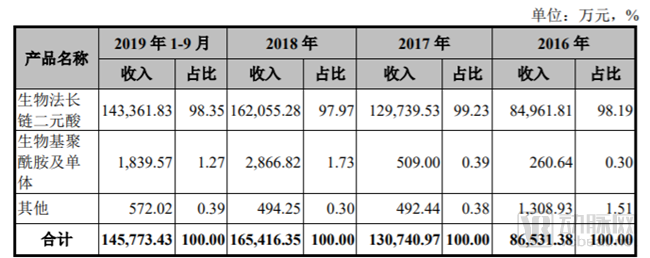
Currently, Cathay Biotech’s product portfolio is primarily divided into three lines: long-chain dicarboxylic acids, pentamethylenediamine, and bio-based polyamide materials, with sales of long-chain dicarboxylic acids serving as the company’s main source of revenue.Sales revenue reached RMB 1.43 billion from January to September 2019, accounting for 98.35% of total product sales during the same period.
Long-chain dicarboxylic acids refer to straight-chain aromatic saturated dicarboxylic acids containing 10 or more carbon atoms. They are an important class of fine chemical intermediates that can be used to synthesize a series of high-value-added specialty chemicals, such as fragrances, pharmaceuticals, specialty nylons, and polyamide hot-melt adhesives. These compounds do not exist in nature and are primarily obtained through chemical or biosynthetic methods. Internationally, chemical production is the predominant method, with major manufacturers including DuPont (USA), Invista (USA/UK), Evonik Degussa (Germany), and Ube Industries (Japan).
With the rapid development of emerging industries such as automotive, electronics, and telecommunications both domestically and internationally, China’s demand for long-chain dicarboxylic acids has been increasing. However, due to the lack of mastery over large-scale production technologies in earlier years, China had long relied on imports for long-chain dicarboxylic acids until Cathay Biotech achieved industrialization of its bio-based long-chain dicarboxylic acid production.
Biosynthesis primarily uses light wax oil (n-alkanes), a petroleum by-product, as the raw material, converting it into long-chain dicarboxylic acids through intracellular enzymatic catalysis. Compared with chemical synthesis, the biosynthetic process is simpler and operates under milder conditions. With high yield, low cost, and minimal environmental pollution, the cost of long-chain dicarboxylic acids produced via biosynthesis has been significantly reduced compared to chemical synthesis following breakthroughs in scalable production.
In 2002, Cathay Biotech constructed the world’s first large-scale production facility for long-chain dicarboxylic acids (LCDAs) using a biological method, achieving large-scale commercial production. In recent years, traditional chemically synthesized LCDAs (primarily dodecanedioic acid [DC12], among others), represented by Invista, have gradually exited the market. At the end of 2015, Invista, a producer of LCDAs via chemical synthesis, announced the closure of its LCDA production line in the United States effective March 2016. Cathay Biotech has since replaced Invista and other chemical synthetic producers, ending their monopoly in the industry.
Cathay Biotech has gradually come to dominate the market with its bio-based production of long-chain dicarboxylic acids, capturing a 90% global market share in this sector. The company has established strong and stable partnerships with major downstream customers, including DuPont, EMS-Chemie, Evonik, and Novo Nordisk. Furthermore, while traditional production of DC10 (sebacic acid) relies on the hydrolysis and cracking of castor oil—a process that poses certain toxicity risks to human health—Cathay Biotech plans to leverage its fundraising investment projects to aggressively expand into the bio-based DC10 (sebacic acid) market, thereby tapping into a market opportunity exceeding 100,000 metric tons for sebacic acid.
Furthermore, due to limitations in synthetic processes, chemical synthesis is currently restricted to producing dodecanedioic acid. By overcoming various shortcomings of chemical synthesis, biosynthesis has enabled the production of dicarboxylic acids with carbon chain lengths ranging from C10 to C18, or virtually any desired chain length. It is understood that Cathay Biotech has become the world’s largest supplier of this product, and the success of this project represents a notable commercial case of bio-based products replacing petrochemical counterparts globally.
In addition to its diverse applications in synthesizing high-performance nylon engineering plastics, premium musk fragrances, paints, coatings, lubricants, and high-temperature dielectrics, it has emerged as a significant player in pharmaceutical development. In recent years, long-chain dicarboxylic acids have demonstrated unique roles and broad prospects in the synthesis of pharmaceutical intermediates, breast cancer diagnostic reagents, drugs for treating skin cancer and AIDS, and the development of novel hypoglycemic agents.
In addition to Cathay Biotech, other manufacturers have announced plans to enter this field this year, such as Xinri Hengli’s planned lauric acid project in Ningxia and Sinopec Qingjiang Petrochemical Co., Ltd.’s long-chain dicarboxylic acid project. However, there is still a significant gap between the production capacity of these projects and Cathay Biotech’s current actual capacity of 50,000 metric tons.
Bio-based pentamethylenediamine is a project that Cathay Biotech has recently brought into production, and the large-scale manufacturing of this product represents a milestone for China’s chemical industry.
In the 1930s, DuPont invented nylon (polyamide, specifically nylon 66), the world’s first synthetic fiber. Nylon 66 is produced by polymerizing two monomers: hexamethylenediamine and adipic acid. However, the production of hexamethylenediamine relies on adiponitrile as a raw material, which has long been monopolized by several multinational corporations abroad. In 2018, global adiponitrile capacity reached 1.746 million metric tons per year, with production totaling 1.41 million metric tons. The production technology for adiponitrile (used to manufacture hexamethylenediamine) is currently controlled by companies such as Invista and Ascend Performance Materials, with Invista being the only company that sells it on a large scale to external parties.
China currently has no operational industrial-scale production facilities for adiponitrile, and domestic demand is met almost entirely through imports. As a critical raw material for the chemical synthesis of hexamethylenediamine, the shortage of adiponitrile severely constrains the development of China’s nylon industry, representing a core bottleneck in the growth of the country’s diamine-based polyamide sector.
In 2014, Cathay Biotech achieved success in the bio-based production of pentamethylenediamine. This bio-based process uses starch-rich crops such as corn as raw materials, offering greater environmental friendliness and renewability compared to chemical synthesis methods. Furthermore, pentamethylenediamine features a higher amine group content and a lower melting point. The resulting bio-based polyamide 56 exhibits superior performance in terms of strength, abrasion resistance, resilience, fatigue resistance, and dyeability. In addition to its use in nylon 56, pentamethylenediamine serves as a raw material for various applications, including fiber spinning, engineering plastics, pharmaceuticals, agrochemicals, and organic synthesis.
At the current stage, Cathay Biotech’s bio-based pentamethylenediamine is primarily used internally or partially supplied to downstream customers for application development. Within the industry, several companies, including Toray Industries and Ajinomoto of Japan, as well as CJ CheilJedang of South Korea and Ningxia Eppen Bioengineering, had previously planned to enter the bio-based pentamethylenediamine market. However, the toxicity of high-concentration pentamethylenediamine to the microorganisms used in biomanufacturing has become a bottleneck for the industrialization of bio-based pentamethylenediamine. To date, none of the aforementioned companies have publicly announced any further progress on their projects.
In the production of bio-based pentamethylenediamine, Cathay Biotech has employed genetic engineering and other techniques to enhance strain tolerance to pentamethylenediamine from multiple perspectives, thereby improving production efficiency and effectively controlling synthesis costs. Currently, Cathay Biotech’s digital factory in Wusu, Xinjiang, has been completed. Upon the commissioning of its bio-based pentamethylenediamine project, it is expected to address the core bottleneck hindering the development of China’s diamine monomer-based polyamide industry: the long-standing shortage of adiponitrile raw material supply.
Bio-based polyamide products are primarily produced through the polycondensation of bio-based pentamethylenediamine, derived from Cathay Biotech’s proprietary assets, with various dicarboxylic acids. This product series has achieved initial scale, mainly comprising PA56, PA510, PA512, and PA514. Currently, the company has collaborated with spinning, fabric, and carpet manufacturers to develop a range of PA56 products, including civil yarns, carpet yarns, and industrial yarns.
Compared with conventional polyamide products, bio-based polyamides offer spinning advantages such as inherent flame retardancy, good moisture absorption, and ease of dyeing. Compared with traditional polymer materials, bio-based materials are both biodegradable and renewable, aligning well with the currently advocated concept of green chemistry. Currently, electronic products such as mobile phones have begun to extensively use recycled materials, and Cathay Biotech provides bioplastics for these electronic products.
In addition, surface coating materials made from pentamethylenediamine are also beginning to shine in the automotive sector, with Audi already adopting this material. In terms of biosynthesis, industry has actually progressed further than we might have imagined.
We have heard it more than once that the 21st century is the century of biology. In addition to the frequent emergence of various biopharmaceuticals and biological therapies, the advent of biosynthetic methods has also overcome many obstacles associated with chemical synthesis.As a revolutionary production paradigm, biomanufacturing utilizes biomass as raw materials or employs biological methods for large-scale material processing and transformation, supplying industrial commodities (such as new material products) to society. This process is characterized by its environmental sustainability, mild operating conditions, and economic viability. By replacing chemical manufacturing processes, biomanufacturing offers an effective solution to humanity’s excessive reliance on traditional petrochemical and chemical products, along with associated challenges such as environmental pollution and safety risks. Consequently, it holds immense potential for future development.
In addition to the aforementioned expansion in the variety of biosynthesized long-chain dicarboxylic acids, a more significant breakthrough in biosynthesis lies in cost reduction. The advent of biosynthetic long-chain dicarboxylic acids has led to a substantial decrease in product prices, thereby driving a considerable expansion of the market size.
Beyond compounds that are difficult to prepare via synthetic chemistry, biosynthesis has also demonstrated its prowess in the realms of raw material manufacturing and new materials. This is evident not only in the fields of long-chain dicarboxylic acids and pentamethylenediamine but also in the hyaluronic acid market, where Bloomage Biotech, leveraging biosynthesis-based technologies, holds a globally leading position within its industry. Overseas, synthetic biology companies such as Twist Bioscience and Ginkgo Bioworks are sparking an investment boom. Influenced by these unicorn enterprises, a cohort of Chinese synthetic biology startups is emerging, focusing either on pharmaceuticals or new materials. These companies aim to expand production and manufacturing possibilities through biosynthesis, offering a novel production and synthesis experience characterized by greater environmental friendliness, energy conservation, and efficiency. Collectively, these enterprises, both large and small, are coalescing into a formidable force, declaring to the world in unison: biosynthesis may well be the future of industry.