

FDA Approves Smart Ingestible Pills for Medication Adherence: 15 Overseas Companies File IPO Prospectuses
In the early days of the digital health boom, VCBeat (WeChat ID: vcbeat) closely monitored medication adherence, a seemingly niche entry point. This year, the medication adherence landscape has seen new developments. On December 6, the U.S. FDA approved the ID-Cap system by etectRx, which leverages sensors to track medication adherence. Meanwhile, the sector has witnessed several recent financing and acquisition activities; for instance, AiCure recently secured $24.5 million in Series C funding. In the following section, we will review the companies operating in the medication adherence space and assess the current state of industry development.
What Is Medication Adherence?
In clinical trials, understanding the timing and frequency of patient medication intake is crucial, as the quality of these data directly impacts the validity and safety of the trial. Inaccurate medication adherence data in many trials can underestimate the efficacy of the investigational drug while overestimating its safety, leading to increased trial costs, prolonged trial duration, and a heightened risk of trial failure.
However, for the following reasons, we remain unaware of the patient's behavior:
- It is difficult to determine whether patients took medication outside the experimental clinic,
- Incomplete medication history,
- Invalid interventions based on flawed data,
- Inadequate patient education and follow-up,
- Duplicate registration and malicious intent.
So, how can we prevent these things from happening?
If trial personnel wish to ascertain what patients are doing after leaving the clinic, they must personally verify the actual medication intake. For instance, trial staff need to verify patient identity to ensure that the registered participant is the same individual who ultimately takes the medication. Furthermore, if data quality is poor or there is a risk of participant dropout, trial personnel must also be able to intervene in patient behavior.
When determining solutions for medication adherence, several practical operational issues must also be considered, including whether changes to the drug manufacturing process are required, trial setup costs, and the speed of trial deployment.
Sensor-Based Monitoring of Medication Adherence Receives FDA Approval
DetectRx is headquartered in Gainesville, Florida, USA. Its ID-Cap system has just received FDA 510(k) clearance. The system features an ingestible capsule that transmits medication adherence event logs to external medical devices after ingestion.
Similar to the system of Proteus Digital Health, a competitor of etectRx, the core of ID-Cap is a standard medication capsule containing a sensor that transmits data upon contact with gastric fluid.
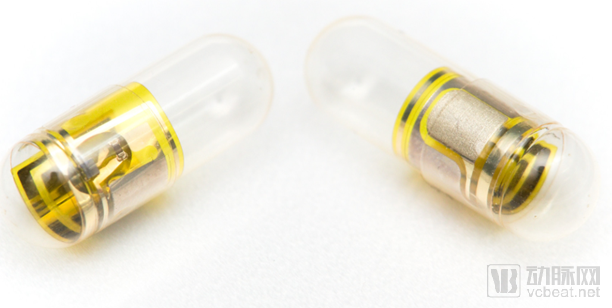
The smart pill approved for etectRx
However, unlike the Proteus system, the ID-Cap system’s receiving device does not need to be adhered to the user’s skin; instead, the sensor can be worn externally. The receiver then transmits data to the patient’s smartphone app, which subsequently uploads the medication adherence data to the system’s website.
Harry Travis, President and CEO of etectRx, once stated, “According to various estimates, medication non-adherence costs patients in the United States between $100 million and $300 million annually, which fully demonstrates the potential of medication adherence tracking technology. This is a tool that can provide clinicians or researchers with highly valuable patient information. These data are intended to accurately confirm that patients have indeed ingested their prescribed medications. We will collaborate with potential partners to ensure that these data can be seamlessly integrated into broader clinical data environments.”
According to the FDA’s 510(k) database, etectRx submitted its application to the FDA in November 2018 and received clearance for its ID-Cap System on December 6 of this year.
Why Is FDA Certification of Human Drug Adherence Systems So Important?
Harry Travis, President and CEO of etectRx, stated that with secure regulatory approval in place, etectRx can now shift its focus to building broader partnerships, including those with pharmaceutical companies, digital health firms, various health associations, clinical research organizations (CROs), and specialty pharmacies. etectRx’s long-term commercialization strategy involves collaborating with these organizations to help them obtain better patient medication adherence data and achieve more accurate research outcomes.
AI-Powered Medication Adherence Monitoring Company Secures Funding
In addition to obtaining FDA approval, companies focused on medication adherence have recently gained recognition in the capital markets. On November 11 this year, AiCure secured $24.5 million in Series C financing. AiCure is a startup with nearly a decade of history, dedicated to using artificial intelligence technology to continuously measure patient medication adherence during clinical trials or routine care.
Palisades Growth Capital led the investment round, which also included new investors Singtel Innov8, Asahi Kasei Corporation, Accelmed Growth Partners, and SpringRock Ventures. All existing institutional investors in the company participated as follow-on investors in this financing round.
Adam Hanina is the CEO of AiCure, a company that leverages advanced facial recognition technology to develop applications for smartphones and tablets, enabling monitoring of patients throughout the entire medication-taking process. Mr. Hanina previously served as a lead expert on medication adherence technologies at the U.S. National Institutes of Health (NIH). He is a passionate advocate for the use of healthcare software as a tool and brings over 16 years of experience in deploying healthcare technologies.
AiCure’s Interactive Medication Assistant (IMA) collects visual and audio data from patients to quantify their engagement with treatment plans, enabling the tool to identify individuals at high risk of discontinuing therapy or exhibiting non-adherence. Meanwhile, pharmaceutical developers can leverage these trends to pinpoint underperforming trial participants, including those who enroll in treatment programs but intentionally fail to participate, thereby reducing clinical trial costs.
AiCure stated that it has filed more than 100 patents and its technology has been deployed in over 25 countries. Although AiCure was founded in 2010, the company did not formally begin seeking venture capital until 2016; prior to securing $12.25 million in Series A financing, it relied on a $7 million grant from the U.S. National Institutes of Health (NIH).
For years, AiCure has released its research and trial data, demonstrating that its technology can improve patient adherence to treatment. Although the company’s approach is quite unique, we have indeed seen other AI-driven solutions in this field, such as those from Pillo and Mabu. Meanwhile, pharmaceutical companies are also seeking out these new technologies to reform traditional clinical trial processes and reduce costs.
In its funding announcement, AiCure stated that the capital would help them “accelerate the deployment of engineering and R&D initiatives to deliver experimental data insights to a broader range of life sciences healthcare companies.”
Industry Benchmark Company Reportedly Facing Funding Shortage Challenges
Of course, in addition to the good news, there was also bad news from this field this month. In early December, it was reported that Proteus Digital Health, a unicorn company in the medication adherence sector, had laid off most of its employees after failing to secure $100 million in financing. In 2017, Proteus announced a partnership with pharmaceutical company Otsuka Pharmaceutical to develop a digital medicine system called Abilify MyCite, which received FDA approval. Abilify MyCite (aripiprazole tablets with sensors) is a drug-device combination product consisting of Otsuka’s oral aripiprazole tablets and an ingestible sensor, along with a signal receiver and application software. It is used to treat patients with schizophrenia, bipolar disorder, and depression, while monitoring their medication adherence. As part of the deal, Otsuka agreed to invest $88 million, including equity stakes and other funds for development.
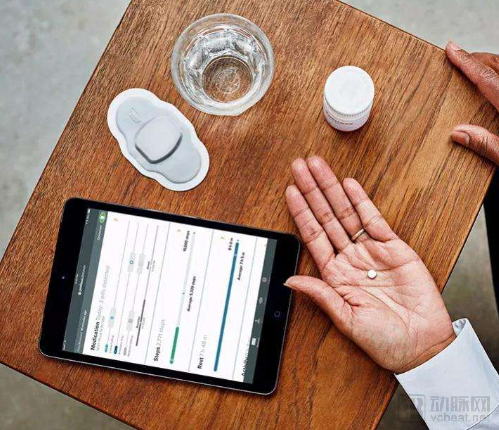
The Abilify MyCite medication adherence tracking system includes a data receiver that adheres to the skin.
Proteus Digital Health was once valued at as high as $1.5 billion, but it struggled to achieve breakthrough success. According to anonymous sources, the issue lay in business partners’ dissatisfaction with the validity of data generated by Proteus Digital Health’s FDA-approved Abilify MyCite product, leading them to terminate their collaborations. The current landscape among competitors may help etectRx secure partnerships. However, in the near future, etectRx may face the same challenges encountered by Proteus Digital Health.
Companies Related to Medication Adherence Products
VCBeat has compiled a list of digital health companies specializing in medication adherence and provided a brief analysis of their developed products. These companies all advocate for the use of innovative approaches, such as sensors, software, mobile technologies, and hardware, to encourage patients to adhere to their treatment regimens.
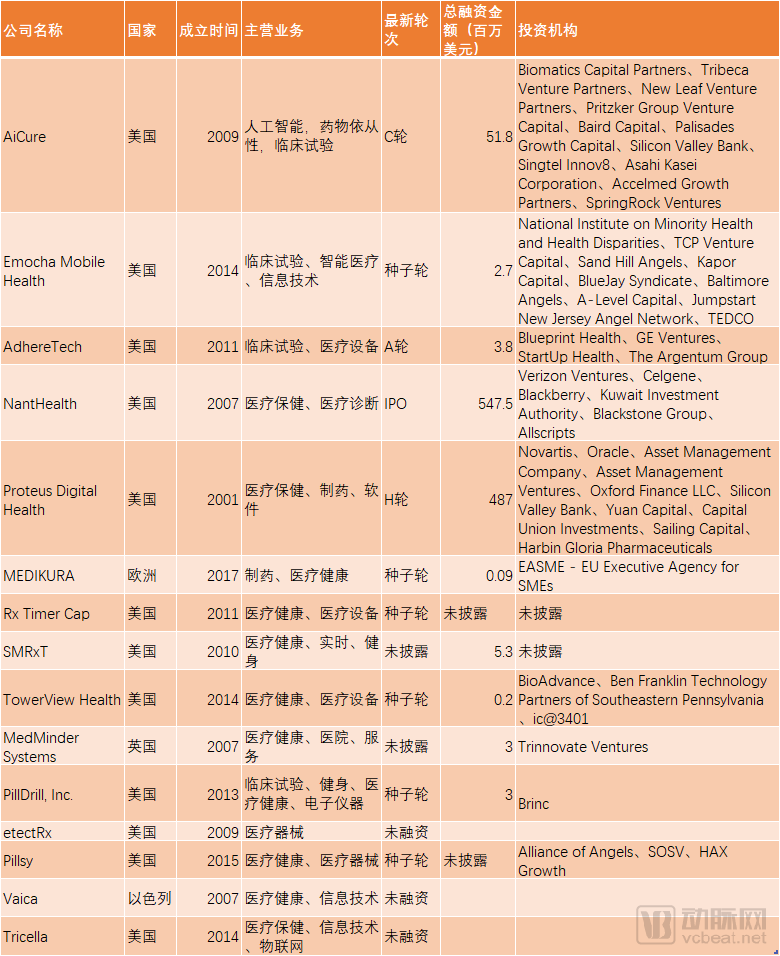
Virtual Observation Therapy (VOT)-Related Companies
Companies adopting Virtual Observed Therapy (VOT) are leveraging facial recognition technology to verify whether patients have actually ingested their medication. Previously, nurses or other healthcare professionals would administer and document patient medication adherence. Currently, VOT serves as an intermediary via smartphone cameras, replacing the need for direct physical observation by healthcare personnel. The benefits of this platform include reducing the costs associated with real-time supervision by medical team members and the documentation of medication intake. Since VOT can be conducted under virtually any circumstances, patients are not required to be hospitalized or visit clinical facilities for medication administration; instead, they can participate in related studies from home, thereby alleviating the logistical and financial burdens on both patients and healthcare institutions. Other similar technologies include Digital Observed Therapy (DOT) and Video Directly Observed Therapy (VDOT).
AiCure
AiCure is one of the main subjects of this article. The company primarily focuses on clinical trials and treatment, offering an AI platform designed to determine when patients actually take their medication. The platform integrates HIPAA-compliant facial recognition and medication identification features. What makes it particularly interesting is its ability to detect whether patients have truly swallowed their medication—for example, by identifying instances where patients may “park” or “hide” pills in their mouths for later consumption or disposal. This is a notable feature. Additionally, all video data can be uploaded synchronously and analyzed subsequently as needed. Much of their research concentrates on early-stage trials, including pharmacokinetic studies, which correlate the presence of drugs in the body with adherence tracking on the platform.
Emocha Mobile Health
Emocha Mobile Health is a Boston-based startup focused on researching medication adherence in patient health, particularly for opioids. The company’s intelligent system includes a HIPAA-compliant mobile application that captures video recordings of patients as they take their medications. These videos are then reviewed to confirm medication ingestion. Additionally, the app enables system control and communication, delivering HIPAA-secure messaging alerts to remind patients to take their medications. A notable potential feature of the app allows patients to simultaneously record any side effects experienced from the medications.
sureAdhere
sureAdhere, a startup based in San Diego, USA, specializes in researching medication adherence in relation to population health outcomes. It received recognition from the U.S. National Institutes of Health (NIH) for its Tuberculosis (TB) Control Program in October 2017. Their platform enables patients to record their medication intake, upload the data to a server, and have it reviewed by healthcare providers, who then document medication adherence. The platform integrates SMS and email notifications to remind patients in case of missed doses, allowing both pharmaceutical companies and healthcare providers to generate reports to review adherence records. Overall, the majority of their research and clinical efforts are focused on tuberculosis, opioid substitution therapy (OST), HIV pre-exposure prophylaxis (PrEP), and hepatitis C.
Sensor-Related Companies
Using sensors to track medication adherence is nothing new, but the technology has only truly matured in the past few years. In 2017, we saw the first drug with an FDA-approved embedded sensor. Currently, there are only two established companies specializing in ingestible biosensors that use their technology to monitor medication adherence. Most companies are applying their technology to capsule sensors containing investigational drugs or attempting to embed sensors into tablets/pills for broader consumer use. Current research efforts are primarily focused on the development and clinical trials of specialty pharmaceuticals.
EtectRx
As previously introduced, EtectRx encapsulates active pharmaceutical ingredients using its ID-Cap system. When a patient swallows a medication containing the microchip, the capsule dissolves, activating the sensor, which then transmits a signal to a reader worn by the patient to track medication adherence. The reader can be easily worn around the neck or attached to the abdomen. Upon receiving the signal, the reader promptly relays information to the physician regarding whether and when the medication was taken, as well as data on drug absorption and metabolism. This enables physicians to gain timely insights into the patient’s medication usage and prescribe treatments accordingly.
Proteus Digital Health
Proteus Digital Health, founded in 2001, has become a unicorn company with cumulative financing of $487 million. Its investors include major corporations such as Novartis and Oracle, as well as Chinese investment firms including Qianyuan Capital, Sail Capital, and Yuheng Pharmaceutical. Recent negative news has also cast a shadow over the prospects of the smart pill sector.
The company’s core product is the Proteus Discover system, a medication management system comprising three components: sensor-enabled smart oral pills, a smart patch, and a mobile app. While these pills are indistinguishable in appearance from conventional pills, they contain a sand-grain-sized sensor internally that monitors how the medication is metabolized and exerts its therapeutic effects within the body. After ingestion, the pill reaches the stomach, where electrodes in the sensor draw power from gastric acid to transmit signals. In conjunction with the skin-worn patch, the sensor measures various physiological parameters—such as heart rate, respiration, body angle, activity levels, and sleep patterns—and transmits this information to the app, which ultimately shares it with the treating physician.
AdhereTech
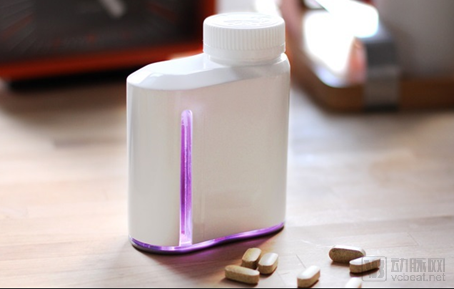
AdhereTech is perhaps one of the most well-known smart pill bottle companies. AdhereTech has launched pill bottles with cellular data capabilities. These bottles can transmit data in real-time when opened. Clinicians can then use this data for patient management. The system also includes SMS and phone reminder services, which can provide real-time assistance to patients based on their medication history. For example, the bottle will automatically light up and emit a beeping sound to remind patients to take their medication on time.
AdhereTech markets its devices as standalone products that do not require synchronization with patients’ mobile applications or other devices, and a single charge lasts for more than six months. Currently, the device is not available for direct-to-consumer (B2C) purchase; instead, it is targeted at health systems and research purposes (B2B). One example is the collaboration between Avella Specialty Pharmacy and AdhereTech to monitor adherence rates for high-cost medications. Frankly speaking, this appears to be the prime niche for any digital health company focused on medication adherence today—specifically within oncology care. Their recent clinical efforts have largely concentrated on specialty markets and chronic conditions, including hepatitis C, cystic fibrosis, and anticoagulation therapy.
NantHealth
NantHealth, founded by Chinese-American scientist Patrick Soon-Shiong, who is hailed as the world’s wealthiest physician, offers a suite of products focused on health data integration, including the smart pill bottle GlowCap. GlowCap has an interesting history: it originated from David Rose’s MIT Media Lab project. David Rose co-founded Ambient Devices, a company dedicated to manufacturing Internet of Things (IoT) devices, and later established Vitality, which specialized in using IoT-enabled smart pill bottles to track medication adherence. Vitality was subsequently acquired by NantHealth. The GlowCap system works with a smart cap installed on medication bottles, sending alerts to patients at the time of their next dose (e.g., audible alarms and color-changing caps). The resulting data can then be shared with the patient’s clinicians or other healthcare team members.
Pillsy
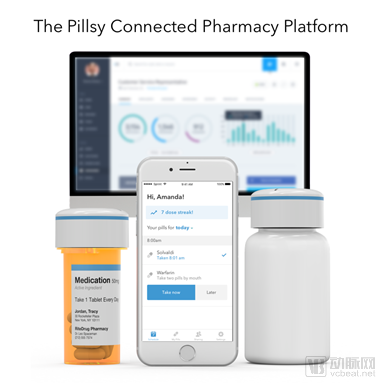
In 2017, Pillsy launched two medication adherence-focused products under the PillsyCap brand: a smart bottle for prescription medications and another for supplements (such as vitamins). PillsyCap supports Bluetooth connectivity and syncs with a mobile app. For instance, when it is time to take medication, the bottle cap emits an audible alert, and the app displays a notification on the patient’s smartphone. This data can also be shared with others, such as family members. Pillsy currently serves both B2B and B2C markets (priced at $39.95 on Amazon).
Rx Timer Cap
Rx Timer Cap has launched the iCa smart pill bottle cap, which syncs via Bluetooth to a mobile app to track medication adherence. They also produce a wirelessly connected pill organizer called iSort (with a 7-day capacity), which can also sync to the app. Both devices issue alerts through the app and the devices themselves to remind patients when to take their medication.
Medikyu
The smart medication bottle caps produced by Medikyu connect to a mobile application. When it is time to take medication, the bottle cap triggers an alert, transmits Bluetooth data to the app, and then uploads it to a cloud server for monitoring by family members. Interestingly (compared to other devices in this field), their business model focuses on subscription services, allowing consumers to join the platform without having to purchase the smart medication bottle.
SMRxT
SMRxT is a company dedicated to improving medication adherence through data analytics. Its product offerings include Nomi, a smart pill bottle. Equipped with multiple sensors, the bottle collects data on medication weight, dosing times, movement, and temperature to study medication adherence. This data can also be shared with clinicians and family members. The bottles are distributed through pharmacies and then delivered to patients, reflecting a B2B business model. Instead of pairing with a patient’s mobile app, the device uses cellular data to transmit information to an online database.
TowerView Health
TowerView acts as a private assistant for the company, connecting drug suppliers, pharmacies, and insurance companies. It then dispenses medications through a smart pillbox. When it is time to take medication, the pillbox emits audible alerts and flashing lights, and sends text message and phone call reminders as needed. Patients can choose to purchase the device ($399.00) or subscribe to a service plan ($39.99/month). The difference is that the subscription service also includes medication delivery and pre-sorting/packaging of drugs, which can then be inserted into the device, eliminating the need for patients to sort their own medications.
MedMinder Systems
MedMinder Systems manufactures several types of smart pill dispensers, such as the “Maya” model with an unlockable design that allows patients unrestricted access, and the “Jon” model with a locking mechanism that opens only according to the patient’s instructions. Each device can be paired with a medical alert feature worn by the patient. Both versions can be loaded with medication by the patients themselves or come pre-filled from pharmacies. These devices are offered as a subscription service, with patients paying a monthly fee for their use.
Vaica
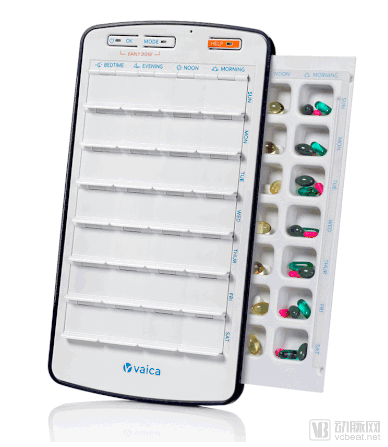
Vaica produces several types of smart pillboxes and packaging. The version best suited for patients is SimpleMed+, a weekly auto-updating pill organizer (28 compartments, with four doses per day across seven days) that can be manually filled or loaded with blister packs. When the next dose is due, an indicator light illuminates and an audible alarm sounds. All adherence data is captured and recorded via a cloud-based platform, allowing clinicians to access and review it. Patients can also sync their data with the company’s app, Medy. Notably, Vaica also manufactures other smart medication devices focused on patient assistance, including smart trays for liquid medications, each holding up to 10 mL.
PillDrill, Inc.
PillDrill, Inc. sells its smart medication manager to patients for $279.00. The system is quite unique as it uses a wirelessly connected hub at home (which lights up and emits an audible alert when a dose is due), and then the patient scans their own medication cup (pre-filled by the patient themselves) to confirm they have taken the correct dose. The cups are arranged in 7 rows and can be freely combined. Additionally, stickers/labels can be placed on other containers (such as injectables, inhalers), which can also be scanned to track adherence. Patients can also use a mobile app and will receive weekly report cards regarding their medication adherence.
Tricella
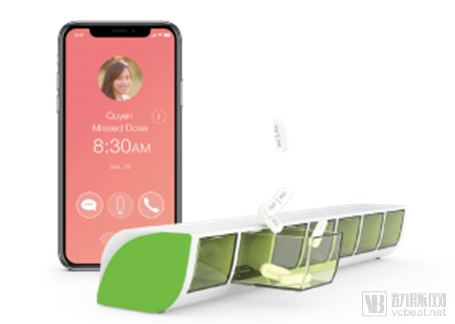
Tricella claims that “pillboxes have gotten smarter,” with its smart pillbox design featuring a unique style. Each pill compartment has a pull-out drawer for storing medication. According to the company’s website, each compartment holds a single dose; if multiple doses are required, multiple compartments are needed. The device is priced at $74.99 per unit. It features Bluetooth connectivity, and data is uploaded via a mobile app.
Summary
Medication adherence is a critical factor influencing healthcare costs, necessitating a more strategic approach to healthcare regulation. Pharmacy leaders must build relationships with patients to extend their services beyond the hospital setting. Crucially, healthcare organizations must collaborate with pharmacy leaders, including pharmacists and general practitioners, to help patients manage self-care at home in a cost-effective manner.
Meanwhile, the rise of technologies such as smartphones is transforming how patients take their medications. Currently, there are more than 20,000 medical or health applications available, at least 200 of which are designed to address medication adherence.
These applications can record patients’ medication schedules, alert them when it is time to take their medications, and remind them when prescription refills are needed. Although these applications may be valuable tools, they rely excessively on patient self-entry.
However, smartphone applications are not the only technology that can assist patients. The numerous smart pill bottles introduced above can detect when medication is removed by using sensors in the cap or by monitoring the weight of the bottle. Of course, more sophisticated technologies are required to monitor whether patients actually ingest the pills after removing them.
Technology can improve people's lives, but when it comes to human health, self-discipline and self-control are the fundamental solutions.
Text and Photos by Zhou Qianyun, Liu Zongyu