

Chaoqian Technology Files IPO Prospectus: Reshaping Traditional Healthcare with 'Medical + Big Data' to Build a Smart Healthcare Platform
Healthcare + Big Data + AI is undoubtedly one of the hottest sectors in the healthcare industry in recent years.
As technologies such as cloud computing, big data, artificial intelligence, and the Internet of Things continue to mature, the Fourth Industrial Revolution, with intelligence at its core, appears to be approaching. Traditional industries are in greater need of empowerment by these emerging technologies to drive the development of new business models and industrial formats. Among them, the healthcare sector, as a cornerstone of public welfare, has taken the lead in big data integration, leveraging favorable policies and capital inflows.
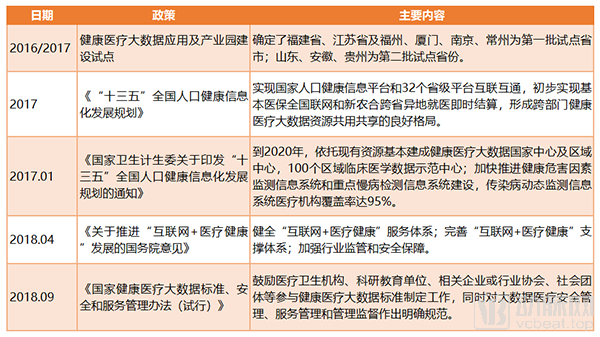
Summary of Policies for the Development of China’s Health and Medical Big Data Industry (2017–2019)
According to data from the China Research Institute for Industrial Development, the market size of China's medical big data industry reached RMB 64.3 billion in 2017, representing a compound annual growth rate (CAGR) of 20% over the five-year period from RMB 33.1 billion in 2013. The Qianzhan Industry Research Institute projects that the scale of China's health and medical big data industry will exceed RMB 80 billion by 2020.
Amid such a vast market capacity, the medical big data sector has become exceptionally hot. According to statistics from Qingtong Capital, as of December 2018, more than 600 startups, 193 financing projects, and over 230 investment institutions had vied to enter the field. Among them is Xi’an Chaoqian Intelligent Technology Co., Ltd. (hereinafter referred to as “Chaoqian Technology”), which is committed to leveraging “big data analytics + artificial intelligence” to provide decision support for healthcare professionals.
“For someone with a technical background, data analysis is my core expertise. Medical big data presents a significant opportunity; upon returning to China, I considered founding a company to contribute to the transformation of the healthcare industry,” said Qian Buyue, Founder and CEO of CHAOQIANKEJI.
Looking back on his life journey, Qian Buyue earned his master’s and doctoral degrees in data mining in the United States, never expecting that he would “stumble” into the healthcare field during this period. While pursuing his doctorate, he participated in the “Brain Activity Map” project launched by former U.S. President Barack Obama, dedicating himself to unraveling mysteries of the human brain, including Alzheimer’s disease. Later, while working at IBM Watson, he served as the team lead for clinical data analysis, spearheading the research and development of multiple medical data analytics products.
Fast-forward to 2015. In that year, certain cities in China began proposing concepts and implementation plans for the development of smart healthcare. Meanwhile, the computer industry witnessed significant technological breakthroughs, with some applications transitioning from laboratories to real-world practice. This provided opportunities for the practical application and further development of the abstract concept of smart healthcare.
It was also in this year that, leveraging years of experience in medical data digitization and artificial intelligence, Qian Buyue seized the opportune moment to return to China and launch a startup. He assembled a team of experts in medical data analytics and AI to co-found a high-tech enterprise dedicated to the internet-based transformation and digitalization of the healthcare industry. Against this backdrop, CHAOQIANKEJI was established.
In the field of medical big data, there is no shortage of technology companies that focus on aggregating medical data or developing medical AI applications. However, based on years of industry insight, Qian Buyue believes that such enterprises find it difficult to integrate into clinical workflows. This is due not only to the inherent barriers within the healthcare industry but also because artificial intelligence and big data still require further breakthroughs in both technology and practical application scenarios.
He stated, “The healthcare industry is a particularly closed-off sector. It is extremely difficult to penetrate hospitals and engage in their operations. First, you must at least gain the trust of hospital personnel. Second, do you clearly understand the pain points of hospitals, and what specific problems can your so-called artificial intelligence solve for them?”
Qian Buyue candidly admitted that the company initially encountered such setbacks. “At first, we aimed to develop referral services and deploy numerous AI-based applications. However, during implementation, we realized our understanding of the healthcare industry was too superficial. It took one or two years for us to become well-versed in hospital operational models, equipment and consumable utilization rates, and pharmaceutical distribution channels. Only then did we feel we had truly entered the industry. This represents the transition from a technology-driven approach to an industry-focused one.”
Therefore, compared with other big data technology companies, CHAOQIANKEJI focuses more on aligning with the inherent development of medical business processes when developing its smart healthcare platform. It achieves comprehensive integration within hospital information systems, strives to reshape traditional diagnosis and treatment workflows, realizes networked services across the entire healthcare journey, and enables patients to access medical care more conveniently in real-world scenarios.
“By definition, the platform we have developed is designed for the medical consultation process,” said Qian Buyue. “It consists of two parts: the patient side focuses more on functional services, such as basic healthcare functions like scheduling examinations and checking results; while the doctor side concentrates more on clinical practice itself, offering professional features such as prescription writing and patient management.”
In 2018, CHAOQIANKEJI entered into a strategic partnership with the First Affiliated Hospital of Xi’an Jiaotong University, launching its smart healthcare service platform at the hospital as a pilot. The platform integrates services including video consultations, mobile-based outpatient convenience clinics, online consultations, examination appointment scheduling, result inquiries, home medication delivery, mobile payment for outpatient services, prepayment for hospitalization, and bed reservations.
According to data disclosed at the Special Session of Xi’an Jiaotong University First Affiliated Hospital during the 12th Annual Conference of Chinese Hospital Presidents, as of November 2018, the hospital’s smart healthcare platform had registered over 70,000 users, with cumulative online consultations exceeding 5,000 visits. The gross merchandise value of its online diagnosis and treatment services surpassed RMB 100 million, and nearly 600 medication delivery-to-home orders were fulfilled.
In addition to the First Affiliated Hospital of Xi’an Jiaotong University, CHAOQIANKEJI has established in-depth collaborations with other major medical institutions, including the Second Affiliated Hospital of Hainan Medical University and Tianjin Huanhu Hospital, to build comprehensive new healthcare service ecosystems for them. “Each hospital has its own unique characteristics and workflows. We need to continuously refine and improve our products during operation to make them increasingly comprehensive, thereby truly elevating the patient experience to a higher level. Therefore, this is a platform that gradually matures through long-term operational practice,” said Qian Buyue.
Commercial monetization is a key issue in the development of the medical big data industry, serving as a crucial link from information collection and application to final revenue generation. Qian Buyue disclosed to VCBeat that the company’s current revenue streams are divided into two parts: one consists of fees for providing hospitals with process informatization solutions, and the other comprises profits generated from jointly operating data platforms with hospitals. While these revenues are currently sufficient to basically sustain the company’s operations, the company remains overall unprofitable as it is still in a phase of rapid expansion.
Meanwhile, Qian Buyue also revealed that the company has just completed its initial Series A financing round, raising tens of millions of yuan to expand the number of partner hospitals. “Over the next one to two years, our product will require significant improvements to better align with the actual needs of hospitals. Within the next five years, we aim to establish a broad, discipline-based data system centered on patient care and patient management.”
“Beyond financial support, the company’s growth also hinges on talent acquisition,” said Qian Buyue. “We have completed the initial product development and accumulated our foundational resources. Moving forward, our focus will shift to iterative updates. Therefore, we plan to recruit more medical professionals to truly understand and develop products from the perspective of clinical needs.”