

Hengdong Biopharma Files IPO Prospectus: Pioneering Agonistic Antibody Platform from Shanghai Jiao Tong University School of Medicine
Tumor immunotherapy is a class of cancer treatments that work by activating the immune system. The most well-known immunotherapeutic agents, PD-1/PD-L1 monoclonal antibodies, are antagonistic antibodies that block immune checkpoints. By reversing immune evasion by tumor cells and partially restoring T-cell function, these antibodies enable T cells to recognize and eliminate tumor cells. In recent years, agonistic antibody drugs have also garnered significant attention. These agonistic antibodies bind to target molecules on the surface of immune cells, activating key immune signaling pathways under their control, thereby enhancing the body’s anti-tumor immune response and leading to the elimination of tumor cells.
According to statistics, there are more than 20 immune agonist antibody projects and nearly 50 combination therapy regimens worldwide, with participation from pharmaceutical giants such as Roche, Merck & Co., Novartis, Bristol Myers Squibb, and Pfizer. Currently, the two categories of agonistic antibodies under global development target two distinct classes of receptors: the immunoglobulin B7-CD28 family and the tumor necrosis factor receptor (TNFR) superfamily. Agonistic antibodies targeting TNFR are considered one of the immunotherapeutic approaches with therapeutic potential comparable to that of immune checkpoint inhibitors. However, most of these agonistic antibodies are still in Phase I or Phase II clinical trials, and none have yet completed Phase III clinical studies.
For antagonistic antibodies, the binding affinity of the antibody to its receptor is directly correlated with its activity. In contrast, the clinical development of agonistic antibody drugs faces challenges because their activity is influenced by multiple factors; excessively high receptor binding can paradoxically lead to reduced agonistic activity. Furthermore, other factors such as receptor clustering, the extent to which natural ligand-receptor binding is completely blocked, IgG subtype, Fc/FcγR binding, valency, and receptor occupancy may all impact the activity of agonistic antibodies.
Hengdong Biologics focuses on developing tumor immunotherapy drugs based on agonistic antibodies. Its core R&D team has nearly 20 years of research experience in the antibody field, with research findings published in top-tier journals such as Science, Cancer Cell, and Nature Communications. Dr. Li Fubin, Co-founder and Chief Scientist of the company, told VCBeat that the establishment of the company was driven not only by the team’s new technological breakthroughs in the field of agonistic antibodies but also by the formation of a multidisciplinary team covering management, investment, strategy, and R&D.
“We were undergraduate classmates and have been friends for decades, so we know each other well and trust each other deeply,” said Dr. Li Fubin when referring to the core team. Hengdong Bio’s core technologies originate from Shanghai Jiao Tong University School of Medicine and have been licensed for technology transfer. Chief Scientist Dr. Li Fubin earned his bachelor’s degree from Fudan University, his Ph.D. from the City University of New York, and completed his postdoctoral fellowship at Rockefeller University. He currently serves as a Principal Investigator and Doctoral Supervisor at Shanghai Jiao Tong University School of Medicine/Shanghai Institute of Immunology, and is one of the key contributors advancing research on the constant region of agonistic antibodies. Between 2013 and 2018, Dr. Li’s research projects received multiple grants from the National Natural Science Foundation of China. In 2011, Dr. Li published groundbreaking research in Science on CD40, a target for agonistic antibodies. In 2018, an agonistic antibody drug targeting CD40 developed by the U.S. biotech company Apexigen entered Phase II clinical trials. The Fc variant used in the company’s platform was precisely the one validated and published by Professor Li in his Science article seven years earlier.

Dr. Li Fubin
The company’s CEO, Yan Xiaohua, holds a dual background in biological sciences and computer science. He previously served as Chief Technology Officer at Haoyiyou, where he led teams in developing a series of healthcare informatics initiatives, including AI-driven medical diagnostic software, pharmacy insurance claims processing platforms, and big data–driven electronic medical record (EMR) systems. He was involved in the entire lifecycle of Haoyiyou, from its founding and growth to its eventual acquisition. The company’s Chief Strategy Officer, Qian Tingzhi, has successfully invested in numerous biopharmaceutical projects and served as a director or supervisor for multiple pharmaceutical and medical device R&D enterprises, assisting them in achieving public listings, thereby accumulating extensive management experience. The company’s Business Development Director, Shi Feng, has spearheaded investment and post-investment management for multiple projects. He previously worked at Promega Corporation, a U.S.-based company that provides innovative solutions and technical support services—including reagents and instruments—for drug screening, molecular diagnostics, and genetic identification in the global life sciences sector, bringing with him rich market experience.
Hengdong Bio’s Agonistic Antibody Engineering Platform enhances the activity of agonistic monoclonal antibodies by modifying the framework region sequences of immunoglobulins (Ig). Leveraging its comprehensive fully human antibody mouse platform and Fc receptor-humanized mouse validation platform, the company is currently developing three agonistic antibody pipelines. “The activity of agonistic monoclonal antibodies is closely related to the structure of their framework regions. Current research has revealed that the Fc region structure within the framework affects antibody activity. Since 2014, we have been studying and validating the impact of another part of the framework—the hinge region—on antibody activity. We found that the biophysical properties of both the hinge region and the Fc region jointly determine the activity of agonistic antibodies. Therefore, we can optimize these two regions based on this principle,” explained Dr. Li Fubin. This discovery was published in Nature Communications in 2019 and has attracted widespread attention.
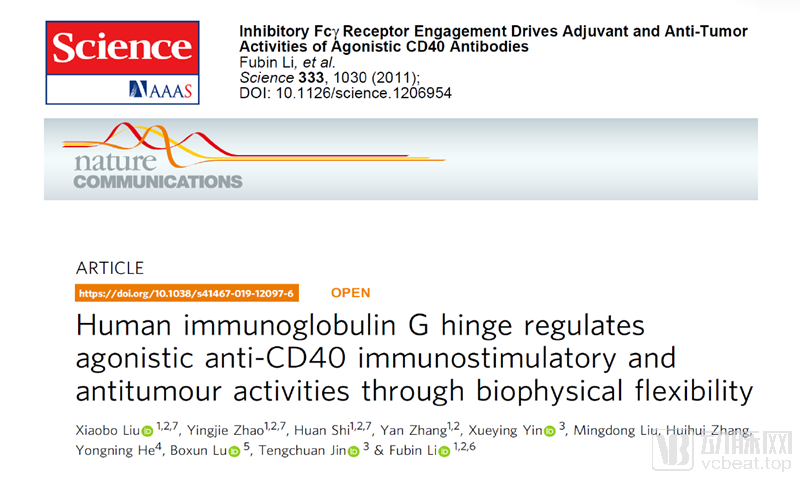
Scientific Research Achievements of Dr. Li Fubin’s Team
It has been revealed that the agonistic antibody with an optimized framework region, developed by Hengdong Bio, exhibits significantly enhanced activity compared to natural agonistic antibodies with unmodified framework regions. Furthermore, as the activity of the optimized antibody is more dependent on the tumor microenvironment, it enables greater targeting of tumors, thereby reducing the toxicity associated with agonistic antibody therapeutics.
Currently, Hengdong Biopharma has filed for global patent protection on the constant region of agonistic antibodies, a technology applicable to multiple immuno-oncology (IO) targets within the TNFR superfamily. The TNFR superfamily comprises 29 known members. Among these, six agonistic antibodies targeting the TNFR superfamily have entered clinical stages worldwide, namely those targeting TNFRSF4 (OX40), TNFRSF5 (CD40), TNFRSF7 (CD27), TNFRSF8 (CD30), TNFRSF9 (4‑1BB), and TNFRSF18 (GITR).
“Antibodies, as tumor immunotherapeutics, offer both stability and specificity. Agonistic antibody drugs have over a decade of clinical research history and possess mechanisms of action distinct from other cancer therapies such as antagonistic antibodies and cell therapies. Once breakthroughs are achieved, they will hold significant potential as monotherapies or in combination regimens. However, no agonistic antibody has yet been approved for marketing or completed pivotal Phase III clinical trials. We aim to address the long-standing challenge of slow progress in agonistic antibody development by engineering the natural sequences of the framework regions,” said Dr. Li Fubin.
Previously, Hengdong Biotech completed an angel financing round of several million RMB, with investors including the founding team and Haoyiyou Medical Group, among other institutions. The company has partnered with Huakang Biotech to jointly develop agonistic antibody drugs. Three pipeline candidates currently under development have completed validation of target selection and antibody constant region optimization strategies. Animal studies are expected to be completed around April next year, at which time Hengdong Biotech will initiate its Series A financing round. The company is also seeking collaborations with pharmaceutical enterprises to jointly advance its pipeline.