

JunLian Healthcare New Drug Express Issue 35: Highlights on DS-8201, Bispecific Antibodies, CAR-T, and Key Clinical Advances
Dec 16, 2019 18:00
CST Updated
18:00
This week, there were 10 new drug data entries, including 7 in oncology, 1 in dermatology, 1 in cardiovascular disease, and 1 in metabolism.
❖Daiichi Sankyo and AstraZeneca jointly announced the Phase II breast cancer treatment results for DS-8201, with an objective response rate (ORR) of nearly 61% in heavily pretreated patients, a truly impressive outcome. Over the past two years, antibody-drug conjugates (ADCs) have regained significant momentum in China; however, development remains predominantly focused on HER2, a highly favorable target. Although various companies claim unique advantages in their antibody, linker, and payload designs, the field is increasingly trending toward a red ocean scenario. DS-8201’s ability to stand out amidst intense competition is indeed surprising, but whether this stems from its high drug-to-antibody ratio of eight low-toxicity small molecules per antibody or from potential immunogenic effects remains unclear. In this therapeutic landscape where mechanisms of action lack clear differentiation, future entrants aiming to gain a foothold will have to let their clinical data speak for itself.
❖The 2019 American Society of Hematology (ASH) Annual Meeting, held in December, was a spectacular event. In addition to the debut of next-generation BTK inhibitors, bispecific antibodies and CAR-T therapies began to emerge as two dominant forces. Previously, CAR-T therapy for refractory and relapsed leukemia and lymphoma was essentially regarded as the last “white knight.” Despite its exorbitant cost, it was still viewed as the final bullet in the arsenal. Bispecific antibodies, although already having oncology products on the market, had long been relegated to the sidelines due to issues such as short half-life and manufacturing costs. However, this situation may be changing. At this year’s ASH meeting, Roche, BMS, Regeneron, Xencor, and Genmab all presented clinical results for CD3-CD20 and CD3-BCMA bispecific antibodies, with objectively response rates (ORR) and complete response (CR) rates that were quite impressive. This has led observers to speculate: what would happen if bispecific antibodies could defeat CAR-T therapies in head-to-head trials? How would Juno, Gilead, and Novartis respond? It is an exciting development; to find out what happens next, we will have to wait for future updates.
Roche’s Tecentriq Triple-Combination Therapy Meets Primary Endpoint in Phase 3 Trial for First-Line Treatment of BRAF-Mutant Melanoma
Roche Announces That Tecentriq (atezolizumab), in Combination with Cotellic (cobimetinib) and Zelboraf (vemurafenib), Met the Primary Endpoint of Reducing the Risk of Disease Progression or Death Compared with the Active Control Arm in a Phase 3 Trial in Patients with BRAF V600 Mutation–Positive Advanced Melanoma
Tecentriq is a PD-L1 monoclonal antibody cancer immunotherapy, Cotellic is a MEK1/2 (a protein in the cell signaling pathway that helps control cell growth and survival) inhibitor, and Zelboraf is a BRAF inhibitor.
A Phase 3, Multicenter, Double-Blind, Placebo-Controlled, Randomized Study in Patients with Previously Untreated BRAF V600 Mutation–Positive Metastatic or Unresectable Locally Advanced Melanoma, with Progression-Free Survival (PFS) as the Primary Endpoint
Patients’ progression-free survival (PFS) showed a clinically meaningful and significant improvement, and the observed safety profile was consistent with the known safety profiles of the individual drugs.
FDA Approves Expanded Indication for Amarin’s Fish Oil Product to Reduce Cardiovascular Risk in Specific Patient Populations
The U.S. FDA Announces Approval of Vascepa (icosapent ethyl) as an Adjunctive Therapy to Reduce Cardiovascular Risk in Adults with Triglyceride Levels Above 150 mg/dL
Vascepa is composed of high-purity icosapent ethyl, derived from the omega-3 fatty acids found in natural fish oil.
The study subjects included patients aged 45 years or older with a history of obstructive diseases of the coronary arteries, cerebrovascular system, carotid arteries, and peripheral arteries.patients aged 50 years or older with diabetes and other cardiovascular disease risk factors
Patients treated with Vascepa have a significantly reduced risk of cardiovascular events, such as stroke or heart attack.
Positive Phase 2 Results for Keytruda Triple Therapy
BioLineRx Presents Phase 2a Clinical Trial Results of BL-8040 in Combination with the PD-1 Antibody Keytruda and Chemotherapy for Patients with Metastatic Pancreatic Cancer at the European Society for Medical Oncology Immuno-Oncology Congress (ESMO IO)
BL-8040 is a peptide antagonist targeting the chemokine receptor CXCR4. By inhibiting CXCR4 function, BL-8040 modulates immune cell trafficking, promotes tumor infiltration by effector T cells, and reduces immunosuppressive cells within the tumor microenvironment, thereby converting “cold” tumors into “hot” tumors.
2aPhase clinical trial, enrolling patients with Stage IV metastatic pancreatic cancer who experienced disease progression after first-line chemotherapy
Among the 22 patients evaluable for efficacy, 7 achieved partial response (PR) and 10 had stable disease (SD), resulting in an overall response rate (ORR) of 32% and a disease control rate (DCR) of 77%. These figures are superior to those of current second-line standard chemotherapy (ORR: 17%; DCR: 52%).
BL-8040Mechanism of Action
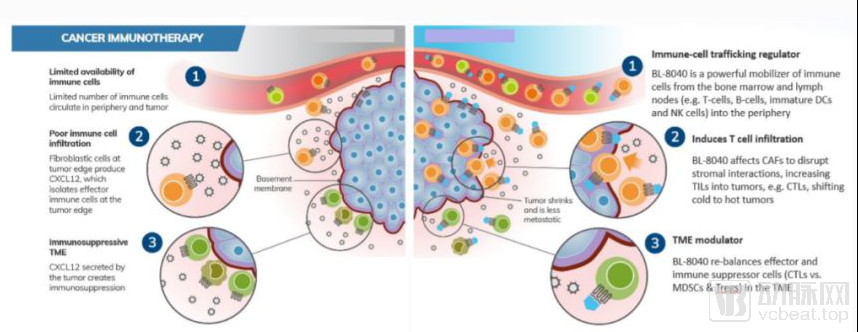
Data Source:BioLineRx
LEO Pharma’s IL-13 Antibody Tralokinumab Meets Three Key Endpoints in Phase 3 Clinical Trials for Eczema
LEO Pharma A/S announced that tralokinumab, a fully humanized IL-13 monoclonal antibody, met all primary and secondary clinical endpoints in three pivotal clinical trials involving adult patients with moderate-to-severe atopic dermatitis (eczema).
Tralokinumab is an IL-13 monoclonal antibody.
Three pivotal Phase 3 clinical trials evaluating the efficacy and safety of tralokinumab as monotherapy in patients with moderate-to-severe atopic dermatitis who are candidates for systemic therapy
In three pivotal clinical trials involving adult patients with moderate-to-severe atopic dermatitis (also known as eczema), all primary and secondary clinical endpoints were met, with detailed results from these trials to be presented at upcoming scientific conferences.
Sarepta Therapeutics’ Vyondys 53 (golodirsen) Receives FDA Accelerated Approval
FDA Announces Accelerated Approval of Sarepta Therapeutics’ Vyondys 53 (golodirsen) for the Treatment of Duchenne Muscular Dystrophy (DMD) Patients Amenable to Exon 53 Skipping, Representing Approximately 8% of the Total DMD Population
Vyondys 53 is a phosphorodiamidate morpholino oligonucleotide. It targets the splicing process of dystrophin pre-mRNA, inducing exon 53 skipping, with the aim of producing a truncated yet functional dystrophin protein.
Efficacy was assessed in two parts of the clinical study. Part 1 included 12 patients with Duchenne muscular dystrophy (DMD), of whom 8 received Vyondys 53 and 4 received placebo. Part 2 was an open-label trial that included the 12 patients from Part 1 and 13 additional patients with DMD.
After >48 weeks of treatment, the mean dystrophin level in patients increased from 0.1% of normal (baseline) to 1.02% of normal.
Kite Submits Marketing Application for CAR-T Therapy KTE-X19
At the recently concluded ASH Annual Meeting, Kite, a Gilead Sciences company, announced that it had submitted a Biologics License Application (BLA) to the U.S. FDA for its CD19-targeted CAR-T therapy, KTE-X19.
KTE-X19 is an autologous CAR-T therapy targeting CD19. It utilizes the XLP manufacturing process, which incorporates T-cell selection and lymphocyte enrichment.
EntryIn a cohort of MCL patients who had previously received five prior lines of therapy, including chemotherapy, anti-CD20 monoclonal antibody therapy, and the BTK inhibitors ibrutinib or acalabrutinib, the patients developed drug resistance or experienced disease relapse.
Among the 60 MCL patients evaluable for efficacy, the overall response rate (ORR) was 93%, with 67% achieving complete response (CR).
Seattle Genetics’ HER2-Specific TKI Meets Phase 3 Clinical Endpoint
Seattle Genetics Announces That Tucatinib, Its HER-Specific Oral Small-Molecule Tyrosine Kinase Inhibitor, Met Primary and Key Secondary Endpoints in the Pivotal Phase 3 HER2CLIMB Trial in Patients with HER2-Positive Metastatic Breast Cancer
Tucatinib is an oral tyrosine kinase inhibitor with high selectivity for HER2, but it does not significantly inhibit EGFR, which also belongs to the human epidermal growth factor receptor family.
A randomized, double-blind, active-controlled study designed to compare the efficacy and safety of tucatinib in combination with the standard-of-care agents trastuzumab and capecitabine versus trastuzumab and capecitabine alone in patients with locally advanced unresectable or metastatic HER2-positive breast cancer. Enrolled patients had previously received treatment with trastuzumab, pertuzumab, and T-DM1, and 47% had brain metastases.
The tucatinib-based triple-combination therapy significantly improved patients’ progression-free survival (PFS), reducing the risk of disease progression or death by 46% compared with the active control group, thereby meeting the primary endpoint of the trial.
AstraZeneca and Daiichi Sankyo’s Blockbuster ADC Therapy Meets Primary Clinical Endpoint
AstraZeneca and Daiichi Sankyo jointly announced that trastuzumab deruxtecan (DS-8201), an antibody-drug conjugate (ADC) co-developed by the two companies, met its primary endpoint in the pivotal Phase 2 DESTINY-Breast01 trial in patients with HER2-positive metastatic breast cancer.
DS-8201 is an innovative HER2-targeting antibody-drug conjugate (ADC) that links trastuzumab, a fully humanized monoclonal antibody targeting the HER2 receptor, to a novel topoisomerase I inhibitor via a tetrapeptide linker. This ADC enables a higher drug-to-antibody ratio, thereby potentially enhancing its tumor-killing efficacy.
Pivotal Phase 2 Clinical Study: The 184 patients enrolled in this trial had received a median of 6 prior lines of therapy, including ado-trastuzumab emtansine (T-DM1), trastuzumab, and pertuzumab.
Patients treated with DS-8201 achieved an objective response rate (ORR) of 60.9% and a disease control rate (DCR) of 97.3%. The median duration of response (DOR) was 14.8 months, and the median progression-free survival (PFS) was 16.4 months.
Forty Seven’s CD47-Targeted Therapy Shows Positive Preliminary Clinical Results
Forty Seven, Inc. announced at the 61st Annual Meeting of the American Society of Hematology (ASH) that its CD47-targeting monoclonal antibody magrolimab, in combination with azacitidine, demonstrated superior efficacy compared to azacitidine monotherapy in a Phase 1b trial involving patients with myelodysplastic syndromes (MDS) and acute myeloid leukemia (AML).
Magrolimab is a monoclonal antibody targeting CD47. CD47 is an immunomodulatory molecule overexpressed on cancer cells, serving as a “don’t eat me” signal that cancer cells use to avoid phagocytosis by macrophages.
Phase b clinical trial, aimed at verifying the efficacy of magrolimab combined with azacitidine in treating high-risk MDS patients and newly diagnosed AML patients who are not suitable for chemotherapy.
The overall response rate (ORR) in patients reached 92%, with 50% achieving complete remission (CR), 33% achieving morphologic CR in the bone marrow, 8% showing improvement in hematologic parameters, and 8% maintaining stable disease.
Preliminary Clinical Results for Roche’s CD20-CD3 Bispecific Antibody Are Positive
At the 61st Annual Meeting of the American Society of Hematology (ASH), Genentech, a member of the Roche Group, presented clinical trial results for two CD20-CD3 bispecific antibodies developed by the company. These two bispecific antibodies, named mosunetuzumab and CD20-TCB, respectively, function as T-cell engagers.
Mosunetuzumab and CD20-TCB can target the CD20 antigen expressed on the surface of B cells, while also binding to the CD3 receptor on the surface of T cells. They recruit the patient’s T cells to the vicinity of B cells and activate these T cells to eliminate the B cells.
In the Phase 1/1b clinical trial, mosunetuzumab was administered as monotherapy to treat patients with relapsed or refractory non-Hodgkin lymphoma (R/R NHL), including those who had previously received CAR-T cell therapy but experienced disease relapse or developed resistance to CAR-T therapy.
Mosunetuzumab achieved an objective response rate (ORR) of 62.7% (n=42/67) in patients with indolent NHL and 43.3% (n=46/124) in those with aggressive NHL. The complete response (CR) rates were 43.3% in indolent NHL and 19.4% in aggressive NHL. Among patients who had previously received CAR-T therapy, the ORR was 38.9% (n=7/18), and the CR rate was 22.2% (n=4/18).
CD20-TCBAntibody Structure
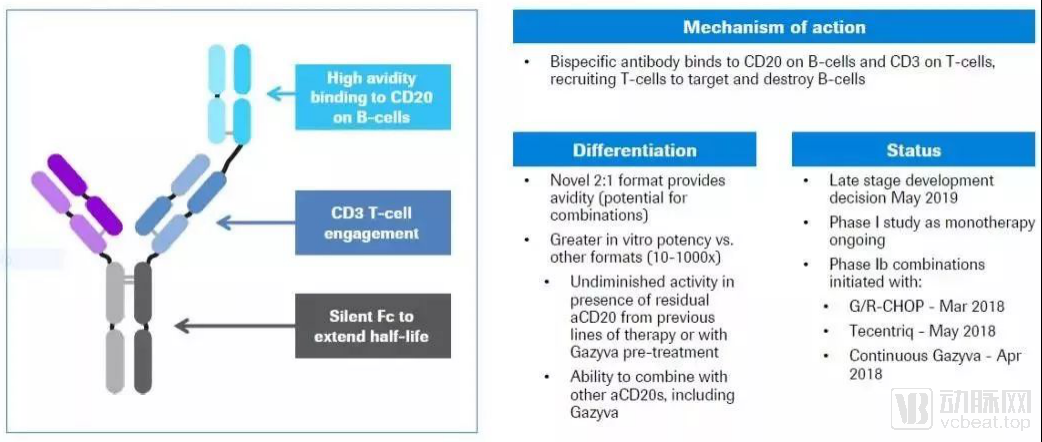
Data source: Roche
❖ Blueprint Medicines Announces Promising Preliminary Clinical Data from the Phase 2 PIONEER Trial of Avapritinib, an Oral KIT and PDGFRα Inhibitor, in Patients with Indolent Systemic Mastocytosis at the ASH Annual Meeting. Serum Tryptase Levels Were Significantly and Rapidly Reduced Across Different Dose Cohorts of Avapritinib
❖At the ASH Annual Meeting, BMS announced that CC-486, as maintenance therapy, demonstrated statistically and clinically significant improvements in overall survival and relapse-free survival compared with placebo in the pivotal Phase 3 QUAZAR AML-001 trial in patients with acute myeloid leukemia.
❖At the 2019 ASH Annual Meeting, Sanofi presented data from the pivotal Phase III CARDINAL study (NCT03347396) evaluating sutimlimab for the treatment of primary cold agglutinin disease. The results demonstrated that the study met both its primary and secondary endpoints. Sutimlimab features a novel mechanism of action and high target specificity, selectively inhibiting the upstream classical complement pathway involved in the disease process while preserving the integrity of the alternative and lectin complement pathways and their immune surveillance functions.
❖ Gene therapy company FerGene announced that its gene therapy, nadofaragene firadenovec, met the primary clinical endpoint in a Phase 3 trial involving patients with advanced high-grade non-muscle-invasive bladder cancer who had an inadequate response to bacillus Calmette-Guérin (BCG). Nadofaragene firadenovec is an adenovirus vector-based gene therapy administered via intravesical instillation through a catheter every three months, delivering an adenoviral vector containing the interferon alfa-2b transgene into the bladder.